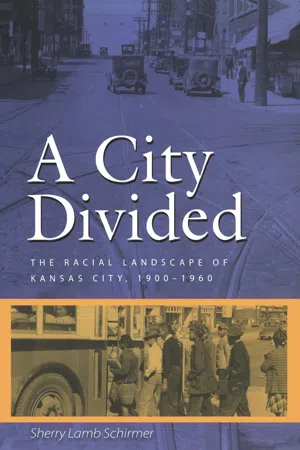
A City Divided traces the development of white Kansas Citians' perceptions of race and examines the ways in which those perceptions shaped both the physical landscape of the city and the manner in which Kansas City was policed and governed. Because of rapid changes in land use and difficulties in suppressing crime and vice in Kansas City, the control of urban spaces became an acute concern, particularly for the white middle class, before race became a problematic issue in Kansas City.
As the African American population grew in size and assertiveness, whites increasingly identified blacks with those factors that most deprived a given space of its middle-class character. Consequently, African Americans came to represent the antithesis of middle-class values, and the white middle class established its identity by excluding blacks from the urban spaces it occupied.
By 1930, racial discrimination rested firmly on gender and family values as well as class. Inequitable law enforcement in the ghetto increased criminal activity, both real and perceived, within the African American community. White Kansas Citians maintained this system of racial exclusion and denigration in part by "misdirection," either by denying that exclusion existed or by claiming that segregation was necessary to prevent racial violence. Consequently, African American organizations sought to counter misdirection tactics. The most effective of these efforts followed World War II, when local black activists devised demonstration strategies that targeted misdirection specifically.
At the same time, a new perception emerged among white liberals about the role of race in shaping society. Whites in the local civil rights movement acted upon the belief that integration would produce a better society by transforming human character. Successful in laying the foundation for desegregating public accommodations in Kansas City, black and white activists nonetheless failed to dismantle the systems of spatial exclusion and inequitable law enforcement or to eradicate the racial ideologies that underlay those systems.
These racial perceptions continue to shape race relations in Kansas City and elsewhere. This study demystifies these perceptions by exploring their historical context. While there have been many studies of the emergence of ghettos in northern and border cities, and others of race, gender, segregation, and the origins of white ideologies, A City Divided is the first to address these topics in the context of a dynamic, urban society in the Midwest.
As the African American population grew in size and assertiveness, whites increasingly identified blacks with those factors that most deprived a given space of its middle-class character. Consequently, African Americans came to represent the antithesis of middle-class values, and the white middle class established its identity by excluding blacks from the urban spaces it occupied.
By 1930, racial discrimination rested firmly on gender and family values as well as class. Inequitable law enforcement in the ghetto increased criminal activity, both real and perceived, within the African American community. White Kansas Citians maintained this system of racial exclusion and denigration in part by "misdirection," either by denying that exclusion existed or by claiming that segregation was necessary to prevent racial violence. Consequently, African American organizations sought to counter misdirection tactics. The most effective of these efforts followed World War II, when local black activists devised demonstration strategies that targeted misdirection specifically.
At the same time, a new perception emerged among white liberals about the role of race in shaping society. Whites in the local civil rights movement acted upon the belief that integration would produce a better society by transforming human character. Successful in laying the foundation for desegregating public accommodations in Kansas City, black and white activists nonetheless failed to dismantle the systems of spatial exclusion and inequitable law enforcement or to eradicate the racial ideologies that underlay those systems.
These racial perceptions continue to shape race relations in Kansas City and elsewhere. This study demystifies these perceptions by exploring their historical context. While there have been many studies of the emergence of ghettos in northern and border cities, and others of race, gender, segregation, and the origins of white ideologies, A City Divided is the first to address these topics in the context of a dynamic, urban society in the Midwest.