- 469 pages
- English
- PDF
- Available on iOS & Android
eBook - PDF
An Introduction to Animal Behaviour
About this book
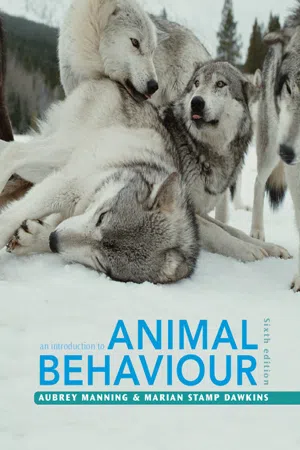
Wolves excitedly greet each other as members of the pack come together; a bumble bee uses its long tongue to reach the nectar at the base of a foxglove flower; a mongoose swiftly and deftly bites its prey to death; young cheetahs rest quietly together, very close to sleep. Now in full colour, this revised and updated edition of Manning and Dawkins' classic text provides a beautifully written introduction to the fundamentals of animal behaviour. Tinbergen's four questions of causation, evolution, development and function form the fundamental framework of the text, illustrated with fascinating examples of complex behavioural mechanisms. The authors provide accounts of all levels of behaviour from the nerve cell to that of the population. The strengths of An Introduction to Animal Behaviour as a textbook include its clear explanations and concise, readable text and the enthusiasm of the authors for their subject.
Information
Action
potential
(i)
A
postsynaptic
neuron,
c,
is
shown
diagrammatically
with
two
presynaptic
neurons,
a
and
b.
(ii)
Spatial
summation:
the
responses
of
presynaptic
neurons
a
and
b
are
summed
by
the
postsynaptic
neuron
c.
(iii)
Temporal
summation:
the
successive
responses
of
one
presynaptic
neuron
are
summed.
(iv)
Facilitation:
c
responds
more
strongly
with
each
succesive
input
from
a.
(v)
Inhibition:
c
responds
less
strongly
if
a
and
b
are
active.
Threshold
for
action
potential
Sub-threshold
postsynaptic
potentials
Resting
potential
Time
(ms)
Time
(ms)
mV
a
alone
b
alone
a+b
Membrane
potential
(mV)
c
a
b
0
20
–20
–40
–60
–80
–40
0
Time
(ms)
mV
a
alone
b
alone
a+b
–40
0
Time
(ms)
mV
a
a
–40
0
Time
(ms)
mV
–40
0
40
60
70
(a)
(b)
Figure
1.8
(a)
Three
examples
of
the
electrical
activity
that
can
be
recorded
from
neurons:
the
resting
potential
when
the
cell
is
at
rest;
postsynaptic
potentials
that
do
not
lead
to
a
‘nerve
spike’
or
action
potential;
and
the
massive
action
potential
itself.
(b)
Some
operations
performed
by
neurons.
Units
of
the
nervous
system
19
Table of contents
- Cover
- AN INTRODUCTION TO ANIMAL BEHAVIOUR
- TITLE
- Copyright
- CONTENTS
- PREFACE
- CHAPTER ONE: Introduction
- CHAPTER TWO: The development of behaviour
- CHAPTER THREE: Stimuli and communication
- CHAPTER FOUR: Decision-making and motivation
- CHAPTER FIVE: Learning and memory
- CHAPTER SIX: Evolution
- CHAPTER SEVEN: Social organization
- REFERENCES
- FIGURE CREDITS
- Index
Trusted by 375,005 students
Access to over 1.5 million titles for a fair monthly price.
Study more efficiently using our study tools.
Frequently asked questions
Yes, you can cancel anytime from the Subscription tab in your account settings on the Perlego website. Your subscription will stay active until the end of your current billing period. Learn how to cancel your subscription
No, books cannot be downloaded as external files, such as PDFs, for use outside of Perlego. However, you can download books within the Perlego app for offline reading on mobile or tablet. Learn how to download books offline
Perlego offers two plans: Essential and Complete
- Essential is ideal for learners and professionals who enjoy exploring a wide range of subjects. Access the Essential Library with 800,000+ trusted titles and best-sellers across business, personal growth, and the humanities. Includes unlimited reading time and Standard Read Aloud voice.
- Complete: Perfect for advanced learners and researchers needing full, unrestricted access. Unlock 1.5M+ books across hundreds of subjects, including academic and specialized titles. The Complete Plan also includes advanced features like Premium Read Aloud and Research Assistant.
We are an online textbook subscription service, where you can get access to an entire online library for less than the price of a single book per month. With over 1.5 million books across 990+ topics, we’ve got you covered! Learn about our mission
Look out for the read-aloud symbol on your next book to see if you can listen to it. The read-aloud tool reads text aloud for you, highlighting the text as it is being read. You can pause it, speed it up and slow it down. Learn more about Read Aloud
Yes! You can use the Perlego app on both iOS and Android devices to read anytime, anywhere — even offline. Perfect for commutes or when you’re on the go.
Please note we cannot support devices running on iOS 13 and Android 7 or earlier. Learn more about using the app
Please note we cannot support devices running on iOS 13 and Android 7 or earlier. Learn more about using the app
Yes, you can access An Introduction to Animal Behaviour by Aubrey Manning,Marian Stamp Dawkins in PDF and/or ePUB format, as well as other popular books in Medicine & Veterinary Medicine. We have over 1.5 million books available in our catalogue for you to explore.