Honorable Mention, 2016 Lyman Awards, presented by the North American Society for Oceanic History
This book is a thrillingly-written story of naval planes, boats, and submarines during World War I.
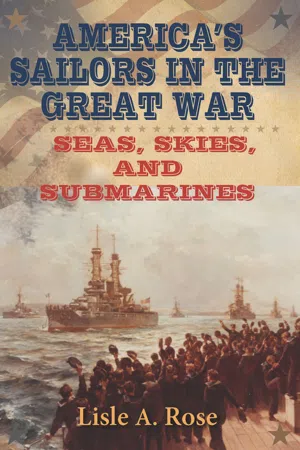
When the U.S. entered World War I in April 1917, America's sailors were immediately forced to engage in the utterly new realm of anti-submarine warfare waged on, below and above the seas by a variety of small ships and the new technology of airpower. The U.S. Navy substantially contributed to the safe trans-Atlantic passage of a two million man Army that decisively turned the tide of battle on the Western Front even as its battleship division helped the Royal Navy dominate the North Sea. Thoroughly professionalized, the Navy of 1917–18 laid the foundations for victory at sea twenty-five years later.
- English
- ePUB (mobile friendly)
- Available on iOS & Android
eBook - ePub
About this book
Trusted by 375,005 students
Access to over 1.5 million titles for a fair monthly price.
Study more efficiently using our study tools.
Information
CHAPTER ONE
State of Play
MARCH 1917, A hundred miles west-southwest of Ireland. Under hazy skies, a steamer perhaps four hundred feet long, displacing five to six thousand tons, plows through lightly choppy seas toward Liverpool or one of the Channel ports. Its holds are crammed with vitally needed grain for the English people and critical supplies for the British army on the western front. Officers and crew are apprehensive; they know they have entered the zone of unrestricted submarine warfare declared the month before by the German Admiralty in Berlin. But despite a steady rise of U-boat sinkings, the odds of their getting through remain better than 60 percent. Together with their brother merchant sailors, they insist upon steaming alone, without the protection and support that a convoy could provide. They believe that convoys take too long to assemble and thus are not cost-effective. Port authorities fear that clusters of convoyed vessels entering harbor and docking all at once would create chaos. At sea, the constant changes in course and speed required for zigzagging in massed formation to frustrate a submerged U-boat attack increase costs even more and demand a level of seamanship that few claim to possess. And the very fact that merchantmen would be “huddled” together in a heavy cluster of ships would make the U-boat’s task even easier. Perhaps two or three escorted ships could do a successful convoy run, but no more.1 The British Admiralty agrees. Convoying belonged to the Age of Fighting Sail when merchant vessels carrying the wealth of new worlds in America and Asia required protection against pirates and enemy fleets. Convoying would be ineffective against the modern U-boat, and neither the French nor the British navies could spare from their precious battle fleets more than a handful of the destroyers required for escort and screening of merchantmen. So the thousands of ships required to keep Britain and thus France and their combined armed forces in the war continue to sail alone toward and through the ever-narrowing funnel of the Western Approaches where lurk the kaiser’s submarines.
On this particular day, as so often, even a moderate sea state successfully masks the narrow ribbon created by a U-boat periscope and the wake of its torpedoes. Without warning, the steamer is rocked by an enormous explosion on the starboard side amidships. As the cold waters of the Atlantic rush into the hull, the engine room becomes an inferno of scalding steam escaping from ruptured boilers and flying hunks of red-hot steel from blasted coal furnaces and grates. Men not immediately boiled or burned to death soon drown from the inrushing waters, while above them the rapidly heeling hull renders all the port-side lifeboats useless; many on the starboard side have been reduced to splinters by the torpedo blast. A host of panicky crewmen and the few civilian passengers on board erupt on deck, while the radio operator sends a hasty SOS before rushing to the rails; the distress call might or might not be picked up ashore. Quickly the vessel capsizes, the shattered hull remaining afloat for a brief time before disappearing beneath the waves, carrying down with it many of those who could not swim or failed to get far enough away. A few are able to reach the several lifeboats that had somehow been launched.
Having made its kill, the submarine cautiously surfaces after its commander first sweeps the horizon with his periscope for telltale signs of smoke that might mark one of the few British destroyers on antisubmarine patrol. Satisfied that no enemy vessels are about, the German crew might in a relatively few instances toss some of their meager stores of food, or water, to the steamer’s survivors or point them in the direction of the nearest land, far away. Then the U-boat, engines clanking, foams off, remaining on the surface in hypervigilance for the several hours required to recharge its batteries. Now alone on a vast ocean, the survivors are more likely than not doomed to die slowly of exposure, hunger, and thirst.
Such is life at sea in the third year of the First World War: underhanded, brutal, pitiless.
A century later, it is difficult to measure the revulsion with which the German air and submarine campaigns of 1915–18 were greeted among the peoples of the West. Even as the world’s great navies began slowly stocking their inventories with “Undersea Boats” in the years before the war, the submarine, along with the “Zeppelin” airship, was widely perceived as an unprecedented violator of basic human decency and fair play. “Before 1914,” an American naval officer wrote eight years later, “nobody knew what a naval war would be like with the new weapon introduced: the submarine. Of course, through numerous exercises, its offensive power had been revealed, but as to the means of meeting the danger, the Admiralties were out of wits, for there had been no war experience to throw any light on the subject. When some young officer happened to succeed in attacking, his admiral barely acknowledged the fact—when he did not receive the report with a rebuke.”2 Training exercises on the Continent and in the waters around the British Isles in the years just prior to the “Great War” reflected a century of general peace in which warfare was perceived in the “highly ritualized and idealistic” terms of a medieval jousting tournament, encouraging “the participants to play out their understanding of” combat, “without having to reconcile it to an unsavory and very dangerous reality (in the case of medieval warfare) or a culturally unimaginable future (in the case of submarine warfare).” Near the end of 1913, a memorandum was prepared in the highest levels of the British Admiralty “in which it was prophesied that the Germans would use their submarines for attacking commerce. So utterly repugnant was this novel idea that both the First Lord [of the Admiralty, Winston Churchill] and the First Sea Lord [Admiral Louis Mountbatten] declared that the paper was fatally ‘marred by this suggestion.’”3
But at sea and in the air as on the western front, the Great War generated its own momentum. Before the horror of the trenches was the terror of the sea. At first German and British submarines confined their campaigns to attacks against each other’s fleet units, which caused mild panic and some significant losses within the Royal Navy but no disruption of its operations to keep the kaiser’s High Seas Fleet penned up in its several North Sea ports. The British naval blockade of Germany announced early in 1915 and firmly if not ruthlessly pursued with frequent interceptions of neutral shipping not only caused anger and dismay among neutral nations—most especially the United States—but also induced the German Admiralty to counter with the only effective weapon it could muster, unrestricted submarine warfare, conducted by means of not only the gun and the torpedo, but also the laying of minefields in the North Sea and adjacent waters.
Perhaps characteristically, the Germans all too soon outdid themselves. In the process, they seemed to confirm and conform to the notion of the bestial “Hun” who violated Belgian neutrality while executing innocent civilians (including nurse Edith Cavell) and deliberately destroying the lovely medieval city and cathedral of Louvain. Declaring a “war zone” around the British Isles, the Imperial German Navy soon enforced it in the most awful fashion. On the early afternoon of May 7, 1915, a single torpedo from the submerged U-20 sank the great Cunard passenger liner Lusitania. In the next hour or so, more than twelve hundred people, including more than one hundred Americans, drowned in the chilly waters off Queenstown (now Cobh), Ireland. Just twenty-four days later, as world opinion continued to seethe with outrage, a single German naval airship—a “Zeppelin”—carried out the first nighttime raid on London, killing seven and wounding thirty-five. In September, in another single Zeppelin raid, LZ-13 floated over central London unmolested, dropping bombs that killed twenty-two and caused more than a half-million pounds in damage.
Suddenly, there seemed no place to hide from an enemy who used whatever medium was at hand to spread indiscriminate terror wherever and whenever possible. The unrepentant, indeed publicly joyful, reaction to the sinking of Lusitania by the German Admiralty and people (who convinced themselves that the great liner carried large stocks of munitions and thus got what it deserved) only intensified the general revulsion elsewhere. In Allied eyes, the German U-boat campaign confirmed the submarine’s sinful status as a silent marauder, an “underwater pirate,” an “undersea serpent,” who killed without warning from ambush beneath the waves, a pitiless, barbaric warrior who “ravaged” the sea lanes and for whom there was no place in modern warfare. Germany’s employment of submarines “covered the new weapon with infamy.” Behind this widespread outrage in both the British Isles and the United States was the naive belief that “sea power” in and of itself “is essentially pacific in its aims and workings.” It thus stood to reason that the evil Hun was prosecuting a submarine war “to bring military tyranny to bear upon the seas and to carry it to the uttermost parts of the Earth where sea power has planted freedom.” Allied naval authorities at the time convinced themselves that the U-boat was at best an annoyance to both war fleets and merchant traffic so long as it adhered to the laws of war. Only “by resorting to unscrupulous methods” had it “become a dangerous commerce destroyer and as such has taken a prominent part in the war.”
As the conflict ground on and five British hospital ships and their people perished before German torpedoes, feelings became, if possible, even more inflamed. Incidents real and alleged included the British steamer Belgian Prince, whose crew was rescued by the U-boat that sank their ship, only to be kept on deck as the submarine skipper closed his hatches, ran several miles, and then submerged deliberately, drowning all but three of his hapless prisoners. By 1918 Britons viewed the submarine war in apocalyptic terms as “the main battlefield of our spiritual crusade.” Antisubmarine war sailors had become “our champions in the contest of ideals . . . the defenders of human nature against those who preach and practice barbarism. . . . Between the old chivalry, and the new savagery, there can be no truce; one of the two must go under.” The bestiality of the German people was beyond question: “Everything that could be charged against them has been already proved by their own words and actions. They have sunk without warning women and children, doctors and nurses, neutrals and wounded men, not by tens or hundreds but by thousands. They have publicly rejoiced over these murders with medals and flags, with songs and school holidays.” American opinion swung decisively behind this view. On the eve of his departure for European waters, young subchaser skipper George Dole wrote that “the Kaiser’s deep sea monsters represent the most perfect engines of evil genius man has been able to devise.”4
The sinking of the Lusitania had outraged President Wilson, who promptly dispatched a stiff note to Berlin, demanding no more such incidents and insisting that U-boat crews be held to “strict accountability” for any future violations of traditional international law of the sea that protected peaceful shipping from harm. Should Berlin fail to take these steps, the United States would break off diplomatic relations—often, though not invariably, a prelude to war. The kaiser’s government reacted grudgingly. As Wilhelm and his people saw it, the British blockade not only flagrantly impoverished an innocent German people but also positively rewarded American business and industrial interests, which, while kept from dealing directly with Germany, could find ready markets and investments in the Allied war effort. Germany responded to Wilson’s demands accordingly. While there was to be no more flagrant destruction of neutral vessels or of passenger ships, the Imperial Navy refused to suspend its U-boat war against British and French merchant shipping in the face of a continuing Allied blockade. The few neutrals who continued to book passage on smaller British passenger vessels, like the cross-Channel steamer Sussex torpedoed by a U-boat in early 1916 with the loss of several Americans, not only took their lives into their hands, but also forced Wilson to make impossible demands on Berlin. These included a German promise—the so-called Sussex Pledge—to order its U-boats to surface, determine the nature of the ship to be attacked, and, if it was a ship carrying passengers, to guarantee the safety of these innocents and the crew before sinking. Once again, the president had threatened to break off diplomatic relations if Berlin failed to accede to his demands. The kaiser and his immediate entourage became in turn outraged by Wilson’s behavior, which Foreign Minister Arthur Zimmerman characterized as hypocritical. The president, he exclaimed, “feels and thinks English.” Late in 1916, Zimmerman began carefully probing the Mexican government for an alliance that might allow German submarine bases on the Gulf coast.5
The British had already nullified the kind of hard-to-enforce policy embodied in the Sussex Pledge by countering the Submarine Menace, as it was known in Allied circles, with the introduction of “Q,” or “mystery,” ships. These apparently innocent but heavily armed cargo steamers and even some sailing schooners (which to German U-boat skippers might be carrying civilian passengers in addition to cargo), traveling alone, had orders to throw open their gun ports and blaze away the moment a U-boat surfaced to determine their nature. To submarine crews, the Q ships represented the essence of British perfidy; their U-boat had suddenly become as much the hunted as the hunter. Indeed, some British Q-ship commanders relished their role quite as keenly as if they’d been riding to hounds in an English field. To hard-pressed Britons, the barbarity of the U-boat war rendered all previous questions of international law null and void. In Whitehall’s view, it was “only necessary to state as a fact that Germany decided to use her submarines to attack and sink our commerce, the life-blood of the British Isles and the source of supply not only to the Army in France but the Grand Fleet that was successfully keeping its German opposite under thumb.” But their very nature limited the number of Q ships that could be deployed. Each converted merchant steamer or sailing vessel was one more removed from Britain’s steadily dwindling inventory of ships vital to national survival. Q ships always faced the prospect of heavy damage if not outright destruction in battle with U-boats. Clearly, they were of limited utility in the antisubmarine war that raged with ever-accelerating intensity in 1915–16.6
Further German folly escalated Wilson’s growing outrage. Shipyards at Kiel, Bremen, and Hamburg had begun to produce the first of eight monster (for the time) eighteen-hundred-plus-ton “merchant” U-boats designed to circumvent the British blockade through long-range underwater passage to markets in the New World.7 In the summer of 1916, one of these huge vessels, Deutschland, made two voyages from Germany to the United States and back. A postwar American naval report concluded that their purpose “must remain a matter, more or less of conjecture,” though both were probably purely commercial voyages. “That feat changed everyone’s mind.” Should any one of the merchant U-boats be converted to “cruisers” or should the normal U-boat in fact possess a longer cruising range than believed, Germany could take its frightful brand of warfare straight to the American coast should the United States choose to enter hostilities. In September Germany dramatized this fear when U-53 under the command of Lieutenant Hans Rose, an Iron Cross pinned to his chest, suddenly appeared in Narragansett Bay, not far from the US Naval War College and the basic training center for entering naval recruits. This voyage, the American report concluded, “assumes more a character of a path-finding expedition. This vessel was a strictly combative vessel. It is interesting to note that on the arrival of this vessel at Newport, the commanding officer stated to the American submarine that he did not need or want a pilot to enter Newport, and that he wanted no supplies or provisions or materials of any kind.” Rose boldly came ashore to call on authorities, informing them in no uncertain terms that his vessel was an armed warship. The German kapitän then took his boat to sea, the crew ostentatiously cheering American fleet units on their way out. Within a few short days, Rose managed to sink no fewer than five merchant vessels (three British, one Norwegian, and one Dutch). All were in international waters, but within view of the Nantucket Lightship. The British steamship Stephano carried American passengers.
Rushed to sea to search for survivors, the US Navy experienced the horrors of the U-boat war directly as the destroyer Benham fished the wretched survivors of the Dutch steamer SS Blommersdijk from the frigid waters of the Atlantic. “The man in the street” became sensibly “scared.” Already alarmed by the potentials of a vast surface war in Atlantic waters suggested by the Battle of Jutland at the end of May, as well as a growing naval rivalry with Japan in the Pacific, Congress and the Wilson administration promptly set to work constructing “a Navy second to none.” The Navy Department itself began to quietly compile a register of civilian-owned vessels—motorboats, yawls, schooners, harbor tugs, and, perhaps most important, privately owned and commercial steam yachts—that might be expropriated for future antisubmarine warfare both along the American Coast from Maine to Florida and in European waters in the case of the bigger ships. The inventory was large and impressive, for in earlier years “many” a yachtsman who was at once wealthy and patriotic had his substantial pleasure craft “built specifically for use” as a navy patrol boat in wartime. By the time the program concluded in 1918, more than four thousand vessels had been requisitioned.8
The German submarine issue was part of a complex tapestry of competing interests, memories, and decisions that at once stayed American entry into the Great War for many months, yet in the end made it inevitable. The country was but a century removed from the last British effort to destroy it and its Revolution. In 1813, a British force had burned Washington, DC, sending President Madison (“Little Jemmy”), his family, and the US government flying like partridges into the northern Virginia countryside. Thereafter, Anglo-American tensions flared over rights to what is now the US Pacific Northwest, outright British sympathy and support for the Confederacy during the early years of the Civil War (the Confederate steam raider Alabama was built in a British yard), and the current rigidly enforced British naval blockade of Germany. Memories were long and resentments died hard. Anglophobia remained entrenched in the upper reaches of the US armed forces. As late as 1911–12, games at the Army War College, of which navy officials were certainly aware, if not outright observers to, were based on “War Plan Red,” in which British forces (“Red”) attacked the United States through Canada after neutralizing “Blue” (US) naval forces in Caribbean and Atlantic waters. “In this war game, RED completely overcame any resistance that BLUE could offer.” As Wilson pondered taking the country to war in the early months of 1917, the new (and first) chief of naval operations (CNO), William S. Benson, told Admiral William Sowden Sims, the designated naval representative to the British Admiralty, not to “let the British pull the wool over your eyes. It is none of our business pulling their chestnuts out of the fire. We would as soon fight the British as the Germans.” Later Benson admitted to a congressional committee that “I might put it this way. I thought that there were certain things going on that we ought to be prepared for in an emergency. Our ships were being held up” by the Royal Navy enforcing the blockade, “and certain things were going on tha...
Table of contents
- Cover Page
- Title Page
- Copyright Page
- Dedication
- Contents
- List of Illustrations
- Acknowledgments
- Introduction
- Chapter One - State of Play
- Chapter Two - Beat to Quarters
- Chapter Three - Aloft
- Chapter Four - “Drab Efficiency”: The Making of the Convoy System
- Chapter Five - Sending the Hunters
- Chapter Six - Battleship Boys
- Chapter Seven - Keeping the Seas
- Chapter Eight - Chasers
- Chapter Nine - Barrages, Batteries, Bombers and Battleships
- Chapter Ten - A Navy Second to None
- Notes
- Bibliography
- Index
Frequently asked questions
Yes, you can cancel anytime from the Subscription tab in your account settings on the Perlego website. Your subscription will stay active until the end of your current billing period. Learn how to cancel your subscription
No, books cannot be downloaded as external files, such as PDFs, for use outside of Perlego. However, you can download books within the Perlego app for offline reading on mobile or tablet. Learn how to download books offline
Perlego offers two plans: Essential and Complete
- Essential is ideal for learners and professionals who enjoy exploring a wide range of subjects. Access the Essential Library with 800,000+ trusted titles and best-sellers across business, personal growth, and the humanities. Includes unlimited reading time and Standard Read Aloud voice.
- Complete: Perfect for advanced learners and researchers needing full, unrestricted access. Unlock 1.5M+ books across hundreds of subjects, including academic and specialized titles. The Complete Plan also includes advanced features like Premium Read Aloud and Research Assistant.
We are an online textbook subscription service, where you can get access to an entire online library for less than the price of a single book per month. With over 1.5 million books across 990+ topics, we’ve got you covered! Learn about our mission
Look out for the read-aloud symbol on your next book to see if you can listen to it. The read-aloud tool reads text aloud for you, highlighting the text as it is being read. You can pause it, speed it up and slow it down. Learn more about Read Aloud
Yes! You can use the Perlego app on both iOS and Android devices to read anytime, anywhere — even offline. Perfect for commutes or when you’re on the go.
Please note we cannot support devices running on iOS 13 and Android 7 or earlier. Learn more about using the app
Please note we cannot support devices running on iOS 13 and Android 7 or earlier. Learn more about using the app
Yes, you can access America's Sailors in the Great War by Lisle A. Rose in PDF and/or ePUB format, as well as other popular books in History & Military & Maritime History. We have over 1.5 million books available in our catalogue for you to explore.