eBook - ePub
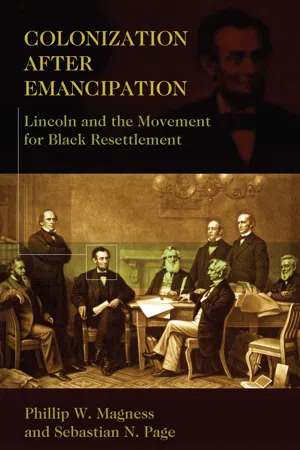
Colonization After Emancipation
Lincoln and the Movement for Black Resettlement
- English
- ePUB (mobile friendly)
- Available on iOS & Android
eBook - ePub
Colonization After Emancipation
Lincoln and the Movement for Black Resettlement
About this book
History has long acknowledged that President Abraham Lincoln, the Great Emancipator, had considered other approaches to rectifying the problem of slavery during his administration. Prior to Emancipation, Lincoln was a proponent of colonization: the idea of sending African American slaves to another land to live as free people. Lincoln supported resettlement schemes in Panama and Haiti early in his presidency and openly advocated the idea through the fall of 1862. But the bigoted, flawed concept of colonization never became a permanent fixture of U.S. policy, and by the time Lincoln had signed the Emancipation Proclamation on January 1, 1863, the word "colonization" had disappeared from his public lexicon. As such, history remembers Lincoln as having abandoned his support of colonization when he signed the proclamation. Documents exist, however, that tell another story.
Colonization after Emancipation: Lincoln and the Movement for Black Resettlement explores the previously unknown truth about Lincoln's attitude toward colonization. Scholars Phillip W. Magness and Sebastian N. Page combed through extensive archival materials, finding evidence, particularly within British Colonial and Foreign Office documents, which exposes what history has neglected to reveal—that Lincoln continued to pursue colonization for close to a year after emancipation. Their research even shows that Lincoln may have been attempting to revive this policy at the time of his assassination.
Using long-forgotten records scattered across three continents—many of them untouched since the Civil War—the authors show that Lincoln continued his search for a freedmen's colony much longer than previously thought. Colonization after Emancipation reveals Lincoln's highly secretive negotiations with the British government to find suitable lands for colonization in the West Indies and depicts how the U.S. government worked with British agents and leaders in the free black community to recruit emigrants for the proposed colonies. The book shows that the scheme was never very popular within Lincoln's administration and even became a subject of subversion when the president's subordinates began battling for control over a lucrative "colonization fund" established by Congress.
Colonization after Emancipation reveals an unexplored chapter of the emancipation story. A valuable contribution to Lincoln studies and Civil War history, this book unearths the facts about an ill-fated project and illuminates just how complex, and even convoluted, Abraham Lincoln's ideas about the end of slavery really were.
Frequently asked questions
Yes, you can cancel anytime from the Subscription tab in your account settings on the Perlego website. Your subscription will stay active until the end of your current billing period. Learn how to cancel your subscription.
No, books cannot be downloaded as external files, such as PDFs, for use outside of Perlego. However, you can download books within the Perlego app for offline reading on mobile or tablet. Learn more here.
Perlego offers two plans: Essential and Complete
- Essential is ideal for learners and professionals who enjoy exploring a wide range of subjects. Access the Essential Library with 800,000+ trusted titles and best-sellers across business, personal growth, and the humanities. Includes unlimited reading time and Standard Read Aloud voice.
- Complete: Perfect for advanced learners and researchers needing full, unrestricted access. Unlock 1.4M+ books across hundreds of subjects, including academic and specialized titles. The Complete Plan also includes advanced features like Premium Read Aloud and Research Assistant.
We are an online textbook subscription service, where you can get access to an entire online library for less than the price of a single book per month. With over 1 million books across 1000+ topics, we’ve got you covered! Learn more here.
Look out for the read-aloud symbol on your next book to see if you can listen to it. The read-aloud tool reads text aloud for you, highlighting the text as it is being read. You can pause it, speed it up and slow it down. Learn more here.
Yes! You can use the Perlego app on both iOS or Android devices to read anytime, anywhere — even offline. Perfect for commutes or when you’re on the go.
Please note we cannot support devices running on iOS 13 and Android 7 or earlier. Learn more about using the app.
Yes, you can access Colonization After Emancipation by Phillip W. Magness,Sebastian N. Page in PDF and/or ePUB format, as well as other popular books in History & American Civil War History. We have over one million books available in our catalogue for you to explore.
Information
Publisher
University of MissouriYear
2011Print ISBN
9780826221490, 9780826219091eBook ISBN
9780826272355Table of contents
- Cover
- Title page
- Copyright
- Contents
- Preface
- Acknowledgments
- Chapter 1 The Curious Politics of Colonization
- Chapter 2 American Freedmen, British Labor
- Chapter 3 Mr. Lincoln's Hobby
- Chapter 4 The Contrabands Question
- Chapter 5 This Most Desirable Country
- Chapter 6 A Self-Supporting Scheme
- Chapter 7 Secretary Seward and the Dutch Treaty
- Chapter 8 Administrative Dysfunction, Congressional Displeasure
- Chapter 9 The Indefatigable James Mitchell
- Chapter 10 Colonization Repudiated, Colonization Revived?
- Chapter 11 Colonization after Emancipation
- Notes
- Sources
- Index