eBook - ePub
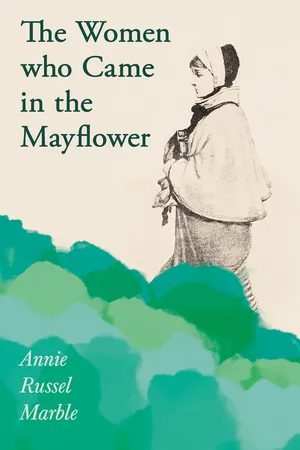
The Women who Came in the Mayflower
Including the Excerpt 'Women Pioneers' by Mrs John A. Logan
- 70 pages
- English
- ePUB (mobile friendly)
- Available on iOS & Android
eBook - ePub
The Women who Came in the Mayflower
Including the Excerpt 'Women Pioneers' by Mrs John A. Logan
About this book
"The Women who Came in the Mayflower" is a 1920 work by Annie Russel Marble within which she looks at the female passengers of the 'Mayflower', an English ship that transported early Pilgrims to the New World in 1620. The ship has since become an important part of American history and culture, as well as the subject of innumerable works of art, plays, films, poems, songs, books, etc. This fascinating treatise is highly recommended for those with an interest in this famous sea voyage and in American history and culture in general. Contents include: "Women Pioneers, by Mrs John A. Logan", "Foreword", "Endurance and Adventure — The Voyage and Landing", "Communal and Family Life in Plymouth 1621-1623", "Matrons and Maidens Who Came in the Mayflower", and "Companions Who Arrived in the Fortune and the Ann". Read & Co. History is republishing this classic work now complete with the excerpt "Women Pioneers" by Mrs John A. Logan.
Information
Topic
StoriaSubtopic
Primordi della storia americanaCHAPTER I
ENDURANCE AND ADVENTURE — THE VOYAGE AND LANDING
December weather in New England, even at its best, is a test of physical endurance. With warm clothes and sheltering homes today, we find compensations for the cold winds and storms in the exhilarating winter sports and the good cheer of the holiday season.
The passengers of The Mayflower anchored in Plymouth harbor, three hundred years ago, lacked compensations of sports or fireside warmth. One hundred and two in number when they sailed,—of whom twenty-nine were women,—they had been crowded for ten weeks into a vessel that was intended to carry about half the number of passengers. In low spaces between decks, with some fine weather when the open hatchways allowed air to enter and more stormy days when they were shut in amid discomforts of all kinds, they had come at last within sight of the place where, contrary to their plans, they were destined to make their settlement.
At Plymouth, England, their last port in September, they had "been kindly entertained and courteously used by divers friends there dwelling,"1 but they were homeless now, facing a new country with frozen shores, menaced by wild animals and yet more fearsome savages. Whatever trials of their good sense and sturdy faith came later, those days of waiting until shelter could be raised on shore, after the weeks of confinement, must have challenged their physical and spiritual fortitude.
There must have been exciting days for the women on shipboard and in landing. There must have been hours of distress for the older and the delight in adventure which is an unchanging trait of the young of every race. Wild winds carried away some clothes and cooking-dishes from the ship; there was a birth and a death, and occasional illness, besides the dire seasickness. John Howland, "the lustie young man," fell overboard but he caught hold of the topsail halyard which hung extended and so held on "though he was sundry fathoms under water," until he was pulled up by a rope and rescued by a boat-hook2.
Recent research3 has argued that the captain of The Mayflower was probably not Thomas Jones, with reputation for severity, but a Master Christopher Jones of kindlier temper. The former captain was in Virginia, in September, 1620, according to this account. With the most generous treatment which the captain and crew could give to the women, they must have been sorely tried. There were sick to be nursed, children to be cared for, including some lively boys who played with powder and nearly caused an explosion at Cape Cod; nourishment must be found for all from a store of provisions that had been much reduced by the delays and necessary sales to satisfy their "merchant adventurers" before they left England.
They slept on damp bedding and wore musty clothes; they lacked exercise and water for drink or cleanliness. Joyful for them must have been the day recorded by Winslow and Bradford4, —"On Monday the thirteenth of November our people went on shore to refresh themselves and our women to wash, as they had great need."
During the anxious days when the abler men were searching on land for a site for the settlement, first on Cape Cod and later at Plymouth, there were events of excitement on the ship left in the harbor. Peregrine White was born and his father's servant, Edward Thompson, died. Dorothy May Bradford, the girl-wife of the later Governor of the colony, was drowned during his absence. There were murmurings and threats against the leaders by some of the crew and others who were impatient at the long voyage, scant comforts and uncertain future. Possibly some of the complaints came from women, but in the hearts of most of them, although no women signed their names, was the resolution that inspired the men who signed that compact in the cabin of The Mayflower,—"to promise all due submission and obedience." They had pledged their "great hope and inward zeal of laying good foundation for ye propagating and advancing ye gospell of ye kingdom of Christ in those remote parts of ye world; yea, though they should be but as stepping-stones unto others for ye performing of so great a work"; with such spirit they had been impelled to leave Holland and such faith sustained them on their long journey.
Many of the women who were pioneers at Plymouth had suffered severe hardships in previous years.
They could sustain their own hearts and encourage the younger ones by remembrance of the passage from England to Holland, twelve years before, when they were searched most cruelly, even deprived of their clothes and belongings by the ship's master at Boston. Later they were abandoned by the Dutchman at Hull, to wait for fourteen days of frightful storm while their husbands and protectors were carried far away in a ship towards the coast of Norway, "their little ones hanging about them and quaking with cold.5"
There were women with frail bodies, like Rose Standish and Katherine Carver, but there were strong physiques and dauntless hearts sustained to great old age, matrons like Susanna White and Elizabeth Hopkins and young women like Priscilla Mullins, Mary Chilton, Elizabeth Tilley and Constance Hopkins. In our imaginations today, few women correspond to the clinging, fainting figures portrayed by some of the painters of "The Departure" or "The Landing of the Pilgrims." We may more readily believe that most of the women were upright and alert, peering anxiously but courageously into the future. Writing in 1910, John Masefield said:6 "A generation fond of pleasure, disinclined towards serious thought, and shrinking from hardship, even if it may be swiftly reached, will find it difficult to imagine the temper, courage and manliness of the emigrants who made the first Christian settlement of New England." Ten years ago it would have been as difficult for women of our day to understand adequately the womanliness of the Pilgrim matrons and girls. The anxieties and self-denials experienced by women of all lands during the last five years may help us to "imagine" better the dauntless spirit of these women of New-Plymouth. During those critical months of 1621-1623 they sustained their households and assisted the men in establishing an orderly and religious colony. We may justly affirm that some of "the wisdom, prudence and patience and just and equall carriage of things by the better part"7 was manifested among the women as well as the men.
In spite of the spiritual zeal which comes from devotion to a good cause, and the inspiration of steady work, the women must have suffered from homesickness, as well as from anxiety and illness. They had left in Holland not alone their loved pastor, John Robinson, and their valiant friend, Robert Cushman, but many fathers, mothers, brothers and sisters besides their "dear gossips." Mistress Brewster yearned for her elder son and her daughters, Fear and Patience; Priscilla Mullins and Mary Chilton, soon to be left orphans, had been separated from older brothers and sisters. Disease stalked among them on land and on shipboard like a demon. Before the completion of more than two or three of the one-room, thatched houses, the deaths were multiplying. Possibly this disease was typhus fever; more probably it was a form of infectious pneumonia, due to enervated conditions of the body and to exposures at Cape Cod. Winslow declared, in his account of the expedition on shore, "It blowed and did snow all that day and night and froze withal. Some of our people that are dead took the original of their death there." Had the disease been "galloping consumption," as has been suggested sometimes, it is not probable that many of those "sick unto death" would have recovered and have lived to be octogenarians.
The toll of deaths increased and the illness spread until, at one time, there were only "six or seven sound persons" to minister to the sick and to bury the dead. Fifteen of the twenty-nine women who sailed from England and Holland were buried on Plymouth hillside d...
Table of contents
- WOMEN PIONEERS
- FOREWORD
- CHAPTER I
- CHAPTER II
- CHAPTER III
- CHAPTER IV
Trusted by 375,005 students
Access to over 1.5 million titles for a fair monthly price.
Study more efficiently using our study tools.
Frequently asked questions
Yes, you can cancel anytime from the Subscription tab in your account settings on the Perlego website. Your subscription will stay active until the end of your current billing period. Learn how to cancel your subscription
No, books cannot be downloaded as external files, such as PDFs, for use outside of Perlego. However, you can download books within the Perlego app for offline reading on mobile or tablet. Learn how to download books offline
Perlego offers two plans: Essential and Complete
- Essential is ideal for learners and professionals who enjoy exploring a wide range of subjects. Access the Essential Library with 800,000+ trusted titles and best-sellers across business, personal growth, and the humanities. Includes unlimited reading time and Standard Read Aloud voice.
- Complete: Perfect for advanced learners and researchers needing full, unrestricted access. Unlock 1.5M+ books across hundreds of subjects, including academic and specialized titles. The Complete Plan also includes advanced features like Premium Read Aloud and Research Assistant.
We are an online textbook subscription service, where you can get access to an entire online library for less than the price of a single book per month. With over 1.5 million books across 990+ topics, we’ve got you covered! Learn about our mission
Look out for the read-aloud symbol on your next book to see if you can listen to it. The read-aloud tool reads text aloud for you, highlighting the text as it is being read. You can pause it, speed it up and slow it down. Learn more about Read Aloud
Yes! You can use the Perlego app on both iOS and Android devices to read anytime, anywhere — even offline. Perfect for commutes or when you’re on the go.
Please note we cannot support devices running on iOS 13 and Android 7 or earlier. Learn more about using the app
Please note we cannot support devices running on iOS 13 and Android 7 or earlier. Learn more about using the app
Yes, you can access The Women who Came in the Mayflower by Annie Russel Marble in PDF and/or ePUB format, as well as other popular books in Storia & Primordi della storia americana. We have over 1.5 million books available in our catalogue for you to explore.