eBook - ePub
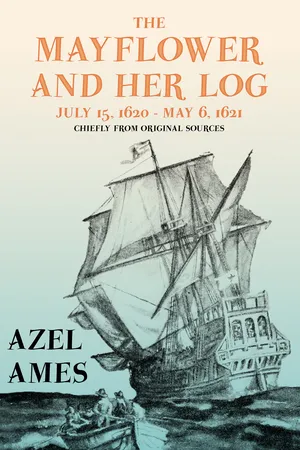
The Mayflower and Her Log - July 15, 1620 - May 6, 1621 - Chiefly from Original Sources
With the Essay 'The Myth of the "Mayflower"' by G. K. Chesterton
- 336 pages
- English
- ePUB (mobile friendly)
- Available on iOS & Android
eBook - ePub
The Mayflower and Her Log - July 15, 1620 - May 6, 1621 - Chiefly from Original Sources
With the Essay 'The Myth of the "Mayflower"' by G. K. Chesterton
About this book
First published in 1901, "The Mayflower and Her Log" looks in detail into the historic voyage of the 'Mayflower', an English ship that transported early Pilgrims to the New World in 1620. The ship has since become an important part of American history and culture, as well as the subject of innumerable works of art, plays, films, poems, songs, books, etc. Drawing upon original sources, this fascinating account of the incidents and people aboard the famous ship is highly recommended for those with an interest in American history and culture. Contents include: "The Myth of the 'Mayflower', by G. K. Chesterton", "Introductory", "The Name—'May-Flower'", "The May-Flower's Consort the Speedwell", "The May-Flower's Charter and the Adventurers", "The May-Flower—The Ship Herself", "The Officers and Crew of the Mayflower", "The May-Flower's Passengers", "Quarters, Cooking, Provisions", etc. Read & Co. History is republishing this classic work now complete with the essay "The Myth of the 'Mayflower'" by G. K. Chesterton.
Information
CHAPTER I
THE NAME—“MAY-FLOWER”
“Curiously enough,” observes Professor Arber, “these names [May-Flower and Speedwell] do not occur either in the Bradford manuscript or in ‘Mourt’s Relation.’” 1
He might have truthfully added that they nowhere appear in any of the letters of the “exodus” period, whether from Carver, Robinson, Cushman, or Weston; or in the later publications of Window; or in fact of any contemporaneous writer. It is not strange, therefore, that the Rev. Mr. Blaxland, the able author of the “Mayflower Essays,” should have asked for the authority for the names assigned to the two Pilgrim ships of 1620.
It seems to be the fact, as noted by Arber, that the earliest authentic evidence that the bark which bore the Pilgrims across the North Atlantic in the late autumn of 1620 was the May-Flower, is the “heading” of the “Allotment of Lands”—happily an “official” document—made at New Plymouth, New England, in March, 1623—It is not a little remarkable that, with the constantly recurring references to “the ship,”—the all-important factor in Pilgrim history,—her name should nowhere have found mention in the earliest Pilgrim literature. Bradford uses the terms, the “biger ship,” or the “larger ship,” and Winslow, Cushman, Captain John Smith, and others mention simply the “vessel,” or the “ship,” when speaking of the May-Flower, but in no case give her a name.
It is somewhat startling to find so thorough-paced an Englishman as Thomas Carlyle calling her the May-Flower “of Delft-Haven,” as in the quotation from him on a preceding page. That he knew better cannot be doubted, and it must be accounted one of those ‘lapsus calami’ readily forgiven to genius,—proverbially indifferent to detail.
Sir Ferdinando Gorges makes the curious misstatement that the Pilgrims had three ships, and says of them: “Of the three ships (such as their weak fortunes were able to provide), whereof two proved unserviceable and so were left behind, the third with great difficulty reached the coast of New England,” etc.
1 A Relation, or Journal, of the Beginning and Proceedings of the English Plantation settled at Plymouth in New England, etc. G. Mourt, London, 1622. Undoubtedly the joint product of Bradford and Winslow, and sent to George Morton at London for publication. Bradford says (op, cit. p. 120): “Many other smaler maters I omite, sundrie of them having been already published, in a Jurnall made by one of ye company,” etc. From this it would appear that Mourt’s Relation was his work, which it doubtless principally was, though Winslow performed an honorable part, as “Mourt’s” introduction and other data prove
CHAPTER II
THE MAY-FLOWER’S CONSORT THE SPEEDWELL
The Speedwell was the first vessel procured by the Leyden Pilgrims for the emigration, and was bought by themselves; as she was the ship of their historic embarkation at Delfshaven, and that which carried the originators of the enterprise to Southampton, to join the May-Flower, —whose consort she was to be; and as she became a determining factor in the latter’s belated departure for New England, she may justly claim mention here as indeed an inseparable “part and parcel” of the May-Flower's voyage.
The name of this vessel of associate historic renown with the May-Flower was even longer in finding record in the early literature of the Pilgrim hegira than that of the larger It first appeared, so far as discovered, in 1669—nearly fifty years after her memorable service to the Pilgrims on the fifth page of Nathaniel Morton’s “New England’s Memorial.”
Davis, in his “Ancient Landmarks of Plymouth,” makes a singular error for so competent a writer, when he says: “The agents of the company in England had hired the Speedwell, of sixty tons, and sent her to Delfthaven, to convey the colonists to Southampton.” In this, however, he but follows Mather and the “Modern Universal History,” though both are notably unreliable; but he lacks their excuse, for they were without his access to Bradford’s “Historie.” That the consort-pinnace was neither “hired” nor “sent to Delfthaven” duly appears.
Bradford states the fact,—that “a smale ship (of some 60 tune), was bought and fitted in Holand, which was intended to serve to help to transport them, so to stay in ye countrie and atend ye fishing and such other affairs as might be for ye good and benefite of ye colonie when they come ther.” The statements of Bradford and others indicate that she was bought and refitted with moneys raised in Holland, but it is not easy to understand the transaction, in view of the understood terms of the business compact between the Adventurers and the Planters, as hereinafter outlined. The Merchant Adventurers—who were organized (but not incorporated) chiefly through the activity of Thomas Weston, a merchant of London, to “finance” the Pilgrim undertaking—were bound, as part of their engagement, to provide the necessary shipping,’ etc., for the voyage. The “joint-stock or partnership,” as it was called in the agreement of the Adventurers and Planters, was an equal partnership between but two parties, the Adventurers, as a body, being one of the co-partners; the Planter colonists, as a body, the other. It was a partnership to run for seven years, to whose capital stock the first-named partner (the Adventurers) was bound to contribute whatever moneys, or their equivalents,—some subscriptions were paid in goods, —were necessary to transport, equip, and maintain the colony and provide it the means of traffic, etc., for the term named. The second-named partner (the Planter body) was to furnish the men, women, and children, —the colonists themselves, and their best endeavors, essential to the enterprise,—and such further contributions of money or provisions, on an agreed basis, as might be practicable for them. At the expiration of the seven years, all properties of every kind were to be divided into two equal parts, of which the Adventurers were to take one and the Planters the other, in full satisfaction of their respective investments and claims. The Adventurers’ half would of course be divided among themselves, in such proportion as their individual contributions bore to the sum total invested. The Planters would divide their half among their number, according to their respective contributions of persons, money, or provisions, as per the agreed basis, which was:2 that every person joining the enterprise, whether man, woman, youth, maid, or servant, if sixteen years old, should count as a share; that a share should be reckoned at L10, and hence that L10 worth of money or provisions should also count as a share. Every man, therefore, would be entitled to one share for each person (if sixteen years of age) he contributed, and for each L10 of money or provisions he added thereto, another share. Two children between ten and sixteen would count as one and be allowed a share in the division, but children under ten were to have only fifty acres of wild land. The scheme was admirable for its equity, simplicity, and elasticity, and was equally so for either capitalist or colonist.
Goodwin notes, that, “in an edition of Cushman’s ‘Discourse,’ Judge Davis of Boston advanced the idea that at first the Pilgrims put all their possessions into a common stock, and until 1623 had no individual property. In his edition of Morton’s ‘Memorial’ he honorably admits his error.” The same mistake was made by Robertson and Chief Justice Marshall, and is occasionally repeated in this day. “There was no community of goods, though there w...
Table of contents
- THE MYTH OF THE “MAYFLOWER”
- INTRODUCTORY
- CHAPTER I
- CHAPTER II
- CHAPTER III
- CHAPTER IV
- CHAPTER V
- CHAPTER VI
- CHAPTER VII
- CHAPTER VIII
- CHAPTER IX
- APPENDIX
- ADDENDA
Trusted by 375,005 students
Access to over 1.5 million titles for a fair monthly price.
Study more efficiently using our study tools.
Frequently asked questions
Yes, you can cancel anytime from the Subscription tab in your account settings on the Perlego website. Your subscription will stay active until the end of your current billing period. Learn how to cancel your subscription
No, books cannot be downloaded as external files, such as PDFs, for use outside of Perlego. However, you can download books within the Perlego app for offline reading on mobile or tablet. Learn how to download books offline
Perlego offers two plans: Essential and Complete
- Essential is ideal for learners and professionals who enjoy exploring a wide range of subjects. Access the Essential Library with 800,000+ trusted titles and best-sellers across business, personal growth, and the humanities. Includes unlimited reading time and Standard Read Aloud voice.
- Complete: Perfect for advanced learners and researchers needing full, unrestricted access. Unlock 1.5M+ books across hundreds of subjects, including academic and specialized titles. The Complete Plan also includes advanced features like Premium Read Aloud and Research Assistant.
We are an online textbook subscription service, where you can get access to an entire online library for less than the price of a single book per month. With over 1.5 million books across 990+ topics, we’ve got you covered! Learn about our mission
Look out for the read-aloud symbol on your next book to see if you can listen to it. The read-aloud tool reads text aloud for you, highlighting the text as it is being read. You can pause it, speed it up and slow it down. Learn more about Read Aloud
Yes! You can use the Perlego app on both iOS and Android devices to read anytime, anywhere — even offline. Perfect for commutes or when you’re on the go.
Please note we cannot support devices running on iOS 13 and Android 7 or earlier. Learn more about using the app
Please note we cannot support devices running on iOS 13 and Android 7 or earlier. Learn more about using the app
Yes, you can access The Mayflower and Her Log - July 15, 1620 - May 6, 1621 - Chiefly from Original Sources by Azel Ames in PDF and/or ePUB format, as well as other popular books in History & Early American History. We have over 1.5 million books available in our catalogue for you to explore.