eBook - ePub
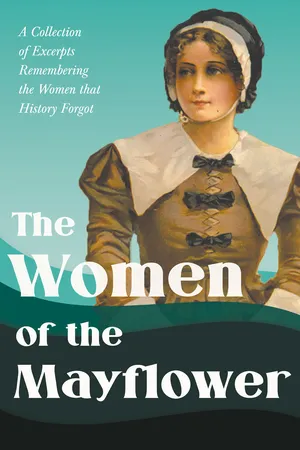
The Women of the Mayflower
A Collection of Excerpts Remembering the Women that History Forgot
- 130 pages
- English
- ePUB (mobile friendly)
- Available on iOS & Android
eBook - ePub
The Women of the Mayflower
A Collection of Excerpts Remembering the Women that History Forgot
About this book
"The Women of the Mayflower" is a collection of excerpts revolving around the female passengers of the 'Mayflower', an English ship that transported early Pilgrims to the New World in 1620. The ship has since become an important part of American history and culture, as well as the subject of innumerable works of art, plays, films, poems, songs, books, etc. An interesting and insightful collection not to be missed by readers keen to hear the voice of the women in early American history. Contents include: "Women Pioneers, by Mrs. John A. Logan", "Matrons and Maidens Who Came in the Mayflower, by Annie Russell Marble", "An Excerpt of Letter X, by Fredrika Bremer".
Information
WOMEN PIONEERS
By Mrs. John A. Logan
The Guiding Hand of Deity, as in all things, can be seen in the ultimate landing of the Pilgrims at Plymouth, New England.
The persecutions inflicted by the bishops and zealots upon dissenters from the mother church, who were denominated "Separatists" caused them to seek a new field where they hoped to be allowed to worship God according to the dictates of their own consciences.
After many unsuccessful attempts, they finally left England, in 1608, and took up their abode in Amsterdam, Holland. There are many conflicting traditions and reports as to the welcome they received in Dutchland. There was, beyond question, disinclination on the part of the Ruler and the people to extend to them cordial hospitality, lest the friendly relations might be interrupted between England and Holland. They were, however, allowed to remain at Amsterdam until, of their own volition, they removed to Leyden, the principal manufacturing town of the Netherlands. They hoped by this change to better their condition and secure employment for the artisans among them who had had training and experience in the factories in England. They endured unspeakable hardships, disappointments and the loss of many of their numbers in Holland. They had gained little but respite from persecution by leaving their homes in England.
Their saintly Bishop, John Robinson by name, hoped that at Leyden, with more lucrative resources, through the possibility of securing employment, they might eventually obtain permanent homes and probably increase the number of followers of their creed. They soon found, however, that Leyden offered little encouragement.
Meanwhile, they heard marvelous stories of the American Continent and of the opportunities it offered for material prosperity, absolute freedom of conscience and perfect religious liberty.
It had been impossible, handicapped as they were by untoward environment, for them to save any money or extend their privileges in any manner. Chained by necessity to daily arduous labor for existence, and enfeebled by illness and misfortunes, they were well nigh exhausted when relief came in the form of agents seeking colonists for America, and "Merchant Adventurers" trying to procure settlers for rich plantations in the new country. The povery of these noble people is evident from the hard terms to which they were obliged to submit in their contracts with the agents and the "Merchant Adventurers" to procure passage to the Land of Hope and Liberty.
After months of negotiations, the Pilgrims finally embarked on the Speedwell, a craft scarcely sea-worthy for the voyage from Delfshaven to Southampton to join the proposed expedition. They reached that port after perilous experiences, which had the effect of discouraging very many of the party, causing the dispirited to abandon their leaders on their arrival at Southampton.
However, the indomitable spirits of such men as Robert Cushman, John Carver, and others were not to be dissuaded from their purpose. Hence, after another long period of waiting and tedious negotiations with the "Merchant Adventurers" and agents of companies interested in securing colonists for the New World, the Mayflower was chartered between the 12th and 22nd of June, 1620. Captain Thomas Jones was in command of the ship; John Clarke as first mate or pilot, an experienced navigator, having crossed the Atlantic many times previously; Robert Coppin was second mate or pilot—he had been once at least on a voyage to the New World; Master Williamson, purser; Dr. Giles Heale, from discovery by the Mayflower descendants, was, doubtless, surgeon of the Mayflower.
There were on board one hundred and two souls. The ship was poorly provided with means of defense, having but three pieces of ordnance and some small arms and ammunition. But these brave souls, some of them with families, and their meagre household effects, dared to set out for a land where they hoped to secure not only religious liberty but opportunity for amassing fortunes.
Alack! with all their religious fervor and heroism "a man's a man for a' that," and it required skilful management on the part of the wisest to adjust the many difficulties and dissolve the innumerable conspiracies that were continually being formed between the zealous but unreasonable religionists and the agents of the "Merchant Adventurers" to change the plans of the leaders of the sect, whose chief object was to establish a colony of their own faith.
Floating the English Union Jack, the Mayflower was piloted by Thomas English, the helmsman of the shallop of the Mayflower, into Plymouth harbor and safely anchored on the stormy night of Sunday, December 16, 1620, thus ending the long voyage of the Pilgrims from Plymouth, England, to Plymouth, New England, in one hundred and fifty-five days. Looking back across the centuries that have intervened, it would be difficult to imagine the emotions that swelled the hearts of those devout people as they stepped upon the soil of the promised land upon which they had builded so many bright hopes. From the Log of the Mayflower, given by Dr. Azel Ames, we learn that there disembarked from the Mayflower one hundred and three souls on that bleak Sunday, December 16, 1620,—seventy-five men and boys and twenty-eight women and girls. Sad to relate, one-half of that number were laid "beneath the sod of their new home before it was clothed by the Spring's verdure."
History and tradition have made heroes of many of the men, and they were entitled to far more glory than they have ever received for their heroic daring. Alas! of the women who shared the burdens and displayed equal courage with the men, little to their credit has been preserved by tradition or history. But when one recalls that in those days women had not the privileges they have now, one realizes that their self-denial, heroism, patience and long-suffering were accepted as a matter of course and no note was taken of it by their selfish liege lords.
In the enlightenment of the twentieth century, one recognizes that the women were the martyrs of that long and perilous voyage. It was the women who kept the weary vigils through sunshine and storm; it was the wives and mothers who were the nurses and comforters of their families; they cooked and cleaned and helped to keep the Mayflower habitable. There were, doubtless, times when weaker women would have been a burden to the men, who had hourly difficulties to overcome, which taxed their courage and strength almost to the point of exhaustion.
When at last they landed, they received a cold reception, not only on account of the inclemency of the midwinter weather, but because the natives were far from cordial in their greetings to strangers whom they suspected had designs upon what they considered their country. They had watched the inroads upon their domain and invasion of their rights by those who had preceded the Pilgrims, and regarded this new intrusion as boding ill for them. However, these brave people set to work religiously to win their way to the confidence and toleration of the savages to whose country they had fled for liberty.
History has long since told the story of the Puritan victories under the banner of the Cross, and of the constant additions to their numbers as soon as the news of the successful landing of the expedition and their auspicious prospects was wafted across the seas to the Old World. At the time, they did not fully appreciate the limitless scope of the blessings their labors, endurance and wisdom under the guidance of the Infinite would bring to the unborn millions of human souls of all land who have continually, to this day, sought freedom of thought, personal rights, and religious liberty in our great American Republic, whose foundation was laid by the Pilgrims who came to our shores in the Mayflower.
It has long since been admitted that mothers have always had all to do with the instilling of principles and developing the character of children. Upon this hypothesis, it is easy to account for the sterling qualities which have characterized New England men and women and given them the leadership in the early days of the Republic in religious education and patriotism. Their Puritan mothers, with their deep religious convictions and conscientious scruples as to the discharge of every duty of life, instilled in their offspring their own exalted religious principles. These sons and daughters, as time has rolled on, have followed the course of the Empire and set up altars to Almighty God and their Country wherever they have halted to establish homes.
As civilization has step by step pushed forward its boundaries from the Atlantic to the Pacific, the same principles of religion and patriotism have inspired the succeeding generations until the American Republic represents the full fruition of the tree of liberty planted so firmly on Plymouth Rock by the Pilgrims.
Unless one has attempted a research of the records, they cannot possibly realize how little has been written of the achievements of the women of the American Nation, notwithstanding the fact that since the landing of the Pilgrims women have stood side by side with the men in the marvelous development of the resources of the New World and the advancement of modern civilization.
The correct explanation of this curious phenomenon lies in the indisputable truth that the brave women who embarked on the Mayflower as the wives and daughters of the adventurous Pilgrims had always been subservient to the male members of their families. The Pilgrim Fathers, laboring under the influence of fanaticism, believed that the Old and New Testaments placed women under the domination of men. Acting upon this conviction, they appropriated the fruits of their women companions' self-sacrifice, intuitive knowledge, inventive genius, wise suggestions and natural diplomacy as their very own, without giving the women any credit whatever or making any note or acknowledgment of the influence and aid of the women who shared in all of the trials and hardships of the perilous voyage across the seas and in establishing homes in the wilderness of the New World.
The examples of the Pilgrim Fathers were followed by their sons for generations. The men, in keeping the records and in 'handing down the traditions, naturally neglected to "render unto Cæsar that which was Cæsar's." The few women shared nobly in the indescribable hardships and suffering experienced by the indomitable spirits who made the first settlements on the shores of New England. Neither history nor tradition has accorded to these women the meed of praise so justly their due. It is left to one's imagination to picture their patience, forbearance, fortitude, quick perception, dauntless courage and intelligence in discharging the duties that fell upon these women as wives, mothers, nurses and companions of men imbued with the idea of their superiority and whose selfishness was prodigious. Trained in the rough school of pioneer struggles which required physical strength, brute force, daring courage, and contempt for weakness, one can readily understand that they were unmindful of the finer feelings and tenderness which are the natural fruits of civilization, and that the men accepted the help of the women as their legitimate rights.
When at last an era of success dawned, it was natural that the men as the leaders of the adventurous settlers of the New World should have all the glory and that the prodigious labors and sacrifices of the women should be overlooked. Half a century had passed before women were accorded any measure of their deserts. During the two-thirds of a century since women had any recognition, they have step by step won their way to equality in all respects, save perhaps physically, to the men, though the privilege of suffrage and representation is not accorded in every state because the women themselves disagree upon the expediency of being given the right of suffrage. With this exception, every avenue is open to women in this "land of the free and the home of the brave."
So well and intelligently have women improved their opportunities that to them belongs the credit of greatly expediting the progress of Christianity, education, and civilization. The natural intuitions of women in the discovery of the good in all things and their keen perception as to how to develop that good are admitted. Julia Ward Howe wrote in the preface of a book "Woman is primarily the mother of the human race. She is man's earliest and tenderest guardian, his life-long companion, his trusted adviser and friend. Her breath is the music of the nursery; the incense of the church." Woman's mission and sphere is thus graphically portrayed by the gifted pen of one of the noblest women of our race.
The majority of women have exemplified this aphorism by the faithful performance of their duties as wives, mothers and members of society. In three or four decades they have succeeded in demonstrating their abilities in fields other than domestic drudgery to which they were assigned in the earlier days of the Republic through the misconception of Bible truths, fanaticism and the prejudices of the unenlightened. The barriers erected by the Puritans have been broken down and women during the last half century in almost equal numbers with men have contested successfully for the honors in science, literature, music, art, political economy, education, the professions of law, medicine and theology, and also in many of the vocations of life which are based on industrial principles—to say nothing of her achievements in the higher realms of Christianity, humanity, philanthropy and in the solution of the problems of social purity, domestic science, municipal administration, cultivation and betterment of the conditions of mankind.
The majority of women as "mothers of the race" have the advantage in that they have the power to transmit to their offspring principles which inspire high ambitions, noble instincts, pure thoughts and inclination for right living. They have in their keeping the infant minds which they can mould and train for noble or ignoble lives. Unfortunately, the influence of mothers does not invariably abide in their children, but in most cases it is felt from the cradle to the grave by the children they have borne and reared properly.
THE EARLY PERIOD OF SETTLEMENT
Jamestown was founded May 13, 1607, and the first woman of whom we have any mention in that settlement was Mistress Forest and her maid, Ann Burrs, and she is supposed to have been the first English woman married on American soil. The terrible sufferings of these settlers from starvation and want is a matter of history, and not more than sixty of the original five hundred souls remained after what is known as the "Starving Time," and it is a most remarkable fact that of these sixty survivors a large proportion were women. In 1621 it became evident that a new lot of settlers must be brought out to America if this new colony was to survive. Sir Edwin Sandys, at the head of the London Company, who had charge of the interests of the Virginia settlers, adopted the plan of sending out wives, respectable young women, to these planters, and in one year he sent over one thousand two hundred and sixty-one new settlers, and on one v...
Table of contents
- WOMEN PIONEERS
- MATRONS AND MAIDENS WHO CAME IN THE MAYFLOWER
- AN EXCERPT OF LETTER X
Trusted by 375,005 students
Access to over 1.5 million titles for a fair monthly price.
Study more efficiently using our study tools.
Frequently asked questions
Yes, you can cancel anytime from the Subscription tab in your account settings on the Perlego website. Your subscription will stay active until the end of your current billing period. Learn how to cancel your subscription
No, books cannot be downloaded as external files, such as PDFs, for use outside of Perlego. However, you can download books within the Perlego app for offline reading on mobile or tablet. Learn how to download books offline
Perlego offers two plans: Essential and Complete
- Essential is ideal for learners and professionals who enjoy exploring a wide range of subjects. Access the Essential Library with 800,000+ trusted titles and best-sellers across business, personal growth, and the humanities. Includes unlimited reading time and Standard Read Aloud voice.
- Complete: Perfect for advanced learners and researchers needing full, unrestricted access. Unlock 1.5M+ books across hundreds of subjects, including academic and specialized titles. The Complete Plan also includes advanced features like Premium Read Aloud and Research Assistant.
We are an online textbook subscription service, where you can get access to an entire online library for less than the price of a single book per month. With over 1.5 million books across 990+ topics, we’ve got you covered! Learn about our mission
Look out for the read-aloud symbol on your next book to see if you can listen to it. The read-aloud tool reads text aloud for you, highlighting the text as it is being read. You can pause it, speed it up and slow it down. Learn more about Read Aloud
Yes! You can use the Perlego app on both iOS and Android devices to read anytime, anywhere — even offline. Perfect for commutes or when you’re on the go.
Please note we cannot support devices running on iOS 13 and Android 7 or earlier. Learn more about using the app
Please note we cannot support devices running on iOS 13 and Android 7 or earlier. Learn more about using the app
Yes, you can access The Women of the Mayflower by Various in PDF and/or ePUB format, as well as other popular books in History & Social Science Biographies. We have over 1.5 million books available in our catalogue for you to explore.