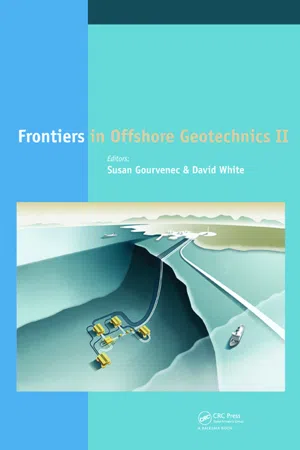
Frontiers in Offshore Geotechnics II comprises the Proceedings of the Second International Symposium on Frontiers in Offshore Geotechnics (ISFOG), organised by the Centre for Offshore Foundation Systems (COFS) and held at the University of Western Australia (UWA), Perth from 8 10 November 2010. The volume addresses current and emerging challenges
- 940 pages
- English
- PDF
- Available on iOS & Android
eBook - PDF
Frontiers in Offshore Geotechnics II
About this book
Information
Table of contents
- Front Cover
- Table of Contents
- Preface
- Committees
- Reviewers
- 1 Keynotes
- A systematic approach to offshore engineering for multiple-project developments in geohazardous areas
- Recommended best practice for geotechnical site characterisation of cohesive offshore sediments
- Gulf of Guinea deepwater sediments: Geotechnical properties, design issues and installation experiences
- Geotechnics for subsea pipelines
- Axial and lateral pile design in carbonate soils
- New frontiers for centrifuge modelling in offshore geotechnics
- Risk and reliability on the frontier of offshore geotechnics
- 2 Geohazards and gas hydrates
- Neotectonic deformation of northwestern Australia: Implications for oil and gas development
- Deepwater Angola part I: Geohazard mitigation
- Deepwater Angola part II: Geotechnical challenges
- Shallow gas hazard linked to worldwide delta environments
- Analysis of submarine flow slides in fine silty sand
- Hydrate dissociation around oil exploration infrastructure
- An investigation of past mass movement events in theWest Nile Delta
- Deformation of seabed due to exploitation of methane hydrate reservoir
- 3 In situ site characterisation and pore pressure measurement
- A site investigation strategy to obtain fast-track shear strength design parameters in deep water soils
- Enhancement of the ball penetrometer test with pore pressure measurements
- Laboratory free falling penetrometer test into clay
- Offshore sediment overpressures: Overview of mechanisms, measurement and modeling
- Angolan deepwater soil conditions: GIS technology development for sediment characterization
- Strength measurement in very soft upper seabed sediments
- CPT in polar snow – preliminary observations
- Parametric study of a free-falling penetrometer in clay-like soils
- The future of deepwater site investigation: Seabed drilling technology?
- Mini T-bar testing at shallow penetration
- Piezometer installation in deepwater Norwegian Sea
- Luva deepwater site investigation programme and findings
- Investigations into novel shallow penetrometers for fine-grained soils
- Seabed drilling vs surface drilling – a comparison
- 4 Soil characterisation and modelling
- Rheological behaviour of soft clays
- A three-dimensional finite element study of the direct simple shear test
- Repeated loading and unloading of the seabed
- A new interpretation of the simple shear test
- Physical modelling of the crushing behaviour of granular materials
- New evidence for the origin and behaviour of deep ocean ‘crusts’
- Soil unit weight estimated from CPTu in offshore soils
- Strain rate dependent simple shear behaviour of deepwater sediments in offshore Angola
- Simplified calibration procedure for a high-cycle accumulation model based on cyclic triaxial tests on 22 sands
- Understanding cyclic loading behavior of soil for offshore applications
- 5 Shallow foundations
- Observations of shallow skirted foundations under transient and sustained uplift
- Numerical study of grillage foundations on sand under combined VHM loading
- The vertical bearing capacity of grillage foundations in sand
- Behaviour of skirted footings on sand overlying clay
- Numerical study of piping limits for suction installation of offshore skirted foundations and anchors in layered sand
- Shallow foundation performance in a calcareous sand
- A numerical study of the vertical bearing capacity of skirted foundations
- The effect of torsion on the sliding resistance of rectangular foundations
- Foundation design challenges of the MCR-A skirted gravity platform
- Constructing breakwater with prefabricated caissons on soft clay
- 6 Piled foundations
- Simplified analysis of laterally loaded pile groups
- Behavior of piles under combined lateral and axial loading
- Investigations on the behavior of large diameter piles under cyclic lateral loading
- BP Clair phase 1 – Pile driveability and capacity in extremely hard till
- Photoelastic investigation into plugging of open ended piles
- Soil-pile interaction during extrusion of an initially deformed pile
- BP Clair phase 1 – Geotechnical assurance of driven piled foundations in extremely hard till
- Pile driving experiences in Persian Gulf calcareous sands
- FLAC3D analysis on soil moving through piles
- Cyclic loading of barrettes in soft calcareous rock using Osterberg cells
- Shaft capacity of drilled and grouted piles in calcareous sandstone
- Numerical analysis of mudmat contribution to capacity of piled offshore platforms
- Simplified numerical model for analysis of offshore piles under cyclic lateral loading
- Centrifuge modelling of rapid load tests with piles in silt and sand
- Field measurements on monopile Dolphins
- Behaviour of driven tubular steel piles in calcarenite for a marine jetty in Fujairah, United Arab Emirates
- CPT-Based design method for axial capacity of offshore piles in clays
- 7 Foundations for renewable energy
- Evaluation of pile capacity approaches with respect to piles for wind energy foundations in the North Sea
- Installation of suction caissons for offshore renewable energy structures
- Lateral behaviour of large diameter monopiles at Sheringham Shoal Wind Farm
- Centrifuge modelling of offshore monopile foundation
- Gravity based foundations for the Rødsand 2 offshore wind farm, Denmark
- Geotechnics for developing offshore renewable energy in the US
- Engineering issues for fixed offshore wind turbines on Lake Michigan Mid Lake Plateau, USA
- Centrifuge model tests on piled footings in clay for offshore wind turbines
- Design of monopile foundations in sand for offshore windfarms
- Experimental evaluation of backfill in scour holes around offshore monopiles
- An investigation of the use of a bearing plate to enhance the lateral capacity of monopile foundations
- Optimizing site investigations and pile design for wind farms using geostatistical methods: A case study
- Towards the FE prediction of permanent deformations of offshore wind power plant foundations using a high-cycle accumulation model
- Cyclic accumulation effects at foundations for offshore wind turbines
- Study on soil-structure interaction of suction caisson by large-scale model tests
- 8 Jack-up units
- Simplified VH equations for foundation punch-through sand into clay
- Characterisation of undrained shear strength using statistical methods
- Centrifuge modelling of spudcan deep penetration in multi-layered soils
- A probabilistic approach to the prediction of spudcan penetration of jack-up units
- An assessment of jackup spudcan extraction
- 3D FE analysis of the installation process of spudcan foundations
- Undrained bearing capacity of deeply embedded foundations under general loading
- 9 Anchoring systems
- Trajectory prediction for drag embedment anchors under out of plane loading
- Setup following keying of plate anchors assessed through centrifuge tests in kaolin clay
- Seismically-induced displacements of a suction caisson in soft clay
- SEPLA keying prediction method based on full-scale offshore tests
- Set-up of suction piles in deepwater Gulf of Guinea clays
- Centrifuge testing of suction piles in deepwater Nigeria clay – Effect of stiffeners and set-up time
- Numerical FEM and laboratory study of the bearing capacity factor Nc for plate anchors
- Caisson capacity in clay: VHM resistance envelope – Part 2: VHM envelope equation and design procedures
- Installation and in-place assessment of drag anchors in carbonate soil
- Caisson capacity in clay: VHM resistance envelope – Part 1: 3D FEM numerical study
- Numerical investigation of the behaviour of suction caissons in structured clays
- Cyclic moment loading of suction caissons in sand
- 10 Pipelines and risers
- Multidirectional analysis of pipeline-soil interaction in clay
- Geotechnical challenges for deepwater pipeline design – SAFEBUCK JIP
- Large deformation finite element analysis of vertical penetration of pipelines in seabed
- Implementation of geotechnical techniques in the analysis of pipeline response
- Lateral soil resistance to an untrenched pipeline under the action of ocean currents
- Vertical cyclic testing of model steel catenary riser at large scale
- Kupe gas project pipeline – optimisation of discrete rock berm design shore approach
- Model test studies on soil restraint to pipelines buried in sand
- Pipe-soil interaction on clay with a variable shear strength profile
- Sweeping behaviour of shallowly-embedded pipeline during cyclic lateral movement
- Advanced nonlinear hysteretic seabed model for dynamic fatigue analysis of steel catenary risers
- Mobilization distance in uplift resistance modeling of pipelines
- Theoretical, numerical and field studies of offshore pipeline sleeper crossings
- Observations of pipe-soil response from the first deep water deployment of the SMARTPIPE®
- 11 Trenching, ploughing, excavation and burial
- Influence of object geometry on penetration into the seabed
- Investigation into the effect of forecutters on plough performance
- State-of-the-art jet trenching analysis in stiff clays
- Numerical modelling of soil around offshore pipeline plough shares
- Anchor–chain–rockfill–soil interaction: Evolution of design methods
- Development of a jet trenching model in sand
- 12 Design and risk
- Structural factors affecting the system capacity of jacket pile foundations
- The new API Recommended Practice for Geotechnical Engineering: RP 2GEO
- Comparison of ISO 19901-2 and API RP 2A seismic design criteria for a site in the Caspian Sea, Turkmenistan
- Offshore geotechnics – safe and sustainable
- Back Cover
Trusted by 375,005 students
Access to over 1.5 million titles for a fair monthly price.
Study more efficiently using our study tools.
Frequently asked questions
Yes, you can cancel anytime from the Subscription tab in your account settings on the Perlego website. Your subscription will stay active until the end of your current billing period. Learn how to cancel your subscription
No, books cannot be downloaded as external files, such as PDFs, for use outside of Perlego. However, you can download books within the Perlego app for offline reading on mobile or tablet. Learn how to download books offline
Perlego offers two plans: Essential and Complete
- Essential is ideal for learners and professionals who enjoy exploring a wide range of subjects. Access the Essential Library with 800,000+ trusted titles and best-sellers across business, personal growth, and the humanities. Includes unlimited reading time and Standard Read Aloud voice.
- Complete: Perfect for advanced learners and researchers needing full, unrestricted access. Unlock 1.5M+ books across hundreds of subjects, including academic and specialized titles. The Complete Plan also includes advanced features like Premium Read Aloud and Research Assistant.
We are an online textbook subscription service, where you can get access to an entire online library for less than the price of a single book per month. With over 1.5 million books across 990+ topics, we’ve got you covered! Learn about our mission
Look out for the read-aloud symbol on your next book to see if you can listen to it. The read-aloud tool reads text aloud for you, highlighting the text as it is being read. You can pause it, speed it up and slow it down. Learn more about Read Aloud
Yes! You can use the Perlego app on both iOS and Android devices to read anytime, anywhere — even offline. Perfect for commutes or when you’re on the go.
Please note we cannot support devices running on iOS 13 and Android 7 or earlier. Learn more about using the app
Please note we cannot support devices running on iOS 13 and Android 7 or earlier. Learn more about using the app
Yes, you can access Frontiers in Offshore Geotechnics II by Susan Gourvenec, David White in PDF and/or ePUB format, as well as other popular books in Technology & Engineering & Civil Engineering. We have over 1.5 million books available in our catalogue for you to explore.