This book explores the concepts and role of green computing and its recent developments for making the environment sustainable. It focuses on green automation in disciplines such as computers, nanoscience, information technology, and biochemistry. This book is characterized through descriptions of sustainability, green computing, their relevance to the environment, society, and its applications.
Presents how to make the environment sustainable through engineering aspects and green computing
Explores concepts and the role of green computing with recent developments
Processes green automation linked with various disciplines such as nanoscience, information technology, and biochemistry
Explains the concepts of green computing linked with sustainable environment through information technology
This book will be of interest to researchers, libraries, students, and academicians that are interested in the concepts of green computing linked with green automation through information technology and their impacts on the future.
1 Green Computing in Wireless Sensor Networks through Energy-Efficient Techniques for Lifetime Improvement
Amita Yadav
MSIT
Contents
1.1 Introduction
1.2 Taxonomy of Energy-Efficient Routing Protocols
1.2.1 Energy Conservation Techniques
1.3 Energy-Efficient Routing Protocols in WSN
1.4 Hierarchical Routing Protocols
1.4.1 Classical-Based Clustering Protocols
1.4.1.1 Centralized and Distributive Clustering
1.4.2 Meta-Heuristic-Based Clustering Protocols
1.5 Experimental Review of Leach Protocol
1.5.1 Simulation of LEACH
1.5.2 Simulation Results
1.5.3 Analysis of LEACH Protocol
1.6 Summary
References
1.1 Introduction
The technological advancement in wireless communication has led to the development of wireless sensor networks (WSNs). With the exceptional capability of not only sensing but processing, WSNs became popular and very much required for many applications. Sensor nodes are small and are deployed in the monitoring area in large amount to detect events. But they are resource constrained. They are tiny nodes with low-cost processor, limited storage capacity, limited transceiver range and limited battery lifetime. Sensor nodes sense the monitoring area such as forests, fields, underwater areas, cities, human body, etc. and transmit the sensed data to the sink. This transmission may take place via single hop or through multi-hops. In single-hop networks, nodes can directly send data to the sink. But generally, a sensor network field is large and the node transmission range is limited, so the nodes may send data to the sink via intermediate nodes or forwarding nodes, which is called as the multi-hop network [1]. In single hop, sensor nodes deplete their energy due to direct data transmission, whereas in a multi-hop, the forwarding nodes deplete their energy and reduce the network lifetime. The lifetime of sensor nodes mainly depends upon a finite source of energy like battery. Therefore, it is crucial to consider the energy-efficient techniques to increase the life span of the network and consequently their role in green computing.
1.2 Taxonomy of Energy-Efficient Routing Protocols
There are a few common requirements of sensor networks for all types of applications in WSN, which are given as follows [2]:
Network lifetime – Nodes are deployed in an unattended environment; therefore, it is required to conserve energy of nodes and prolong the network lifetime. If a network fails due to energy depletion of nodes, communication failure occurs.
Network size – Sensor nodes are deployed in a large network area to detect more events. A large coverage area is the interest of most applications.
Minimum faults – Data packet may be lost in transmission of data to the sink. Many events may be missed, and monitoring of environment is broken. Data reliability is the major concern of applications.
The sensor nodes are generally deployed in an inaccessible area. These sensor nodes are limited in battery power, and replacement of batteries is not an easy task in remote areas. The major challenge is to keep the network alive. A limited battery power makes it difficult to manage and monitor the network. Therefore, it is required to conserve the node energy in order to increase the network life span.
Various sources of energy dissipation, which we have already discussed in the previous chapter, are idle listening, collisions, over-hearing, over-emitting, etc.
1.2.1 Energy Conservation Techniques
Various ways for conserving energy are discussed in Ref. [3], which are given as follows:
Sensor nodes consume equal amount of energy in ready mode as well as in receiving mode; therefore, sleep mode and a wake-up schedule must be set for event sensing to save energy. The idle scheduling time depends on the network traffic.
To conserve the energy in WSNs, the sensor network nodes use data fusion. Using data fusion, the amount of data transmitted from sensor nodes to the base station is reduced. Data fusion combines one or more data packets from different sensor nodes to produce a single packet. Also, data must be aggregated to reduce the transmission load. Sensor network is divided into clusters. Member nodes in the cluster send the data to the cluster head (CH), where the data is aggregated and data fusion takes place.
In WSN, data processing is much cheaper than data transmission. Data compression performed through various algorithms saves energy.
In a clustered network, CHs aggregate the data and transmit it to the base station (BS). The responsibility of a CH node is more as compared to the member nodes in the network. Therefore, CH consumes more energy or dies quickly in a homogeneous network. The communication load must be balanced to increase the lifetime of the network. Load balancing technique equally distributes the traffic load in the network, and a good network performance can be attained. Load balancing of CHs can be achieved through a random rotation of CH. It can also be achieved via appointing advanced nodes as CH in a heterogeneous network as they have more battery power.
By lowering the transmission range, the energy can be conserved, but network coverage is still required. Therefore, a mechanism that takes care of transmission range as well as coverage of network is needed. Heterogeneous sensor networks consider the concept of remaining energy and distance [4].
There are different layers which work in their own way to achieve energy efficiency.
1.3 Energy-EfficientRouting Protocols in WSN
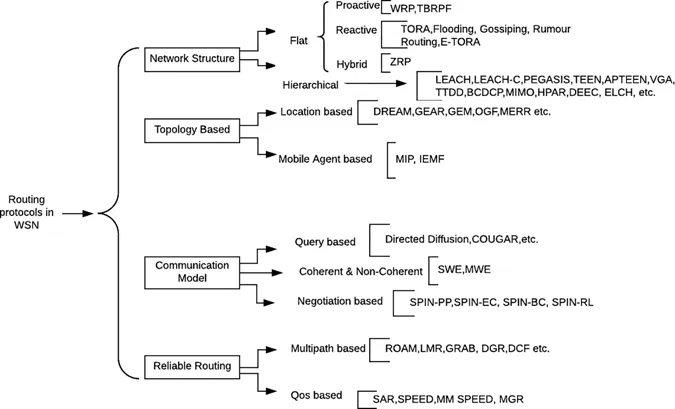
WSNs are battery-operated devices. Therefore, an energy-efficient routing protocol is required. According to Ref. [5], routing protocol for WSNs is classified into four categories – network structure, topology-based, communication model and reliable routing as shown in Figure 1.1.
FIGURE 1.1 Routing protocols in WSNs.
The first category is further divided into flat protocol and hierarchal protocols; second category into location-based and mobile agent-based; third category into query-based, coherent- and non-coherent-based, and negotiation-based; and fourth category into multipath-based and QoS-based protocols. Our research focus is on how protocols reduce the energy consumption and increase the network life span. Data sensing, data processing and data communication are the major factors that need to be considered while designing an energy-efficient routing protocol for WSN. However, data transmission and data reception require maximum energy; therefore, the main emphasis is on designing protocols that use less power in communication is given in the survey. Various performance parameters of routing protocols such as energy per packet, energy and reliability, network lifetime, average energy dissipation, low energy consumption, total number of alive nodes, total number of data signal received at BS, average packet delay, packet delivery ratio, time until the first node dies, energy spent per round, idle listening, packet size, and distance have also been discussed. Now, routing protocols in Ref. [7] are further distinguished as follows:
I. Network structure-based routing protocol – Nodes in the network are either uniformly distributed or randomly distributed. In this category, the nodes are either at similar level or at different levels of hierarchy. It is further classified as follows:
Flat protocol– In this scheme, all the nodes are of similar type. In trend, these protocols for WSNs can be divided, in step with the routing strategy, into three main distinctive categories: proactive, re-active and hybrid protocols [6]. Most of these protocols fluctuate in lots of methods and do not present the identical traits, even though they were designed for the same network.
Proactive routing protocol – Like wired network, in proactive protocols (or table-driven routing protocols), each node maintains its routing table to discover the route to the destination based on the intermittent exchange of routing messages between the specific nodes. Every node is required to preserve one or more tables with the help of routing records. In addition, nodes reply to various changes in network topology by wirelessly sending updates and appropriately retaining a regular network view. Consequently, direction to a few destinations, the packet will be forwarded through a predefined path, thereby avoiding time delay in path finding. However, to keep the data intact, heavy bandwidth and battery power is required which is always deficient and re...
Table of contents
Cover
Half Title
Series Page
Title Page
Copyright Page
Table of Contents
Preface
Editors
Contributors
Chapter 1 Green Computing in Wireless Sensor Networks through Energy-Efficient Techniques for Lifetime Improvement
Chapter 2 Challenges and Opportunities with Green and Sustainable Computing in Healthcare
Chapter 3 Green Computing and Its Related Technologies
Chapter 4 Wearable Computing and Its Applications: An Approach towards Sustainable Living
Chapter 5 Role of IoT and Sensors in Achieving Sustainability
Index
Trusted by 375,005 students
Access to over 1.5 million titles for a fair monthly price.
Study more efficiently using our study tools.
Frequently asked questions
Yes, you can cancel anytime from the Subscription tab in your account settings on the Perlego website. Your subscription will stay active until the end of your current billing period. Learn how to cancel your subscription
No, books cannot be downloaded as external files, such as PDFs, for use outside of Perlego. However, you can download books within the Perlego app for offline reading on mobile or tablet. Learn how to download books offline
Perlego offers two plans: Essential and Complete
Essential is ideal for learners and professionals who enjoy exploring a wide range of subjects. Access the Essential Library with 800,000+ trusted titles and best-sellers across business, personal growth, and the humanities. Includes unlimited reading time and Standard Read Aloud voice.
Complete: Perfect for advanced learners and researchers needing full, unrestricted access. Unlock 1.5M+ books across hundreds of subjects, including academic and specialized titles. The Complete Plan also includes advanced features like Premium Read Aloud and Research Assistant.
Both plans are available with monthly, semester, or annual billing cycles.
We are an online textbook subscription service, where you can get access to an entire online library for less than the price of a single book per month. With over 1.5 million books across 990+ topics, we’ve got you covered! Learn about our mission
Look out for the read-aloud symbol on your next book to see if you can listen to it. The read-aloud tool reads text aloud for you, highlighting the text as it is being read. You can pause it, speed it up and slow it down. Learn more about Read Aloud
Yes! You can use the Perlego app on both iOS and Android devices to read anytime, anywhere — even offline. Perfect for commutes or when you’re on the go. Please note we cannot support devices running on iOS 13 and Android 7 or earlier. Learn more about using the app
Yes, you can access Green Automation for Sustainable Environment by Sherin Zafar, Mohd Abdul Ahad, M. Afshar Alam, Kashish Ara Shakil, Sherin Zafar,Mohd Abdul Ahad,M. Afshar Alam,Kashish Ara Shakil in PDF and/or ePUB format, as well as other popular books in Informatica & Sviluppo sostenibile. We have over 1.5 million books available in our catalogue for you to explore.