eBook - ePub
Soil-Water Interactions
Mechanisms Applications, Second Edition, Revised Expanded
- 464 pages
- English
- ePUB (mobile friendly)
- Available on iOS & Android
eBook - ePub
About this book
Emphasizing pioneering achievements, this work offers a clear and systematic description of various soil-water phenomena and their applications to soil problems such as water retention and the flux of water in soils and clays. This second edition contains material on the physical properties of adsorbed water, the application of fractal theory to solute and water flows in field soils, fingering research, and more.
Information
1
ENERGY CONCEPT AND THERMODYNAMICS OF WATER IN SOIL
1.1 Energy Concept of Water in Soil
1.1.1 Historical Review of the Energy Concept
Capillary Potential
Buckingham (1907) introduced the concept that flow of water results from a difference in capillary potential between two points in the soil. He considered that the soil exerts an attraction sufficient to hold water against the action of gravity, and that this attraction decreases as the amount of water held by the soil increases. He proposed the term “capillary potential,” ψ, to describe this attraction. ψ(θ) was defined as the work required to pull a unit mass of water away from the large mass of soil whose water content is θ, the volume fraction of water. He introduced the equation

where x is the height above a water surface in a column of soil standing in water, at equilibrium.
By measuring water content at different heights in these columns, he could obtain the relation between capillary potential and water content for various soils. He obtained curves of the type shown in Fig. 1.1, which have proved to be of enormous value in the study of soil water. Before that time, only “water content” had been used to express the state of water in soil. But if the water contents of two soils are equal, the state of water in each soil need not be the same. The concept of capillary potential enabled scientists to compare quantitatively, with the same scale, the state of water in various moist soils. Buckingham established the foundation for scientific studies on soil water. It should be noted that the sign of g in Eq. (1.1) should be negative, as pointed out by Gardner et al. (1922). Consequently, Eq. (1.1) should be written

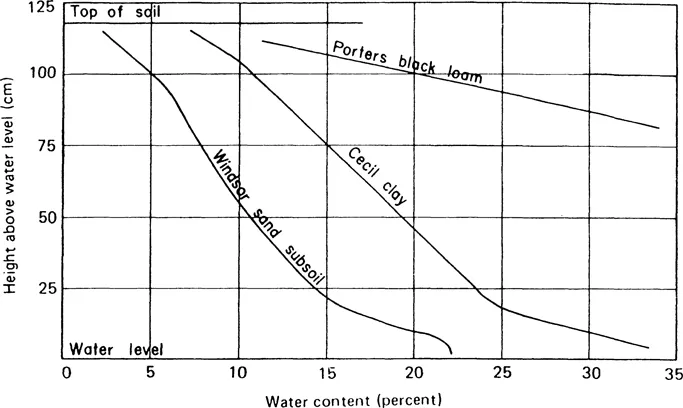
Fig. 1.1. Distribution of water in 48-in. columns of soil after 53 to 68 days. (From Buckingham, 1907)
This equation always shows a negative capillary potential.
The capillary potential as defined by Buckingham has weaknesses from both theoretical and practical points of view. He was aware of some of these deficiencies. Consider the system shown in Fig. 1.2, with the soil column in contact with a free water surface. Assuming that the system comes to equilibrium with pure water in the soil, the combined force acting on an infinitesimal mass of water in the soil is zero. One of the forces is gravity, whose direction is perpendicular downward. The force, equal to the magnitude of gravity and opposite in direction, may be the capillary force. As gravity can be expressed by gravitational potential, so the capillary force could also have a potential that is numerically equal to the gravitational potential and opposite in sign. This capillary force, however, does not have a potential in the mechanical sense. The capillary force’s field, or capillary potential considered by Buckingham, can appear only under conditions where the system reaches an equilibrium state in the gravitational field. Then the work required to move an infinitesimal mass of water from one point to another is zero, as pointed out correctly by Buckingham. On the other hand, when a soil column of infinite height is brought into contact with a free water surface, and if the gravitational field does not exist, water continues to rise by capillary force. The capillary force field or capillary potential does not exist in this system.
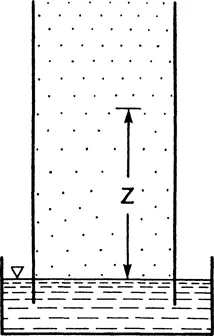
Fig. 1.2. Soil column at moisture equilibrium with a free water surface.
The same conclusion is recognized in a system where a soil column with a free water surface is placed in a centrifugal force field. A capillary potential appears to exist, which is numerically equal to the potential of the centrifugal force and opposite in sign.
Capillary potential, as used by Buckingham, should have been related to a physical quantity other than a potential in the mechanical sense. A potential whose existence is possible only under conditions where the system comes to equilibrium in an external force field should be related to the change of state of the substance in the system. Buckingham did not recognize this point. The theoretical analysis of the system shown in Fig. 1.2 can be performed exactly by use of a chemical potential, as discussed by Russell (1942). That is,

Therefore,

where Δμw is the chemical potential of water in soil, based on that of bulk water.
This inability to relate capillary potential to a state quantity of water in soil prevented effective application of the concept of capillary potential to analysis of various phenomena connected with soil solutions in the field and the laboratory. In most cases, water in soil is not in contact with a free water surface. One cannot measure the value of capillary potential of such water with the concept of capillary potential proposed by Buckingham.
This problem was solved to some degree by Gardner et al. (1922), who proposed an equation that shows the relationship between the pressure of water in soil (a state quantity of water) and its capillary potential.

where ρ is the density of water in soil and P is the pressure of water in soil relative to atmospheric pressure. In the general case, ρ is a function of pressure; however, assuming that water is incompressible, ψ becomes equal to P/ρ. The introduction of this relationship between ψ and P led to the development of tensiometer and suction plate apparatus for measuring capillary potential of water in soil which was not in contact with a free water surface.
Establishment of the Energy Concept
The further development of studies on soil water required a more general concept to express the state of water in soil. Studies of the relationship between plant growth and soil water could not ignore the existence of solutes in soil solution. Moreover, research into the physical and mechanical properties of soil needed a concept to compare the state of water over the whole water content range from saturation to oven-dry.
Various concepts were proposed in the decade after 1935 to satisfy this demand. They include pF by Schofield (1935), water potential by Veihmeyer and Edlefsen (1937), osmotic potential and pressure potential by Day (1947), and soil moisture stress, the sum of water suction and osmotic pressure, by Wadleigh and Ayers (1945). Although these concepts have different names, they are all expressions of chemical potential (total potential) of water in soil relative to free water at the same temperat...
Table of contents
- Cover
- Half Title
- Series chapter
- Title Page
- Copyright Page
- Preface to Second Edition
- Preface to the First Edition
- Table of Contents
- 1 Energy Concept and Thermodynamics of Water in Soil
- 2 Interaction Between Soil Particles and Soil Solution
- 3 Interaction Between Particles Through Water
- 4 Capillarity
- 5 Water Flow Through Soil
- 6 Unsaturated Water Movement
- 7 Field Water Regimes
- Index
Trusted by 375,005 students
Access to over 1.5 million titles for a fair monthly price.
Study more efficiently using our study tools.
Frequently asked questions
Yes, you can cancel anytime from the Subscription tab in your account settings on the Perlego website. Your subscription will stay active until the end of your current billing period. Learn how to cancel your subscription
No, books cannot be downloaded as external files, such as PDFs, for use outside of Perlego. However, you can download books within the Perlego app for offline reading on mobile or tablet. Learn how to download books offline
Perlego offers two plans: Essential and Complete
- Essential is ideal for learners and professionals who enjoy exploring a wide range of subjects. Access the Essential Library with 800,000+ trusted titles and best-sellers across business, personal growth, and the humanities. Includes unlimited reading time and Standard Read Aloud voice.
- Complete: Perfect for advanced learners and researchers needing full, unrestricted access. Unlock 1.5M+ books across hundreds of subjects, including academic and specialized titles. The Complete Plan also includes advanced features like Premium Read Aloud and Research Assistant.
We are an online textbook subscription service, where you can get access to an entire online library for less than the price of a single book per month. With over 1.5 million books across 990+ topics, we’ve got you covered! Learn about our mission
Look out for the read-aloud symbol on your next book to see if you can listen to it. The read-aloud tool reads text aloud for you, highlighting the text as it is being read. You can pause it, speed it up and slow it down. Learn more about Read Aloud
Yes! You can use the Perlego app on both iOS and Android devices to read anytime, anywhere — even offline. Perfect for commutes or when you’re on the go.
Please note we cannot support devices running on iOS 13 and Android 7 or earlier. Learn more about using the app
Please note we cannot support devices running on iOS 13 and Android 7 or earlier. Learn more about using the app
Yes, you can access Soil-Water Interactions by Shingo Iwata,Iwata in PDF and/or ePUB format, as well as other popular books in Physical Sciences & Hydrology. We have over 1.5 million books available in our catalogue for you to explore.