![]()
Part I
Relational contracting principles
![]()
Chapter 1
Introduction
This chapter begins by depicting the fundamental concepts of relational contracting in general and in the construction industry particularly. Afterwards, it goes into deeper details of the six major types of relational contracting, namely project partnering, strategic partnering, project alliancing, strategic alliancing, public-private partnerships (PPP) and joint venture.
Fundamentals of relational contracting
Relational contracting1 (RC) is a subject that originally attracted attention in the 1960s (McInnis, 2000). Macneil (1974) advocated that according to RC, a ‘contract’ can be treated as a ‘present promise’ of doing something in the future that has dynamic and continuous states of interrelated past, present and future. In other words, contract, which involves present communication of a commitment to a future event, is a projection of exchange into the future (Kumaraswamy et al., 2005). It should be noted that present promise would affect the future by limiting choices that would be available during contract execution. In addition, because of uncertainty and complexity, all future events cannot be easily perceived or quantified. Macneil (1974, 1980) stated that thus contracts should be flexible so as to adjust for future events and effectively address the uncertainties as and when they arise. Macaulay (1963) defined RC as the working relationship amongst the parties who do not always follow the legal mechanism offered by the written contracts, and the parties themselves govern the transactions within mutually acceptable social guidelines. Therefore, the relationship itself develops obligations among the contracting parties.
Rahman and Kumaraswamy (2005) stated that based on an emerging branch of modern contract law, RC provides necessary flexibility to contracts and essential elements of team building. RC dynamically takes into account the events before and after the moments of contract formation. Table 1.1 summarizes various characteristics of classical and modern contract law in relation to construction projects. Eisenberg (2000) stated that RC recognizes that the ‘formation of contract is a dynamic, evolving process’. RC emphasizes the ongoing relationships among the contracting parties for the success of a contract and it encourages long-term provisions and mutual future planning, and introduces a degree of flexibility into the contract, by considering a contract to be a relationship among the parties (Macneil, 1974, 1980). RC holds that the world of contract is a world of relations but not a world of discrete transactions. It is a continuous dynamic state, and all segments of ‘past, present and future’ are interrelated (Macneil, 1974). Goetz and Scott (1981) reckoned that in general, RC principles are frequently seen in the ‘best effort’ clauses, when parties fail to devise precise performance specifications and well-defined obligations, and thus project ‘exchange’ into the future and rely on continuous relationships.
Relational contracting in construction
The construction industry has long been suffering from little cooperation, limited trust and ineffective communication, thus resulting in an adversarial relationship between different parties (Moore et al., 1992; Chan et al., 2004b). In fact, construction project teams are composed of different hierarchically and interlinked parties, such as clients/owners, architects, engineers, quantity surveyors, main/general contractors, subcontractors, specialist contractors and suppliers. As a result, complicated relationships exist within project teams and they can adversely affect a project’s performance if they are not
Table 1.1 Characteristics of classical and modern contract law (adapted from Rahman and Kumaraswamy, 2005)
| Classical contract law | Modern contract law |
| Rules were usually binary | Rules are often versatile |
| An overriding preference for objective and standardized rules | Highly flexible in adopting rules that are individualized and even subjective |
| Principally static | Principally dynamic |
| Static rules of interpretation that take into account of events only at the moment of contract formation | Dynamic rules of interpretation that consider events before and after the moment of contract formation |
| Static legal-duty rule | Dynamic modification regime that considers the value of ongoing reciprocity |
| Static review of liquidated damages provisions | Dynamic review of liquidated damages that takes into account of the actual loss |
| Only bargains are enforceable | Subjective elements play a critical role in the basic principles of contract interpretation |
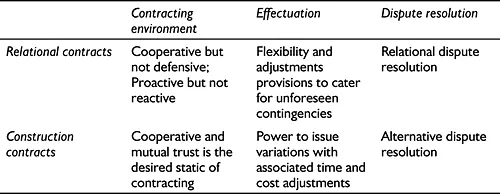
managed effectively (Walker, 1989). RC has thus been introduced to be an innovative and non-confrontational relationship-based approach to the procurement of construction services in many countries, such as the USA, the UK, Australia and Hong Kong over the last decade (Palaneeswaran et al., 2003; Kumaraswamy et al., 2005; Rahman and Kumaraswamy, 2005). RC is an approach to manage such complex relationships between the players in construction contracts/teams. The foundation of RC is based on recognition of mutual benefits and win-win scenarios through more cooperative relationship between parties (Macneil, 1978; Alsagoff and McDermott, 1994; Jones, 2000; Rowlinson and Cheung, 2004b; Kumaraswamy et al., 2005). RC embraces and underpins different approaches, mainly including partnering, alliancing, joint venture, other collaborative working arrangements and better risk-sharing mechanisms (Macneil, 1978; Alsagoff and McDermott, 1994; Jones, 2000; Rahman and Kumaraswamy, 2002a, 2004; Rowlinson and Cheung, 2004b). As practiced in the construction industry in its myriad forms, the core of RC is to establish the working relationships between the parties through a mutually developed, formal strategy of commitment and communication aimed at win-win situations for all parties (Kumaraswamy et al., 2005). Sanders and Moore (1992) viewed RC as aiming to generate an organizational environment of trust, open communication and employee involvement. Palaneeswaran et al. (2003) viewed that win-win RC approaches such as partnering and alliancing provide vehicles for clients and contractors to drive towards excellence by achieving quality with greater value. Kumaraswamy et al. (2005) stressed that RC is not a ‘one-size-fits-all’ guaranteed fix, but it is a philosophy that has to be tailored for each situation to which it is applied. Therefore, companies considering RC should evaluate their business objectives, analyse the role of RC in assisting them to achieve those objectives and determine the appropriate style of collaboration to implement. Rahman and Kumaraswamy (2002a) opined that flexible contract conditions should be provided under the broad umbrella of RC principles and this requires transforming traditional relationships towards a shared culture that transcends organizational boundaries (Construction Industry Institute, 1996). Rahman and Kumaraswamy (2004, 2005) also viewed that RC provides the means to sustain ongoing relations in long and complex contracts by adjustment processes of a more thoroughly transaction-specific, continuous and administrative kind. This may or may not include an initial agreement. However, if it does, the need for the contract may be of less importance. Walker and Chau (1999) believed that RC approaches appear useful in achieving the overall objective, which is to reduce the sum of production and transaction costs. In fact, most disputes arise from unclear and/or inappropriate risk allocation (Kumaraswamy, 1997), and risk allocation and management are considered central to contractual and governance structures (Kumaraswamy et al., 2004). Walker and Chau (1999) also stated that RC offers a cost-effective means of encouraging collectively beneficial behaviour when transactions are exposed to opportunism, but a fully contingent contract is too costly to specify. As a matter of fact, given the many potential permutations, all possible contingencies and their likely outcomes cannot be prepared. In addition, they considered that RC is characterized by the subordination of legal requirements and related formal documents to informal agreements in commercial transactions, such as verbal promises or partnering charters. Ling et al. (2006) perceived that RC principles may be mobilized to offer contractual incentives/flexibility, improve relationships among contracting parties, and lubricate any transactional frictions. Cheung (2001) viewed that RC has to allow certain flexibility so as to enable essential adjustments when necessary. Rowlinson and Cheung (2004b) summarized the characteristics of relational contracts and construction contracts in Table 1.2 and they viewed that RC is multilayered and in Australia, it has been identified that there are three levels, namely the Inspector, Engineer and the
Table 1.2 Characteristics of relational contracts and construction contracts (adapted from Rowlinson and Cheung, 2004b)