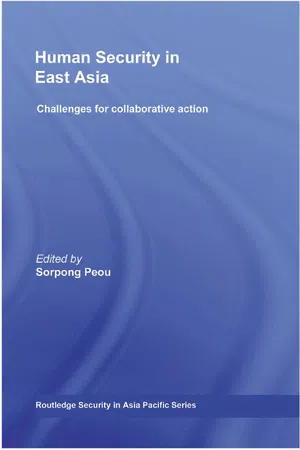
Since the end of the Cold War the number of interstate wars has remained relatively low, although whilst states may be more secure than ever this does not mean that individual human beings are too. This has led to a growing recognition of the importance of human security, in contrast to the traditional realist focus on state security. This book explores human security in East Asia, focusing in particular on the challenges to collaboration among actors involved in the process of human security promotion. It examines the theoretical complexities of conceptual arguments about human security, drawing on the ideas of scholars from Asia and the West, to provide a global perspective on what causes human insecurity and how security can best be achieved. It considers in detail case studies of military interventions in East Asia, in particular East Timor, and assesses how successful collaborative efforts have been in providing human security. It also explores case studies of non-military intervention, including international criminal justice in Cambodia and East Timor. It discusses the relationship of regional great powers such as China and Japan to human security promotion, arguing that it will be better served if these powers engage less in the traditional game of geopolitics and if human security objectives do not work against actors' interests. It shows how interventions to uphold human security have not always succeeded to the extent that was hoped, despite the best of intentions, and considers how improved collaboration can be achieved, so that future interventions enjoy more consistent success.
- 216 pages
- English
- ePUB (mobile friendly)
- Available on iOS & Android
eBook - ePub
About this book
Information
Part I
Human security
Theoretical and conceptual contentions
1
Critical challenges for globalism in human security studies
The study of human security is driven by the process of globalization. Globalism, as a theoretical perspective, has its intellectual roots in Western liberalism (see Chapter 2). According to two leading American liberal scholars, Robert Keohane and Joseph Nye, globalism is ‘a state of the world involving networks of interdependence at multi-continental distances, linked through flows and influences of capital and goods, information and ideas, people and force, as well as environmentally and biologically relevant substances’.1
Globalism is also associated with the multiplicity of threats to security – a growing set of actors and methods. It presents itself in different forms of threat: military, political, legal, socioeconomic and cultural. The number of actors in this new global politics has increased: states are no longer the key actors, but only one of many; the role of international organizations has become more significant; non-governmental actors (including non-governmental organizations, NGOs) have become more vocal and influential. Market forces have now become more recognizable. Methods for dealing with these threats to security have also multiplied. According to globalists, old-fashioned military globalism in the forms of imperialism, colonialism and interstate rivalry has been on the decline, while a new form of military globalism, the different forms of intervention for peace, arose. Legal globalism is spreading across the world in such forms as international or global criminal justice. Political globalism spreads ideas about power and democracy. Economic globalism sprang from Western capitalism and continues to spring into life in remote corners of the world through the process of marketization.
Globalism in the context of human security as a ‘public good’ faces tough challenges, though. Because the number of threats has grown, the number of actors involved in this type of security has increased, and the number of methods for dealing with human insecurity has multiplied, the question is whether collaborative action among the multiplicity of actors has grown – or can ever become – more effective.
The globalist referent object for, and sources of threat to, human security
Collaborative action for human security differs from collective defense and collective security in terms of the referent object for security. In collective defense, the concept of security is defined in military terms, with the state as the referent object for security. States are what need to be protected from external threats.2 States, treated as ‘black boxes’ or ‘billiard balls’, must think strategically about their national survival under international anarchy. They are assumed to behave in a ‘self-help’ manner in their pursuit of self-interest and in defense of independence and work to protect their territorial integrity by way of maximizing their material power and enhancing their relative position within the international system, where only sovereign states reign supreme.
In collective security, states also remain the main referent object for security, but the concept is broadly defined in an internationalist context. Immanuel Kant and his disciples, in particular, have envisioned the possibility of a ‘perpetual peace’ among republican states, and their political vision has influenced contemporary idealism or liberal internationalism in the context of collective security,3 whose referent object for security remains the state. On collective security, Inis Claude explains that it ‘purports to provide security for all states, by the action of all states, against all states which might challenge the existing order by the arbitrary unleashing of their power’.4
Globalists, however, have made the case that states are no longer the only referent object for security, due to the decline in old-fashioned militarism. They would draw comfort from the fact that the overall rate of state ‘death’ has slowed. Since 1415, states (recognized as sovereign by European states) have experienced less insecurity defined in terms of loss of sovereignty. They would agree with the ‘soft’ realist argument that state aggression in the modern world has become rare.5 Both Keohane and Nye also observe that ‘interstate use and threat of military force have virtually disappeared in relations in certain areas of the world, notably among the advanced, information-area democracies bordering the Atlantic and the Pacific and among a number of their less wealthy neighbors’.6 In this brave new world, even small states stay alive and well.
Insofar as acknowledging that the pursuit of national security may still be legitimate,7 globalists give greater attention to the individual. According to a UN Development Programme (UNDP) report, the 1990s saw only about 220,000 people killed in conflicts between states, whereas about 3.6 million people died in wars within states.8 It no longer makes sense to talk about the state as the only referent for security. People (defined as individuals and groups or communities) should become the analytical focus in security studies.9
Globalist proponents of human security have now agreed on one conceptual aspect: people, not sovereign states, are the main referent object for security. The UNDP has been most responsible for formally advancing the concept of security concerning the daily lives of ‘ordinary people’ or how they live and – safely and freely – exercise their choices.10 In the mid-1990s, the Commission on Global Governance also redefined security by making the following point: ‘global security extends beyond the protection of borders, ruling elites, and exclusive state interests to include the protection of people’.11 Canada, one of the early champions in human security, also defended this people-centered approach to security. When still Minister of Foreign Affairs, Lloyd Axworthy contended that ‘[e]ssentially, this is the idea that security goals should be primarily formulated and achieved in terms of human, rather than state, needs’.12
However, it should be pointed out that everyone does not receive equal attention in human security studies. Victims of war, refugees, women, children in war situations, and poor individuals stand among the most vulnerable groups and thus receive the most attention. Women face various forms of violence rooted in gender-based injustices, such as sexual discrimination and abuses. Children are caught in armed conflicts and exploited when forced to serve as child soldiers. Some further argue in defense of the need to protect vulnerable civilians, including young men and the elderly.13
As to the question of what threatens human security, globalists again differ from proponents of collective defense/national security and collective security. For political realists, interstate war is the main source of threat. As Walt puts it, ‘The main focus of security studies is … the phenomenon of [inter-state] war. The study of traditional security assumes that conflict between states is a constant possibility and that the use of military force has far-reaching effects on states and societies’. He also makes the case that ‘security studies may be defined as the study of the threat, use, and control of military force’.14 (This does not suggest that realism pays no attention to non-state sources of threat. Some have noted the threats of terrorism15 and ethnic violence.)16 Collective security also rests on the rationale that external aggression against states remains the main source of military threat to international peace and security. Certain member states within the international community are expected to violate the norms of world peace.
While looking at a broader picture, proponents of human security disagree among themselves as to what constitutes the main sources of threat. The narrow ‘protection-based’ approach (championed by Canada and others in the West,17 including the International Commission on Intervention and State Sovereignty, ICISS) clashes with the broader ‘development-based’ approach (championed by UNDP and the Commission on Human Security supported by Japan).18 The broad approach became an extension of an old paradigm known as ‘basic human needs’, developed in the 1970s,19 but is thought to be analytically less vague than the concept of human development, which ‘provided no clear guarantee for individuals. Many could be still sacrificed in the course of bringing the broad range of good things to the majority, by governments who warmly adopted the language of human development’.20 In 1991, Ken Booth argued that humans’ security means ‘emancipation’, defined in terms of ‘the freeing of people (as individuals and groups) from the physical and human constraints, which stop them carrying out what they would freely choose to do’. In his critical perspective: ‘War and the threat of war is one of those constraints, together with poverty, poor education, political oppression, and so on’.21 More recently, initially led by the UNDP, the broad approach has gone beyond war or armed conflict to include other non-military threats to ‘human dignity’, such as unemployment, hunger, disease and natural disasters, said to kill more people than bombs and bullets. The list of threats to human security is indeed long, and the sources of threat are numerous, ranging from those that are human-made to those that ‘stem from the forces of nature’.22 Most scholars and state leaders in East Asia have adopted this approach. Woosang Kim and In-Taek Hyun, for instance, define human security as ‘a condition of relative safety that is free from humanitarian emergencies caused by natural or man-made disasters’.23 The Commission on Human Security lent more legitimacy to this approach when it issued a major report contending that ‘the protection of the vital core of all human lives in ways that enhance human freedoms and human fulfillment … It means creating political, social, environmental, economic, military and cultural systems that together give people the building blocks of survival, livelihood and dignity’.24
The narrow approach, however, emphasizes freedom from actual violence and the fear of war and violent crime (such as genocide, politicide, democide and terrorism). The Human Security Report,25 for instance, defines human security as ‘freedom from actual violence’ and ‘the fear of violence’ in political, criminal and economic terms. Political violence includes armed conflict, genocide and international terrorism. Criminal violence, which kills far more people than both war and terrorism combined, includes homicide and rape. Although not explicitly stated, the Report seems to define violence in economic terms. For instance, human trafficking is ‘a cause of human insecurity’ because ‘[t]raffickers seek to exploit their victims for long-term profit’.26
We may need to find some middle ground between the two competing but complementary approaches. The broad approach is too elastic if it includes such terms as ‘human dignity’, which is a matter of personal and cultural interpretation that can never be evaluated or shared by everyone. For some, it means ‘emancipation from oppressive power structures – be they global, national, or local in origin and scope’.27 For others, it means something rather vague. An Asian scholar, for instance, refers to dignity as rulers’ acceptance of their people’s role within society. Rulers must accept advice from their people.28 If we go down this road, we will end up going ‘beyond measurable limits’,29 and perhaps nowhere. The narrow approach is too restrictive to allow the concept to be defined more broadly than the structural causes and consequences of war or armed conflict, nor does it explicitly include others forms of economic violence.
We need to stick with the UNDP’s key (if unelaborated) statement: ‘Without peace, there may be no development. But without development, peace may be threatened’.30 Although still a highly contested concept, peace defined as the absence of military, political, criminal and economic violence (not human dignity or safety or livelihood per se) serves as the conceptual boundary of human security. Natural disasters (such as the tsunami that devastated the coastal regions of Southeast and South Asia and claimed hundreds of thousands of human lives) should not be construed as a human security problem. Car accidents and health problems such as cancer – which kill millions of people each year, but do not result from the conscious policy decisions and actions of individuals or collective bodies – do not constitute challenges to human security, either.
We need to define human-made violence in a more restrictive fashion by placing emphasis on its organizational character. According to Kofi Annan, the fear of violence includes different forms of organized violence: genocide, war crimes, crimes against humanity or the ‘wholesale slaughter’ of civilians,31 civil, especially ethnic, conflict, and terrorism. Both MacFarlane and Khong focus on organized violence as the threat to human security, with an emphasis on the agency of ‘individual perpetrators’ (or a collection of them) who violently intrude on the ‘bodies’ of individuals.32
In my view, the military, political, criminal and economic (MPCE) framework for human security is reasonably restrictive. The cases of Cambodia and East Timor enable us to conceptualize human security in a way that is analytically possible, policy-relevant and practical. In military terms, humans are insecure when directly subject to the actual use of armed force in such forms as military attack (external and domestic) and other brutal acts, such as genocide or ‘ethnic cleansing’. Military violence remains the traditional form of human fear – a military threat to states as well as to individual human beings, their citizens. This type of fear is still in line with political realism, the key concept of which is national security. The arch-classical political realist Hans Morgenthau regarded the intensification of individuals’ personal anxieties, fears and insecurities to be rooted in domestic instability, which leads people to identify themselves with the power and foreign policies of their nations.33
The Human Security Report (2005) further contends that ‘Protecting citizens from foreign attack may be a necessary condition for the security of individuals, but it is certainly not a sufficient one. Indeed, during the last 100 years far more people have been killed by their own governments than by foreign armies’.34 Indeed, the dictatorial regimes in the socialist world we...
Table of contents
- Human Security in East Asia
- Routledge Security in Asia Pacific Series
- Contents
- Acknowledgements
- List of contributors
- Introduction
- Part I Human security
- Part II Collaborative Action on Human Security in East Asia
- Notes
- Bibliography
- Index
Trusted by 375,005 students
Access to over 1.5 million titles for a fair monthly price.
Study more efficiently using our study tools.
Frequently asked questions
Yes, you can cancel anytime from the Subscription tab in your account settings on the Perlego website. Your subscription will stay active until the end of your current billing period. Learn how to cancel your subscription
No, books cannot be downloaded as external files, such as PDFs, for use outside of Perlego. However, you can download books within the Perlego app for offline reading on mobile or tablet. Learn how to download books offline
Perlego offers two plans: Essential and Complete
- Essential is ideal for learners and professionals who enjoy exploring a wide range of subjects. Access the Essential Library with 800,000+ trusted titles and best-sellers across business, personal growth, and the humanities. Includes unlimited reading time and Standard Read Aloud voice.
- Complete: Perfect for advanced learners and researchers needing full, unrestricted access. Unlock 1.5M+ books across hundreds of subjects, including academic and specialized titles. The Complete Plan also includes advanced features like Premium Read Aloud and Research Assistant.
We are an online textbook subscription service, where you can get access to an entire online library for less than the price of a single book per month. With over 1.5 million books across 990+ topics, we’ve got you covered! Learn about our mission
Look out for the read-aloud symbol on your next book to see if you can listen to it. The read-aloud tool reads text aloud for you, highlighting the text as it is being read. You can pause it, speed it up and slow it down. Learn more about Read Aloud
Yes! You can use the Perlego app on both iOS and Android devices to read anytime, anywhere — even offline. Perfect for commutes or when you’re on the go.
Please note we cannot support devices running on iOS 13 and Android 7 or earlier. Learn more about using the app
Please note we cannot support devices running on iOS 13 and Android 7 or earlier. Learn more about using the app
Yes, you can access Human Security in East Asia by Sorpong Peou in PDF and/or ePUB format, as well as other popular books in Politics & International Relations & International Relations. We have over 1.5 million books available in our catalogue for you to explore.