First published in 1985, this title includes contributions from leading economists and addresses many seminal aspects of Keynes' work and methods. This revival will be of particular interest to lecturers and advanced students of economics.
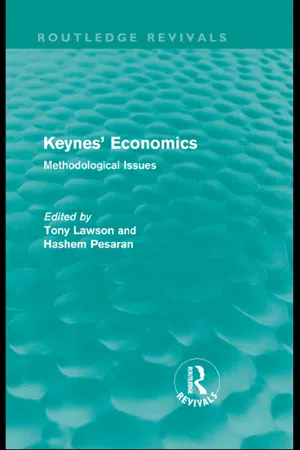
- 266 pages
- English
- ePUB (mobile friendly)
- Available on iOS & Android
eBook - ePub
1
ECONOMICS: AN INTRODUCTION METHODOLOGICAL ISSUES IN KEYNES’
Tony Lawson and Hashem Pesaran
When a field of study becomes marked by dissatisfaction and disillusionment, methodological analyses and debates tend to become prominent and often provide pointers to fruitful directions for the subject to move in. Economics is currently undergoing just such a period of crisis: the post-war Keynesian orthodoxy has been criticised, only to be replaced by what, to many people, seem to be implausible theories concerning the formation of expectations and the functioning of markets; the value of econometrics as an effective tool for discriminating between competing theories has been seriously questioned; and there are crucial disagreements as to the nature and scope of economics. It seems, therefore, that there may be some benefit to be gained from reexamining the fundamental concepts and methods involved in economics.
Recent books on economic methodology, such as those by Blaug (1980), Boland (1982), Caldwell (1982), Hollis and Nell (1975) and Katouzian (1980), all provide valuable contributions towards this end. None of these, however, deals with Keynes’ contribution on methodology in any depth, and yet Keynes’ work on methodology was not insignificant. In fact, Keynes’ methodological contribution has been neglected generally, being overshadowed by his other work on economic theory and policy analysis. In an attempt, in part, to rectify matters in 1983, the centenary of Keynes’ birth, the Cambridge Journal of Economics organised a conference on methodological issues in Keynes’ work. Such was the interest shown at this conference that it was decided that a selection of the papers presented should be extended and developed for publication. This volume is the outcome.
The following chapters, then, not only provide a general overview of aspects of Keynes’ contribution to methodology, but are also concerned with clarifying, developing and criticising Keynes’ work. Before providing a summary of what each particular chapter contributes, however, it seems worthwhile first to point out what this volume of papers does not achieve.
First of all it does not represent a unified whole, and many of the con-tributions provide conflicting interpretations and criticisms of Keynes’ work. For example, whilst Hodgson seems to interpret Keynes’ position as both empiricist and rationalist, Carabelli interprets him as being anti-empiricist and anti-rationalist. Such differences in part reflect different uses of the same words and the reader is warned to beware of this. Differences in the use of words such as ‘rationality’, are, however, quite common in the literature, particularly in the philosophy of science; for this reason we have preferred authors to define their own particular use of these words within their papers. To give a further example of different interpretations of Keynes’ contribution, whilst Lawson is sympathetic to Keynes’ criticism of Tinbergen’s work, believing it, in the main, to be well-founded, Klant finds such criticism ‘presumptuous’.
Second, the volume does not provide a uniform interpretation of what is ‘Keynes’ or ‘Keynesian’. Whilst many chapters reserve such terms for referring only to claims and theories actually put forward by Keynes, Wren-Lewis, for example, is explicit that he is not doing this; in his case the use of the term ‘Keynesian’ is reserved for models in which the “primary role [is] given to effective demand in determining output, employment and unemployment’.
Finally, because the chapters concentrate on developing and criticising aspects of Keynes’ views, the volume as a whole cannot represent a complete account of Keynes’ methodological contribution. It is nevertheless a start. It is also to be hoped that this volume will stimulate a greater interest both in methodological issues to which Keynes contributed and in methodological issues generally.
The first chapter in the volume, by Hodgson, examines Keynes’ views on expectations and the relationship between expectations and economic activity. Hodgson argues, perhaps contentiously, that Keynes failed to consider sufficiently the importance of institutions and ‘the social culture and structures which give [expectations] colour and substance’. However, having emphasised the importance of institutions, Hodgson acknowledges the difficulties of producing the endogenous theory of institutions without which his own critique of Keynes is incomplete. Hodgson interprets Keynes as providing a ‘psychologistic’ and ‘rationalist’ conception of human action which is, however, highly qualified by the fact of uncertainty about the future. Within Keynes’ analysis, however, Hodgson claims to find inconsistencies which stem from Keynes’ implicit assumption that ‘state personnel’, in contrast to others, always ‘act under the guidance of reason and persuasion’. The resolution of these inconsistencies, according to Hodgson, leads logically either to the rational expectations approach or to the ultra individualism of the Austrian School. The author’s alternative strategy is to suggest that we reject Keynes’ psychologistic and rationalist conceptions of human action and adopt instead a more institutionalist approach. Thus among the methodological conclusions drawn out by Hodgson are the desirability of interdisciplinary study and the need for resources to be devoted to the study of institutions and their historical development.
Central to Hodgson’s analysis is Keynes’ theory of expectations formation, and the essentially indeterminate nature of long-term expectations. This is a theme which is taken up and developed in the second chapter, by Alexander Dow and Sheila Dow. These authors examine the notion of animal spirits in Keynes’ analysis and show how it is related to his earlier work on probability. Dow and Dow argue convincingly against those who interpret animal spirits as involving irrationality. (This theme is also taken up elsewhere in the volume by Carabelli.) In enquiring why the notion of animal spirits should have fallen into disfavour, the authors conclude that it is because there is no place for this notion in the methodological framework employed by the neoclassical orthodoxy. To emphasise the importance of incorporating animal spirits into the analysis, therefore, is to reject the current neoclassical orthodoxy and to adopt the methodology of Keynes. For Dow and Dow the notion of animal spirits epitomises the view that the process of expectations formation does not lend itself to the probability calculus. The position of these authors is more subjectivist than Hodgson’s. Whilst the latter gives greater weight to the social and cultural factors and thus feels that studying the role and nature of institutions will provide important insights, Dow and Dow place greater emphasis on the impossibility of prediction in the social sciences and the need for economists, instead, to be ‘alert to a change of mood in the economy’. A methodological implication that Dow and Dow draw from their analysis is the need ‘to tackle each question from a variety of angles, with a variety of methods’ or, in short, a return to the methodological framework employed, as they see it, by Keynes.
The theme of expectations formation is also taken up by Wren-Lewis, who focuses on how the process of expectations formation has been treated in practice in specific models of the UK economy. Wren-Lewis considers the responses of builders of large-scale ‘Keynesian’ models to the ‘challenge’ of the Rational Expectations Hypothesis (REH) and argues that the REH and the theoretical underpinnings of Keynesian models are not necessarily incompatible. In doing so the author is implicitly adopting a particular view of REH which emphasises only that expectations should be consistent with the underlying macro-economic model in question. However, like Hodgson, Wren-Lewis emphasises the importance of divergent expectations on the part of economic agents and thus would appear to cast doubt on the merits of assuming such consistency.
With their concentration on the role and nature of expectation the three chapters discussed above can be said to share a common theme. The same is also true of the next four chapters appearing in the volume, where Keynes’ views on methods of analysis, and especially on induction and statistical inference, are assessed.
The first of these chapters, by Klant, examines how economists have failed in their attempts to reduce their subject to the explanatory ideal of Newton’s mechanics, and considers Keynes’ argument that such a reduction is impossible because economics is essentially different in nature to the ‘natural sciences’. Klant, in fact, is highly critical of Keynes, both in the latter’s failed attempt to solve Hume’s induction problem and in his criticisms of Tinbergen’s work on econometrics. However, the author does conclude that in emphasising the problems involved in the ‘slippery transition’ from description to inference in statistical work, Keynes’ contribution is highly relevant. Ultimately the author agrees with Keynes that modelling cannot be mechanical but instead is highly judgemental; and he shares Keynes’ conclusion that economics is essentially a moral science. The implication for statistical modelling drawn by Klant is not that quantitative models should be abandoned, but rather that they should be handled with ‘care’.
The next chapter, by Pheby, attempts to provide clear insights into Keynes’ methodology by examining explicit criticisms that Popper and his supporters have made of it. The author concludes that Keynes and Popper are not as far apart as is usually believed and, moreover, that on issues where their views do diverge it is Popper’s position that seems untenable. Thus, for example, Pheby rejects Popperian criticisms of Keynes on the grounds that Popper himself needs to employ something like the principle of the ‘uniformity of nature’ adopted by Keynes. In fact the author proceeds to argue that Popper and Keynes, on some issues, are probably closer than, say, either of them is to Friedman, whose influential views are considered to be instrumentalist.
Lawson’s chapter, which follows Pheby’s, argues that contributions which focus on Keynes’ comments dealing with ‘technical issues’ in econometrics risk missing what are really Keynes’ more fundamental criticisms. These criticisms, according to Lawson, stem from theories and arguments developed by Keynes in his Treatise on Probability. In order both to illustrate significant aspects of this work and to pave the way for a discussion of Keynes’ views on econometrics, Lawson finds it helpful to discuss Keynes’ arguments concerning the value of prediction in the context of model or hypothesis evaluation. This facilitates a contrast between Keynes’ inductive account and other, more prominent, falsificationist accounts. Focusing on Keynes’ inductivist theory, Lawson argues that it is this which underlies Keynes’ more fundamental criticisms of econometrics, and contends that if econometricians are to continue to refer to Keynes’ comments as though they remain relevant then it is Keynes’ inductivist criticisms that should be ‘answered’. The remaining ‘technical’ criticisms, after all, can be found in a much more comprehensible and complete form in most modern econometric text-books.
Pesaran and Smith also focus on the ‘debate’ between Tinbergen and Keynes but, unlike the previous authors (and indeed unlike most authors who have written on this subject), spend some time examining Tinbergen’s side of the debate. In going over the debate, the authors liken themselves to military historians, whose ‘purpose in refighting this battle is not to change the result, but to learn its lessons’. The authors argue that Keynes, like many others at the time, chose in his criticism to concentrate exclusively on Tinbergen’s work on testing economic theories and overlooked altogether the importance and novelty of Tinbergen’s approach for practical policy analysis. As a result, they argue, Keynes held a one-sided view of the usefulness of econometrics and misjudged its potential for policy analysis—an area of special concern to Keynes himself. The authors conclude that econometric ‘practice expanded not because Keynes was wrong in his technical and methodological criticisms of Tinbergen’s work, but because Tinbergen’s work happened to fill a vacuum that was created by the need to formulate and implement the type of interventionist policies that Keynes himself had advocated’. In this, therefore, Pesaran and Smith reach a similar conclusion to that of Klant.
The final four chapters in the volume each focuses on distinct aspects of Keynes’ methodological contribution. The first of these, by Carabelli, explores the notions of ‘cause’, ‘chance’ and ‘possibility’ in Keynes’ writings. Carabelli argues that in his use of the terms ‘cause’ and ‘chance’ Keynes was not concerned with the properties of objects but rather with reasons for knowing and believing. Thus, according to Carabelli, ‘cause’ (like probability) was treated by Keynes in a practical way, as in ordinary discourse, with constant reference, albeit implicit, to a limited body of knowledge. As with ‘cause’, Keynes used the term ‘chance’ in a subjective sense, reflecting a cognitive perspective. Thus, argues Carabelli, Keynes rejected any idea of objective chance. In fact, chance was interpreted by Keynes as a situation where there is complete ignorance—a situation in which there is no reason to believe one alternative in preference to any other. However, Keynes thought that such a situation would be particularly uncommon and therefore doubted the usefulness of the ‘probability calculus’ for characterising actual situations. Since he believed that social science is ultimately founded on belief rather than on material truth, for Keynes, as Carabelli notes, change can occur as a result of the process of persuasion. Thus Keynes arrived at the notion of ‘possibility’. Such a notion, amongst other things, enabled Keynes to judge the past from the perspective that things could have been different, and this view lay behind his faith in attempts at public persuasion.
Boland’s chapter examines the strategy adopted by Keynes in arguing against the Marshallian orthodoxy. Keynes’ ‘claimed assault’, according to Boland, was to try and show that the classical Marshallian theory was a special case of a more general theory. Keynes’ concept of generality, in Boland’s view, ‘rests…on the methodological position that considers a model with more exogenous givens to be more general’, whilst, in the neoclassical orthodoxy, generality is measured by the number of endogenous variables. Therefore, although a short-run model that treats ‘macro-variables’ (such as the level of aggregate demand, the general level of prices and interest rates) as exogenously given is regarded as general in Keynes’ methodological framework, the same model is interpreted by neoclassical theory as a special case of a long-run model where all variables, apart from the naturally-given psychological states of individuals, given technology and natural resources, are endogenously determined, including the macrovariables. As long as these are the only variables permitted to be exogenous, then the neoclassical interpretation of Keynes’ general-vs-special case argument will ‘always see Keynes’ assault as a failure’. Instead, according to Boland, what is fundamental in Keynes’ ‘assault’ is a notion of liquidity (which following Hicks is interpreted very generally by Boland as both financial and non-financial liquidity, the latter including spare productive capacity). Liquidity enters the analysis because of the existence of uncertainty. Accepting the necessity of the notion of liquidity as a short-run endogenous variable, then, argues Boland, any long-run model, such as neoclassical models, must be irrelevant. However, Boland concludes that, ‘until mainstream neoclassical economics drops its dependence on narrow psychologistic individualism, Keynes’ assault will not be much of a struggle for neoclassical economic theorists’.
In the next chapter Chick argues that in The General Theory Keynes finds it possible to present a static analysis of output, employment and prices whilst incorporating historical time, and that in achieving this Keynes’ use of the device of the wage-unit for measuring ‘real’ output is fundamental. Chick considers it to be typical of a firm in an ‘entrepreneur economy’ that costs of production are set before actual demand is known. For a static analysis of production to proceed, therefore, something must be assumed not only about capital, as is usually the case, but also about costs including wages. Chick argues that for Keynes it is significant that the ‘supply curve’ need not enter into the determination of actual wages and employment. This does not mean, however, that wages are indeterminate, for this’ view ignores the role of history in determining wages’. However, Chick argues that by denoting demand and supply functions in terms of the wage unit—the wage of ‘ordinary labour’—these functions become ‘independent of the level of wages and hence independent of the historical component of their determination’. This permits a static analysis ‘while allowing the historical element in wage determination to be preserved in the background’. Thus Chick maintains that while static analysis permits the determination of the value of output in wage-units, the nominal level of output cannot be found unless the nominal level of money wages is first determined.
The final chapter, by Backhaus, attempts to further our understanding of the rise and success of Keynesianism. This task is seen by the author as being especially difficult both because there is no undisputed interpretation of what is the central message of Keynes’ General Theory, and, more importantly, because Keynesianism as a phenomenon in macro-economic policy did not originate with the publication of The General Theory. Backhaus thus believes it is necessary to disentangle Keynes’ economics from Keynesianism, and argues that this is facilitated ‘if we geographically remove an analysis of the roots of Keynesianism from Cambridge’. The author in fact concentrates on Germany where, he argues, ‘the first full-scale application of [Keynes’] General Theory had taken place…well before the book was actually published’. Backhaus proceeds by raising the issue of the extent to which Keynes’ main economic contributions were in fact anticipated within Germany. In this he acknowledges not only the problems associated with deciding what Keynes’ main economic contributions are, but perhaps more importantly, the difficulty of inter-preting what is meant by ‘anticipated’ These questions have recently been addressed by Patinkin (1982) and Backhaus takes this work as his point of departure. However, Backhaus concludes that Patinkin’s s account is inadequate, pointing out that ‘variations in the professional organisation of economics, across cultures and over time, are not captured by Patinkin’s approach to studying applications of the General Theory’. In particular, Backhaus argues that Patinkin’s s account rules out the German economists W.Sombart and W.Launtenbach as possible anticipators of Keynesianism. He then provides convincing arguments based on case-studies, that these two economists should in fact be seen as anticipators of Keynesianism. Sombart, a professor at Berlin University, argued for Keynesian policy measures on the basis of historical theory and analysis, whilst according to Backhaus Lautenbach, a civil servant shaped the ‘German economic policy for recovery during the crucial years of 1932–1935…in a Keynesian mould almost singlehanded’. However it was Keynes who became influential. Keynes’ writings and lectures had received significant attention in Germany well before the publication of The General Theory, and his contributions proved more quantifiable than the historical analysis of Sombart, whilst Lautenbach ‘never claimed to be an original thinker but preferred to describe himself as Keynesian’. This study, as the author writes, may thus ‘be seen as preparatory for a more precise understanding of the methodological basis of Keynesianism, including the reasons for its astonishing success’.
Although the chapters in this volume are limited in scope, they nevertheless reveal that Keynes’ methodological contribution is extensive and that it remains highly pertinent, bearing as it does on issues that continue to be important and contentious in economics. Col...
Table of contents
- Cover Page
- Title Page
- Copyright Page
- Bibliographical Note
- 1. Methodological Issues in Keynes’ Economics: an Introduction
- 2. Persuasion, Expectations and the Limits to Keynes
- 3. Animal Spirits and Rationalitsy
- 4. Expectations in Keynesian Econometric Models
- 5. The Slippery Transition
- 6. Are Popperian Criticisms of Keynes Justified?
- 7. Keynes, Prediction and Econometrics
- 8. Keynes on Econometrics
- 9. Keynes on Cause, Chance and Possibility
- 10. The Foundations of Keynes’ Methodology: The General Theory
- 11. Time and the Wage-unit in the Method of The General Theory: History and Equilibrium
- 12. Keynesianism in Germany
- Contributors
Trusted by 375,005 students
Access to over 1.5 million titles for a fair monthly price.
Study more efficiently using our study tools.
Frequently asked questions
Yes, you can cancel anytime from the Subscription tab in your account settings on the Perlego website. Your subscription will stay active until the end of your current billing period. Learn how to cancel your subscription
No, books cannot be downloaded as external files, such as PDFs, for use outside of Perlego. However, you can download books within the Perlego app for offline reading on mobile or tablet. Learn how to download books offline
Perlego offers two plans: Essential and Complete
- Essential is ideal for learners and professionals who enjoy exploring a wide range of subjects. Access the Essential Library with 800,000+ trusted titles and best-sellers across business, personal growth, and the humanities. Includes unlimited reading time and Standard Read Aloud voice.
- Complete: Perfect for advanced learners and researchers needing full, unrestricted access. Unlock 1.5M+ books across hundreds of subjects, including academic and specialized titles. The Complete Plan also includes advanced features like Premium Read Aloud and Research Assistant.
We are an online textbook subscription service, where you can get access to an entire online library for less than the price of a single book per month. With over 1.5 million books across 990+ topics, we’ve got you covered! Learn about our mission
Look out for the read-aloud symbol on your next book to see if you can listen to it. The read-aloud tool reads text aloud for you, highlighting the text as it is being read. You can pause it, speed it up and slow it down. Learn more about Read Aloud
Yes! You can use the Perlego app on both iOS and Android devices to read anytime, anywhere — even offline. Perfect for commutes or when you’re on the go.
Please note we cannot support devices running on iOS 13 and Android 7 or earlier. Learn more about using the app
Please note we cannot support devices running on iOS 13 and Android 7 or earlier. Learn more about using the app
Yes, you can access Keynes' Economics (Routledge Revivals) by Tony Lawson,Hashem Pesaran in PDF and/or ePUB format, as well as other popular books in Business & Business General. We have over 1.5 million books available in our catalogue for you to explore.