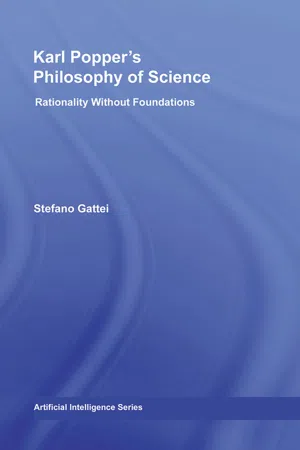
This book seeks to rectify misrepresentations of Popperian thought with a historical approach to Popper's philosophy, an approach which applies his own mature view, that we gain knowledge through conjectures and refutations, to his own development, by portraying him in his intellectual growth as just such a series. Gattei seeks to reconstruct the logic of Popper's development, in order to show how one problem and its tentative solution led to a new problem.
- 136 pages
- English
- ePUB (mobile friendly)
- Available on iOS & Android
eBook - ePub
About this book
Information
1 Young Popper’s Intellectual Revolution
In the early 1930s, Popper’s Logik der Forschung (actually published in November 1934) came to solve two traditional philosophical problems: the problem of demarcation between science and non-science (by what criterion do we decide which hypothesis is scientific?) and the problem of induction (which has many formulations and variants, among which Popper chose the following: how do we learn from experience?). The traditional answer to the first question is that all and only established theories belong to science, while the traditional answer to the second is that experience leads to the adherence to established theories.
Popper’s answers were different. First, he said that those hypotheses are scientific which are capable of being tested experimentally, where tests of a hypothesis comprise attempts to refute it. Second, he argued that learning from experience is the very act of overthrowing a theory with the help of that experience: we learn from experience by repeatedly positing explanatory hypotheses and refuting them experimentally, thus approximating the truth by stages.
This conclusion took a long elaboration, which is very interesting both from the historical and the philosophical point of view. Historically, it is interesting to see how Popper came to his original solutions, while philosophically it is interesting to understand why he changed his views.
AUTOBIOGRAPHY AND PHILOSOPHY
The best way to approach and understand Popper’s thought is undoubtedly the historical one. In his autobiography Popper offered a picture of his own intellectual development. Such a reconstruction, however, is not always reliable and in this case tends to obscure, rather than illuminate, the intellectual revolution he underwent as a young intellectual. As an intellectual autobiography, Unended Quest presents the path Popper followed from one philosophical problem to another, leaving little place for personal elements or the context in which his ideas grew. By imposing his own mature views upon his memories, Popper portrayed his intellectual evolution as a sort of linear progress: from the youthful involvement with politics, to psychology in the 1920s, to the logic of science in the 1930s, to the work on the open society during the Second World War, until the “metaphysical” developments of the early 1950s.1 Deeming science an adventurous revolutionary endeavour, Popper wrote his own autobiography so that a sort of rationality of scientific revolutions underlies the narrative, concealing the plurality of directions in which he moved, the different options he had to face, the intellectual impasses and the crucial turns.2 The publication of Popper’s early German writings—a few articles and three important theses, which were made available to Popper scholars in edited form only in 2006—allows now for a completely new picture.
In the 1920s Austria witnessed the rise to prominence of a vast, socialist-informed movement for the reform of primary and secondary school.3 Its undisputed leader was Otto Glöckel (1874–1935), author of Die österreichische Schulreform (1923) and Drillschule, Lernschule, Arbeitschule (1928). In order to promote school reform, the Vienna city council merged the pedagogic and psychological institutes, thus establishing a two-year teacher training programme that combined academic and practical training. Among the teachers were Moritz Schlick (1882–1936), professor of philosophy of science, and Karl Bühler (1879–1964), theorist of the school-reform movement, a pupil of Oswald Külpe (1862–1915) and a member of the so-called Würzburg School of psychology.4 The Pedagogic Institute allowed students the possibility to attend lectures at the University of Vienna, and Popper took this opportunity, particularly to attend lectures by the mathematicians Wilhelm Wirtinger, Philipp Furtwängler, Eduard Helly, Kurt Rudmeister and, above all, Hans Hahn, from whom he learned to see the history of thought as a succession of problems.
At the time he entered the Institute, Popper was a high school student with leftist political views, looking for a future. The Institute provided him with the opportunity to carry out a socially valuable job, that of teaching the lower classes. He thus set up studying pedagogy, but was also invited to attend lectures in psychology, philosophy, and sciences, as well as cultivating his love for music. The works written during the years spent at the Pedagogic Institute (1925–1927)5 are crucial if we want to follow and attempt to reconstruct the different phases of the complex process that turned Popper, within the span of eight years, from an aspiring school-teacher to a mature philosopher.
Popper’s very first publication dates from 1925: “Über die Stellung des Lehrers zu Schule und Schüler: Gesellschaftliche oder individualistische Erziehung?”6 appeared in Schulreform—the official organ of the school-reform movement, together with Die Quelle.7 It deals with the attitude of teachers towards their pupils, and argues that pupils should be regarded as much as possible as individuals, rather than as kinds. Popper would stick to this idea for the rest of his life, but this brief article plays no significant role in his early intellectual development. By contrast, the years between 1927 and 1931 are of the highest relevance. For the five essays written in this period turn out to be crucial: they comprise two longer articles, published in Die Quelle, and above all three theses, the most important of which (the ones completed in 1927 and 1929) only became available to scholars after Popper’s death, in 1994.
FROM HEIMAT TO RATIONALITY
The first of the mentioned essays, “Zur Philosophie des Heimatgedankens” (1927),8 deals with the problem of how to make students abandon the restricted perspective acquired in the environment in which they were born, in order to embrace wider views about culture, law, and rationality. Written after a seminar held at the Pedagogic Institute, it argues that learning starts from beliefs and habits that each individual learns within his Heimat, that is, the environment in which each individual was born and with which he identifies himself. Teachers should not overlook the cultural background of their pupils, and should rather take it as the first, necessary step towards their future intellectual development. However, the teachers’ task is to help pupils gradually free themselves from it, in favour of wider and richer perspectives. As Popper would later argue, each person has the natural propensity to develop some kind of dogmatism that should later be abandoned through the conscious appeal to reason.
The pedagogy of the school-reform movement highlighted how learning should be rooted in the environment in which children grow up, that is, in their Heimat. The word Heimat, however, was too much laden with political meanings, also referring to a strong sense of belonging to one’s homeland, both at the local and at the national level. The organizers of the seminar—led by Eduard Bürger, editor of Die Quelle—were trying to combine Heimat and socialism, and the school-reform movement aimed at forming the citizens of a modern nation. Together with other members of the Verein freie Schule, Glöckel was close to the Deutscher Schulverein, a group upholding nationalist and anti-Semitic views. Popper (whose family was of Jewish descent) was very far from all that, and in his 1927 article he criticizes the educational limits and political dangers of the concept of Heimat, in favour of designing a socialist and cosmopolitan view for progressive education.
Upon completing his coursework at the Pedagogic Institute, Popper submitted a protothesis, his Hausarbeit, carried out a training period in a secondary school, and took the final exam. The thesis, “Gewohnheit” und “Gesetzerlebnis” in der Erziehung: Eine pädagogisch- strukturpsychologische Monographie (1927),9 is an attempt to provide a psychological explanation for children’s innate need of dogmatism.
Popper asks whether psychology can be scientific. He is sure the question can be answered in the affirmative, but notices that nobody has ever provided an adequate explanation of what a scientific psychology would be. He therefore sets himself this task. In order to provide such an explanation, he offers a theory which he himself admits is unoriginal. Indeed, although he never says so explicitly, Popper clearly adopts a position very close to Hans Vaihinger’s:10 in order to be scientific, psychology must be able to decide whether a statement is true or false on the basis of the available empirical evidence. This is a necessary prerequisite for any discipline aspiring to achieve the status of science. Therefore, the aim of the philosophy of science becomes that of explaining how scientists assign truth-values to statements.
This is Popper’s first attempt to develop a philosophy of science:11 it is a philosophy of science with a strong inductivist flavour, despite its deductivist methodology. For, on the one hand, Vaihinger’s theory is deductive: it states that theory must necessarily open the way to any empirical research, by pointing to its object. On the other hand, however, Popper wants to find a way to make theory guide research without allowing it to play a decisive role with experience. In order to avoid any circularity, he clearly states that the study of phenomena must precede the theoretical phase, and that facts should be observed in a purely neutral way, independently of any theoretical prejudice. The neutrality of observation and its primacy over theory are characteristic features of an inductivist approach—an approach that in 1927 Popper explicitly adopted but that he would relinquish later on.12
In fact, Popper opens his 1927 thesis as follows: “The present study, although highly theoretical in its main parts, has entirely arisen out of practical experiences [with pupils], and has eventually to serve practice again. Its method is therefore essentially inductive.”13 As opposed to Freud’s, Adler’s, and others’ psychological theories, that often go beyond what is factually verifiable and even impose their points of view upon the facts, the theories of natural science, he says, only abstract from empirical data, never asserting something beyond the facts.14
The inductive process follows three steps: “an unprejudiced description (phenomenology) of empirical facts,”15 that is, a comprehensive description of the psychology of “lawfulness” among children; an “attempt at abstraction”;16 and an “ordered representation (from a theoretical perspective),”17 so as to offer an explanation of the phenomena taken into consideration. Interestingly, Popper also highlights an intrinsic danger in the inductive method, one that particularly threatens psychoanalysis. For, the phenomenology (the first step of the inductive process) always receives feedback from the theory governing the research (third step), so that the facts are selected in order to fill certain gaps in the theory:
As time goes by, systematics penetrates deeper and deeper into phenomenology; this entails the danger that phenomenology—the description, which must be purely empirical and unprejudiced—gets influenced by the theory itself. As a consequence, it [phenomenology] presupposes the theory for which it should provide the inductively based empirical evidence in the first place; this would clearly be a so-called circular reasoning, a petitio principii.18
However, he is not interested in solving this problem, for he thinks that a solution was provided already by Vaihinger. Scientific research requires theories that demarcate the range of facts that are to be studied; as such, however, theories should be deemed “fictions”: they are mere organizational tools, not true (or false) descriptions of facts. Once a particular fact to be studied is identified, we must observe it in a neutral, objective way: only then do “fictions” acquire the status of scientific theories, or hypotheses (in Vaihinger’s terminology).19 If, then, as a consequence of a testing process, they get verified, we can regard them as theories, on an equal level with those in the natural sciences.20 However, in order to be empirical, it is crucial that a theory “may only be formed inductively, through abstraction from empirical facts, and may never be projected into them.”21 Before getting to this stage, we need “fictions.”
On the basis of this theory Popper deals with the problem of developing an adequate theory of critical thinking. Karl Bühler clearly distinguished between critical thinking and mechanical association, but an equally clear distinction between critical thinking and dogmatic thinking was still lacking. As opposed to dogmatic thinking, Popper says, critical thinking is described by the theory of judgements: we should doubt any statements that have not been adequately justified.22 He had difficulties overcoming the inner tension in his own view between the idea that thinking played an active role and the inductivist idea that regarded judgement as something passive, only accepting what is justified, rather than actively looking for errors. Consider the following passages:
Free thinking […] is critical thinking—dogmatic thinking is not free: under free thought one can only understand thinking “without prejudices,” that is, thinking which judges states of affairs, without presupposing the result (the judgement) of judging; critical thinking is also thinking with foundations; it is active, spontaneous and autonomous thinking, in contrast with dogmatic thinking, which does not touch the accepted (adopted) “judgement.”23
We shall use the terms “dogmatic” and “critical” in a more liberal sense than is often usual: by “dogmatic” thinking we wish to mean a type of thinking that is characterized by the mere acceptance of and sticking to certain principles. These principles are adopted, “blindly” taken for true, without even recognizing the possibility of their falsehood; in particular, they are not investigated as to their correctness through experience; one sticks to them, that is, one applies them stubbornly wherever they seem to be applicable.24 Critical thinking, by contrast, may be characterized by such questions as “is it really true (or “correct”)?, “does it really have to be that way?”; also in the field of ethics: “is it really good and right?”, etc. Critical thought attempts to question the principles that are usually at first blindly received and dogmatically maintained, in order to accept and apply them first after verification, particularly by means of experience, but also through reflection.”25
We can see in these passages elements that very well fit with the sceptical attitude and the critical view Popper would adopt a few years later. However, they are mingled with ideas that clearly betray an inductivist stance. These early methodological remarks do not display any feature of Popper’s deductive method by trial and error. His stance is thoroughly traditional, that is, inductive—and the same can be said of his ideas concerning demarcation.26 From the inductivist point of view, the problems of induction and demarcation are inextricably combined: only those theories that have been justified can be deemed scientific. It is the same view adopted in Die beiden Grundprobleme der Erkenntnistheorie (without §11): here Popper states that only decidable theories are scientific.27
POPPER’S DOCTORAL DISSERTATION AND THE CONFRONTATION WITH THE WÜRZBURG SCHOOL
Popper progressively moved from psychology to philosophy of science by discussing the methods of the psychology of thought. He had already begun to do so in the 1927 thesis, as we have just seen, but he did so more thoroughly and significantly in his doctoral dissertation, Zur Methodenfrage der Denkpsychologie, which was examined by Schlick and Bühler in 1928.28
In the dissertation Popper discusses the use of philosophical anthropology as a guide for research in psychology. He asks, in particular, whether it is to be assumed—as Schlick and the Gestalt psychologists had done—that psychological processes can and must be reduced to phys...
Table of contents
- Cover Page
- Title Page
- Copyright Page
- List of Abbreviations
- Note
- Acknowledgments
- Introduction: Critical Rationalism
- 1 Young Popper’s Intellectual Revolution
- 2 Science and Philosophy
- 3 Metaphysics
- 4 Popper and Kuhn: Clashing Metaphysics
- 5 The Ethical Nature of Popper’s Understanding of Rationality
- Notes
- Bibliography
Trusted by 375,005 students
Access to over 1.5 million titles for a fair monthly price.
Study more efficiently using our study tools.
Frequently asked questions
Yes, you can cancel anytime from the Subscription tab in your account settings on the Perlego website. Your subscription will stay active until the end of your current billing period. Learn how to cancel your subscription
No, books cannot be downloaded as external files, such as PDFs, for use outside of Perlego. However, you can download books within the Perlego app for offline reading on mobile or tablet. Learn how to download books offline
Perlego offers two plans: Essential and Complete
- Essential is ideal for learners and professionals who enjoy exploring a wide range of subjects. Access the Essential Library with 800,000+ trusted titles and best-sellers across business, personal growth, and the humanities. Includes unlimited reading time and Standard Read Aloud voice.
- Complete: Perfect for advanced learners and researchers needing full, unrestricted access. Unlock 1.5M+ books across hundreds of subjects, including academic and specialized titles. The Complete Plan also includes advanced features like Premium Read Aloud and Research Assistant.
We are an online textbook subscription service, where you can get access to an entire online library for less than the price of a single book per month. With over 1.5 million books across 990+ topics, we’ve got you covered! Learn about our mission
Look out for the read-aloud symbol on your next book to see if you can listen to it. The read-aloud tool reads text aloud for you, highlighting the text as it is being read. You can pause it, speed it up and slow it down. Learn more about Read Aloud
Yes! You can use the Perlego app on both iOS and Android devices to read anytime, anywhere — even offline. Perfect for commutes or when you’re on the go.
Please note we cannot support devices running on iOS 13 and Android 7 or earlier. Learn more about using the app
Please note we cannot support devices running on iOS 13 and Android 7 or earlier. Learn more about using the app
Yes, you can access Karl Popper's Philosophy of Science by Stefano Gattei in PDF and/or ePUB format, as well as other popular books in Philosophy & Philosophy History & Theory. We have over 1.5 million books available in our catalogue for you to explore.