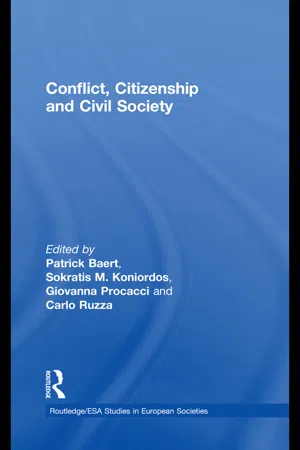
This book provides readers – students, researchers, academics, policy-makers, activists and interested non-specialists – with a sophisticated understanding of contemporary discussion, analysis and theorizing of issues pertaining to conflict, citizenship and civil society. It does so through thirteen pieces of most recent in-depth sociological research that delve on: challenges to citizenship, civil society and citizenship in early and late modernity, the reflexive imperative in transformations of civil society, social conflict challenges to social science approaches, methodology and explanatory power, gender, minorities-immigrants-refugees and the extension of citizenship, violence in modernity, the place of civil society for sociology, and postcolonialism, trauma, and civil society.
eBook - ePub
Conflict, Citizenship and Civil Society
- 278 pages
- English
- ePUB (mobile friendly)
- Available on iOS & Android
eBook - ePub
Conflict, Citizenship and Civil Society
About this book
Information
Chapter 1
Introduction
The erosion of the post-war political orthodoxy
Patrick Baert and Sokratis M. Koniordos
This book deals with the interplay between conflict, citizenship and civil society, mainly (though not exclusively) in the context of contemporary Europe. It builds on some of the main contributions to the eighth bi-annual Congress of the European Sociological Association, which took place in Glasgow in 2007. Rather than imposing a rigid structure on the volume, we have preferred to give the authors the freedom to articulate the theme of the conference in their preferred way and to link their contribution to their specific interests and expertise.
For at least two decades after 1945, several countries of Western Europe experienced unprecedented prosperity combined with a peaceful co-existence. The benefits were not equally distributed, but there was a widespread unspoken assumption that the kind of economic cooperation and the social-democratic consensus that characterised the then-EEC (European Economic Community) would lead to the further extension of citizenship rights, eventually to the benefit of all and possibly also to the growth of the civil sphere within the individual nation-states. This presupposition underscored the confidence and vigour with which the European project was defended and eventually extended, and the subsequent democratisation of Eastern Europe, discussed in Janusz Mucha’s chapter, made perfect sense in this light.
Since the late 1970s a number of societal developments have led to the questioning of this post-war political orthodoxy or at least to recognition of the need to refine and update it. Some of these developments are intertwined with the European project itself. For instance, the implementation of the principle of free movement of people has led to the gradual uncoupling of rights and citizenship and has occasionally – and especially now at the time of a worldwide recession – led to disquiet on the part of the local workforce.
Other developments are broader in scope, and not restricted to Europe or the European Union. The late twentieth century rise of neo-liberalism, with the demise of Keynesian economics in favour of a monetarist ‘supply side’ policy and reining-in of welfare commitments in pursuit of tax reduction, has dramatically reshaped the way in which politicians across the ideological spectrum think of citizenship. Across Europe, both ‘centre-right’ and ‘centre-left’ governments have made concerted efforts to substitute the duty-based model of ‘active labour market policy’ for the previous rights-based model of welfare (Pierson 2006). The shift has been actively promoted by some social scientists (see Giddens 1998), but shown to have adverse social-psychological effects by others (Sennett 1998, 2004, 2007). It remains to be seen to whether the current economic crisis will consolidate, accelerate or reverse this shift. As Anniken Hagelund and Grete Brochmann show in their contribution, even the Scandinavian countries, often regarded as the last bastions of the welfare state, have partly adopted this duty-based model.
Other factors, besides those intimately connected with neo-liberalism, have contributed to change in the socio-political landscape. First, the rise in immigration from outside Europe, with its multicultural manifestations, has led some commentators, including Maria Baganha in this volume, to question whether the notion – or indeed the whole framework – of citizenship is still appropriate for analysing society today. While some prefer to talk of a ‘post-national’ citizenship, others prefer the notion of a ‘neo-national’ citizenship that corresponds closely with the metaphor of a ‘fortress Europe’ (Feldblum 1998). Second, awareness that ‘traditional’ concepts of citizenship need to be re-thought has grown, mainly because they rely on gendered notions of the public (as opposed to the private) to such an extent that women are seriously disadvantaged and in some cases outright marginalised. This argument has a long pedigree (see also Walby 1994) but is developed here by Ruth Lister and Arnlaug Leira in exciting new directions. Third, in reaction to the terrorist attacks in New York, London and Madrid, several countries put in place procedures that critics view as reversing a long struggle for basic rights, leading to calls on both sides of the Atlantic for a more measured response (see, for instance, Ignatieff 2004).
These transformations away from the post-war orthodoxy have often been accompanied by new societal challenges and highly contentious political decisions. New forms of deprivation and new social conflicts have arisen partly because the unprecedented concentration of economic power especially within global cities required a flow of low-skilled workers, a substantial number of whom were illegal immigrants (Sassen 1998). In this context, Giovanna Procacci’s contribution, based on her presidential address, spells out the predicament of the immigrant population in Europe today. The French riots of 2005 remind us of the potentially explosive undercurrent that may result from decades of marginalisation (see in this context Wacquant 2007), while in a number of countries far-right parties have been able to implement strict restrictions on immigration or at least set an anti-immigration agenda that other ‘mainstream’ parties were all too ready to follow. Combined with US and UK-led foreign policy vis-à-vis the Middle East, it has not been surprising that there has been an upsurge of political consciousness, in particular among young Muslim immigrants.
The movement away from the post-war political orthodoxy has also led to new forms of political mobilisation. New social movements characterising the late twentieth and early twenty-first century have taken on a substantially different shape – not least because they are no longer neatly tied to a nation-state – with significant repercussions for the way in which issues of citizenship are articulated. As Saskia Sassen (1998, 2006) and Ulrich Beck (2006, 2007) argue, the new social movements of today develop a transnational, cosmopolitan citizenship, able to connect local grievances and local issues to broader global projects, although there is still a debate as to whether this new type of citizenship bypasses the nation-state or draws on it in new creative ways. In this respect, Donatella Della Porta regards current social movements in a similar way.
While the post-war political orthodoxy presented the ideal of a Europe free of conflict and war, developments in the last couple of decades have shown otherwise. Since the 1990s, Europe has been confronted with various forms of conflict that had been widely viewed as consigned to the past. These range from the violent, tragic break-up of Yugoslavia and the involvement of several European countries in the Iraq war to the eruption of internal ethnic tensions such as the French émeutes. In this light, Jeffrey C. Alexander’s chapter in this volume is particularly pertinent in spite of its predominantly non-European focus. It sheds light on the cultural trauma experienced by many, especially at times of war and abrupt political and ideological change, and the various techniques for dealing with horrific experiences that can never be forgotten and are notoriously difficult to remedy. Likewise, Consuelo Corradi’s attempt to conceptualise violence becomes especially relevant in the context of events in the past two decades.
Whereas sociologists and political scientists developed a comprehensive vocabulary to analyse the post-war political orthodoxy, there is still uncertainty as to which conceptual tools help comprehend the current constellation. The contemporary socio-political setting seems to lack the internal coherence that characterised earlier ‘consensus’ times. Some sociologists, including David McCrone in his contribution, argue that well established notions such as ‘civil society’ are more than adequate for grasping the complexities of today. Others have tried to define the current era in contrast with previous forms of modernity (see, for instance, Bauman 2000; Beck 1999; and Nicos P. Mouzelis and Margaret Archer’s chapters in this volume). Longer assessment is needed to judge whether currently fashionable notions such as ‘reflexive modernity’, ‘liquid modernity’ or ‘network society’ capture the conflict-ridden and precarious nature of the current era. Furthermore, we learn from David Silverman’s methodological essay in this book that we should be wary of any theorising that does not somehow take into account how people experience and give meaning to the very same concepts that the researchers attribute to them and their situation.
This volume is organised in three parts. The first part, entitled ‘Conceptual explorations’, provides a broader theoretical background against which the later discussions make more sense. For instance, this part includes discussions about the usefulness of notions such as modernity and reflexivity for studying the contemporary situation. The second part, ‘Thematising conflict, citizenship and civil society’, analyses specific topics or case studies to probe such issues as the changing role of gender in Europe or the role of ethnic minorities. The third part, ‘Rethinking conflict, citizenship and civil society’, sets out novel theoretical proposals for studying the current socio-political reality, such as a proposal for a new sociology of violence.
Part 1, entitled ‘Conceptual explorations’, comprises four papers. The lead is taken by Giovanna Procacci’s piece, ‘New challenges to citizenship’. Procacci argues that citizenship has been the main narrative describing strategies of construction of political and social arrangements in modern societies, particularly in Europe. Yet, while citizenship increasingly attracts criticism, other narratives have been proposed as more accurately accounting for the ongoing socio-political transformations, such as cosmopolitanism, multiculturalism, communitarianism and human rights. The chapter examines the challenges to citizenship, and evaluates them from the vantage point of current conflicts. Particular focus is laid on migration issues. Here citizenship is perceived more as a pull factor, opposing the restrictive orientation of migration policies, rather than as an expansion of rights that facilitate social integration. Yet citizenship seems to be less urgent among migrants’ demands than are other statuses such as residence or permission to stay, in so far as the latter give access to rights. The chapter discusses empirical cases and asks what the consequences of a growing gap between residents and citizens could be for democratic societies.
Next is the chapter by Nicos P. Mouzelis, entitled ‘Civil society and citizenship in early and late modernity’. From a sociological point of view, modernity can be regarded as the type of social organisation that became dominant in Europe after the English industrial revolution and the revolution in France. It entailed the decline of segmental localism and the large-scale mobilisation and inclusion of the population in the ‘imaginary community’ of the nation-state. This led to the concentration of not only the means of production but also the means of domination and persuasion at the national centre – as well as to the ‘top-down differentiation’ of institutional spheres (economic, political, social, cultural), each portraying (at least potentially) its own values, logic and historical trajectory. Mouzelis points out that in late and globalised modernity we see similar processes occurring on a planetary level, so his aim is to see how civil society and citizenship rights are linked to the major features of early and late modernity.
In Margaret S. Archer’s ‘Reflexivity’s transformations: the demise of routine action and its consequences for civil society’, reflexivity is considered a prerequisite for all forms of social life including that of traditional societies. But in the case of traditional societies, reflexivity was limited both in extent and in kind by ‘contextual continuity’. The progressive effect of modernity was one that entailed increased reflexivity: a growth in its scope and reach. Within Europe, nascent globalisation spells the generalisation of ‘contextual discontinuity’ to all. This results from the tendential effect of ‘morphogenesis’, whereby variety stimulates yet greater variety, when untrammelled by counterbalancing morphostatic processes. This process reshapes the situations confronted by all. Hence, as the author notes, for the first time in human history, the reflexive imperative applies to all.
According to Archer, however, modes of reflexivity result from a combination of ‘social context plus personal concerns’, as do their consequences. Structurally induced ‘contextual discontinuity’ and the cultural ‘logic of opportunity’ may fuel reflexive deliberations based upon instrumental rationality for many, but, equally, they foster meta-reflexive Wertrational concerns, responsible not only for European social movements but also for a transformed civil society. Individual life worlds are no longer amenable to orchestration by habitus, but neither is public life at the capricious mercy of individualised serial self-reinvention. Since reflexivity is held to mediate between structure and agency, its own transformation is redefining and restructuring conflict, citizenship and civil society – as the novel reflexive responses to the novelty of ‘morphogenesis unbound’.
In the chapter that follows by Donatella Della Porta, entitled ‘Conflict, citizenship and civil society: how emerging social conflicts challenge social science approaches’, the author starts with a discussion of the concept of ‘civil society’ and similar ones developed in different sub-disciplines. This leads on to an attempt to bridge these concepts discursively in order to overcome some limitations in their actual use. Della Porta argues her case particularly in relation to the study of social movement and its internal cleavages between disciplinary, methodological and national approaches.
In a second part, extrapolating from empirical research on recent conflicts, the author stresses how their very nature poses a strong demand for cross-fertilisation among different approaches. In particular, she suggests that the new wave of conflict that became visible with the protest against the World Trade Organization (WTO) millennium round in Seattle in 1999 has shaken some dominant images of movements as institutionalised collective actors. The new conflicts call, for instance, for: a reframing of traditional ‘social questions’ and new ‘differential rights’; the transnationalisation of the movement’s organisational structures; the emergence of a global discourse and the targeting of supranational institutions; the convergence of different types of actors in networks and campaigns; and the presence of multiple and ‘tolerant’ identities. Therefore the suggestion is that these elements – far from making old sociological categories useless – actually stimulate a re-examination of social movements and notions of citizenship.
Finally, Della Porta discusses how these conflicts reflect upon conceptualisations of citizenship. While bringing social rights back in, they challenge the conception of national borders that had helped define the boundaries for the recognition of those rights. At the same time, the language of rights is also much more in evidence, linking social, civic and political universal rights to the specific concerns of new constituencies. This leads to an expression of hope that some developments in the social sciences might improve our capacity to understand the new conflicts through a ‘cross-fertilisation’ of different theories and methods.
Part 2, entitled ‘Thematising conflict, citizenship and civil society’, comprises five chapters. The first two, each from its own perspective, consider gender. The first contribution is by Ruth Lister and bears the title ‘Citizenship, civil society and conflict: a gendered perspective’. The paper begins with some general reflections on the meanings of citizenship and on its contextual and contested nature. It then focuses on the key elements of feminist analyses of citizenship, making links to the theme of conflict. In particular, this section discusses: the implications of the challenge to the fixed public-private divide, which thereby opened up the domestic sphere as a citizenship space and locus for conflict; the embodiment of citizenship and the assault on women’s bodily integrity often associated with conflict; some of the theoretical dilemmas rais...
Table of contents
- Routledge/European Sociological Association Studies in European Societies
- Contents
- Figures, tables and boxes
- Contributors
- Chapter 1 Introduction
- Part 1 Conceptual explorations
- Part 2 Thematising conflict, citizenship and civil society
- Part 3 Rethinking conflict, citizenship and civil society
- Postscript
- Name index
- Subject index
Trusted by 375,005 students
Access to over 1.5 million titles for a fair monthly price.
Study more efficiently using our study tools.
Frequently asked questions
Yes, you can cancel anytime from the Subscription tab in your account settings on the Perlego website. Your subscription will stay active until the end of your current billing period. Learn how to cancel your subscription
No, books cannot be downloaded as external files, such as PDFs, for use outside of Perlego. However, you can download books within the Perlego app for offline reading on mobile or tablet. Learn how to download books offline
Perlego offers two plans: Essential and Complete
- Essential is ideal for learners and professionals who enjoy exploring a wide range of subjects. Access the Essential Library with 800,000+ trusted titles and best-sellers across business, personal growth, and the humanities. Includes unlimited reading time and Standard Read Aloud voice.
- Complete: Perfect for advanced learners and researchers needing full, unrestricted access. Unlock 1.5M+ books across hundreds of subjects, including academic and specialized titles. The Complete Plan also includes advanced features like Premium Read Aloud and Research Assistant.
We are an online textbook subscription service, where you can get access to an entire online library for less than the price of a single book per month. With over 1.5 million books across 990+ topics, we’ve got you covered! Learn about our mission
Look out for the read-aloud symbol on your next book to see if you can listen to it. The read-aloud tool reads text aloud for you, highlighting the text as it is being read. You can pause it, speed it up and slow it down. Learn more about Read Aloud
Yes! You can use the Perlego app on both iOS and Android devices to read anytime, anywhere — even offline. Perfect for commutes or when you’re on the go.
Please note we cannot support devices running on iOS 13 and Android 7 or earlier. Learn more about using the app
Please note we cannot support devices running on iOS 13 and Android 7 or earlier. Learn more about using the app
Yes, you can access Conflict, Citizenship and Civil Society by Partick Baert,Sokratis Koniordos,Giovanna Procacci,Carlo Ruzza,Sokratis M. Koniordos,Patrick Baert in PDF and/or ePUB format, as well as other popular books in Politics & International Relations & Civics & Citizenship. We have over 1.5 million books available in our catalogue for you to explore.