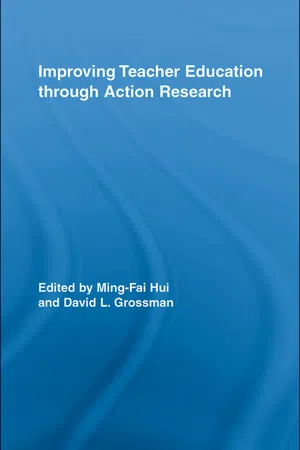
There has been a dearth of studies on teacher educators using action research to improve their own practice. This book is the first systematic study of a group of teachers examining and enhancing their own practice through the inquiry process of action research. This book presents a broad overview of a variety of methodologies that can be used to improve teacher preparation and professional development programs. It is a 'must read' book for those educators who are new to the college teaching profession and for those who are aspired to be outstanding and successful lecturers.
- 196 pages
- English
- ePUB (mobile friendly)
- Available on iOS & Android
eBook - ePub
Improving Teacher Education through Action Research
About this book
Information
Section 1
Assessment for Learning
1 Developing Productive Synergies Between Formative and Summative Assessment Processes
David Carless
Faculty of Education, University of Hong Kong
INTRODUCTION
The powerful impact of assessment on student learning has long been recognized. One of the earliest formulations of this notion runs as follows: “the quickest way to change student learning is to change the assessment system” (Elton & Laurillard, 1979, p. 100). Assessment affects the content, mode, and orientation of students’ learning (Gibbs, 2006). Students, being essentially pragmatic, have a primary focus on achieving a high mark rather than demonstrating deep understanding of material (Greer, 2001). Following from this, summative assessment practices have tended to dominate the assessment process, frequently to the detriment of formative aspects (Knight & Yorke, 2003). It is increasingly being recognized that these formative dimensions or what is commonly referred to as assessment for learning, have a powerful potential for enhancing student learning, yet are often not exploited fully (Black & Wiliam, 1998; Gibbs & Simpson, 2004).
At the outset, I wish to make some brief terminological clarifications. I use formative assessment and assessment for learning interchangeably and place them within a constructivist teaching and learning approach that sees students as taking an active part in the development of their own learning (cf. Shepard, 2000). I see formative assessment as an essential component of good teaching and as much about learning as about assessment. For the purpose of this chapter, I use formative assessment to denote dialogues between a tutor and students or between students and students that serve as feedback with potential to stimulate enhanced student learning. Summative assessment is seen as a judgment leading to the award of a mark or grade, usually as part of a certification process that leads to a qualification or academic award.
The improvement of assessment practices (both formative and summative) has the potential to make a major contribution to the enhancement of student learning outcomes. Some form of marriage between summative assessment and formative assessment might satisfy the accountability aspects of the former, whilst reinforcing the learning aspects of the latter. A suggested guiding principle is that summative assessment should be designed with learning foremost, whilst minimizing threats to the reliability of measurements.
The development of productive synergies between formative and summative functions of assessment has a number of potential advantages. In terms of motivation, students are most likely to buy into the formative aspects if they help them to do better in a summative assignment. With respect to peer feedback processes (Liu & Carless, 2006) and self-assessment (Boud, 1995, 2000), these core elements of the formative process of learning also have potential to support higher achievement in summative assessments (McDonald & Boud, 2003). Building productive relationships between the formative and summative functions of assessment is, however, not without its challenges. For example, Pellegrino, Chudowsky, and Glaser (2001) warned that the more purposes a single assessment seeks to serve, the greater the possibility of each purpose being compromised. A way forward perhaps is not to regard formative and summative assessment as separate entities, but to see them as informing each other (Taras, 2005).
The focus of this chapter is on action research seeking to develop productive synergies between formative and summative assessment within a module in a teacher education institute. Teacher education is a particularly important site for close scrutiny of assessment practices in view of the future role of trainee teachers in assessment of and feedback to their students. The specific problem that the action research sought to address was ineffectiveness of feedback on summative assignments. The aims of the chapter are threefold: to illustrate how formative assessment can be integrated within a summative assignment, to discuss how students responded to the assessment processes for the module, and to draw out some wider implications relevant to the interface between assessment and learning in teacher education.
The specific teaching context was a module for English major students on the topic of assessment. The module comprised 30 teaching hours with 15 weekly 2-hour sessions. The class size was somewhat large with 50 preservice students enrolled, native speakers of Cantonese mainly in their early 20s. I was the sole instructor teaching the module. The objectives of the module can be summarized for students to demonstrate: an understanding of approaches to formal and informal, formative and summative assessment so as to promote pupil learning; and an ability to construct and justify appropriate types of assessment tools for use in primary English as a second language (ESL) classrooms. The fact that the module itself is on the topic of assessment is significant because it facilitates integration between the concepts being taught and the way that the module assessment is carried out.
ASSIGNMENT RATIONALE AND OPERATIONALIZATION
This section firstly discusses the rationale for the module assignment in terms of how it tackles identified problems in feedback processes. Secondly, it describes how this rationale was operationalized.
Rationale
My initial thinking about summative assignments was that they are sometimes not well-integrated with the teaching and learning during the module and that as feedback on assignments is summative in nature, there is little opportunity for students to make improvements. A key problem is the failure to include iterative cycles of feedback and revision that normally characterize academic writing (Taras, 2006). In addition, once a mark is awarded and summative feedback is received, it is difficult for students to use feedback so that they can do better on a subsequent task (Stefani, 1998). James (2000), for example, outlined dissatisfactions from university students concerning both the timeliness and usefulness of written feedback on their assignments. A repercussion of these kinds of scenarios is that the potential learning benefits of feedback on summative assignments are not being fully exploited (Carless, 2006a).
In terms of a potential solution to the problem of the relative ineffectiveness of feedback on summative assignments, the literature provided some inspiration. A study by Butler (1988), afforded a high profile by the Black and Wiliam (1998) meta-analysis, compared three forms of feedback treatment: grade only, comment and grade, comments only. This study of 11-yearold Israeli students found that comments only led to greater learning gains than comments with grade, due to the ego involving properties of the award of a grade. Even with mature students, James (2000) noted that marks had a major impact on students’ self-perceptions and self-esteem. Following from this, I decided to arrange the summative assignment in such a way that there would be emphasis on formative assessment through instructor feedback and student peer interactions before a grade was awarded.
A group assignment was chosen so as to encourage collaboration and peer learning amongst students. The issue of awarding grades in group assignments has long been recognized as a thorny area (Race, 2001), in particular the phenomenon of “social loafing” or the presence of “free riders” may enable students to be rewarded for work they have not done (Heath-field, 1999). There are various procedures for awarding grades for group assessments (see Falchikov, 2005, for a review). For the current module, I required each group of three (small groups tend to reduce the likelihood of social loafing) to indicate clearly the specific contributions of members to the overall assignment. I awarded two grades, one for the individual contribution (40% weighting) and one for the group as a whole (60% weighting). I believed that this procedure supported the award of a reliable assessment of student work, whilst retaining the advantages of group collaboration.
The assignment (see Appendix 1.1) was for students to develop a portfolio of assessment tools, write a rationale, and relate the tools to primary school pupil learning, in line with the module theme of assessment for learning. During the process of completing the assignment, peer and self-assessment within their groups of three were encouraged.
Operationalization
The above rationale was operationalized through the following steps. Firstly, the details and criteria for the assignment were distributed in the first session of the module and a brief introduction was provided so as to make expectations and processes explicit. Secondly, students were given some class time in the sixth class to form groups and begin preparation of the assignment. Thirdly, in Week 8, students submitted via email an outline for their assignment and received prompt, albeit brief, written feedback to support ongoing planning. Fourthly, in Weeks 9 and 10, the groups met with me for a tutorial of about 15 to 20 minutes to receive further feedback on their draft assignment. Students who submitted a full or almost complete draft were best placed to gain from this tutorial. Fifthly, students handed in the completed final version of their assignment in Week 12, three weeks prior to the completion of the module.
The final stage of this process was that after my provisional marking of the assignment, students attended in Weeks 13 and 14 a “mini-viva,” that is, an oral “defence” of their work. In this case, the mini-viva was not designed to award marks or distinguish between borderline grades, but to generate dialogue and provide feedback. My idea for a mini-viva was prompted by the desire to provide an opportunity for timely oral feedback before a mark was awarded (cf. Butler, 1988). Brown and Knight (1995) provided support for this kind of process as follows, “Feedback, ideally, ought to involve the interplay of the tutor’s understanding and the learner’s…Dialogue is therefore not simply desirable but arguably essential” (p. 112).
The mini-viva, which replaced the normal weekly class, took the form of a tutorial for each group lasting 15 to 20 minutes. The content of the mini-viva differed slightly from group to group according to their assignment content and student characteristics, but essentially focused on: Tutor requests for clarification or elaboration on some of the points made; questions and feedback relating to the most challenging part of the assignment, the relationship between assessment items and pupil learning; and feedback on matters related to English language usage, because the students were second language learners training to be teachers of English.
The focus of the mini-viva was on discussion and feedback; student performance was not assessed. I believe it was motivating for students, however, because the mark was not yet awarded, and they were still eager to demonstrate their knowledge, understanding, and diligence. For one or two students who I perceived as possible free riders, I was also able to use the mini-viva to satisfy myself that they had made an adequate contribution to the group assignment.
After the mini-viva tutorial, as the final stage to the assignment process, I briefly reexamined the assignment scripts and finalized the grades. Sample scripts were then moderated by a colleague, as per standard departmental quality assurance procedures. The marked assignments were then returned to students.
DATA COLLECTION
Getting students to think about teaching, learning, and assessment processes is valuable in any context, but particularly so when participants are future entrants to the teaching profession. I collected data from students through three main data collection methods. Firstly, “five-minute papers,” adapted from Angelo and Cross (1993), were used to collect written feedback from students from the whole class (see sample in Appendix 1.2). Five-minute papers, completed by students at the end of a class or series of classes, are user-friendly ways to elicit views from all participants about instructional issues. To complete the feedback loop, I extracted selected student responses and distributed them to students in a subsequent session, explaining how student feedback would be acted on. An end of module 5-minute paper was also distributed to evaluate the assessment processes discussed earlier.
The second means of data collection supplemented the above by means of a focus group of three student volunteers. Two discussions were held lasting about 30 to 40 minutes. The first focus group meeting was at the mid-point of the module to review progress of teaching and learn...
Table of contents
- Cover Page
- Title Page
- Copyright Page
- List of Figures
- List of Tables
- Foreword
- Acknowledgments
- Introduction: Teacher Educators Conducting Action Research in an Era of Accountability
- SECTION 1 Assessment for Learning
- SECTION 2 Innovative Pedagogy
- SECTION 3 Linking Theory to Practice
- Contributors
Trusted by 375,005 students
Access to over 1.5 million titles for a fair monthly price.
Study more efficiently using our study tools.
Frequently asked questions
Yes, you can cancel anytime from the Subscription tab in your account settings on the Perlego website. Your subscription will stay active until the end of your current billing period. Learn how to cancel your subscription
No, books cannot be downloaded as external files, such as PDFs, for use outside of Perlego. However, you can download books within the Perlego app for offline reading on mobile or tablet. Learn how to download books offline
Perlego offers two plans: Essential and Complete
- Essential is ideal for learners and professionals who enjoy exploring a wide range of subjects. Access the Essential Library with 800,000+ trusted titles and best-sellers across business, personal growth, and the humanities. Includes unlimited reading time and Standard Read Aloud voice.
- Complete: Perfect for advanced learners and researchers needing full, unrestricted access. Unlock 1.5M+ books across hundreds of subjects, including academic and specialized titles. The Complete Plan also includes advanced features like Premium Read Aloud and Research Assistant.
We are an online textbook subscription service, where you can get access to an entire online library for less than the price of a single book per month. With over 1.5 million books across 990+ topics, we’ve got you covered! Learn about our mission
Look out for the read-aloud symbol on your next book to see if you can listen to it. The read-aloud tool reads text aloud for you, highlighting the text as it is being read. You can pause it, speed it up and slow it down. Learn more about Read Aloud
Yes! You can use the Perlego app on both iOS and Android devices to read anytime, anywhere — even offline. Perfect for commutes or when you’re on the go.
Please note we cannot support devices running on iOS 13 and Android 7 or earlier. Learn more about using the app
Please note we cannot support devices running on iOS 13 and Android 7 or earlier. Learn more about using the app
Yes, you can access Improving Teacher Education through Action Research by Ming-Fai Hui,David L. Grossman in PDF and/or ePUB format, as well as other popular books in Didattica & Didattica generale. We have over 1.5 million books available in our catalogue for you to explore.