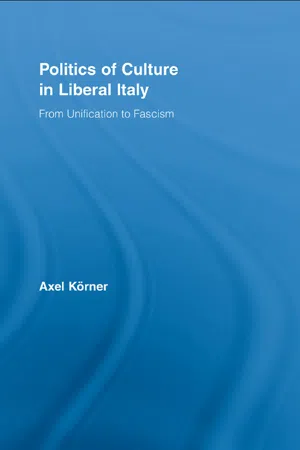
With chapters on theatre and opera, architecture and urban planning, the medieval revival and the rediscovery of the Etruscan and Roman past, The Politics of Culture in Liberal Italy analyzes Italians' changing relationship to their new nation state and the monarchy, the conflicts between the peninsula's ancient elites and the rising middle class, and the emergence of new belief systems and of scientific responses to the experience of modernity.
- 428 pages
- English
- ePUB (mobile friendly)
- Available on iOS & Android
eBook - ePub
Part I
Political and Social Conflict
1 Notabili
The Local Persistence of the Old Régime
. . . relics of past regimes which refuse to die out
(Antonio Gramsci)1
ANCIENT NAMES
On 18 October 1859 the Marquis Gioacchino Napoleone Pepoli and his family arrived at the commune of San Giorgio in the province of Bologna. With fireworks, music and cheers to “our king Vittorio Emanuele” the local population celebrated their annexation to Piedmont. As soon as the people noticed the arrival of the noble family they formed a procession and presented the Marquis the royal coat of arms.2 This enthusiasm for the liberation from the Papal regime and the unification of Italy would not prevent the same local population from staging uprisings against the imposition of new taxes and conscription to the Piedmontese army. Occasionally, cheers for Vittorio Emanuele were replaced by cheers for the ancient ruler, the pope. However, whatever their attitudes towards the Italian State, the majority remained loyal to the local nobility.
A study on politics of culture at a municipal level has to examine the social composition of the local political elites and their economic background. Italian historians have largely rejected Arno Mayer’s now classical study on The Persistence of the Old Régime.3 Although Mayer’s thesis is not unproblematic if applied across Europe, an analysis of social and political elites in the former Papal Legations presents convincing evidence for the persistence of the Old Regime, despite the watershed of Italian Unification. According to James Sheehan, Mayer fails to demonstrate “that aristocratic élites were relatively more important than other élites.” However, the case of the former Papal States seems to show exactly that: the aristocratic elites continued to occupy a predominant role on all levels of social and political representation, well after Unification.4 Only where a specific professional expertise was required was their position eventually challenged by a new professional elite of middle class origin. It is for this reason that municipal cultural policy deserves special attention, and it is here that one aspect of Mayer’s argument seems less convincing: Mayer suggests that the hegemonic role of the ancient elites is directly reflected at the level of cultural representation, in the arts and architecture of the period.5 However, decoding aesthetic debates about the theatre’s repertoire or urban planning, a more complex relationship between power, administration and cultural representation emerges. At the level of the cities’ cultural self-representation the ancient elites, which constituted the Moderates’ local power base, were increasingly superseded by cultural and technical experts of professional and middle class origin, who were often Democratic in their political orientation. Although the educated middle class suffered from a “structural disadvantage” with respect to their socio-economic position and their political role in the local administration, they were supported by Italy’s changing political climate after the parliamentary revolution of 1876, when the Democratic Left came to power. They were able to exploit their professional expertise to impose their aesthetic values and, in more general terms, they discovered the political power of culture as the means of breaking into the existing hegemonies.
Piero Aimo differentiates between a period of “amministrazione dei ‘notabili’” until 1865 and a period of “amministrazione dei ‘borghesi’” dating from 1865 to 1900.6 As a description of the social background of the local elites these categories seem not unproblematic. In Reggio Emilia, for instance, Moderate landowners dominated local politics until the electoral reforms of the 1880s. While these notabili, rooted in the Risorgimento tradition, were in their majority of middle class background, part of the bor-ghesia terriera, the case of Bologna seems more complex.7 Here, la fin des notables was postponed until well into the twentieth century. For several decades after Unification local politics remained dominated by patrician families, aristocratic landowners resident in the Legations’ capital.
In his History of Italy, Croce explained the role of Italy’s nobility in the municipal administrations after 1860 in terms of “the people’s general and spontaneous trust in the patricians, the gentry, the princes, dukes, and marquises”.8 In most parts of Italy people voted primarily according to the personal prestige of local candidates, if they voted at all. As late as 1886 the prefect of Modena declared that “the predominant aspect of the election was [the voters’] complete political indifference.” Not political programmes, but the candidates’ social status determined the vote.9 After Unification the prestige of the ancient names lived on, in spite of the fact that the kingdom did not grant their bearers any significant privileges. Since the eighteenth century monarchical powers had challenged noble privileges in the Italian states and feudal rights of jurisdiction had been abolished.10 With the exception of the hereditary princes of the royal family, the Piedmontese constitution did not even grant the aristocracy seats in the upper house.11 Numerous noble titles or names, still in use after 1860, were not recognized in the heraldic hand-books. Nevertheless, before the parliamentary revolution of 1876 43.3% of the members of the upper chamber belonged to the aristocracy, including four out of the five senatori from Bologna nominated in 1860.12 Likewise 29.4 % of the members of the lower chamber and 43% of the members of the government were of noble origin.13 “As the closest advisors and favourites of a powerful monarchy,” the Piedmontese nobility in particular was able to assert its leadership. Anthony Cardoza has challenged scholarship which stressed the fusion of new and old elites and the nobility’s marginalisation after 1861.14 The role of the nobility in the political institutions of the kingdom might appear less important than in Britain or Prussia during the same period, but considering the nobility did not fulfil a constitutional role, its position seems remarkable. According to Croce it was owing to the
prestige of their names, the custom of seeing them since centuries in these positions, the fact that unlike the gente nuova they seemed to offer major guarantees of disinvolvement, of rectitude, of love towards the public well-being and the glory of their city.15
In 1860 the Corriere dell’Emilia, which was owned by Bologna’s later mayor the Marquis G. N. Pepoli, justified the strong presence of the nobility in the city’s elected representation:
The council has to represent our illustrious city. The reason why so many of the famous names of our nobility are represented here is because there are no important differences keeping them apart from us. For the mere sake of declaring war against the aristocracy we do not want to fall into a primitive democracy. Rather than appearing generous, such a reaction would express a lack of enlightenment, distinction and education. An industrialist might figure rather well [among the members of the council], but we do not understand why the musician, the painter, the stone-mason, the teacher, the doctor, the surgeon, the pharmacist and so on is needed to constitute the town council. This would mean that any trade, any profession, including the mimes of the theatre and the beggars of the street should have the right to represent their commune.16
For decades after Unification local politics in Bologna remained dominated by the Moderate Destra. In the Piemontese parliament the Destra, the Historic Right, was referred to as the “partito aristocratico,” while the Sinistra, the Historic Left, was the “partito borghese.”17 Characterising the Destra’s approach to politics, Cammarano speaks of an “aristocratic concept of politics,” conceived as “arte di governo,” which was based on exclusive upbringing and excellent education.18 As late as 1884, Minghetti’s successor as chairman of Bologna’s Associazione Costituzionale and long time deputy for Imola, Count Giovanni Codronchi, invoked this ideal in a letter to Count Nerio Malvezzi, urging him to stand for election:
It seems to me that the upper classes have the duty of involving themselves in public life in order to prevent society from falling into the hands of the worst elements. . . . You have an illustrious name and I must invoke noblesse oblige to induce you to accept an office that will acquire authority and decorum through your name.19
A Socialist councillor from Bologna could still in 1896 oppose “democratic councillors” to “aristocratic councillors.” While the Democrats, he averred, shared at least some of the Socialists’ concerns, the Moderates were only interested in serving the interests of the local notables.20
In particular the local and provincial administrations and the office of the mayor played an important role in the political careers of the local aristocracy. While Dennis Mack Smith insists on the decline of the Italian aristocracy during the nineteenth century, he describes local government as “their perquisite.”21 As a young mayor of the small town Grinzane, near Alba in Piedmont, Count Camillo Benso di Cavour provided the most prominent example of a Moderate aristocrat, who from a position in the local administration went into national and international politics.22 From the fourteenth century his family had belonged to the local ruling class. Likewise in Bologna the prestige of ancient names and the ownership of land determined membership in the local administration. Under the Papal regime the cardinal nominated the magistrati or conservatori who formed the local government. After Unification, with Rattazzi’s law on communal administration, the council elected a giunta to lead the administration, while the king nominated the mayor. However, in Bologna the names of the men in charge hardly changed from one political regime to the next.23 During the transition the administration was first led by Count Giovanni Malvezzi, whose family had occupied important positions in the Papal administration since the sixteenth century. In November 1859 the Marquis Luigi Pizzardi, the last conservatore of the Papal government, was elected Senatore (mayor). Even though the first giunta included a few representatives of the middle classes, they had been elected on the list of the “aristocratic” Destra Storica. All the important positions of the giunta were occupied by the landed aristocracy—Count Carlo Marsili, Count Giovanni Massei, Count Agostino Salina and Count Achille Sassoli.24 In January 1862 the king nominated Count Carlo Pepoli mayor, succeeded in 1866 by the Marquis Gioacchino Pepoli. Between November 1868 and February 1872 the Democrat Camillo Casarini led for a short period the local administration, the first representative of the middle classes in this office. After a short interregnum Gaetano Tacconi became mayor of Bologna (1875–1889), a landowner of middle class origin, governing with a Moderate majority. The first mayor elected directly by the council was again a representative of landed aristocracy, Marquis Luigi Tanari, who declined the nomination.25 After more than a decade under Alberto Dal-lolio, a Moderate landowner of middle class origin, the Marquis Giuseppe Tanari, became mayor from 1905 to 1911. A comparison with Milan presents a rather different picture during the same period, even if all mayors still belonged to the Destra. While the first mayor after Unification was a landowner (Antonio Beretta, 1860–1867), the second mayor of Milan was a banker (Giulio Belinzaghi, 1868–1884), the third a philosopher and man of letters (Gaetano Negri, 1884–1889).26
Box 1.1 Count Carlo Pepoli and Marquis Gioacchino Pepoli
The political career of the Pepoli exemplifies the role of Bologna’s ancient nobility in the administration after the city’s liberation. Two Pepoli, Count Carlo Pepoli and the Marquis Gioacchino Napoleone Pepoli succeeded each other as mayors, the first in office from 1862 to 1866, the second from 1866 to 1868. Descendents of the famous Taddeo Pepoli, who held Bologna’s signo-ria in the fourteenth century, they belonged to one of Italy’s most ancient noble families. “How m...
Table of contents
- Cover Page
- Title Page
- Copyright Page
- Dedication
- List of Illustrations
- List of Tables
- List of Biographical Boxes
- Abbreviations
- Acknowledgments
- Introduction
- Part I: Political and Social Conflict
- Part II: Writing the Past
- Part III: The City, the Nation and European Culture
- Notes
- Bibliography
Trusted by 375,005 students
Access to over 1.5 million titles for a fair monthly price.
Study more efficiently using our study tools.
Frequently asked questions
Yes, you can cancel anytime from the Subscription tab in your account settings on the Perlego website. Your subscription will stay active until the end of your current billing period. Learn how to cancel your subscription
No, books cannot be downloaded as external files, such as PDFs, for use outside of Perlego. However, you can download books within the Perlego app for offline reading on mobile or tablet. Learn how to download books offline
Perlego offers two plans: Essential and Complete
- Essential is ideal for learners and professionals who enjoy exploring a wide range of subjects. Access the Essential Library with 800,000+ trusted titles and best-sellers across business, personal growth, and the humanities. Includes unlimited reading time and Standard Read Aloud voice.
- Complete: Perfect for advanced learners and researchers needing full, unrestricted access. Unlock 1.5M+ books across hundreds of subjects, including academic and specialized titles. The Complete Plan also includes advanced features like Premium Read Aloud and Research Assistant.
We are an online textbook subscription service, where you can get access to an entire online library for less than the price of a single book per month. With over 1.5 million books across 990+ topics, we’ve got you covered! Learn about our mission
Look out for the read-aloud symbol on your next book to see if you can listen to it. The read-aloud tool reads text aloud for you, highlighting the text as it is being read. You can pause it, speed it up and slow it down. Learn more about Read Aloud
Yes! You can use the Perlego app on both iOS and Android devices to read anytime, anywhere — even offline. Perfect for commutes or when you’re on the go.
Please note we cannot support devices running on iOS 13 and Android 7 or earlier. Learn more about using the app
Please note we cannot support devices running on iOS 13 and Android 7 or earlier. Learn more about using the app
Yes, you can access Politics of Culture in Liberal Italy by Axel Körner in PDF and/or ePUB format, as well as other popular books in History & European History. We have over 1.5 million books available in our catalogue for you to explore.