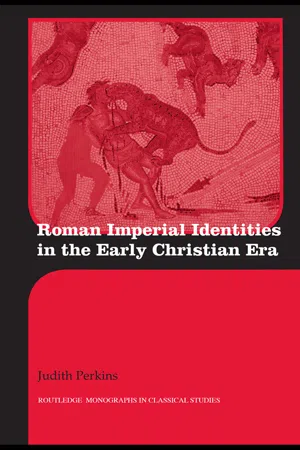
Through the close study of texts, Roman Imperial Identities in the Early Christian Era examines the overlapping emphases and themes of two cosmopolitan and multiethnic cultural identities emerging in the early centuries CE – a trans-empire alliance of the Elite and the "Christians." Exploring the cultural representations of these social identities, Judith Perkins shows that they converge around an array of shared themes: violence, the body, prisons, courts, and time.
Locating Christian representations within their historical context and in dialogue with other contemporary representations, it asks why do Christian representations share certain emphases? To what do they respond, and to whom might they appeal? For example, does the increasing Christian emphasis on a fully material human resurrection in the early centuries, respond to the evolution of a harsher and more status based judicial system?
Judith Perkins argues that Christians were so successful in suppressing their social identity as inhabitants of the Roman Empire, that historical documents and testimony have been sequestered as "Christian" rather than recognized as evidence for the social dynamics enacted during the period, Her discussion offers a stimulating survey of interest to students of ancient narrative, cultural studies and gender.
Trusted by 375,005 students
Access to over 1.5 million titles for a fair monthly price.
In the early third century, Hippolytus in his Commentary on Daniel charged the Roman Empire with imitating Christianity. Hippolytus pointed to the overlapping chronology and similar methodology of the two institutions:
For as the Lord was born in the forty-second year of the emperor Augustus … and as the Lord also called all nations
and tongues by means of the apostles and fashioned a people
of believing Christians, a people of the Lord and a new name, so all this was imitated
in every way by the empire
that was ruling then through the work of Satan. For it also collected to itself the most high-born
from every nation
and naming them “Romans” prepared them for battle. (4.9.1–2)
In this passage, Hippolytus gives Jesus credit for devising the notion of collecting a multicultural diversity of peoples and forming them into a new cosmopolitan social unity or “cultural identity”: “the people of believing Christians.” The Lord’s idea was then co-opted by the Roman Empire, which gathered the highborn from every nation and called them “Romans.” Hippolytus positions these two dichotomized groups as strictly opposed to one another.
Hippolytus was obviously a partisan observer, but his observation that the group identity-making processes of Christianity and the imperial elite were related and intertwined deserves attention. In this chapter, I am going to examine some of the processes used to construct these cultural identities to understand how these emergences might overlap and relate to each other. In particular, I will follow up on Hippolytus’ suggestions. Early Christian writers reflect a spectrum of attitudes toward the empire. However, what is striking about Hippolytus’ statement, besides its demonstration of Christian aplomb, is its clear articulation of two factors that were crucial for the consolidation of the empire.1 Hippolytus recognizes first that, in the early imperial period, cultural identities premised on shared practices and common beliefs and incorporating a diversity of peoples were increasingly important. Second he targets the Roman state’s practice of recruiting and utilizing elite provincials, “the highborn,” and using them as agents to help in governing the empire.
Constructing an imperial elite identity
In the first centuries CE, as Hippolytus suggests, a network of the highborn was under construction that would join together elite from across the empire. Many of the provincial elite had Roman connections and were Roman citizens (Millar 1977:477–9). By the middle of the second century, the eminent orator Aelius Aristides could claim for the elite of the Greek east “common ownership for the Roman name” (Or. 39.63). And he, like Hippolytus, emphasizes the high status of these provincials associated with Rome: “Many in each city are citizens of yours no less than of their fellow natives ….There is no need of garrisons holding acropolises, but the most important and powerful
in each place guard their countries for you” (Or. 26.64). Aristides and Hippolytus, for all their social and cultural differences, both perceive that in the early empire, a new alliance of “Romans” was being formed, comprising the “highborn” and “the most important and powerful” people from across the empire.2 Both writers recognize that shared high status provides the core of this alliance.
Cultural identities are produced through difference; an “us” is created in terms of a “not them.” Numerous categories are available for differentiating one group from another—nationality, religion, gender, status, race, and geography to name some potential differentials. When amidst this array of choices, a group selects particular differences and stipulates that these are fundamental for establishing identity, this selection must be recognized as part of the group’s will to power, its strategy for acquiring and expanding its influence. In the early imperial period, a new cultural identity was under construction emphasizing high status as a crucial determinant; it was to be a trans-empire community of the elite.
The focus on status in this cultural identity appeared in disguise; it presented as an emphasis on education and high culture.3 All the people who could exhibit their expertise in a shared education and cultural repertoire could claim membership in this group. The demands of this educational standard in a world of general illiteracy made it restrictive; few other than the elite had the leisure or opportunity to meet its requirements. But for all those who shared in this education and its refined interests, it provided the basis for a collective self-understanding and group identity. Hippolytus reports accurately when he describes the emergence of a new group in the early empire composed of the “highborn from every nation.” Common educational pursuits were unifying persons from diverse localities across the empire into a common social constituency. The educational and linguistic proficiency required for this group identity limited it primarily to those with high status.
In recent years a number of sophisticated analyses have been devoted to the mechanics of cultural identity making in the early imperial period, particularly with regard to Greek identity as it accommodated to Roman rule.4 The Greeks with their long history and wide geographical dispersion over time employed various differentiating polarities to forge a group identity out of their diversities. They emphasized their common descent from the original Hellenic tribes, for example (Hall 1997), and they highlighted the cultural differences separating “Greeks” from “barbarians” (Hall 1989). In the early imperial period, Greek cultural identity underwent another reconfiguration. Suzanne Saïd characterizes this new identity as a “cultural and elitist definition of Greekness” (2001:291). Ruth Webb explicitly describes the reality behind the educational criteria that were being increasingly invoked to establish Greekness; they were based on “knowledge that took considerable amounts of time and money to acquire” (2006:45).
Genealogical definitions of Greekness never completely lost their valence in the imperial period. As Hadrian’s criteria for participation in the Panhellenic league attest, to belong cities were required to demonstrate their direct descent from the original Hellenes, the Ionians, the Dorians, and Aeolians (Romeo 2002:21).5 But if genealogy was not erased in establishing claims to Hellenism, in the early empire, a turn toward criteria that were “more easily shared and transmitted than blood” occurred (Malkin 2001:11). In the first three centuries CE, a new paideia, a new educational and cultural regimen, began to provide the basis for a cosmopolitan Greek identity. This paideia concentrated on the Greek past and its literary and political achievements. It required that the educated be able to employ (to imitate) an Attic form of Greek spoken and written centuries earlier, during the fifth and fourth centuries BCE. The educated were also expected to conform as strictly as possible to the rhetorical and literary forms, techniques, historical and mythological themes, and ethical stances of that earlier period (Anderson 1993).
While Athenian writers of the classical period traditionally had provided a model for Greeks writing after them, the strict criteria for imitation promoted in this new paideia – adherence to the vocabulary, grammatical usage, and topics employed by Attic writers—were an innovation (Swain 1996:20). In his Lives of the Sophists, Philostratus coined the name “Second Sophistic” to describe the rhetorical style of a group of orators renowned for their mastery of this new paideutic standard to emphasize its relation to the language and rhetorical practices of the early Sophists of the fifth and fourth centuries BCE.6 These second sophists attracted and instructed students and showcased their rhetorical and linguistic abilities as they competed for honor and prestige in public orations. The term Second Sophistic has come to refer to the cultural movement associated with this imperial paideia and its adherents.7
An important result of sophistic paideia was that it allowed persons of diverse locations and ethnicities to acquire Greekness by virtue of their education. Philostratus describes the students coming to study with Scopelian in Smyrna in the late first century CE. He names first the ones from nearby cities and then continues his list: “But besides these he attracted also Cappadocians and Assyrians, he attracted also Egyptians and Phoenicians, the more illustrious of the Achaeans and all the youth of Athens” (Vit. soph. 518). These students form an eclectic group from diverse points across the empire, but Philostratus uses the term the Hellenes to refer to all of them (Whitmarsh 2005:14).8 Through their studies, the students attain a common cultural identity as Greeks.9
The literature of the early empire provided a privileged site for constructing and disseminating the identities necessary for the complex social and political realities of the new cosmopolitanism. Tim Whitmarsh, in his keen analyses of Plutarch, Dio, and Lucian, and other imperial writers has demonstrated how slippery and shifting the categories of identity were in this period (2001:33). Cultural identities appear to morph as individuals accommodate themselves to their multiple and variegated social and political relationships (Goldhill 2001:19).10 Men of varying ethnicities were becoming “Greeks” by virtue of their education, and many “Greek” writers, including most of Philostratus’ sophists, are “Romans” through citizenship (Whitmarsh 2005:14). Christopher Jones argues that even the opposition Roman/Greek is too static for understanding the cultural dynamics of the period. He points to the multiple attachments, “civic, regional and sometimes ‘barbarian’—that coexist within Hellenism in the self-consciousness of even the most fully ‘Hellenic’ writers” (2004:14). In the early empire, individuals immersed in their divergent cultural worlds, like chameleons, deployed their various cultural identities to achieve strategic ends (Whitmarsh 2001:22, 216).
The cultural productions of the early imperial period thus provided an important site for the Greek-speaking elite to negotiate and construct their cultural identities vis-à-vis each other and Roman power. Thomas Schmitz, in his study of the Second Sophistic, argues that the artificial diction and historicizing tendencies of these productions more sharply separated the educated elite from those who were socially, politically, culturally, and economically below them (1997:95). In my examination of the subjectivity being scripted in the Greek romances and political writings of the period, I am going to treat the Greek-speaking elite as a single interest group. A major function of the practices of the Second Sophistic was to construct a sense of group identity among the elite across the empire. And although I subscribe to the views of scholars who describe the multiple and shifting subject positions held by members of the Greek-speaking elite during this period, my focus will be on this culturally constructed elite identity. I am less interested in the subtle interactions and competitions of the elites evidenced in the texts of the period and more in the divisions that the texts created between the elite and the non-elite (Schmitz 1997:97–135).
For all the supposedly close ties of kinship and patronage linking constituencies in the ancient cities, this period experienced an increasing disparity between the elite and the others in their communities. As civic leaders were pulled toward the imperial center, the civic model of shared political ties was eroded (Osborne 2006:10). In an economic analysis of the early imperial centuries, Willem Jongman points to the processes that facilitated a major transfer of income and wealth from the periphery of the empire to its center. He notes the economic effect of this transfer: “The imperial elite [across the empire] grew increasingly rich and much of this wealth was due to Empire” (2002:47 n. 59). Jongman’s comment supports Ramsay MacMullen’s blunt assessment of the socioeconomic trajectory of the empire’s first five centuries: “Fewer have more” (1974:38). Brent Shaw summarizes the effect of the new imperial arrangements as “a more stable and efficient structure for the exploitation of inferiors” (2000:372). Unlike the modern colonial empires organized around nation-states, Rome did not extract all the benefits of empire for itself, but recirculated them among the provincial elite as they assumed their roles in implementing empire. In the early empire, Rome’s presence abetted the elite’s interests, but the under stratum lost influence.
In the face of this disparity, the differences between and among elite Greeks and Romans seem to flatten, and their agendas to align. In the cosmopolitan world of the second century, the most significant us-versus-them polarity was not that distinguishing elite Greeks from elite Romans, who to a significant extent shared a similar cultural world; rather, it was the polarity that set off elites from the non-elites in their own cities. And sophistic education, with its emphasis on recondite language and styles of speaking, only exacerbated this divide (Hingley 2005:56–7). When Aelius Aristides says prominent men in the second century would be ashamed in front of a witness to speak in anything other than the Attic Greek of hundreds of years earlier, even if he exaggerates, one begins to sense the communication barriers being erected between the prominent and the others in their communities (Or. 1. 326).11 Aristides suggests a restricted definition of human when he declares that whole world believes Attic is “ the common speech of all humans” (Or. 1.324).
Enforcing social divisions may have been a feature of the classicizing movement underlying Second Sophistic practices from its beginnings. An early endorsement of strict Attic standards already places the phenomenon within a nexus of Roman rule and the Greek elite’s superiority to the masses. Dionysius of Halicarnassus, a Greek historian and rhetorician writing in Rome at the end of the first century BC, begins his treatise on the...
Table of contents
Cover Page
Title Page
Copyright Page
Acknowledgements
Permissions
Introduction
1 Cosmopolitan identities
2 False deaths and new bodies
3 Constructing a patriarchal elite
4 Resurrection and judicial bodies
5 Place, space and voice
6 Trimalchio: Transformations and possibilities
7 Resurrection and social perspectives
8 The rhetoric of the maternal body
9 Competing chronologies
Works cited
Frequently asked questions
Yes, you can cancel anytime from the Subscription tab in your account settings on the Perlego website. Your subscription will stay active until the end of your current billing period. Learn how to cancel your subscription
No, books cannot be downloaded as external files, such as PDFs, for use outside of Perlego. However, you can download books within the Perlego app for offline reading on mobile or tablet. Learn how to download books offline
Perlego offers two plans: Essential and Complete
Essential is ideal for learners and professionals who enjoy exploring a wide range of subjects. Access the Essential Library with 800,000+ trusted titles and best-sellers across business, personal growth, and the humanities. Includes unlimited reading time and Standard Read Aloud voice.
Complete: Perfect for advanced learners and researchers needing full, unrestricted access. Unlock 1.5M+ books across hundreds of subjects, including academic and specialized titles. The Complete Plan also includes advanced features like Premium Read Aloud and Research Assistant.
Both plans are available with monthly, semester, or annual billing cycles.
We are an online textbook subscription service, where you can get access to an entire online library for less than the price of a single book per month. With over 1.5 million books across 990+ topics, we’ve got you covered! Learn about our mission
Look out for the read-aloud symbol on your next book to see if you can listen to it. The read-aloud tool reads text aloud for you, highlighting the text as it is being read. You can pause it, speed it up and slow it down. Learn more about Read Aloud
Yes! You can use the Perlego app on both iOS and Android devices to read anytime, anywhere — even offline. Perfect for commutes or when you’re on the go. Please note we cannot support devices running on iOS 13 and Android 7 or earlier. Learn more about using the app
Yes, you can access Roman Imperial Identities in the Early Christian Era by Judith Perkins in PDF and/or ePUB format, as well as other popular books in History & Ancient History. We have over 1.5 million books available in our catalogue for you to explore.