![]()
Part I
The older history of aphasia
![]()
1
Aphasia in antiquity and the Middle Ages
These days we think of aphasia and other cognitive impairments as a result of damage to mental processes represented in the brain and other parts of the central nervous system. This was not always so, and the route by which we came to our current understanding of aphasia and aphasiology is the subject of this book.
In this chapter we start with what the ancients knew of aphasia and the role of the brain in language, other cognitive processes and behaviour from the surviving writings that have come down to us. The period from antiquity to the Middle Ages stretches from the beginnings of recorded history to the fall of the Roman Empire in the fifth century AD, and seen from a Eurocentric perspective, the civilisations of the ancient Mediterranean (Egypt, Greece, the Roman Empire) and the Christian traditions of the Middle Ages played the central role. In ancient Egypt, and later in Greece, the heart rather than the brain was considered of central importance. In the Middle Ages the idea that human illness could be understood in terms of an imbalance of bodily fluids was the dominant assumption. When a role for the brain began to emerge, it was the large ventricular spaces in the brain, and the fluids they contained, rather than the substance of the brain that was seen as the seat of the human soul.
Aphasia has probably existed since humans have been able to speak, though when speech first emerged is a matter of hot debate, and may never be known with any reasonable certainty. True syntactically organised language probably did not emerge until 2 million years ago when early humans (Homo erectus) are thought to have left Africa to populate the world (Corballis, 2002). Modern humans enjoy a rule-governed capacity to generate an infinite range of utterances from a finite set of elements – what is called recursive syntax by many, but modern human language may have been preceded in its emergence by some form of protolanguage, which is seen as a stage preceding the development of full syntax (Bickerton, 1990). Bickerton (1990), for instance, argues that infant language, pidgin languages, and the languages taught to apes in captivity are all protolanguages made up of utterances comprising a few words, without syntactic structure beyond basic word order. Some form of aphasia, we can assume, has existed for as long as human beings have been able to use protolanguage.
The fossilised skulls and other bones of early humans (Australopithecus, Homo erectus, Neanderthal, etc.) provide only indirect indications of the evolution of brain size and jaw shape and movement, but fossilised skulls show different forms of partly healed cranial trauma (Finger, 1994:3f.), and several millennia-old skull findings with trepanations (systematic drilling of varying geometric holes in the cranial bone as some form of treatment for illness) seem to suggest that it has been clear for a long time that humans have made a connection between the head, the brain, illness and behaviour, although the exact purpose of these trepanations remains unclear.
Naturally, the first mentions of speech and language impairments in history do not appear until after the development of systems of writing in the Middle East, which was around 3500 BC (Crystal, 1987).
Ancient Egypt
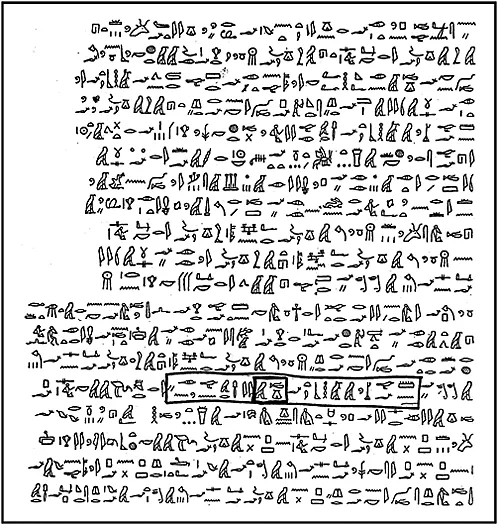
The earliest written traditions of medicine come from the Ancient Egyptian high culture. Many histories of medicine and surveys of the history of aphasia begin with the Edwin Smith Papyrus (Bouton, 1991; Critchley, 1964b; Gibson, 1962, 1967; Howard & Hatfield, 1987; O’Neill, 1980; Sondhaus & Finger, 1988), which is a later copy of a medical, surgery-oriented case collection that is approximately dated between 3000 and 2200 BC. Figure 1.1 shows a transliteration from the hieratic into the hieroglyphic, as printed in Breasted (1930: Table VIIa/VIIIa). One part of the text is attributed to the celebrated Egyptian physician and politician Imhotep (approx. third century BC). A total of 48 cases are presented in the papyrus, each following the pattern of examination, diagnosis, treatment, and is structured following the ‘from head to toe’ principle. A large number of the 48 cases described had head injuries (Ackerknecht, 1992:21)
At least five of the cases display evidence of speech and language problems. Case 17 is described as ‘speechless’ because of a fracture of the upper jaw, and cases 19, 20 and 22 exhibit injuries to the temporal area of the skull and are described as ‘speechless’. There is no differentiation between central (caused by brain injury) and peripheral (damage outside the central nervous system) disorders. Case 20 probably had a traumatic aphasia: one part of the description reads as follows:
Figure 1.1 shows cases 19 to 21 in the original hieroglyphics and the framed part corresponds to the quoted paragraph. The double-framed part reads ‘he is speechless’. Although it is stated that treatment is not possible, it is
proposed that the rubbing of ointment on the head and pouring a fatty liquid into the ears is a beneficial therapy.
Although it becomes clear from this observation and others that cranial and cerebral trauma can, for example, cause mobility, perception, and speech disorders, no connection is inferred between the brain and the symptoms. The brain was generally afforded no great importance in Egyptian medicine (or religion). While in the Egyptian mummification of the dead all the organs were stored, the brain was pulled out through the nose with a hook and discarded. This is, among other things, a reflection of the cardiocentric view (Joachim, 1890) dominant in Ancient Egypt, which considered the heart as the home of the soul, where a person’s capacity for Good and Evil resides.
Ancient Greece and Rome
The Greek spiritual world played a prominent role in early European thinking and for the early history of medicine and early Greek medical science formed the basis of modern medicine in its current form (Ackerknecht, 1992; Bouton, 1991:1–30). Roman medicine was a continuation of the Greek tradition (for example, ‘Roman’ physician Galen wrote in Attican Greek) and is therefore considered within the tradition of Greek medicine.
The theory of fluids
In the first pre-Christian millennium the notion that there were four fundamental elements (air, fire, earth, water) from which everything else is built, was inherited from Mesopotamia and Egypt. This four-element theory was developed further by different philosophers within the framework of natural philosophy (for example by Empedocles, 504–433 BC), in an attempt to understand the facts of nature and the essence of human nature. Certain physical characteristics and human bodily fluids were attributed to the basic elements as shown in Table 1.1.
Since bodily fluids played a crucial role, this approach is also called the theory of fluids (see Ackerknecht, 1992:38–39; see also Finger, 1994:12f.). Using this approach the causes of diseases were quite consistently considered as due to some imbalance of the bodily fluids. Attempts at healing hence consisted primarily in manipulating the balance of fluids through bloodletting, starvation, fluid deprivation, heat treatment, regurgitation, faecal evacuation and sweating. Epilepsy, for instance, was interpreted as an excess of cold phlegm, which treatment attempts to reduce by means of thermal cures. Deficits after cranial injuries were interpreted as an accumulation of undesirable life fluids. Cranial drillings – trepanations – were sometimes attempts at the evacuation of undesirable fluids, and in some cases may have been effective. This might have been due to a reduction of intracranial pressure. Without the theory of fluids the fundamental medical and early psychological thinking of
Table 1.1 The relationship between the elements, physical characteristics and human bodily fluids
| Element | Characteristic | Bodily fluid |
| Air | Dry | Yellow bile |
| Fire | Warm | Blood |
| Earth | Cold | Phlegm (mucus) |
| Water | Moist | Black bile |
the subsequent centuries is difficult to understand and the theory remained the basis of many model representations of human physiology and medical intervention until the eighteenth century. Ackerknecht (1970:95) shows that the use of the ‘unholy trinity: bloodletting, emetic (vomiting), and laxative’ played a crucial role up to the nineteenth century. These purges often had negative consequences (not uncommonly the patient’s death).
Early notions of localisation of mental faculties
Below we sketch the most important thinking of the Greco-Roman period concerning the connection between cognitive processing and a possible localisation in the structure of the human body. Essentially, the question centred on whether the human mind is represented in the brain or in the heart. Therefore, crucial findings of Greco-Roman anatomy and physiology are also briefly discussed.
Early writers Alcmaeon (approx. 500 BC) and Anaxagoras (500–428 BC) considered that the brain was the organ of perception and thinking. The philosopher Plato (428–347 BC) developed the ideas of Democritos and postulated a tripartite soul that also corresponded to anatomically different parts of the human being. Reason and mind were located in the head; higher characteristics such as pride, fear, courage, and wrath were in the heart, and lower characteristics such as lust and desire were located in the liver or in the abdomen. As human speech had been associated with the rational part of the soul since Pythagoras (580–428 BC), this was an important step for the examination of the relationship between speech, language and brain.
Anatomy was not very precise at this time because anatomical ...