- 194 pages
- English
- ePUB (mobile friendly)
- Available on iOS & Android
eBook - ePub
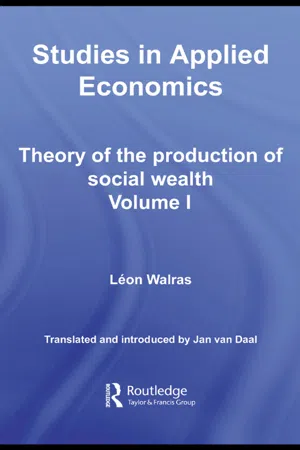
Studies in Applied Economics
About this book
First Published in 2004. Studies in Applied Economics is an English translation of Études d'économie politique appliquée (1898) by Léon Walras (1834–1910). Until now, Éléments d'économie politique pure (1874) was the only book by Walras available in English (Elements of Pure Economics, 1954). It contains the theory of general economic equilibrium under free competition, with the concept of utility maximization as its core. Walras's conclusion was that where free competition is possible, it should be the rule. So, in the present book, he advocates protective regulation, within which economic agents may compete freely. For water, gas or railway transport, for instance, where free competition is impossible, rules are formulated to maintain its advantages. Issues such as money, capital, credit, banking and the stock markets are also dealt with. The book's final chapter recapitulates the themes of Walras's three main works: Éléments, Études d'économie sociale and this volume, Études d'économie politique appliquée. Walras's aim was to provide an economic blueprint for a social ideal where poverty and similar evils could be banished.
Part I
Money
1 Gold money with regulating silver token1,i
The forthcoming expiration of the convention of 23 December 1865, which constituted the Latin Union, and the meeting in Paris of a conference to discuss and decide about the conditions of its prolongation bring me to reconsider a monetary system that I have already exposed very concisely, but explicitly enough for scientists, at the end of a memoir entitled ‘Théorie mathématique du bimétallisme’. This memoir was published in the Journal des économistes, December 1876, May 1881 and October 1882, and reproduced in my Théorie mathématique de la richesse sociale.ii The system consisted of monometallism based on gold, combined with a silver token, distinct from coins for small change, to be introduced into the circulation or withdrawn from it in such a way that the value of the multiple standard would not vary.iii Three elements simultaneously determine the value of the metal that constitutes the money commodity: (1) the utility of this metal as a commodity; (2) its utility as money, in other words, as the ‘desired cash balance’; (3) its total quantity. The increase or the decrease of the first two elementsiv will increase or decrease its value; the increase or the decrease of the third element will decrease or increase its value. Consequently, if one or the other utility were to increase, or if the quantity should decrease, one would have to introduce the special token into the circulation, in order partially to supply the money metal and keep, at the same time, enough metal in the mode of commodity. If one or the other utility were to decrease, or if the quantity should increase, the special token would have to be withdrawn [4] from circulation, in order to leave the money commodity in its place and to avoid too much metal in the form of a commodity. In this way, we shall be able to regulate the variation in value of money. I shall again expose this system, making it in a way more complete, and more accessible. If possible, I shall put its principle beyond contest. Finally, I shall develop its practical conclusion, applicable to the present circumstances.
I realize that the aim of my system, as I see it, will result in most economists, whether monometallists or bimetallists, denouncing it. To answer the latter, I have already hinted that their objection is not admissible: presenting the bimetallic standard for the whole world to adopt, because it would be a much stabler standard than the monometallistic standards, means giving everyone the right to claim for himself to seek the greatest stability of the monetary standard. However, I shall have to take on the monometallists’ argument.
Value – they will say – is a relative fact. When the price of corn increases from 20c to 25c, that is, from a fifth to a quarter of a franc (5 g) per pound (500 g), the price of silver in corn decreases by this very fact from 5 lb to 4 lb a franc. There is no reason to say that the value of corn has increased by one-quarter without saying at the same time that the value of silver decreased by one-fifth. Strictly speaking, the value of corn as such and the value of silver as such are things that do not exist; and, consequently there is no reason to seek their constancy or regulate their variation.
I accept their initial argument, but not what follows, and I shall undertake to demonstrate to those readers who are willing to pay a little attention that this consequence is not necessarily what it seems.
Strictly speaking, it is quite sure that value does not exist: there are only ratios of values or prices. But I have proved in my Éléments d’économie politique pure, or in the first four memoirs of my Théorie mathématique de la richesse sociale,v which resume it [i.e. the Éléments], that these [5] ratios of values or prices are mathematically equal to the ratios of the intensities of the last wants satisfied, i.e. of the raretés for each consumer. In the first two memoirs, I have established that this equality occurs in the exchange of two commodities as well as in the exchange of several commodities for one another. In the second two I have shown that it persists throughout all complications of production and the formation of capital, and that it is valid for productive services as well as products. We shall see, by the example of the problem of money, how the substitution of the ratios of raretés for ratios of values will bring absolute elements into our discussion instead of relative ones and provide us with the solution to the most important economic questions.
Likewise, when its price was 20c, the intensity of the last want for corn satisfied was, for every consumer, in the same proportion to the intensity of the last want for silver satisfied as 1 is to 5. At a price of 25c, this intensity of the last want for corn satisfied will be in the same proportion to the last want for silver satisfied as 1 is to 4. Both terms of these two proportionalities exist of their own accord. For each consumer facing whatever commodity, we may perfectly well conceive of wants decreasing in intensity, from the more or less intense want that solicits the first unity or fraction of a unity of the commodity, when consumption had not yet taken place at all, to zero want, called satiety, experienced after consuming the commodity extensively. This conception becomes completely clear by setting up utility or want curves or functions as have been formulated by Gossen, Jevons and myself. Consequently, we also understand quite well that, the ratio of the intensities of the last wants of corn and silver satisfied being switched from 1/5 to 1/4, either the intensities of the last wants of corn satisfied decreased by 25 per cent, where the raretés of silver did not change, or the intensities of the last wants of silver satisfied increased by 20 per cent, while the raretés of corn remained the [6] same. In the first case everybody stops at a want for corn somewhat more intense than before; in the second case everybody will be a little nearer to satiety with respect to silver. Now, we may agree that in the first case it will be said that the value of corn has increased by 25 per cent while silver has not changed. In the second, it will be said that the value of silver has dropped by 20 per cent while corn has remained stable.
For the sake of simplification, we may also proceed in the same way as we do with respect to sizes, as far as the intensities of the last wants satisfied or the raretés are concerned. When people say that, in a certain country, ‘inhabitants’ height has increased or decreased’, they are speaking about the average height of a whole generation as compared with the average height of another generation. Similarly, when one says that, in a certain market, ‘the rareté of some commodity has increased or decreased’, it is clear that one is speaking about the average rareté of that commodity during a certain period as compared with its average rareté in another period. In this sense it could be stated, as an assertion that may be true or false but that everybody will understand, that ‘for half a century the average intensity of the last want of corn satisfied has not changed, while the average rareté of silver is only four-fifths of what it was fifty years ago’. So let us imagine for a moment that these average raretés are directly measurable and that there are two types of goods, indicated in a general way by (A) and (B). If the average rareté of (A) is multiplied by α (α being greater than 1 or less), and if the average rareté of (B) is multiplied by β (β may also be superior or inferior to 1), one can prove mathematically that the price of (A) in (B) would be multiplied by α/β and that of (B) in (A) by β/α. One might therefore say, substituting the word value for rareté, that in the case of these price changes the value of (A) has been multiplied by α and that of (B) by β. So, finally, under the inexact expression ‘variation in value of a commodity’ lies a pertinent idea, namely that of considering the [7] circumstances of utility and quantity inherent in that commodity that have brought about the variation in its price in all the others or of the other prices in its own.
Money does not have any rareté;vi we do not feel a direct need with an intensity that decreases with the consumption of the metal as money but only as far as it regards the metal as a commodity. But under the regime of an unlimited coinage by the State on account of private individuals, precious metal as a commodity will command the same value as money. From this it follows that considering money as something whose value does not vary, or will only vary regularly, means considering precious metal as something whose average rareté does not vary, or will vary regularly. Pursuing the fixity or the regular variation in the value of money is the same as pursuing the fixity or the regular variation in the average rareté of precious metal. Is this pursuit impossible and chimerical?
Obviously – our adversaries will say. The intensities of the last wants satisfied, or these raretés as you define them, are not, as you supposed, sizes that can be evaluated. How can we find the average? How can we know whether this average is greater or lesser than another is at a certain moment? So how then, can we fix it or get it to vary following such and such rule?
Well, this problem is no more insurmountable than the previous one.
If, by chance, there should exist a commodity whose rareté is fixed by its nature, whether or not the money commodity itself, the problem would be solved, since it would then suffice to ensure that the price of money in that commodity, or the price of that commodity in money, would not vary, or would vary regularly, so that the ratio of the raretés would not vary either, or would also vary regularly. This would be the final situation resulting from our manipulation of the respective quantities of the metal as a commodity and as money. For example, if corn was, by its nature, of fixed rareté, it would suffice to ensure that the price of corn in silver remained 20c [8] so that the rareté of silver would not vary; and it would suffice to ensure that the price of corn increased from 20c to 25c so that the rareté of silver would decrease by 20 per cent. Now, as a matter of fact, it is quite reasonable to believe corn, by its nature, of fixed rareté, at least when we consider it over rather long periods. Corn is a kind of commodity of which a given quantity is at the same time both necessary and sufficient for us, because it is an essential but dull foodstuff that is eaten only out of necessity and not for ...
Table of contents
- Cover Page
- Title Page
- Copyright Page
- Preface
- Abbreviations and Notes On the Text
- Introduction
- Part I: Money
- Part II: Monopolies
Trusted by 375,005 students
Access to over 1.5 million titles for a fair monthly price.
Study more efficiently using our study tools.
Frequently asked questions
Yes, you can cancel anytime from the Subscription tab in your account settings on the Perlego website. Your subscription will stay active until the end of your current billing period. Learn how to cancel your subscription
No, books cannot be downloaded as external files, such as PDFs, for use outside of Perlego. However, you can download books within the Perlego app for offline reading on mobile or tablet. Learn how to download books offline
Perlego offers two plans: Essential and Complete
- Essential is ideal for learners and professionals who enjoy exploring a wide range of subjects. Access the Essential Library with 800,000+ trusted titles and best-sellers across business, personal growth, and the humanities. Includes unlimited reading time and Standard Read Aloud voice.
- Complete: Perfect for advanced learners and researchers needing full, unrestricted access. Unlock 1.5M+ books across hundreds of subjects, including academic and specialized titles. The Complete Plan also includes advanced features like Premium Read Aloud and Research Assistant.
We are an online textbook subscription service, where you can get access to an entire online library for less than the price of a single book per month. With over 1.5 million books across 990+ topics, we’ve got you covered! Learn about our mission
Look out for the read-aloud symbol on your next book to see if you can listen to it. The read-aloud tool reads text aloud for you, highlighting the text as it is being read. You can pause it, speed it up and slow it down. Learn more about Read Aloud
Yes! You can use the Perlego app on both iOS and Android devices to read anytime, anywhere — even offline. Perfect for commutes or when you’re on the go.
Please note we cannot support devices running on iOS 13 and Android 7 or earlier. Learn more about using the app
Please note we cannot support devices running on iOS 13 and Android 7 or earlier. Learn more about using the app
Yes, you can access Studies in Applied Economics by Léon Walras in PDF and/or ePUB format, as well as other popular books in Business & Business General. We have over 1.5 million books available in our catalogue for you to explore.