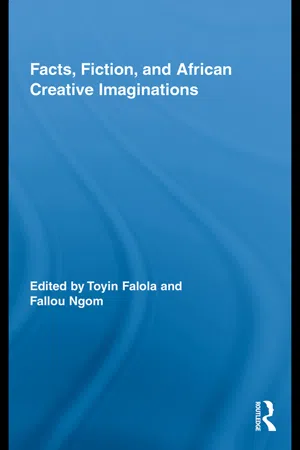
This volume brings together insights from distinguished scholars from around the world to address the facts, fiction and creative imaginations in the pervasive portrayals of Africa, its people, societies and cultures in the literature and the media. The fictionalization of Africa and African issues in the media and the popular literature that blends facts and fiction has rendered perceptions of Africa, its cultures, societies, customs, and conflicts often superficial and deficient in the popular Western consciousness. The book brings eminent scholars from a variety of disciplines to sort out the persistent fictionalization of Africa, from facts pertaining to the genesis of powerful cultural, political or religious icons, the historical and cultural significance of "intriguing" customs (such as tribal marks), gender relations, causes of conflicts and African responses, and creative imaginations in contemporary African films, fiction and literature, among others.
eBook - ePub
Facts, Fiction, and African Creative Imaginations
- 336 pages
- English
- ePUB (mobile friendly)
- Available on iOS & Android
eBook - ePub
Facts, Fiction, and African Creative Imaginations
About this book
Information
Part I
Significance of African Popular Icons and Culture
1
Whose Image of Whose Africa?
Problems of Representation in Ryszard Kapuscinski’s The Shadow of the Sun
Lena L. Khor
Problems of representation loom large in Ryszard Kapuscinski’s most recent book The Shadow of the Sun (2001). Some reviewers have criticized Kapuscinski not only for factual inaccuracies but also for reproducing the stereotypical misrepresentations of Africa by previous European travel writers.1 Other critics have been willing to overlook Kapuscinski’s fondness for blending fact with fiction because his distortion of facts leads to a “truer” representation of reality.2 The question one confronts when reading The Shadow of the Sun thus must be: does Kapuscinski’s loose treatment of facts portray Africa as it truly is or does it perpetuate the Eurocen-tric version of “the Africa that never was?” (Hammond and Jablow 1977). Through an analysis of reviews and a close reading of the text, I argue that, although the intention and effect of representing a “truer” picture of reality is respectively laudable and valuable, Kapuscinski’s misrepresentation of facts may ultimately be more harmful than helpful to Africa.
In this chapter, I will first survey the critical reception of The Shadow of the Sun, examining especially the debate surrounding the impact of Kapuscinski’s factual inaccuracies. After that I will turn to how the book tries to re-present an Africa often misrepresented as homogenous, hopeless, and indolent, but at the cost of creating other stock representations of Africa and Africans. My goal is to suggest that Kapuscinski’s method of fact bending, that occasionally borders on myth making, for the purpose of combating previous stereotypes of Africa, in effect perpetuates yet more stereotyping of Africa in the Western imagination. Although Kapuscinski has a commendable purpose—to portray a hopeful vision of Africa—the fact-defying method that he employs undermines this agenda and puts Afri-cans at risk of more misrepresentation and misunderstanding by the international community. Unlike most readers of The Shadow of the Sun, who might consider the question of factual misrepresentation once, if at all, and then merely tangentially, Africans are forced to negotiate the facts and the myths of Africa directly every single day. This is the “truest” reality.
SITUATING KAPUSCINSKI’S AFRICA: CRITICAL REACTIONS AND CRITICAL TRUTHS
In The Shadow of the Sun, Kapuscinski takes the reader on a journey across sub-Saharan Africa beginning in Accra, Ghana, in 1957, and ending in Mikumi National Park, in Tanzania, in the recent past. A collection of short narratives, the book relates the experiences Kapuscinski had and the people he encountered over the forty years that he traveled to and across the African continent. The narrative follows neither chronological nor geographical form. Rather, it moves back and forth in time and crisscrosses the distance of the continent. The stories themselves are a mix of political events (a coup in Zanzibar and Nigeria, a lecture on the Hutu and Tutsi conflict in Rwanda, a visit to a Sudanese war refugee camp in Itang, Ethio-pia), and personal adventures (the breakdown of the truck that Kapuscinski has hitched a ride on from Nouakchott, Mauritania’s capital, in the Saha-ran desert, and his struggle for survival when confronted with a cobra in an African hut on his way to Uganda).
The breadth that this book tries to cover in geographical space, historical time, political power, sociology, and cultural anthropology makes The Shadow of the Sun an engagingly interdisciplinary representation of Africa. Unfortunately, its ambition proves perhaps to be also its Achilles’ heel. The usual questions of factual accuracy, authenticity, and cultural capital that hound travel narratives are compounded in this book by the fact that the place is Africa and the author is a white Polish poet turned foreign correspondent who seems to be mining the continent for nuggets of experience. As such, other questions of colonialism, imperialism, Orientalism, Eurocentri-cism, and racism rear their ugly heads as well. Kapuscinski’s unconventional narrative style and lyrical language only tighten the knots in the tangled web of complications that his identity and his writing already weave.
Foremost among these complications is perhaps the following question: can a European man freely (in terms of poetic license) and accurately (in terms of authenticity) represent Africa? Can a white, non-African writer express his African vision artistically and capture the spirit rather than the material life of the continent and its people without stepping on the bur-ied land mines of Orientalist exoticism, Eurocentric prejudices, and black-white stereotypes? This question has been firmly in place at least since Isak Dinesen’s Out of Africa (1938).3 Yet how is an author to proceed with the crafting of his vision of a place not his own and especially one, like Africa, still smarting from slowly healing lacerations of misrepresentation? There is much at stake in personal narratives like Kapuscinski’s. As African countries wrestle to improve their image to attract foreign investment for socioeconomic development, for example, misrepresentations of Africa to the outside world can be costly to trade and development. The privileged access that a European voice has to press coverage can, consequently, guarantee that his compelling picture of Africa, whether it is true or not, runs the risk of defining Africa to the world. The result can be another colonizing gaze albeit from a post-colonial generation.
It should come as no surprise, then, that The Shadow of the Sun received some negative reviews, the most scathing of which came from John Ryle of the Times Literary Supplement (2001). Ryle questions the reliability of Kapuscinski’s literary journalism in The Shadow of the Sun by pointing out what he maintains are factual errors and grossly inaccurate, not to mention irresponsible, generalizations about Africa and Africans. Ryle alludes to The Emperor: Downfall of an Autocrat (1989), an earlier book by Kapus-cinski on the fall of the Ethiopian ruler Haile Selassie, as another example of Kapuscinski playing fast and loose with facts. Ryle’s review also showcases a response from Richard Pankhurst, “a historian of Ethiopia who was personally acquainted with Haile Selassie I,” that lists the implausibilities in The Emperor (Ryle 2001). Based on the authority of the historian Pankhurst and of Ryle’s own (competing Western) personal experience in Africa, Ryle accuses Kapuscinski’s writing of being “a variety of latter-day literary colonialism, a kind of gonzo orientalism, a highly selective imposition of form, conducted in the name of humane concern, that sacrifices truth and accuracy, and homogenizes and misrepresents Africans even as it aspires to speak for them” (2001). These are strong words; because they come from a man who, as the Anthropology and Ecology Editor of the Times Literary Supplement, carries the authority of his position on a reputable publication; they are words that will bear some weight in the archives.
A careful look at Ryle’s review shows that his point of contention with Kapuscinski does indeed center on factual inaccuracies and implausibili-ties. For the present context, I would like to underscore that. This problem of facts and realism with Kapuscinski actually hinges on a point that highlights the gap between personal narratives and news reports in singular ways. For example, Ryle describes the collection of stories in the book as haphazardly “moving back and forth in time” and implausibly “sometimes right out of time” (2001). Although Ryle does not explain his extraordinary description of the time frames in the book, the statement itself demonstrates the incredulous disbelief with which Ryle views Kapuscinski’s stories. He demands from these personal narratives factual accuracy and realistic plausibility. In other words, Ryle seems to have trouble conceptualizing Kapuscinski’s narratives as narrative. As instances of narrative, they are stories that subscribe to their own logic of narrative, a logic that Kapuscinski is creatively trying to invent through his writing, a logic that defies not just the rules of fact and reality but also the conventional rules of narrative theory.4
Ryle then devotes a substantial part of his review to exposing the numerous factual errors in The Shadow of the Sun by providing data based primarily on ethnographic literature and historical records as well as information predicated on the authority of his own personal experience. For illustrative purposes, it might be useful to examine one such factual inaccuracy, highlighted by Ryle, that of bookstores in Addis Ababa. Here is Ryle on Kapuscinski:
He describes visiting the bookstore in the University of Addis Ababa. It is, he says, the country’s only bookstore—and completely devoid of books. Really? There are at least a half-a-dozen bookshops in Addis Ababa, all with books for sale, and have been since the Derg era … Not content with this already quite erroneous assertion, Kapuscinski continues “It is this way in most African countries. Once, I remember, there was a good bookshop in Kampala … Now—everywhere, nothing.” Here hyperbole becomes distinctly misleading. There may not be a branch of Borders or Barnes and Noble in Kampala, but there are numerous bookshops there, and in Nairobi, Dar-es-Salaam, Johannesburg, Cape Town and dozens of other African cities, small and large. (2001)
Almost any reader must admit Ryle’s evidence is rather damning. Even as the reader acknowledges the irony of accepting the credibility of Ryle’s statements based on his personal experience (Ryle, after all, is urging the reader to question the credibility of Kapuscinski’s statements because it is based only on Kapuscinski’s personal experiences), he is forced to an inevitable conclusion that agrees with Ryle’s.
In the chapter of the book that yielded the previous example, Kapuscin-ski is writing about Addis Ababa in the mid-1990s. It is hardly plausible that there were no bookstores anywhere on the entire continent of Africa at that time. The reader thus cannot help but acknowledge the implausibility and factual error of Kapuscinski’s statements that so irritate Ryle. In this particular case of the missing bookstores, Ryle’s approach, still grounded in his sense that fact and realism must prevail, the conflict seems to be a straightforward duel between experts. It is Kapuscinski versus Ryle; the bookstores Kapuscinski could not find that Ryle found. But is Ryle’s approach the only way, or the most productive way, to read such travel narratives like The Shadow of the Sun? As intimated earlier, criteria of factual accuracy, realistic plausibility, and now, the authority and authenticity of one personal experience over another may not be the real issues at stake in a...
Table of contents
- Routledge African Studies
- Contents
- Figures
- Preface
- Introduction
- Part I Significance of African Popular Icons and Culture
- Part II Religion and African Creative Imaginations
- Part III Gender and African Artistic Imaginations
- Part IV African Cultures and Artistic Imaginations
- Contributors
- Index
Trusted by 375,005 students
Access to over 1.5 million titles for a fair monthly price.
Study more efficiently using our study tools.
Frequently asked questions
Yes, you can cancel anytime from the Subscription tab in your account settings on the Perlego website. Your subscription will stay active until the end of your current billing period. Learn how to cancel your subscription
No, books cannot be downloaded as external files, such as PDFs, for use outside of Perlego. However, you can download books within the Perlego app for offline reading on mobile or tablet. Learn how to download books offline
Perlego offers two plans: Essential and Complete
- Essential is ideal for learners and professionals who enjoy exploring a wide range of subjects. Access the Essential Library with 800,000+ trusted titles and best-sellers across business, personal growth, and the humanities. Includes unlimited reading time and Standard Read Aloud voice.
- Complete: Perfect for advanced learners and researchers needing full, unrestricted access. Unlock 1.5M+ books across hundreds of subjects, including academic and specialized titles. The Complete Plan also includes advanced features like Premium Read Aloud and Research Assistant.
We are an online textbook subscription service, where you can get access to an entire online library for less than the price of a single book per month. With over 1.5 million books across 990+ topics, we’ve got you covered! Learn about our mission
Look out for the read-aloud symbol on your next book to see if you can listen to it. The read-aloud tool reads text aloud for you, highlighting the text as it is being read. You can pause it, speed it up and slow it down. Learn more about Read Aloud
Yes! You can use the Perlego app on both iOS and Android devices to read anytime, anywhere — even offline. Perfect for commutes or when you’re on the go.
Please note we cannot support devices running on iOS 13 and Android 7 or earlier. Learn more about using the app
Please note we cannot support devices running on iOS 13 and Android 7 or earlier. Learn more about using the app
Yes, you can access Facts, Fiction, and African Creative Imaginations by Toyin Falola, Fallou Ngom, Toyin Falola,Fallou Ngom in PDF and/or ePUB format, as well as other popular books in Literature & African Literary Criticism. We have over 1.5 million books available in our catalogue for you to explore.