- 322 pages
- English
- ePUB (mobile friendly)
- Available on iOS & Android
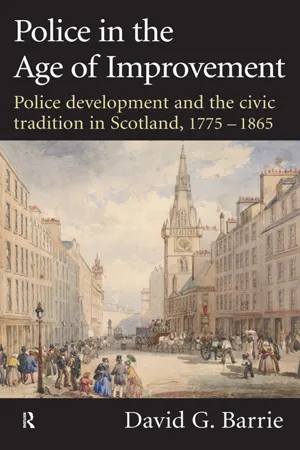
Police in the Age of Improvement
About this book
The study of police history in Scotland has largely been neglected. Little is known about the Scottish police's origins, development and character despite growing interest in the machinery of law enforcement in other parts of the United Kingdom. This book seeks to remedy this deficiency.
Based on extensive archival research, its central aim is to provide an in-depth analysis of the economic, social, intellectual and political factors that shaped police reform, development and policy in Scottish burghs during the 'Age of Improvement'. The key issues addressed include: the workings of traditional forms of law enforcement and why these were increasingly deemed to be unsuitable by the late eighteenth and early nineteenth centuries; why, and in what ways, the pattern, nature and origins of police development in urban Scotland differed from elsewhere in Britain; in what ways the Scottish police model compared and contrasted with other British models; the impact of police reform on urban governance and the struggle between social groups for control of the local state; the concerns and priorities behind police policy.
In addressing these questions, Police in the Age of Improvement moves beyond many of the 'problem-response' interpretations which have preoccupied many police historians, and locates reform within the wider contexts of urban improvement, municipal administration and Scottish Enlightenment thought. It will be essential reading for anyone interested in the history of policing, urban management and social change in the late eighteenth and nineteenth centuries.
Frequently asked questions
- Essential is ideal for learners and professionals who enjoy exploring a wide range of subjects. Access the Essential Library with 800,000+ trusted titles and best-sellers across business, personal growth, and the humanities. Includes unlimited reading time and Standard Read Aloud voice.
- Complete: Perfect for advanced learners and researchers needing full, unrestricted access. Unlock 1.4M+ books across hundreds of subjects, including academic and specialized titles. The Complete Plan also includes advanced features like Premium Read Aloud and Research Assistant.
Please note we cannot support devices running on iOS 13 and Android 7 or earlier. Learn more about using the app.
Information
Table of contents
- Cover
- Half Title
- Title Page
- Copyright Page
- Dedication
- Table of Contents
- List of figures and tables
- Abbreviations
- Acknowledgments
- 1 Introduction
- 2 Policing before the police: law enforcement in the late eighteenth century
- 3 Politics, pressures and policing initiatives: Glasgow in the Age of Enlightenment, 1779–1800
- 4 Urban challenges and new expectations: police origins and the pattern of adoption, 1800–32
- 5 Conflict and consensus: framing the model of urban management, 1800–32
- 6 Pioneers in police? The police model and its historical significance, 1800–33
- 7 National legislation and the state of burgh policing at mid century, 1833–62
- 8 Policing the Scottish city, 1800–48
- 9 Towards incorporation: changing attitudes towards urban administration and challenges to elected police commissions, 1833–64
- 10 Conclusion
- Appendix I: Social status classifications of police commissioners’ occupational profiles
- Appendix II: Selection of amended police constitutions, 1800–33
- Bibliography
- Index