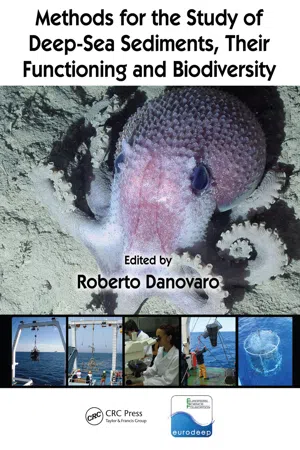
For years scientists viewed the deep sea as calm, quiet, and undisturbed, with marine species existing in an ecologically stable and uniform environment. Recent discoveries have completely transformed that understanding and the deep sea is recognized as a complicated and dynamic environment with a rich diversity of marine species. Carefully designe
eBook - PDF
Methods for the Study of Deep-Sea Sediments, Their Functioning and Biodiversity
- 460 pages
- English
- PDF
- Available on iOS & Android
eBook - PDF
Methods for the Study of Deep-Sea Sediments, Their Functioning and Biodiversity
About this book
Information
Table of contents
- Front cover
- Contents
- Foreword
- Premise
- Preface
- Contributors
- Introduction
- Section I: Deep-Sea Environmental Variables
- Chapter 1. Total Organic Matter and Water Contents, Grain Size, Bulk Density, Porosity, and Redox Potential of Sediments
- Chapter 2. Total Organic Carbon, Total Nitrogen, and Organic Phosphorus in Marine Sediments
- Chapter 3. Bioavailable Organic Matter: Total and Enzymatically Hydrolyzable Proteins, Carbohydrates, and Lipids
- Chapter 4. Photosynthetic Pigment Concentrations in Marine Sediments
- Section II: Food Supply of Organic Matter to the Deep-Sea Floor
- Chapter 5. Fluxes of Labile Organic Matter to the Sea Floor
- Chapter 6. Total Carbohydrate Flux from Sediment Trap Samples
- Chapter 7. Total Protein Flux from Sediment Trap Samples
- Chapter 8. Total Lipid Flux from Sediment Trap Samples
- Chapter 9. Total DNA from Sediment Trap Samples
- Chapter 10. Phytopigment Flux from Sediment Trap Samples
- Section III: Deep-Sea Benthic Life
- Chapter 11. Viral Abundance
- Chapter 12. Prokaryotic Abundance
- Chapter 13. Fluorescence In Situ Hybridization and Catalyzed Reporter Deposition for Benthic Prokaryote Assemblage Structure
- Chapter 14. Prokaryotic Abundance by Real-Time PCR
- Chapter 15. Abundance of Heterotrophic Benthic Protists
- Chapter 16. Abundance of Benthic Foraminifera
- Chapter 17. Abundance of Metazoan Meiofauna
- Chapter 18. Macrofaunal Abundance
- Chapter 19. Megafaunal Abundance
- Section IV: Deep-Sea Benthic Diversity
- Chapter 20. Extraction and Purification of DNA from Marine Sediments Suitable for the Analysis of Prokaryotic Diversity
- Chapter 21. Archaeal Diversity Analysis Using 16S rDNA T-RFLP (Terminal- Restriction Fragment Length Polymorphisms)
- Chapter 22. Benthic Bacterial Diversity Based on Cloning and Sequencing of 16S rRNA Genes
- Chapter 23. Benthic Bacterial Diversity Analysis Based on ARISA (Automated Ribosomal Intergenic Spacer Analysis)
- Chapter 24. Meiofaunal Diversity
- Chapter 25. Macrofaunal and Megafaunal Diversity
- Chapter 26. Parameters for the Measurement of Marine Benthic Structural and Functional Diversity
- Section V: Deep-Sea Benthic Functioning
- Chapter 27. Deep-Sea Experiments and Manipulations
- Chapter 28. Effect of Pressure on Enzymatic Activities, Viral Production, and Prokaryotic Heterotrophic Production
- Chapter 29. Organic Carbon Remineralization Rates in Marine Surface Sediments
- Chapter 30. Degradation and Turnover of Organic Matter in Marine Sediments
- Chapter 31. Extracellular DNA Extraction from Marine Sediments
- Chapter 32. Degradation of Extracellular DNA in Marine Sediments
- Chapter 33. Viral Production in Marine Sediments
- Chapter 34. Determination of Living/Dead and Active/Dormant Bacterial Fractions in Marine Sediments
- Chapter 35. Prokaryotic Biomass in Marine Sediments
- Chapter 36. Benthic Prokaryotic Heterotrophic Production Using the Leucine Incorporation Method
- Chapter 37. Prokaryotic Chemoautotrophic Production in Marine Sediments
- Chapter 38. Meiofaunal Biomass and Secondary Production
- Chapter 39. Macrofaunal and Megafaunal Biomass and Biochemical Composition
- Chapter 40. Protistan Grazing on Benthic Prokaryotes and Viruses
- Chapter 41. Meiobenthic Predation on Prokaryotes
- Chapter 42. Analysis of Benthic Food Webs and Benthic Trophodynamics
- Section VI: Suggested Readings for the Study of Deep-Sea Biodiversity and Ecosystem Functioning
- Suggested Readings
- Index
- Back cover
Trusted by 375,005 students
Access to over 1.5 million titles for a fair monthly price.
Study more efficiently using our study tools.
Frequently asked questions
Yes, you can cancel anytime from the Subscription tab in your account settings on the Perlego website. Your subscription will stay active until the end of your current billing period. Learn how to cancel your subscription
No, books cannot be downloaded as external files, such as PDFs, for use outside of Perlego. However, you can download books within the Perlego app for offline reading on mobile or tablet. Learn how to download books offline
Perlego offers two plans: Essential and Complete
- Essential is ideal for learners and professionals who enjoy exploring a wide range of subjects. Access the Essential Library with 800,000+ trusted titles and best-sellers across business, personal growth, and the humanities. Includes unlimited reading time and Standard Read Aloud voice.
- Complete: Perfect for advanced learners and researchers needing full, unrestricted access. Unlock 1.5M+ books across hundreds of subjects, including academic and specialized titles. The Complete Plan also includes advanced features like Premium Read Aloud and Research Assistant.
We are an online textbook subscription service, where you can get access to an entire online library for less than the price of a single book per month. With over 1.5 million books across 990+ topics, we’ve got you covered! Learn about our mission
Look out for the read-aloud symbol on your next book to see if you can listen to it. The read-aloud tool reads text aloud for you, highlighting the text as it is being read. You can pause it, speed it up and slow it down. Learn more about Read Aloud
Yes! You can use the Perlego app on both iOS and Android devices to read anytime, anywhere — even offline. Perfect for commutes or when you’re on the go.
Please note we cannot support devices running on iOS 13 and Android 7 or earlier. Learn more about using the app
Please note we cannot support devices running on iOS 13 and Android 7 or earlier. Learn more about using the app
Yes, you can access Methods for the Study of Deep-Sea Sediments, Their Functioning and Biodiversity by Roberto Danovaro in PDF and/or ePUB format, as well as other popular books in Scienze fisiche & Biologia marina. We have over 1.5 million books available in our catalogue for you to explore.