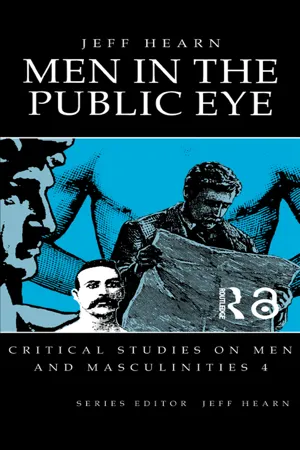
Men in the Public Eye reveals why men's domination in and of the public sphere is a vital feature of gender relations in patriarchy. It also shows how public domains dominate private domains, contributing to the intensification of public patriarchies. Jeff Hearn explores these important issues by focusing on the period 1870-1920, when there was massive growth and transformation in the power of the public domains. He demonstrates that these historical debates and dilemmas are still relevant today as men search for new, postmodern forms of masculinities.
- 304 pages
- English
- ePUB (mobile friendly)
- Available on iOS & Android
eBook - ePub
Men In The Public Eye
About this book
Information
CHAPTER 1
Introduction: the problem of public men
In working on this book, I found a kind of passionate enthusiasm for tracking down the ‘origins’, historical or otherwise, of present-day masculinities, particularly the public masculinities of public men. I say this whilst being immensely dubious about the search for origins, especially those that are distant and archaic (Hearn 1987a, p. 192). This seemed different, however: it appeared immediate. I was drawn to discover where and how public men began to be as we are now in our public masculinities. I knew it had something to do with the enlargement and domination of the public domains, sometimes sudden, sometimes gradual, over the private with modernization and modernity, and particularly the creation of a new kind of universalization of experience. In this sense we now see ourselves not simply as individuals but as part of the mass collectivity of men, in corporation-produced images, words, deeds, and actions. This is easily seen as a huge burden, a massive negativity, that detracts from some essential and higher ‘man’. This is mistaken: there is no such ‘higher being’. The ever-presence of corporate, universal man is neither a good nor an evil; it is what has become. The problem of public men thus refers to both these confusions around the form of masculinities, especially public masculinities, and the intense associations of public men and power already described, and exacerbated in the technological, institutional, and organizational developments of the ‘modern world’.
So how have we come to recognize the problem of ‘public men’? The rise of this problem, and the rise in the recognition of the problem, necessarily involves a process of public recognition in the public domains (for example, in politics and academia). All men become ‘public’ in the process of (public) recognition, just as all discourse is public. Thus one could reasonably, if longwindedly, refer to this process as the public rise of the public problem of public men—it is only in the public domains that a ‘problem’, as private trouble, becomes the problem, as public issue.
Just as the way men are talked about, understood, and explained in everyday conversations is partly a question of the material impact of (particular) men and partly a question of their construction in discourse, so this is equally so in the more public debates of men, academic, political or otherwise. The changing ways in which men have been seen and are now seen involves both material changes in men and what men do (for example, the type of work men do) and changes in the placing of men in discourse. This means that to describe ‘the rise of the problem of public men’ is to describe both some of those material changes and the ways that they are constructed, which includes constructions in everyday conversation, politics, and academic study. For example, what we call ‘history’ is both a story of material and other changes, a discursive construction of such changes; and it is also a story about itself, in the senses that both the material changes and the discursive constructions include the productions of other histories. Something similar could be said of everyday conversation. Thus material and discursive changes in everyday, political, and academic speech about men are all part of themselves, and all relevant to undertaking the rise in the problem of men, especially public men.
When someone speaks about men or masculinities in everyday conversation, they are both saying something about the ‘topic’ and, at least if they are a man, showing something of the ‘topic’. Similarly, in academic discourse on men or masculinities, the ‘topic’ is talked about and it is displayed, certainly within the malestream and probably also in counter-streams. For these reasons, the history of ideas about men is very much part and parcel of the central problem (of men).
In this chapter I shall look at the recognition of the problem of public men in three main and closely interrelated ways: first, in terms of cultural and historical constructions; secondly, political and other critiques; and thirdly, contradictions around public men in the context of modernization.
Cultural and historical constructions
While we live in ‘patriarchy’, indeed in ‘world patriarchy’, the manner and form of gender relations throughout the world is intensely varied. Though related, however indirectly and at least at times in some of our minds to biology, sex, and ‘sexual difference(s)’, gender is materially and culturally produced. This applies both to cultural variations in the signification of gender in particular societies, and more ambitiously to the category of ‘gender’ itself. Gender always remains a cultural, practical accomplishment (as well as a human, sensuous one as Marx might have said1). To see gender as cultural formation is not to subscribe to a cultural explanation of gender. Gender is culture, which is itself historically and materially formed. This involves transforming matter to matters of interest. Men and gender are produced in the conflicts and struggles of history and politics.
Gender and gender relations are also subject to great historical transformations, albeit with pronounced historical irregularity. At times the pace of change has been intense; often contributing to and reinforced by rapid change in a variety of social arenas and through a variety of social processes. Men's domination of the public domains has been ancient, contested, and culturally variable. In medieval society there were definite separate spheres for women and men, for example in religious, court, and military arenas. By the fifteenth century women's participation in the public domains was increasing. In Restoration England of the late seventeenth and early eighteenth centuries, political and economic changes in urbanization, industrialization, and capital accumulation, and the growth in the admittedly still small electorate were intimately connected with change in families, households, and gender relations. These in turn, it has been argued, provided the context for definitions of masculinities:
As the structural bases of gender relations had shifted and were thrown into disarray, the meaning of masculinity itself was brought into question, debated, and in part redefined. Women's assertion of sexual agency, of an equality of desire, and of equal rights within marriage, inspired men to abandon traditional roles within the family, just as changes in the organization of work and political changes eroded their economic autonomy and the traditional system of fixed political statuses in precapitalist society.
(Kimmel 1987, p. 134)
Amongst the affluent class, the ‘“new man” of Restoration England was transformed into a feminized, feminine “invert”, as vain, petty and pretty as any woman’ (p. 135). While there are a number of conceptual and empirical difficulties with this kind of analysis, particularly around the assumption of the externalized (economic and political) structural bases of gender relations, it is clear that the perception of men and masculinities as a contested problem, indeed as significant at all, is historically variable and historically constructed.
As already noted, change in men and gender relations involves both social change and discursive change. Thus from the beginnings of the Enlightenment in the sixteenth century the promotion of ‘rational’ approaches to human affairs was also a question of gender.2 This is most obviously seen in the association of particular forms of masculinity with the rational control of society, nature, and each other. At a rather naive level this has sometimes been seen simply as a sign of men's power to control, and hence dominate. On the other hand, it is worth noting that in the eighteenth century, both Leibniz and Bentham employed rational argument against war and militarism: men's rationality turned against another form of men's power. Bentham also emphasized the irrationality of antisodomitical violence and advocated the decriminalization of sodomy in a series of unpublished essays (Corber 1990).
The eighteenth and nineteenth centuries saw further massive transformations of gender relations. This was for many reasons—economic, political, sexual, spatial. Gender, gender ideology, and ideologies around gender became more explicit. While the words ‘feminine’ and ‘masculine’ were in use in the sixteenth century, ‘femininity’ and ‘masculinity’ did not acquire widespread recognition as significant categories for describing identifiably gendered people until the nineteenth century.3 A central feature of this was the establishment of a series of ideologies around the notion of ‘separate spheres’ for women and men:4 ‘the central belief…of a male breadwinner gaining a livelihood through work and maintaining his female [and child] dependants within the home…. In this view, husband and wife were the archetype, but father and child, brother and sister, uncle and niece, master and servant reproduced the relationship of clientage and dependency’ (Davidoff 1979, p. 64; my emphasis and insertion).
Very importantly these divisions and differences were, and indeed are, matters of ideology. As Leonore Davidoff and Catherine Hall write, with respect to the English middle class of the eighteenth and nineteenth centuries: ‘Public was not really public and private was not really private despite the potent imagery of “separate spheres”. Both were ideological constructs with specific meaning which must be understood as products of a particular historical time’ (1986, p. 33). These shifts to the ideologies of separate spheres are usually dated around the first fifty, sixty, seventy years of industrialization from the 1780s. Connections might be made between specific cultural, literary, and ideological representations of gender and sexuality, and changing patterns of industrialization, employment, geographical mobility, and domestic organization; in short, a correspondence between the gendered and the institutional separation of the public and private spheres. There are, not surprisingly, problems with such accounts. Dating such gender shifts is in fact extremely problematic, not least because of variations by economic class. For example, early industrialization often engaged large numbers of women workers in the public domains.
A rather different perspective is provided by John Savile (1988) when he suggests that the eighteenth-century preoccupation with rampant sexuality for women and men had indeed been superseded by the 1850s by the ‘Victorian’ pattern of separate gendered (passive/active) sexualities. This view has in turn been challenged by A.D.Harvey (1978, 1989) through analysis of literary conventions. Even in the 1740s Samuel Richardson's novels Pamela and Clarissa were already portraying women as naturally passive and asexual, following on the previous view of women as sexual predators. By the 1810s, pornographic books dealing with flagellation of men by women were fashionable, as was gossip about predatory lesbians. Harvey suggests that these constituted the reaction of male chauvinist fantasy against what was then the standard model of passive female sexuality. These particular class-specific literary modes thus provide much earlier accounts of ‘separate spheres’.
Either way, by the second half of the nineteenth century, ideologies of the separate spheres for women and men appeared more fully established (Pleck & Pleck 1980), and the further categorization of gendered states was proceeding apace—through medical, psychiatric, moral, sexual, and other discourses. For example, the terms ‘homosexual’ and ‘homosexuality’ were formulated in 1869 by the Hungarian doctor Karoly Maria Benkert (Weeks 1989, p. 213). Jeffrey Weeks (1989, p. 87) describes 1885 as an annus mirabilis of sexual politics, in which several purity and legal campaigns came strongly to the fore, including the passing of the Criminal Law Amendment Act, which raised the age of sexual consent, and the Labouchère Amendment, which criminalized male homosexuality. According to Michael Kimmel (1986, p. 14),5 in 1886 ‘[t]he words “heterosexual” and “homosexual” came into popular usage [in the United States]…after a review of Krafft-Ebing's Psychopathia Sexualis in the New York Times.’ The turn of the century saw all kinds of further gendered/sexual elaborations and institutional developments (e.g. Mangan & Walvin 1987). Frank Mort (1987) places such gender ideologies in the wider context of ‘gender-specific discourse on sexuality’. In particular he notes an association between the promotion of ‘manliness’ within muscular Christianity and the intellectual inspirations of ‘the moralized language of evolutionary science’ (p. 115). He goes on to suggest that ‘language of purity (for men) opened up a space for women to define their own images of female sexual identity’ (p. 116).
Accordingly, the late nineteenth century has to be seen as a time of major and crucial change in the construction of masculinities (e.g. Kimmel 1987; Dubbert 1979; Pleck & Pleck 1980). Writing in the context of the United States, Kimmel notes how the twin forces of industrialization and political democracy threatened ‘masculinity’—or, more accurately, particular types of masculinities—at that time. And, while problems remain around such notions of ‘threatened masculinity’ or ‘crisis in masculinity’ (Brittan 1989), as well as the relationship of ‘gender’ and the ‘economic’ (see pp. 96–102), the general significance of historical change at that time is difficult to doubt. In particular, and if for no other reason, present-day confusions and divergences of masculinity, so pervasive in this fracturing postmodern world, cannot be seen outside of history.
What is of profound interest here is the ‘publicization’ (Brown 1981) of the social world, the bringing of activities and issues into the public domains. This is important in both the growth of larger and more powerful organizational means of production, control, and indeed institutional violence, and the transformation of masculinities in their various forms. Publicization has created a set of circumstances in which there is a huge array of universalizable images and informations about what men and masculinities are or are meant to be. External information is not new to humans, nor is it new in large quantities; what is new is its universalizable qualities—its availability to all men, its speaking to all men, its complex combination of internalization and externalization. We are in a profound sense alienated from whatever might be called a sense of ‘self’. The potential power of both individuals and collectivities is assumed by others, so that those who work on and are responsible for the production of those mass images are not better able to see themselves.
Critiques
These cultural and historical circumstances have also brought a number of major developments that have assisted the recognition of the problem of public men, and provided political and other critiques of public men. In this way, the historical transformation of gender cannot be separated off from gender politics and the politics of sexuality.
These include most obviously the rise of feminist theory and practice. In saying this I am thinking particularly of the fact that feminist theory and practice has a long history; and not only in the late nineteenth and twentieth centuries. Feminism has long been making the invisible visible, speaking of problems that have no name, making voices, decentring the centre, recentring the other, making the private public, challenging and changing consciousness, recognizing and deconstructing patriarchy, celebrating sisterhood, and opposing the power, domination, oppression, and violence of men. Feminism has always addressed the problem of men (Hanmer 1990).6
A different kind of cultural and historical construction is represented by gay liberation and gay studies since the late 1960s. These have produced their own critiques of men, paradoxically through recognizing men loving and desiring men. In addition, developments as diverse as socialist organization, psychoanalysis, and critical cultural studies have contributed to the critique of public men. They can be understood as both outcomes of and responses to the universalizing tendencies of modernization, both reactions to and appreciations of the collective subject. Despite their own dominant patriarchalism, they have in some instances assisted the recognition of public men and the problem of public men. From all of these have come first ‘men's studies’, and then the critique of men (and the critique of ‘men's studies’).7
Feminist critiques of men, in theory and practice; gay studies and gay critiques; antisexist critiques; the critique of men—all contribute both to making men and masculinities explicit, and paradoxically to the deconstruction of men and masculinities. The impact of feminism on men and men's response to feminism were often at first a personal and private matter; increasingly, this has changed as men in public situations—in organizations, in business, trade unions, political parties—have had to respond to feminist initiatives. Similarly, men's positive pro-feminist responses have become more public— in groups, networks, newsletters, organizations. Critical study on men in the public domains has become increasingly recognized as a political, as well as an academic, issue.
The focus on public men in relation to these ‘gender critiques’ has revealed a further paradox. Feminism has shown the importance of personal experience, the political nature of the personal, the personal nature of the political, the interrelation of the private and the public; the implications of this for studying men are not si...
Table of contents
- Front Cover
- MEN IN THE PUBLIC EYE
- Critical studies on men and masculinities
- Title Page
- Copyright
- Contents
- List of tables and figures
- Series editor's preface Jeff Hearn
- Preface
- Acknowledgments
- Foreword Pluralizing perspectives: the present and the past
- 1 Introduction: the problem of public men
- PART 1 FROM THE MALESTREAM TO PUBLIC PATRIARCHIES
- PART 2 PUBLIC MEN IN PUBLIC PATRIARCHIES
- Afterword Beyond public men?
- Notes
- Bibliography
- Name Index
- Subject Index
Trusted by 375,005 students
Access to over 1.5 million titles for a fair monthly price.
Study more efficiently using our study tools.
Frequently asked questions
Yes, you can cancel anytime from the Subscription tab in your account settings on the Perlego website. Your subscription will stay active until the end of your current billing period. Learn how to cancel your subscription
No, books cannot be downloaded as external files, such as PDFs, for use outside of Perlego. However, you can download books within the Perlego app for offline reading on mobile or tablet. Learn how to download books offline
We are an online textbook subscription service, where you can get access to an entire online library for less than the price of a single book per month. With over 1.5 million books across 990+ topics, we’ve got you covered! Learn about our mission
Look out for the read-aloud symbol on your next book to see if you can listen to it. The read-aloud tool reads text aloud for you, highlighting the text as it is being read. You can pause it, speed it up and slow it down. Learn more about Read Aloud
Yes! You can use the Perlego app on both iOS and Android devices to read anytime, anywhere — even offline. Perfect for commutes or when you’re on the go.
Please note we cannot support devices running on iOS 13 and Android 7 or earlier. Learn more about using the app
Please note we cannot support devices running on iOS 13 and Android 7 or earlier. Learn more about using the app
Yes, you can access Men In The Public Eye by Jeff Hearn in PDF and/or ePUB format, as well as other popular books in Social Sciences & Sociology. We have over 1.5 million books available in our catalogue for you to explore.