1
INTRODUCTION
Amira K. Bennison
Cities and the influences that shape them are a topic of endless fascination. Philosophers and thinkers of many persuasions have seen in the city both perfection and degradation. On the one hand, Plato’s Republic and St Augustine’s City of God rest upon the assumption that the city is the apogee of human achievement in this life and the next, while on the other hand the biblical image of the whore of Babylon encapsulates all that is negative about urban life. Muslims viewed cities and urban life with similar ambivalence, and a contrast emerges between Muḥammad’s archetypal city, Medina, known as ‘the illuminated one’ (al-munawwara), or the philosopher al-Farābī’s virtuous city (al-madīna al-fāḍila), and the view of the grand doyen of Islamic historiography, Ibn Khaldūn, that, despite being essential to ‘civilisation’, the city was the locus of immorality and corruption. While Cairo is fondly called ‘Mother of the World’, the city in its generic form is also seen as a seductress, responsible for sapping the manly energies (muruwwa) of those men of the desert, mountain and steppe who succumb to its charms. Such polarities reflect the dualism of the early Muslim experience and the long drawn out encounter that occurred between the life-styles of the Arabian peninsula and the sedentary civilisations of the Near East from the rise of Islam in the mid-seventh century onwards.
Muḥammad’s choice of one town – Medina – as the site for his perfect community and another – Mecca – as its spiritual epicentre gave cities a quintessential role within the new faith and created an enduring link between urban life and the practice of Islam. However, the specific ways in which Islam influenced urban life from Spain to India, and beyond, are not always easy to elucidate or even identify, and many other factors influenced the material form of cities and the urban culture they sheltered. We would do well to remember that Ibn Khaldūn introduced his discussion of urban life with the statement that ‘dynasties and royal authority are absolutely necessary for the building of cities and the planning of towns’, and attributed their survival to ecology.1 He then proceeded to say that Muslims only really started to build cities when ‘royal authority’ got the upper hand over religion, which previously ‘forbade them to do any excessive building or to waste too much money on building activities for no purpose’, thereby suggesting that religion in a narrow sense did not play a major role in the morphology of cities.2
Ibn Khaldūn’s words bring us to the long, and to some extent ongoing, debate about whether an ‘Islamic city’ exists or not, a question he would probably have answered in the negative. Although many of the chapters in this volume do refer to the issue directly or obliquely, our purpose is not to sally forth into this theoretical fray: the reductionist implications and Orientalist prejudices upon which the concept of an Islamic city is predicated have been thoroughly exposed elsewhere. Nonetheless, it is important to recognise the assumptions that have informed the study of cities in the Islamic world, with which we all engage, whether consciously or unconsciously, in the course of our work.
Orientalists began to take a concerted interest in the nature of the city in the Islamic world in the early twentieth century when the successes of empire gave European scholars unrivalled access to the object of their interest, while also allowing them to compare the ‘Islamic’ city, generally called the ‘medina’, with the ‘modern’ towns and cities being built alongside them. The cities of antiquity and medieval European cities provided other important points of comparison for Orientalist scholarship of the period. The differences that apparently existed between cities in the Islamic world and their medieval and modern Western European counterparts were then attributed to Islam and the Oriental mentalité it was purported to have engendered, without any rigorous definition of what either actually meant.
According to the Orientalist canon laid down by the Marçais brothers and von Grunebaum, the distinguishing characteristics of such cities were: a centrally located great mosque; a spatial market hierarchy in which the most prestigious trades were located closest to the mosque; public baths; a governorial complex; inward-looking residential quarters; and, a wall system. A discursive relationship was established between Islam and such urban characteristics as narrow streets, blind alleys, courtyard houses and a relative lack of open public spaces. The apparent absence of urban corporations of a medieval European type, and thus cities’ subjugation to despotic political powers, was similarly attributed to the pernicious effects of Islam. By extension, some scholars, working from the Weberian definition of urban status, questioned the very existence of cities as sociopolitical entities in Islamic lands, thus also implying that it was difficult for Muslims to organise in a democratic manner. Moreover, urbanism during the Islamic era was seen as a regression from the orderly Graeco-Roman city plan that had preceded it, in the same way that Islamic civilisation was seen as regressive in contrast to both Graeco-Roman civilisation and its modern Western European descendant. As André Raymond puts it, the Orientalist concept of the Islamic city was ‘fundamentally negative’ because it was based on what that city lacked in contrast to Graeco-Roman and European cities.3
Concerns about the validity of this model were raised from the 1960s when Lapidus countered traditional understandings of the ‘Islamic city’ in his Muslim Cities in the Later Middle Ages,4 but the debate reached its height in the late 1980s and early 1990s after Janet Abu-Lughod published her forthright article ‘The Islamic city – historic myth, Islamic essence and contemporary relevance’ in 1987.5 Nezar Alsayyad expanded on the argument in the first two chapters of his book Cities and Caliphs in 1991,6 which was followed by André Raymond’s article ‘Islamic city, Arab city: Orientalist myths and recent views’, published in 1994.7 Despite their differences in approach, these authors broadly agreed that the essential problems in the notion of the Islamic city that had developed during the mid-twentieth century were its Orientalist premises, its ahistoricity and its tendency to present a typology based on a very small number of cities – those of North Africa in the first instance, and those of Syria in the second. The prestige of the scholars involved and the deceptive simplicity of their model had lulled successive generations of academics, both non-Muslim and Muslim, into accepting it without question.
In addition to identifying the range of stereotypes and generalisations apparent in the study of cities and urbanism in the Islamic world, the revisionist works of Abu-Lughod, Alsayyad and Raymond suggest alternative ways in which to approach the vexing subject. Drawing on her experience in India, Janet Abu-Lughod claims that there is a difference between Islamic and non-Islamic urban environments even in regions of similar climate and topography and she puts forward three areas where religion does have an urban impact: the legal distinction Islamic law makes between Muslims and non-Muslims, gender segregation and property rights. Nezar Alsayyad argues for a more geographically and chronologically grounded approach and therefore investigates what he describes as ‘Arab Muslim’ cities in the first Islamic centuries. André Raymond similarly stresses the importance of historically locating the study of cities, citing as examples evidence that the ‘degradation’ of the Graeco-Roman street plan pre-dated the rise of Islam, and Ottoman archival materials that act as a ‘corrective’ to the idea of a ‘non-administered city’.8 In Raymond’s opinion the key characteristics of the ‘traditional’ Arab city are a separation between residential and market areas, and the tendency for confessional or ethnic segregation in residential quarters. He finishes by arguing for:
the notion of a traditional city marked by ‘regional’ aspects (Arab in the Mediterranean domain, Irano-Afghan and Turkish), but naturally fashioned in depth by the Muslim population that organised it and lived in it (with its beliefs, institutions, and customs, all profoundly impregnated by Islam).9
Arguably the most important recent contribution to the study of cities in the Islamic world is Paul Wheatley’s magisterial work The Places where Men Pray Together: Cities in Islamic Lands, Seventh through the Tenth Centuries, which the author, somewhat self-effacingly, describes as a ‘sustained gloss’ on al-Muqaddasī’s (al-Maqdisī’s) geographical work, Aḥsan al-taqāsīm fī ma‘rifat al-aqālīm.10 This work offers an encyclopaedic analysis of the urban networks in each region (iqlīm) of the tenth-century Islamic lands, with the exception of Sind, using al-Muqaddasī’s geography as a base. As a scholar of comparative urban studies, Wheatley is primarily concerned with the external links between urban settlements and the identification of hierarchies among them, but he also dedicates a substantial chapter to the internal ‘fabric’ of the city.11 In this chapter, evidence from cities from al-Andalus to Central Asia highlights the real diversity in urban forms across the region even when viewed at the same historical moment, the tenth century. It is only in his epilogue that Wheatley directly addresses the question of whether a distinct ‘Islamic’ city existed, and offers a cautious summation of his findings, which stresses again the diversity of urban forms in the Islamic lands, but also the undeniable stimulation to urbanism occasioned by the rise of Islam in the form of the Umayyad and ‘Abbasid empires. He ends by reminding us that whatever our own criteria of judgement may be, from the perspective of a tenth-century Muslim such as al-Muqaddasī, ‘religion had come to contextualize virtually all perceptions and expectations of urban life, past, present and future’.12
Recognition of the flaws inherent in assuming the existence of a generic ‘Islamic’ city whose contours are applicable at all times and places has directed the thrust of subsequent scholarship towards further detailed research into the physical shape of cities and their socio-political structures. As Susan Slyomovics and Susan Miller note in the introduction to The Walled Arab City in Literature, Architecture and History, which looks at North African cities:
The search for theoretical insights is important, unfortunately it has taken precedence over the individual case studies needed to conduct basic comparative work. Concentrating on generalities, scholars have lost sight of the importance of discerning how a North African city ‘works’ both in the present and in the past, and in reality and imagination.13
Following on from this caveat, the objective of this volume is to move away from theoretical and typological issues and to approach the subject of the city from a variety of disciplinary perspectives that explore how religion ‘contextualised’ urban life and form, and how particular urban institutions ‘worked’ at specific times and places. It draws together research and analysis from the sometimes disparate realms of archaeology, architecture and history in order to look at cities not simply as physical entities but also as socio-political and literary constructs. We hope that by placing the material findings of archaeologists alongside the city as described and imagined in texts, we can present a more nuanced and complex picture of the interaction between religion and the many other salient factors that contributed to the development of cities in the pre-modern Islamic world.
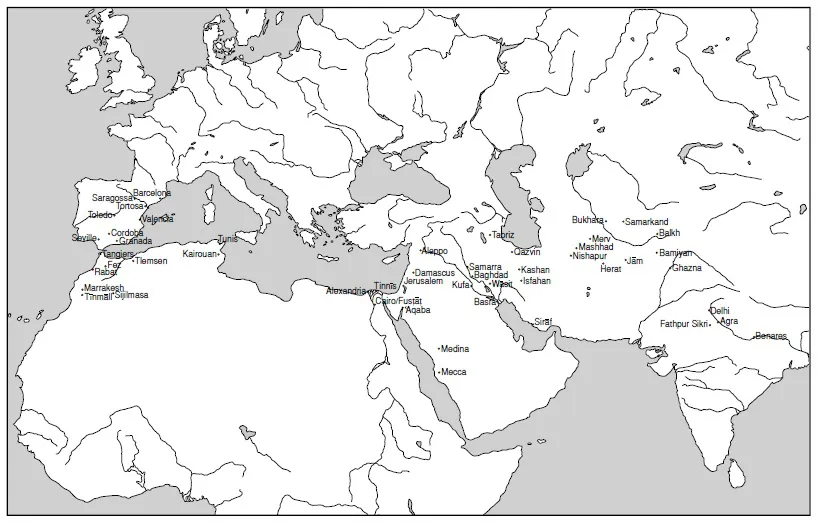
The volume’s remit is broad in both chronological and spatial terms. It looks at the pre-modern city from Umayyad to Ottoman times within a geographic area stretching from the Iberian peninsula in the west to Central Asia and north India in the east (Figure 1.1). It would be impossible to cover such a span exhaustively; therefore it presents snapshots of different cities in various epochs with the aim of studying processes rather than identifying the quintessential characteristics of such cities. The choice of period and the use of the adjective ‘pre-modern’ are based on the assumption that the rise of the European colonial empires in the nineteenth century and the forms of Western-driven globalisation that followed did transform the urban landscape and raise quite different academic concerns from those relevant to the earlier period. The construction of new colonial cities, the ‘ghettoisation’ of older indigenous settlements, the modernisation of cities and the concomitant political, social and economic changes that took place make it appropriate to consider the nineteenth century as the end of one era and the start of another. Although some historians of the Middle East follow a European historical chronology according to which the post-1500 era is called ‘early modern’, in terms of the city it seems more appropriate to consider Raymond’s ‘traditional city’ a feature of the landscape until the nineteenth century at least.
To begin with the Islamic conquests and consider the period from the seventh century AD until the colonial era as a single unit may appear to contravene Alsayyad and Raymond’s plea for greater sensitivity to changes occurring over time, and lead us into the trap of accepting without question the Orientalist assumption that Islam had a definitive role in shaping all aspects of urban life. However, the assertion of Muslim political control over numerous urban centres and their creation of new towns does allow us to flag up the Islamic conquests as heralding in a new era despite the often gradual nature of change and the continuities from late antiquity that are indubitably present. Moreover, it is the prerogative of an edited volume to bring together work that might otherwise not be viewed in parallel: we have deliberately sought diversity, temporal and geographical, in order to draw into focus areas of difference as well as similarity, and to present religious and literary ideals that may have had quite wide circulation in space and time alongside real examples of urban conformity, non-conformity and interaction with such ideals. Finally, the study of cities and urbanism in the Islamic world is a recognised field even if some of its ideological antecedents are dubious. For this reason, the volume does not cover cities in the sameregion before the rise of Islam or attempt to make extensive synchronic comparisons with cities in non-Muslim parts of the world.
Figure 1.1 Map of the Islamic lands showing the locations of the main centres discussed in the volume. Drawing by Piet Collet.
Two key terms need further elucidation: ‘city’ and ‘religion’. With respect to the former, although Wheatley describes all urban entities as cities, he also recognises the different ‘levels’ of settlement that existed in a continuum from large villages to substantial conurbations. Arabic speakers, and Muslims in general, used many different terms for urban settlements and associated structures such as forts and citadels. In the early Islamic period, a distinction existed between garrison towns (miṣr, amṣār) and more fully developed cities (madīna, madīnāt). Later the term madīna was also applied to royal complexes. The term qaṣr covered a multitude of units from a luxurious residence or walled palace to a fortified town or village. Terms for frontier settlements such as ḥuṣn, thughr and ribāṭ had similarly fluid meanings that shifted with place and time. We have attempted to convey some sense of this bewildering variety in our choice of urban sites, which include not only familiar metropoli like Cordoba, Cairo and Isfahan but also less well known locations such as Madīnat al-...