Research on human judgment and decision making has been strongly guided by a normative/descriptive approach, according to which human decision making is compared to the normative models provided by decision theory, statistics, and the probability calculus. A common empirical finding has been that human behavior deviates from the prescriptions by normative models--that judgments and decisions are subject to cognitive biases. It is interesting to note that Swedish research on judgment and decision making made an early departure from this dominating mainstream tradition, albeit in two different ways. The Neo-Brunswikian research highlights the relationship between the laboratory task and the adaptation to a natural environment. The process-tracing approach attempts to identify the cognitive processes before, during, and after a decision. This volume summarizes current Swedish research on judgment and decision making, covering topics, such as dynamic decision making, confidence research, the search for dominance structures and differentiation, and social decision making.
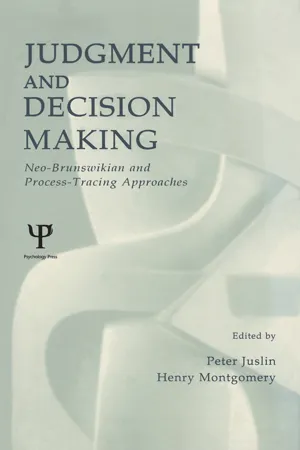
eBook - ePub
Judgment and Decision Making
Neo-brunswikian and Process-tracing Approaches
- 352 pages
- English
- ePUB (mobile friendly)
- Available on iOS & Android
eBook - ePub
Judgment and Decision Making
Neo-brunswikian and Process-tracing Approaches
About this book
Information
Chapter 1
Introduction and Historical Remarks
Peter Juslin
Uppsala University
Henry Montgomery
Stockholm University
Uppsala University
Henry Montgomery
Stockholm University
Cognitive psychology is approaching its fortieth anniversary. In this relatively short period, the field has seen immense growth, and specialization into various subdomains like research on memory, problem solving, attention, and language acquisition. Moreover, cognitive psychology is starting to merge with other disciplines, as exemplified by the recent developments referred to as cognitive science and cognitive neuroscience. One of the remarkable features of Swedish work in cognitive psychology is the strong position of judgment and decision making (JDM) research, going back to Mats Björkman’s studies of judgment in the sixties (e.g., Björkman, 1965). This observation is made not to de-emphasize the impact of contributions made by Swedes working in other areas, but only to point out that from an international perspective, problems of judgment and decision making have attracted the interest of a surprising number of researchers in Sweden. Their interest is reflected in the chapters of this volume.
Cognitive research on JDM has been greatly influenced by normative models for decision making under uncertainty derived from statistics and economics. The mother of all such normative models originates in Pascal’s Wager from 1658 (Hacking, 1975), in which the idea of rational decision making as maximization of expected value is first presented. The modern incarnation of Pascal’s idea—the theory of maximization of subjective expected utility (SEU theory)—imposes constraints on a person’s decision making that allow the decisions to be interpreted as maximization in terms of a subjective utility function and a subjective probability measure (e.g., Savage, 1954). The strong influence of SEU theory on cognitive JDM research has had two important consequences: First, decision making has been conceived of in terms of the two main subcomponents of SEU theory; utility functions and subjective probabilities. Second, research has been guided by a normative/empirical approach, where human decision behavior is compared to the normative yardstick provided by SEU theory. Because SEU theory stresses the subjective nature of utility and probability, it is concerned with the coherence of preferences and beliefs, rather than the correspondence between subjective and environmental states (Hammond, 1996). The research inspired by SEU theory has produced an impressive list of phenomena that seem to demonstrate that human decision behavior violates the coherence requirements of SEU theory—in the popular jargon, that people are victims of cognitive biases (Kahneman, Slovic, & Tversky, 1982).
In view of this dominant influence of SEU theory on JDM research, it is interesting to note that Swedish JDM research has come to depart from this tradition, albeit in two rather different ways. One line of research introduced by Mats Björkman in the 1960s has been influenced by the probabilistic functionalism of Egon Brunswik (Brunswik, 1952; Hammond, 1966); the second line of research was inspired by the work on cognitive processes in other areas of cognitive psychology, primarily problem solving (Newell & Simon, 1972). Both of these traditions in Swedish JDM research are amply illustrated in the chapters of this volume.
Neo-Brunswikian Research on Judgment and Decision Making
Chapters 2, 3, and 4 are concerned with dynamic decision making. The research reported in these chapters deviates from traditional JDM research in both of the aspects discussed above. The decision problem is no longer thought of in terms of utilities and probabilities, or maximization of an expected value, but in terms of prolonged interaction with a complex and dynamic system where the decision problem largely takes the form of attaining control of the system. Moreover, the coherence norm is replaced by an evaluation of the correspondence between the intended state of the system and the actual state. Chapter 2 (Brehmer) illustrates how people faced with a dynamic decision task develop simple and efficient heuristics that allow reasonable decision making, despite falling short of rationality as defined by SEU theory. In Chapter 3 (Jansson) research on dynamic decision is applied to the poorly structured problems encountered in everyday life, with a particular concern for the interaction between the goal formulation process and the formation of mental models. In Chapter 4 (Rigas and Brehmer), the puzzling relationship between psychometric intelligence and performance in dynamic decision tasks receives closer scrutiny. The research on dynamic decision making provides one example of a neo-Brunswikian concern with representative design (Brunswik, 1952). The simulation of dynamic systems is an attempt to present the participants in the laboratory with realistic samples of the causal texture of the environment, or at least samples with many properties in common with a real-life decision task.
A second area with a recent re-emergence of Brunswikian ideas is in research on realism or calibration of subjective probabilities (confidence). Subjective probability assessments are well calibrated to the extent that they are realized in terms of the corresponding relative frequencies; that is, in subjective probability category .xx, the event should occur with relative frequency .xx. The Brunswikian idea of representative design was introduced in the area by the so called ecological models (McClelland & Bolger, 1994), which propose that one important contributor to the overconfidence phenomenon is a violation of representative design. This research is still within the SEU paradigm in the sense of being concerned with subjective probabilities. However, the issue of calibration is approached with models that highlight the correspondence between subjective probabilities and ecological probabilities and thus transcends the traditional coherence norm of SEU theory.
Chapter 5 (Juslin and Olsson) presents theoretical models of calibration of subjective probabilities based on the distinction between Brunswikian and Thurstonian origins of uncertainty in judgment (Juslin & Olsson, 1997). Besides the ecological models, the chapter presents a number of computational models that add stochastic components to the judgment processes of the Brunswik-inspired ecological models (see Erev, Wallsten & Budescu, 1994, on stochastic components). In Chapter 6 (Winman and Juslin), a new model of the hindsight or “knew-it-all-along” phenomenon is presented. This model—the accuracy-assessment model (Winman, Juslin, & Björkman, 1998)—exemplifies the need to carefully understand what the participants are trying to achieve with their judgments, again a basic tenet of Brunswikian psychology. In hindsight experiments the participants may not only be concerned with reproducing the exact answers they selected in foresight (process simulation), but also with producing an overall response pattern that seems appropriate to the accuracy expected in the task. Chapter 6 (Allwood and Björhag) elaborates on how confidence judgments relate to a wider realm of behavior, where the context, social norms, and motivational factors become important. It is proposed that calibration of confidence is determined by multiple factors—reviewed and discussed in the chapter—go beyond what is captured by any current models of confidence in judgment.
Process-Tracing in Human Decision Making
In the early seventies, Svenson (1974) published a technical report, which subsequently was widely cited in JDM research. Svenson showed that think-aloud data could be used to study the cognitive processes in decision making. This work was continued by Montgomery and Svenson (1976), who proposed that decision making is a sequential process in which different decision rules and information processing strategies can be used at different points in time in order to minimize cognitive effort. This theoretical framework inspired the development of two cognitive process theories of human decision making, namely search for dominance structure (SDS) theory (Montgomery, 1983) and differentiation and consolidation (Diff Con) theory (Svenson, 1992). These theories are presented in Chapters 8 (Montgomery and Willén) and 9 (Svenson), respectively. Both theories stress that decision making is a constructive activity that aims to prepare the individual for efficient action. The theories differ in their view of the role of information structuring and how decision rules are used. SDS theory regards decision making as a search for a good structure (i.e., a structure in which one alternative is dominant). In this search, decision rules play a subordinate role. Diff Con theory views the structuring and the use of decision rules as separate activities, which in conjunction help the decision maker to find sufficient differentiation between the alternatives. Diff Con theory is also concerned with consolidation processes, following after the decision, a topic that is left aside in SDS theory. Chapter 8 also discusses a recent development of SDS theory—the perspective model—that in some respects bridges the gap between SDS theory and Diff Con theory.
The constructive and adaptive nature of JDM is further highlighted in the two chapters that follow. In Chapter 10, Gärling, Karlsson, and Selart investigate how people use mental accounts to control their actions in everyday economic decision making. The idea is that by assigning one’s overall wealth into different mental accounts (e.g., current assets, current income, or future income), one will end up with different propensities to consume. Sjöberg criticizes the expectation models of attitude in Chapter 11. In line with SEU theory these models assume that attitudes are formed by combining relatively stable beliefs and values. In contrast, Sjöberg proposes that attitudes as well as values and beliefs are constructed from a common underlying image—the subjective associations connected with the attitude-object.
Chapters 12 through 14 posits JDM in a social context, where outcomes—in one way or another—are determined jointly by the decisions by several individuals. In Chapter 12, Biel, Eek, and Gärling investigate the role of norms as guides to decisions in social dilemmas that complement the evaluation of outcomes. They find that norms matter in social decision making, but in different ways depending on the context of the social dilemma (e.g., what is considered as a fair distribution of outcomes in one context may be perceived as unfair in another). In Chapter 12 Selart and Eek discuss how people who face social decisions (i.e., decision concerning justice) adapt to task and context factors. Finally, in Chapter 14 Hemlin applies JDM research and research on group processes to the peer-review process in science (e.g., at scientific journals and funding agencies). The volume ends with commentaries by Hammond and Fischhoff that serve to place the research presented in the volume into the grander picture of current trends in international JDM research. Hammond provides a penetrating discussion and criticism of the neo-Brunswikian research performed in Sweden, from the perspective of more traditional Brunswikian theory. Fischhoff elaborates on the characteristic features of Swedish JDM research in the process-tracing tradition.
The volume has been subdivided into three main sections. The first section presents chapters that stress the relationship between the laboratory task and the tasks people meet in their natural environments, and in other respects explicitly acknowledge a Brunswikian inheritage. The second section concentrates on JDM as a mental process, and mainly provides work in the tradition of process-tracing studies. The third section highlights the social aspects of JDM. The headings of these three sections are, of course, meant to convey central points of emphasis, and not to be imperative or exhaustive in any sense. Needless to say, “Brunswikians” are interested in mental processes and researchers in the process-tracing tradition acknowledge the importance of considering the natural context of JDM-processes.
The year during which this volume was prepared (1997) is not only the fortieth since the birth of cognitive psychology, but the seventieth since the birth of Mats Björkman—the researcher who pioneered Swedish JDM studies. The contributors to this volume are all colleagues, former doctoral students or “grand” students of Mats Björkman. It is therefore a great pleasure for us to dedicate this volume to him. We also acknowledge the support by the Swedish Council for Research in the Humanities and Social Sciences in the preparation of this volume.
References
Björkman, M. (1965). Studies in predictive behavior. Explorations into predictive judgments based on estimation, categorization, and choice. Scandinavian Journal of Psychology, 6, 129–156.
Brunswik, E. (1952). The. conceptual framework of psychology. Chicago: University of Chicago Press.
Erev, I., Wallsten, T.S., & Budescu, D.V. (1994). Simultaneous over- and underconfidence: The role of error in judgment processes. Psychological Review, 101, 519–527.
Hacking, I. (1975). The emergence, of probability. London: Cambridge University Press.
Hammond, K.R. (1966). Probabilistic functionalism: Egon Brunswik’s integration of the history, theory, and method of psychology. In K.R.Hammond (Ed.), The. psychology of Egon Brunswik. New York: Holt, Rinehart, & Winston.
Hammond, K.R. (1996). Human judgment and social polity: Irreducible uncertainty, inevitable error, unavoidable injustice. New York: Oxford University Press.
Juslin, P., & Olsson, H. (1997). Thurstonian- and Brunswikian origins of uncertainty in judgment: A sensory sampling model of confidence in sensory discrim...
Table of contents
- Cover
- Half Title
- Title
- Copyright
- Dedication
- Contents
- 1. Introduction and Historical Remarks
- PART I: JUDGMENT AND DECISION MAKING IN AN ENVIRONMENTAL CONTEXT
- PART II: JUDGMENT AND DECISION MAKING AS MENTAL PROCESSES
- PART III: JUDGMENT AND DECISION MAKING IN A SOCIAL CONTEXT
- PART IV: COMMENTARIES
- Author Index
- Subject Index
Trusted by 375,005 students
Access to over 1.5 million titles for a fair monthly price.
Study more efficiently using our study tools.
Frequently asked questions
Yes, you can cancel anytime from the Subscription tab in your account settings on the Perlego website. Your subscription will stay active until the end of your current billing period. Learn how to cancel your subscription
No, books cannot be downloaded as external files, such as PDFs, for use outside of Perlego. However, you can download books within the Perlego app for offline reading on mobile or tablet. Learn how to download books offline
Perlego offers two plans: Essential and Complete
- Essential is ideal for learners and professionals who enjoy exploring a wide range of subjects. Access the Essential Library with 800,000+ trusted titles and best-sellers across business, personal growth, and the humanities. Includes unlimited reading time and Standard Read Aloud voice.
- Complete: Perfect for advanced learners and researchers needing full, unrestricted access. Unlock 1.5M+ books across hundreds of subjects, including academic and specialized titles. The Complete Plan also includes advanced features like Premium Read Aloud and Research Assistant.
We are an online textbook subscription service, where you can get access to an entire online library for less than the price of a single book per month. With over 1.5 million books across 990+ topics, we’ve got you covered! Learn about our mission
Look out for the read-aloud symbol on your next book to see if you can listen to it. The read-aloud tool reads text aloud for you, highlighting the text as it is being read. You can pause it, speed it up and slow it down. Learn more about Read Aloud
Yes! You can use the Perlego app on both iOS and Android devices to read anytime, anywhere — even offline. Perfect for commutes or when you’re on the go.
Please note we cannot support devices running on iOS 13 and Android 7 or earlier. Learn more about using the app
Please note we cannot support devices running on iOS 13 and Android 7 or earlier. Learn more about using the app
Yes, you can access Judgment and Decision Making by Peter Juslin,Henry Montgomery in PDF and/or ePUB format, as well as other popular books in Psychology & Cognitive Psychology & Cognition. We have over 1.5 million books available in our catalogue for you to explore.