When can contexts and diversity be resources, rather than risks, for children's developmental pathways? Scholars, policy makers, and practitioners increasingly realize that middle childhood matters as a time when children's pathways diverge, as they meet new and overlapping contexts they must navigate on their way to adolescence and adulthood. This volume shines new light on this important transition by tracing how these contexts -- cultural, economic, historical, political, and social -- can support or undermine children's pathways, and how children's own actions and the actions of those around them shape these pathways. With a focus on demographic changes taking place in the U.S., the volume also maps how experiences of diversity, reflecting culture, ethnicity, gender, and social class, matter for children's life contexts and options.
Chapters by a team of social scientists in the MacArthur Foundation Research Network on Successful Pathways through Middle Childhood present the fruits of ten years of research on these issues with diverse cultural and ethnic communities across the U.S. These include:
*a set of models and measures that trace how contexts and diversity evolve and interact over time, with an epilogue that aligns and compares them;
*surprising new findings, quantitative and qualitative, with cases showing how children and families shape and are affected by their individual, recreational, institutional, and cultural experiences; and
*applications to policy and practice for diverse children and families.
The importance of these new models, methods, findings, and applications is the topic of commentaries by distinguished scholars with both U.S. and international perspectives.
The book is intended for researchers, practitioners, and policy makers, as well as students in psychology, sociology, and education.
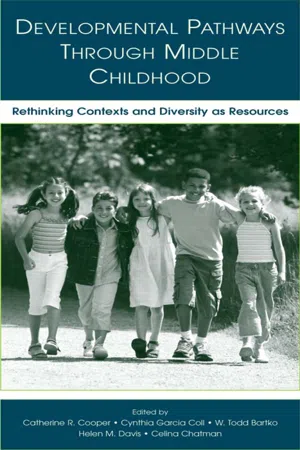
eBook - ePub
Developmental Pathways Through Middle Childhood
Rethinking Contexts and Diversity as Resources
- English
- ePUB (mobile friendly)
- Available on iOS & Android
eBook - ePub
Developmental Pathways Through Middle Childhood
Rethinking Contexts and Diversity as Resources
About this book
Information
T H E M E
1
HOW ADULTS AND CHILDREN, THROUGH THEIR PERCEPTIONS AND ACTIONS, CONNECT RESOURCES ACROSS FAMILY, SCHOOL, AND COMMUNITY CONTEXTS
C H A P T E R
1
Family Educational Involvement: Who Can Afford It and What Does It Afford?
Heather B. Weiss
Harvard Family Research Project
Eric Dearing
University of Wyoming
Ellen Mayer
Holly Kreider
Harvard Family Research Project
Kathleen McCartney
Harvard Graduate School of Education
Family educational involvement is a primary component of national efforts such as Head Start and Title I to increase the academic performance of children at risk for underachievement (Nakagawa, 2000). Broadly defined, family educational involvement consists of the activities that families engage in to support or enhance their children’s learning. Although meta-analyses have found positive effects of family involvement on children’s achievement (Fan & Chen, 2001; Jeynes, 2003), other reviews have pointed out numerous methodological limitations in this research (Baker & Soden, 1997; Mattingly, Prislin, McKenzie, Rodriquez, & Kayzar, 2003). This study uses multiple methods to extend previous work on family educational involvement by highlighting links between social-ecological context, family involvement, and children’s achievement over time.
FAMILY EDUCATIONAL INVOLVEMENT AS SOCIAL CAPITAL
Family educational involvement includes academically-oriented parenting behaviors such as reading to the child and participating in school activities such as volunteering in the child’s classroom. Theorists posit that involvement is linked with achievement via the social capital that schools provide parents, and in turn, that parents provide their children (for a review, see Marjoribanks, 2002). Parent–teacher and parent–child relationships form two parts of the triad of relationships linking parents, teachers, and children. These relationships facilitate a flow of information that supports children (Coleman, 1991). For example, social interaction with teachers and other school personnel can provide parents access to expertise and the culture of schools. In turn, academically-oriented social interaction between parents and children facilitates achievement by providing children access to their parents’ knowledge, regarding both scholastic expertise and school culture. In addition, parent-to-child socialization processes directed at children’s social-emotional development (e.g., behavior regulation) may occur during parents’ involvement in their children’s education (Hagan, MacMillan, & Wheaton, 1996).
There is an emerging set of empirical findings supporting the use of family involvement programs for at-risk children and families. In their recent synthesis, Henderson and Mapp (2002) concluded that there is a “positive and convincing relationship between family involvement and benefits for students, including improved academic achievement” (p. 24). Most studies, however, include only one contemporaneous assessment of child performance and family involvement. Although this is a useful step in estimating the association between involvement and child functioning, these studies cannot address the effects of involvement on children’s achievement trajectories.
In addition, nonexperimental studies based on single assessments are usually limited in their ability to control for omitted variable bias and reverse causation. Notably, however, Izzo and colleagues (Izzo, Weissberg, Kasprow, & Fendrich, 1999) completed a longitudinal study of family involvement from kindergarten to third grade and reported that increases in family involvement were associated with achievement gains. Yet, family educational involvement does not occur in a vacuum. There is likely a complex interplay between involvement and the family or school contexts in which involvement is embedded.
FAMILY EDUCATIONAL INVOLVEMENT IN CONTEXT
Social-ecology theorists have emphasized the need to understand child development as a process nested within both proximal and distal contexts that influence and are influenced by children (Bronfenbrenner, 1979; Sameroff & Fiese, 2000). Ecologically-valid assessments of links between family educational involvement and child achievement call for conceptual and empirical models that examine developmental contexts within and outside the home environment, mechanisms linking context and development, and continuity and change in these processes over time using multilevel analytical strategies. This attention to contexts outside the home may be particularly important during middle childhood when children are transitioning into school (Eccles, 1999).
Researchers, in fact, consistently find variations in educational involvement across levels of income, with lower-income families displaying lower rates of involvement at home and school compared with other families (e.g., Lareau, 1989). Differences have been explained in part by working class parents’ limited cultural capital for complying with school involvement requests, their deference to teachers’ professionalism (which is an obstacle to communication with the school), and researchers measuring middle class types of involvement (Crozier, 1999; Lareau, 1989).
Family involvement researchers also have studied the role of contexts and relationships outside the family, most notably classroom and school contexts and parent–teacher relationships. Work in this area has been focused on classroom, school, and teacher affordances for educational involvement (Eccles, 2001; Gibson, 1966, 1979). That is, researchers have begun to examine characteristics of these contexts and relationships that may facilitate and support family educational involvement.
Teacher outreach to parents, for example, is positively associated with family involvement in the classroom (Epstein & Dauber, 1991), and the size of this association is largest for less educated, poor, and single parents (Becker & Epstein, 1982; Epstein, 1990). Yet, the results of research linking schoollevel predictors and involvement have been more complex. Feuerstein (2000), for example, found school contact with parents to be associated with involvement at school and home–school communication, but not involvement at home. Further, the provision of opportunities for educational involvement may not translate into high involvement levels if schools experience high family mobility (Nakagawa, Stafford, Fisher, & Matthews, 2002).
It also remains unclear whether classroom and school contexts that afford family educational involvement are stimulating children’s academic achievement, either indirectly or directly. In other words, evidence exists that school contexts are associated with level of family involvement and that level of family involvement is associated with child outcomes, but formal tests of the hypothesis that family educational involvement mediates the link between school context and child outcomes are rare. School characteristics, such as staff quality, may directly impact child achievement through quality of education, but may also indirectly impact achievement via family educational involvement, such that higher-quality staff may facilitate increases in involvement, which in turn may increase children’s achievement.
In addition, most family involvement research is based on main effect questions such as the following: “Is family involvement associated with child outcomes” (Epstein & Sheldon, 2002)? Although informative, main effect questions regarding family involvement ignore the potentially complex interplay between involvement and the contexts in which it occurs. Families living in high-risk contexts are often diverse with regard to social niche such as level of education (Furstenberg, Cook, Eccles, Elder, & Sameroff, 1999); as such, the effects of family educational involvement may vary across children living in low-income families. Identifying the causes of these variations is a means of identifying children for whom family involvement provides the greatest benefits, a point relevant to intervention policies.
If family educational involvement provides parents and their children access to human and cultural and institutional resources, then families who have few alternative means of gaining this capital should benefit most from educational involvement. Families in which the parents have low levels of education are a case in point. More specifically, parents’ access to teacher expertise and the institutional culture of schools via involvement should be most important for parents who have less formal educational experiences, primarily because these parents are less likely to have academic expertise and knowledge of school culture compared with other parents.
There is clear evidence of a link between family educational involvement and children’s academic achievement (Eccles & Harold, 1993; Fan & Chen, 2001; Henderson & Mapp, 2002). However, the role of school context has been understudied in this research. In this study, we examine family involvement during kindergarten as a process that has both contemporaneous and developmental implications for children and that is nested within family, classroom, and school contexts. We define family involvement as behaviors that parents engage in to support their children’s learning, such as attendance at school events (e.g., PTO meetings), academic activities at home (e.g., reading at home), and parent communication with the teacher, school, or other parents. Notably, our examination uses a sample of lowincome families that are diverse with regard to both ethnicity and U.S. geographic region. Further, we use both quantitative and qualitative analytic strategies.
Integrating social capital and social-ecology perspectives, this study emphasizes three points: (a) family educational involvement functions via the social transmission of human and cultural and institutional resources of schools to parents and in turn to children, (b) some contexts and relationships may facilitate and support this social transmission of resources more than other contexts and relationships, and (c) these resources may be particularly valuable for families with lower levels of educational experience, primarily because these families are less likely to possess human and cultural resources associated with schools. We use quantitative methods to examine whether teacher outreach to parents and school context (e.g., availability of family support services) heightens educational involvement for low-income families and, in turn, child academic achievement; in other words, do these contexts provide affordances for educational involvement and thereby provide affordances for child academic success? We also explore for whom family educational involvement affords the most. That is, we examine how links between family educational involvement and child achievement vary as a function of family educational background. We hypothesize that family involvement during kindergarten will have more positive effects on achievement for children from less educated families who are at greater risk for school failure compared with other children.
In addition, we examine qualitatively the meanings, contexts, and processes of family involvement for lower education mothers, and explore how these processes may support their children’s literacy development. Taken together, our quantitative and qualitative analyses tell a fuller story of social capital processes linking social-ecological context, family educational involvement, and children’s achievement pathways for mothers with limited levels of education.
QUANTITATIVE METHODS
Participants
Data for this study were drawn from the School Transition Study (STS), a multicohort longitudinal follow-up investigation to the experimental impact evaluation of the Comprehensive Child Development Program (CCDP). The CCDP was a federally funded early intervention program for low-income children and their families from birth to kindergarten. The STS included children from 3 of the original 21 sites across the United States from kindergarten through fifth grade (n = 390). Sites included a Western city with a primarily Latino population (site 1; n = 125), a Northeastern city with a primarily African American population (site 2; n = 175), and a rural New England town with an almost entirely White population (site 3; n = 90). These three sites were selected to provide a diverse array of families with regard to geographic region and ethnicity.
This study draws from the largest cohort of children (N = 213), who began kindergarten in 1995. This cohort of children includes a large number of African American children (81, 38%), approximately equal numbers of White (57, 26.8%) and Hispanic (55, 25.8%) children, and small numbers of biracial children (7, 3.3%) and children of other ethnic backgrounds (13, 8.8%). More than half of the children (111, 51.9%) lived in single-parent households while in kindergarten. The sample consisted overwhelmingly of mothers who were primary caregivers (five fathers and eight grandmothers were primary caregivers); hereafter we refer to primary caregivers as mothers. None of the mothers reported family incomes in excess of $40,000; the vast majority (196, 94.2%) earned below $20,000, and more than three quarters (162, 77.9%) were living on less than $12,000 a year. In addition, many of the mothers (70, 33.2%) had less than a high school education. About equal numbers reported that their education ended at 12th grade (52, 24.4%) or that they had taken a few college courses (55, 25.8%).
The quantitative analyses set included 167 of the 213 children in the sample, as well as their families, teachers, and schools. The 46 children omitted from the analyses (due to missing principal or teacher reports) were not significantly different from other children on key demographic indicators (child ethnicity and gender; maternal education, partner status, age at child birth, and primary language; study site).
Measures
Demographic data were collected for children and their families during recruitment and enrollment into the CCDP. For this study, four of these “baseline” demographic characteristics of children and families were used as model covariates in statistical analyses: child ethnicity, child gender, maternal age at childbirth, and maternal primary language. Additional demographic data were collected during the parent interview at kindergarten. For this study, maternal education and partner status were included in statistical analyses.
School-level affordances were measured via principal reports of the overall school context. School principals completed 74-item self-report questionnaires related to aspects of their schools’ environments including characteristics of teacher and staff (e.g., quality of instruction), students (e.g., percentage at grade level), families (e.g., parental cooperation), and the school facility (e.g., computer resources). Principals’ reports of their school contexts were analyzed using principle components factor analysis.
Three factors explained over 30% of the variance in the principal reports. Based on these factors, three composite variables were formed using questionnaire items with factor loadings of .45 or higher on a rotated (i.e., varimax) component matrix (see Table 1.1 for the top five loading items for each factor, reliability estimates, and intercorrelations). Although the first factor contained items reflecting child and family problems in schools, we reverse scored this factor so that higher scores on all school context variables represented better school environments. We labeled these three variables Child and Family Strengths (20 items), Supports and Services (10 items), and Staff and Community Investment (11 items). High scores on Child and Family Strengths indicated that principals perceived their
TABLE 1.1
Item Loadings for Principal Report Factors
Item Loadings for Principal Report Factors
schools as having a high level of student performance, involved parents, and few student behavior problems. High scores on Supports and Services indicated that principals perceived their schools as having a high level of physical resources (e.g., books) and servic...
Table of contents
- Cover Page
- Title Page
- Copyright Page
- Foreword
- Acknowledgments
- Editors’ Introduction
- Theme 1
- Theme 2
- Theme 3
- Epilogue: Mapping Concepts of Contexts, Diversity, and Pathways Across Disciplines
Trusted by 375,005 students
Access to over 1.5 million titles for a fair monthly price.
Study more efficiently using our study tools.
Frequently asked questions
Yes, you can cancel anytime from the Subscription tab in your account settings on the Perlego website. Your subscription will stay active until the end of your current billing period. Learn how to cancel your subscription
No, books cannot be downloaded as external files, such as PDFs, for use outside of Perlego. However, you can download books within the Perlego app for offline reading on mobile or tablet. Learn how to download books offline
Perlego offers two plans: Essential and Complete
- Essential is ideal for learners and professionals who enjoy exploring a wide range of subjects. Access the Essential Library with 800,000+ trusted titles and best-sellers across business, personal growth, and the humanities. Includes unlimited reading time and Standard Read Aloud voice.
- Complete: Perfect for advanced learners and researchers needing full, unrestricted access. Unlock 1.5M+ books across hundreds of subjects, including academic and specialized titles. The Complete Plan also includes advanced features like Premium Read Aloud and Research Assistant.
We are an online textbook subscription service, where you can get access to an entire online library for less than the price of a single book per month. With over 1.5 million books across 990+ topics, we’ve got you covered! Learn about our mission
Look out for the read-aloud symbol on your next book to see if you can listen to it. The read-aloud tool reads text aloud for you, highlighting the text as it is being read. You can pause it, speed it up and slow it down. Learn more about Read Aloud
Yes! You can use the Perlego app on both iOS and Android devices to read anytime, anywhere — even offline. Perfect for commutes or when you’re on the go.
Please note we cannot support devices running on iOS 13 and Android 7 or earlier. Learn more about using the app
Please note we cannot support devices running on iOS 13 and Android 7 or earlier. Learn more about using the app
Yes, you can access Developmental Pathways Through Middle Childhood by Catherine R. Cooper,Cynthia T. Garc¡a Coll,W. Todd Bartko,Helen M. Davis,Celina Chatman in PDF and/or ePUB format, as well as other popular books in Psychology & Developmental Psychology. We have over 1.5 million books available in our catalogue for you to explore.