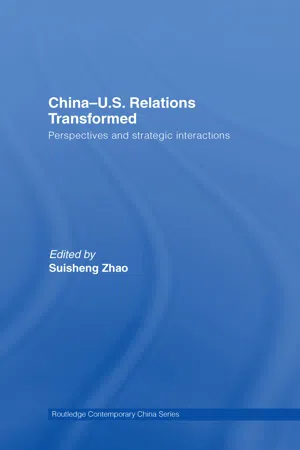
China's emergence in the 21st century to the status of great power has significant implications for its relationship with the United States, the sole superpower in the post-Cold War World. Now that China is rising as an economic, political, and military power and has expanded its diplomatic activism beyond Asia into Europe, Latin America, Africa, and the Middle East, its rise has profoundly transformed its relationship with the US and compelled leaders in both countries to redefine their positions toward each other. This book, written by leading scholars and policy analysts from both the US and China, explores the transformation and multifaceted nature of US-China relations, including how the political elite in both countries have defined their strategic objectives in response to China's rise and managed their relations accordingly. It provides an up-to-date analysis on the policy adjustments of the last decade, and covers all the important issue areas such as security, nuclear deterrence, military modernization, energy, trade and economic interaction, and Asia-Pacific power reconfiguration. It does not seek to confirm either an alarmist or optimistic position but presents different views and assessments by foreign policy specialists with the hope that leaders in Washington and Beijing may make positive adjustments in their policies to avoid confrontation and war. It will also be an invaluable resource for students and scholars of US and Chinese politics, international relations and comparative politics.
- 256 pages
- English
- ePUB (mobile friendly)
- Available on iOS & Android
eBook - ePub
Part I
Introduction
1
Implications of China’s rise for U.S.–China relations
An ancient empire, China was one of the most powerful nations in the world before the spread of the Industrial Revolution that gave rise to modern European powers, the U.S.A., and Japan. A mid-kingdom, accounting for about one third of the world output as recently as the early nineteenth century, China began a steady decline thereafter as it plunged into war, famine, isolation, and revolution. After about 200 years of struggle for national independence and modernization, China reemerged as a global power in the twenty-first century. If China is able to sustain the momentum of the recent decades, it will ultimately regain the glorious position it enjoyed two centuries ago. The Summer Olympics of 2008 is a symbol of this national resurgence from a dark cocoon of decline and isolation into the light of international recognition.
China’s rise certainly poses a serious challenge to public policy-makers everywhere in the world, particularly to policy-makers in the U.S.A., the sole superpower in the post-Cold War world. While some Americans welcome China’s rise as creating new opportunities for great power cooperation, others worry about a “China threat” to U.S. security and economic interests as China now demonstrates its rapidly rising power as a counterweight to U.S. influence. Has China’s rise led U.S.–China relations toward a vicious conflict for war or toward a convergence of interests for cooperation? Can the two countries manage their rivalry and competition to preserve peace by exploring areas in which China’s national interests overlap U.S. interests and where cooperation brings mutual benefits? This book represents a modest effort by leading scholars and policy analysts from the U.S.A. and China to examine the dynamics of transformation and multifaceted nature of U.S.–China relations. Focusing on how the political elite in both countries define their strategic objectives in response to China’s rise and manage their relationship accordingly, this book looks at strategic issues facing policy-makers in the U.S.A. and China and explores where this crucially important bilateral relationship is heading.
The transformation of U.S.–China relations
In spite of theoretical equality and anarchy in the modern nation-state system, a hierarchical structure often exists among states, reflecting variations in their relative power status. Hegemonic states command dominant positions over other states, resting on a robust economic base and military capabilities, supplemented and solidified by soft normative power. The hegemonic states have a vested interest in maintaining the established international system because their values and interests are often universalized to the point where they largely conform to the rules, values, and institutions of the system. Rising powers, however, often demand a change in the power hierarchy and become challengers to the established system. Historically, the rise of great powers has always been associated with a transformation in the relationship between the rising powers and their more established counterparts. Sometimes this rise has even produced a restructuring of the hierarchy, i.e. a power transition from dominant states to challengers in the international system.1 Whether or not a systemic power transition took place, the inevitable power competition often caused disruptive conflicts and even large-scale wars. During the twentieth century, except for the competition between the U.S.A. and the U.K. that resulted in a more or less peaceful power transition from a hegemonic Pax Britannica to a Pax Americana, all other great power competitions were violent and disruptive. For example, the rivalry between Germany and the U.K. was one of the causes leading to World War I; the emergence of Germany and Japan was followed by World War II; and the competition between the Soviet Union and the U.S.A. caused a prolonged Cold War.
Now China is rising and its rising power status is recognized by many Americans. A 2006 survey by the Chicago Council on Global Affairs and the Asia Society shows that “60% of Americans believe that China’s economy will grow to be as large as the US economy within two decades or so.”2 Utilizing its rising economic power in foreign affairs, China’s diplomatic activism has been increasingly observed well beyond its neighboring Asian countries into Latin America, Africa, the Middle East, and Europe. Although China has not reached the position of parity with American power, its rapid rise has profoundly transformed the Sino-U.S. relationship and made the bilateral relationship increasingly strategic and globally significant. Consequently, a profound debate about the implications of China’s rise for U.S.–China relations has taken place among scholars and policy-makers in both the U.S.A. and China.
Liberal optimists believe that globalization has produced growing strategic interdependence among great powers. This strategic interdependence constrains the U.S.A. and China from pursuing zero-sum strategies toward each other. As a result, China’s rise has increased the common stakes for these two countries to expand cooperation on almost all important international issues, such as trade and investment, fighting terrorism, the proliferation of weapons of mass destruction, trade liberalization, environmental protection, energy, transnational crime, and pandemic diseases. As an American scholar has argued, globalization is reshaping the international strategic environment, in which the interests of the U.S.A. and China will limit strategic competition and compel closer cooperation in response to shared strategic threats and challenges. Although this high-level common interest does not preclude sharp differences over specific issues, it is likely to create pressure on both countries to cooperate in many areas to defend, maintain, and strengthen the international system and to restrain them from pursuing containment or confrontational strategies.3 Strategic and economic interdependence thus become positive forces for integrating China into the established international system in which self-interests and growing networks of international involvement will impose their own constraints and help ensure its emergence as a responsible stakeholder in the international system. This view is echoed by another American scholar: “Fortified by both globalization and its economic policies, China has thus become an ardent supporter of the existing international economic order.”4 A Chinese scholar also suggests that although China is not a fully satisfied power in the international system because of its historical grievances against the Western powers and unresolved issues such as Taiwan, China is basically a status quo power, eager to be part of the international community because China has benefited enormously from the international political and economic system since the late 1970s. “China’s development is shaped by the international system and, most significantly, as an important participant, China is also helping to shape the changing international system at the beginning of the twenty-first century.”5 China’s search for a greater role in world affairs, in this case, will not necessarily threaten U.S. interests in the non-zero-sum game.
Realist alarmists, in contrast, argue that “there will be no win-win situation in conflicts among international political entities accompanying the rise of China” because “the rise of a state’s power status indicates an expansion of its political power. This in turn causes the fall of other states’ power status and political power.”6 By this logic, China’s rise will inevitably alter the international status quo as a rising China will want to define its interests more expansively and seek a greater degree of influence. If successfully fulfilling its expected potential, China will join a select group of modern great powers, including Great Britain in the nineteenth century, Germany and Japan during World War II, and the Soviet Union and the U.S.A. during the Cold War. Each of these rising great powers expanded their influence and pursued some form of hegemony to protect its interests or even launched aggressive warfare against rival states. A rising China is likely to engage in an intense security competition with the U.S.A. to maximize its share of world power. This may consequently upset the balance of power and spark realignments particularly in East Asia as well as the rest of the world because most of China’s neighbors and other powers will have to decide whether to join the U.S.A. or China in a new round of power competition. It is not difficult for alarmists to find evidence in an unsatisfied China which suggests that China’s rise is being fraught with tensions with the U.S.A. For example, America’s accidental bombing of the Chinese Embassy in Belgrade in 1999 and China’s capture of an American spy plane in 2001 provoked extreme nationalistic responses from both the Chinese public and government. In response to the U.S. policy toward Taiwan, China has determined to prevent U.S. intervention should China have to use force in its efforts towards unification with Taiwan.7 In addition, China has forged links with the anti-American government in Venezuela and conducted business with the Sudan’s genocidal government, which the U.S.A. has been trying to isolate. In these cases, China is challenging U.S. interests, raising the specter of great power rivalry.
In addition to theoretical debate, the rise of China has profoundly transformed the strategic thinking of policy-makers in both Washington and Beijing. For about a century before China’s recent emergence, the U.S.A. either engaged or confronted China for various purposes, but it always regarded China as secondary in significance – important simply in the context of rivalry with other powers, such as imperial Japan during the Pacific War and with the Soviet Union during the Cold War. China’s rise has changed the strategic thinking of China in the U.S.A. from “a weak China” to “a strong China.”8 The U.S.A., for the first time, has to deal with China for its own sake and is anxious to see whether or not the latter will challenge U.S. predominance in world affairs. This change has given rise to a sense of fear among some in the U.S.A. that a rising China could become a post-World War II Soviet Union or a nineteenth-century Germany. The Pentagon’s 2001 Quadrennial Defense Report (QDR), a geopolitical blueprint issued right after the events of September 11, took a capacity-based approach to define enemies and believed that “[a] military competitor with a formidable resource will emerge in the region” and become the long-term threat to the U.S.A. Although the report did not mention the name of China, everyone recognized who was being identified.9 The 2006 QDR states explicitly that: “Of the major and emerging powers, China has the greatest potential to compete militarily with the U.S.A. and field disruptive military technologies that could over time offset traditional U.S. military advantages absent U.S. counter strategies.”10
Consequently, many Americans have begun wondering how China as a great power will use its influence globally and regionally. At the global level, China has gone around the world in search of raw materials and has been trying to lock up energy supplies, including pursuing deals with countries under U.S. sanctions or with U.S. security concerns, such as Venezuela, Sudan, and Iran. This development has caused a suspicion that China is not only challenging the U.S.A.’s historic dominance in many parts of the world but also undermining Western efforts to promote transparency and human rights, damaging U.S. interests and values. This suspicion has been intensified by the lack of transparency in China’s rapid military modernization program. China has striven to modernize its military forces but has not made its purposes clear nor indicated how far the military modernization program has gone and will go. The 1996 QDR expressed concern: “secrecy envelops most aspects of Chinese security affairs. The outside world has little knowledge of Chinese motivations and decision-making or of key capabilities supporting its military modernization.”11
At the regional level, China’s resurgence has raised some questions about its aspiration in Asia-Pacific. Will it seek to restore the position of ancient dominance and develop a sphere of influence over its periphery for security if Chinese capacities enable Beijing to pursue a regional dominance? Will China challenge U.S. strategic alliances in East Asia and diminish U.S. strategic presence? For nearly every Asia-Pacific economy in recent years, China has replaced the U.S.A. as the largest foreign-trade partner and has become an increasingly more important source of economic growth. With the emerging Asia-Pacific reg...
Table of contents
- Routledge contemporary China series
- Contents
- Illustrations
- About the editor and contributors
- Acknowledgments
- Part I Introduction
- Part II Perspectives of Chinese scholars
- Part III Perspectives of U.S. based scholars
- Index
Trusted by 375,005 students
Access to over 1.5 million titles for a fair monthly price.
Study more efficiently using our study tools.
Frequently asked questions
Yes, you can cancel anytime from the Subscription tab in your account settings on the Perlego website. Your subscription will stay active until the end of your current billing period. Learn how to cancel your subscription
No, books cannot be downloaded as external files, such as PDFs, for use outside of Perlego. However, you can download books within the Perlego app for offline reading on mobile or tablet. Learn how to download books offline
Perlego offers two plans: Essential and Complete
- Essential is ideal for learners and professionals who enjoy exploring a wide range of subjects. Access the Essential Library with 800,000+ trusted titles and best-sellers across business, personal growth, and the humanities. Includes unlimited reading time and Standard Read Aloud voice.
- Complete: Perfect for advanced learners and researchers needing full, unrestricted access. Unlock 1.5M+ books across hundreds of subjects, including academic and specialized titles. The Complete Plan also includes advanced features like Premium Read Aloud and Research Assistant.
We are an online textbook subscription service, where you can get access to an entire online library for less than the price of a single book per month. With over 1.5 million books across 990+ topics, we’ve got you covered! Learn about our mission
Look out for the read-aloud symbol on your next book to see if you can listen to it. The read-aloud tool reads text aloud for you, highlighting the text as it is being read. You can pause it, speed it up and slow it down. Learn more about Read Aloud
Yes! You can use the Perlego app on both iOS and Android devices to read anytime, anywhere — even offline. Perfect for commutes or when you’re on the go.
Please note we cannot support devices running on iOS 13 and Android 7 or earlier. Learn more about using the app
Please note we cannot support devices running on iOS 13 and Android 7 or earlier. Learn more about using the app
Yes, you can access China-US Relations Transformed by Suisheng Zhao in PDF and/or ePUB format, as well as other popular books in History & Chinese History. We have over 1.5 million books available in our catalogue for you to explore.