- 256 pages
- English
- ePUB (mobile friendly)
- Available on iOS & Android
eBook - ePub
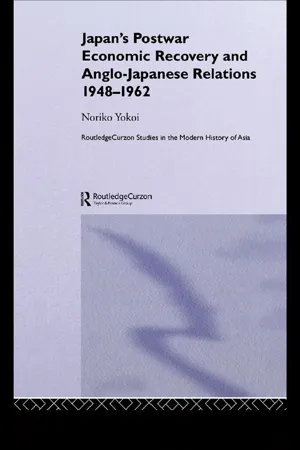
Japan's Postwar Economic Recovery and Anglo-Japanese Relations, 1948-1962
About this book
Ever since Japan's economy recovered in the 1960s, scholars have been searching for the reasons for its meteoric postwar success. Until now, much research has been based on the study of Japan's society, its political and economic infrastructure, and its particular model of capitalism. But now that American and British government documents from the 1950s have been released, it emerges that the United States - as part of its Cold War economic and military strategy in East Asia - played a large part in assisting Japan out of its economic difficulties, whereas Britain's role seems to have been more ambivalent and circumspect. This book sets out to rectify the lack of full research into Anglo-Japanese trade relations from the late 1940s up to the early 1960s, and to examine the impact of cultural differences and perceptions on diplomacy, as well as the influence of prevailing political considerations like the Cold War. This book highlights the ebbs and flows in bilateral relations as Japan increased its economic and financial presence in Southeast Asia and Britain retreated politically and economically from its Empire in the East.
Trusted by 375,005 students
Access to over 1.5 million titles for a fair monthly price.
Study more efficiently using our study tools.
Information
Subtopic
Politics1 Introduction
Since Japan’s high-speed growth in the 1960s, there has been a growing amount of scholarly work on Japan’s postwar success, and this peaked in the 1980s when Japan became the world’s second strongest economy and the world’s largest creditor nation. The focus of the inquiry was the Western desire to understand how a country deficient in raw materials, devastated in the Second World War and stripped of its empire could have recovered so quickly from defeat and risen to become one of the strongest economies in the world in a matter of few decades.1 Much of the focus on Japan’s so-called economic miracle examined the peculiarities of Japan’s political and economic framework, such as the emphasis on consensus and cooperation between the ruling party, the bureaucracy and big business.2 There have also been studies of institutional characteristics such as the seniority wage system and the practice of life-time employment.3 Other factors that have been highlighted are Japan’s education system, the ‘paternalistic orientation behind the notion of labour and management…enthusiastic acceptance of benevolent guidance, the work ethic and an inclination to save’.4 Although there have been numerous works emphasising one aspect of Japan’s society or the other to explain the reasons for Japan’s economic miracle, these explanations have become clichéd over the years. At times, they have fuelled the notion that Japan is unique which has not been very constructive nor particularly insightful.
Diplomatic historians, with their reliance on publicly released government documents, have had an opportunity to contribute to this body of literature since the thirty-year rule availed them of postwar documents. Hence historians have been publishing books on Japan’s economic recovery since the mid-1980s. Initial research results have identified the Cold War in Asia as the major factor behind the US decision to ‘reverse’ its postwar policy towards Japan in order to maintain a balance of power in the region. A subsequent wave of historical inquiry has shifted the emphasis to economics and trade as the reason for the US decision to sponsor Japan’s economic recovery. Scholars representing this view have argued that the United States saw urgency in sponsoring the economic recovery of key countries in Europe and Asia as a means of pursuing its vision of a multilateral trading system, even in a compromised form in the immediate postwar period. The impetus behind this decision was both to enable the United States to sustain the Western economic trading system, and also to maintain the health of the US economy during the period of trade disequilibria known as the dollar gap.
This book follows the historical inquiry pursued by the latter group of historians, but the focus of the research will be on the British perspective, which has been mentioned tangentially but not addressed fully in the existing works. Specifically, the book will focus upon the argument cited frequently by US historians that Britain opposed the US-sponsored Japanese economic recovery due to a conflict of interest with its own policies. The book will explore the two themes that have been presented by scholars as examples of British opposition to Japan’s economic recovery. The first is the impact of Japan’s economic recovery on Britain’s sterling policy in Asia; the second is British fears of a revival of the cut-throat competition of the pre-war period and its effects upon British industries if Japan were allowed to pursue its economic recovery with little restraint from the postwar international trading community at large.
Britain has often been viewed as being opposed to US attempts to resuscitate the Japanese economy through an intricate triangular trading system whereby the United States supplied raw cotton to Japan, which was used to manufacture cotton goods for export to Southeast Asia in exchange for raw materials that were sold on to the United States for dollars. This was because the US plan allegedly impinged upon the postwar British triangular trading system, which was centered on its Southeast Asian colonies as the dollar-earning pivot. It has been argued that Britain subsequently regulated Japan’s economic activity with the countries that fell within the Sterling Area’s jurisdiction in order to stifle Japanese competition, thereby limiting Japan’s chances of resurrecting its economy through trade with the Sterling Area members, who were far-flung across Southeast Asia, South Asia, Australasia, the Middle East, Europe and Africa,5 and accounted for a quarter of the world’s trade between 1951 and 1957.6
Moreover, scholars argue that Britain’s attempts to postpone Japan’s GATT (General Agreement on Tariffs and Trade) entry in the postwar period represents further evidence of Britain’s opposition to Japan’s economic recovery. British industrial representatives, particularly those representing Lancashire’s textile concerns, lobbied for protection against perceived as well as actual Japanese competition. They were particularly fearful of the repetition of the pre-war, unfair trade competition, which consisted of price dumping, government subsidies and copyright infringement, which contributed to the overall erosion of Britain’s export market share. Their views were represented by the Board of Trade, which was responsible for Britain’s commercial policy; in this way the industry lobby withstood internal cabinet opposition to postpone Japan’s GATT membership until 1955. In addition, Britain refused to base its trade relations with Japan on the spirit of the postwar multilateral trading system of free and fair trade until 1962—a full six years after the most-favoured-nation treatment clause in the 1951 peace treaty had expired.
This book will explore the two inter-related issues between 1948 and 1962, in order to assess whether Britain’s overall policy towards Japan was based upon a comprehensive effort to block the latter’s economic recovery. The year 1948 has been chosen as the starting point of the research because it was the year that official trade relations began between the two countries in the postwar period. The year 1962 is seen as the natural end of this research because it was the year that the two countries signed the treaty of commerce, establishment and navigation that formalised bilateral commercial relations. The intervening years are treated chronologically to analyse the validity of the hypothesis, and to examine the impact of Britain’s decisions upon its relations with Japan and its postwar sponsor, the United States.
The book’s structure follows the evolution of Anglo-Japanese sterling and trade relations, which can be divided into three phases: the Open Payments Agreement (1948–51), the Sterling Payments Agreement (1951–7), and bilateral trade agreements (1958–62), with an expanded focus upon the middle phase. The book follows the development of each of the three agreements—albeit loosely—to illustrate the strategies formulated by British policymakers and to assess how closely they adhered to, or how far they deviated from, the original blueprint. The middle phase, from 1951 to 1957, has been covered in most detail because that period encompassed Britain’s greatest activity and investment in the success of the postwar Sterling Area and by extension, its interest in Japan as an important sterling partner in East Asia.
The first phase, covered in Chapter 2, was characterised by bilateral agreements between the respective Sterling Area countries and Japan. The trading countries controlled trade balances with little supervision from the United Kingdom. The bilateral nature of the agreement, however, restricted countries from expanding their trade relations with Japan. To circumvent the limitations, Britain invited sterling countries that had a rough balance of payments with Japan into a participant pool, where members grouped their trade volume for economies of scale. Sterling Area relations with Japan never exceeded the minimum during this first phase because the dollar clause in the agreement permitted the SCAP (Supreme Commander of the Allied Powers) to convert any excess sterling into dollars twice a year. Although the SCAP never activated the dollar point, the potential for a dollar drain through Japan deemed the latter a hard currency country, thus the Sterling Area countries were discouraged from expanding their trade relations beyond the necessary level.
The second phase, covered in Chapters 3 to 8, was characterised by Japan’s signing of the Sterling Payments Agreement. Britain initiated the change in order to introduce Japan to an established Sterling Area trading system of the postwar period. As part of this transition process, the dollar clause was abrogated to open the way for Japan to become a soft currency country. Britain’s aim behind the shift from the Open Payments Agreement to the Sterling Payments Agreement was governed entirely by self-interest. The postwar Sterling Area and its vitality was Britain’s paramount concern. Britain realised Japan’s potential role for stimulating intra-Asian trade as the regional ‘workshop’, and in the process, revitalising sterling as the trading currency of choice in the region. Thus she encouraged Japan’s use of sterling as an international currency for multilateral trade. The additional benefit of inviting Japan to expand trade relations with the Asian Sterling Area countries was the affordability of Japan’s manufactured goods, which were appropriate in price and quality for many of the ‘under-developed’ colonies. The results of Britain’s strategy are clearly illustrated in Figures 1.1 and 1.2, where 67 per cent of Japan’s imports from the Sterling Area are shown to have come from the Asia-Pacific region, which included Australia, New Zealand, Pakistan, India, Ceylon, Burma, Malaya, Hong Kong and Singapore.7 Exports to these countries accounted for 81 per cent of Japan’s exports to the Sterling Area. Thus the British policymakers’ blueprint reveals that Britain saw Japan as an important economic partner in Asia, who could contribute to the resuscitation of sterling in the region, which underlies the fact that Britain did not pursue a comprehensive plan to thwart Japan’s economic recovery.

Figure 1.1 Japan’s exports to the Sterling Area, 1951–7
Source: Bank of Tokyo 1969.
Britain’s sterling policy towards Japan in the second phase was clouded, however, by its inability to reconcile Japan’s membership in a postwar multilateral trading system that was governed by liberal economic principles. The three underlying components of economic liberalism were the open door policy, the most-favoured-nation treatment and the principles of comparative advantage.8 During the 1950s Britain was unable to extend a single component of these postwar ideals to Japan due to strong domestic resistance. The open door policy, for example, was never truly functional, because most soft currency countries took advantage of the temporary privilege extended to them to use quantitative restrictions to limit imports of goods from certain hard currency countries, during their balance of payments crises or the dollar gap. In some instances, quantitative restrictions were used as an excuse to limit imports of manufactured goods that competed with their domestic production, as in the case of Britain and its restrictive licensing of Japanese goods. Moreover, Britain reserved its rights to extend de jure MFN (Most Favoured Nation) rights to Japan throughout the 1950s through its decision not to apply the GATT rules to Japan. The decision stemmed from two factors. The first was Britain’s hopes of protecting its market share in the Commonwealth bloc against Japanese competition via the continuation of a preferential tariff system that discriminated in favour of Commonwealth goods. Britain’s plans to engineer lower Commonwealth tariffs were not granted due to the GATT’s no-new-preference rule, which precluded any member from increasing preferential treatment without extending it to all members. Thus Britain felt that it could not invite Japan into an association that did not allow for protection in its traditional market. Second, Britain felt that the GATT rules on adverse competition by a member country relied too heavily on consensus building and discouraged swift action by a country wronged by unfair competition. Unable to reconcile herself to the proposed rule, Britain felt uncomfortable inviting Japan into the GATT until a more decisive regulation was enforced within the GATT framework or until Japan exhibited more ‘responsible’ behaviour within the trading community. Last, the US vision of a multilateral trading system based upon competitive advantage failed to function in regard to Britain in the 1950s because the latter could not come to terms with the fact that more competitive labour and raw material sources existed elsewhere for the production of inexpensive manufactured goods for the world market. This was especially true in the case of textiles manufacturing, where Britain asked countries such as India, Pakistan, Hong Kong and Japan to adhere to voluntary export restrictions in order to protect its own domestic industry from losing market share to foreign competition. Thus the second phase saw a conflict of interest between British policymakers who saw opportunities to be gained from Japan’s economic recovery, and those who sought to protect themselves from its revival. Thus Britain sent mixed messages to Japan and the United States about its policy. This second phase lasted for seven years, but came to an end with Britain’s decision to abrogate the outdated Sterling Payments Agreement and the accompanying exchange of letters.

Figure 1.2 Japan’s imports from the Sterling Area, 1951–7
Source: Bank of Tokyo 1969.
The final phase, treated in Chapter 9, was characterised by the unravelling of the postwar Sterling Area as a result of the diminishing importance of a centralised dollar reserve. This was due to the return of dollar convertibility, and to the increasing independence of individual Sterling Area members’ economic policies. Britain, which viewed itself as providing strategic guidance to the postwar Sterling Area, viewed Japan with less importance as a result of Britain’s diminished role in the Asian Sterling Area. Thus, by the third phase, Japan’s relevance to British policy became proportionate to the actual level of Anglo-Japanese trade, which was miniscule in comparison to their respective total trade (see Figures 1.3 and 1.4). This explains why Britain did not prioritise the signing of a formal commercial policy to legitimise trade relations after the lapse of the Sterling Payments Agreement. The period of lull continued from 1956 until 1959, when Britain’s export potential in the booming Japanese market became an opportunity that the former could not resist. Thus this period saw a shift in emphasis, as British exporters gained greater national influence while the political impact of domestic manufactures such as textiles waned in comparison.
Survey of the literature
As mentioned in the introductory paragraph, most of the research on Japan’s economic recovery has focused on internal factors. In spite of this trend, the last fifteen years have seen a steady output of scholarly study of the external factors behind Japan’s economic recovery, with the release of American and British government documents. Works of note are Michael Schaller’s The American Occupation of Japan; Andrew J.Rotter’s The Path to Vietnam; and William Borden’s The Pacific Alliance. Schaller’s work focuses on Washington’s decision to reverse the course of the occupation due to the intensifying of the Cold War, and places the role of the Supreme Commander of the Allied Powers during the occupation, Douglas MacArthur, firmly back in its proper perspective. Moreover, Schaller highlights the decision by American policy-makers to promote Japan’s ‘greater co-prosperity sphere’ by linking its economy with that of Southeast Asia, in order to promote its economic recovery and to ensure that Southeast Asia did not enter the communist orbit. Rotter has gone one step further by linking American policymakers’ decision to sponsor Japan’s economic recovery with the eventual American involvement in the Vietnam War. Although Borden also argues that the United States actively supported Japan’s economic recovery, he highlights the importance of Japan’s economic recovery to America’s plans for a multilateral trading system in the non-communist world. For such a system to succeed, the United States needed to provide sufficient economic aid to Europe and Asia, to enable the ‘free’ world to continue purchasing American products.

Figure 1.3 Britain’s share of total Japanese imports and exports, 1948–62
Source: United Nations 1952–67.
All of the three works cited above refer in passing to Britain’s postwar Asian interests. Schaller has dealt the least with Britain’s perspective, while Borden has conducted some research based on American documents. Rotter, who has conducted archival research at the Public Record Office in Kew, deals in greater detail with Britain’s interests in Southeast Asia. All three indicate the importance that Britain placed on its economic ties with Southeast Asia, and argue that British industrialists felt threatened by Japan’s economic links with t...
Table of contents
- Cover Page
- RoutledgeCurzon Studies in the Modern History of Asia
- Title Page
- Copyright Page
- Illustrations
- Acknowledgements
- Usage and Abbreviations
- 1 Introduction
- 2 The Open Payments Agreement with Japan
- 3 Embarking on the Sterling Payments Agreement
- 4 Learning the rules of engagement
- 5 Britain at the helm?
- 6 Limits to Britain’s policy towards Japan
- 7 Britain and Japan’s GATT entry
- 8 A period of lull
- 9 The Anglo-Japanese Commercial Treaty
- 10 Conclusions
- Appendix 1
- Appendix 2
- Appendix 3
- Appendix 4
- Appendix 5
- Notes
- Bibliography
Frequently asked questions
Yes, you can cancel anytime from the Subscription tab in your account settings on the Perlego website. Your subscription will stay active until the end of your current billing period. Learn how to cancel your subscription
No, books cannot be downloaded as external files, such as PDFs, for use outside of Perlego. However, you can download books within the Perlego app for offline reading on mobile or tablet. Learn how to download books offline
Perlego offers two plans: Essential and Complete
- Essential is ideal for learners and professionals who enjoy exploring a wide range of subjects. Access the Essential Library with 800,000+ trusted titles and best-sellers across business, personal growth, and the humanities. Includes unlimited reading time and Standard Read Aloud voice.
- Complete: Perfect for advanced learners and researchers needing full, unrestricted access. Unlock 1.5M+ books across hundreds of subjects, including academic and specialized titles. The Complete Plan also includes advanced features like Premium Read Aloud and Research Assistant.
We are an online textbook subscription service, where you can get access to an entire online library for less than the price of a single book per month. With over 1.5 million books across 990+ topics, we’ve got you covered! Learn about our mission
Look out for the read-aloud symbol on your next book to see if you can listen to it. The read-aloud tool reads text aloud for you, highlighting the text as it is being read. You can pause it, speed it up and slow it down. Learn more about Read Aloud
Yes! You can use the Perlego app on both iOS and Android devices to read anytime, anywhere — even offline. Perfect for commutes or when you’re on the go.
Please note we cannot support devices running on iOS 13 and Android 7 or earlier. Learn more about using the app
Please note we cannot support devices running on iOS 13 and Android 7 or earlier. Learn more about using the app
Yes, you can access Japan's Postwar Economic Recovery and Anglo-Japanese Relations, 1948-1962 by Noriko Yokoi in PDF and/or ePUB format, as well as other popular books in Politics & International Relations & Politics. We have over 1.5 million books available in our catalogue for you to explore.