This book addresses important findings, assumptions, problems, hopes, and future guidelines on the use of advanced research techniques to study the moment-by-moment mental processes that occur while a reader or listener is understanding language. The core techniques are eye tracking and ERPs, with some extensions to others such as fMRI. The On-line Study ofSentence Comprehension has been written by top researchers in the field of psycholinguistics, who are also leading experts in the use of eye tracking and ERPs. This book combines comprehensive overviews of the state of the art on theoretical progress, the latest on assumptions behind the use of eye movements (reading and visual world) and ERPs methods with papers that address specific research questions. This work covers not only methodological issues but also discusses the theoretical progress in understanding language processing using temporally fine-grained methods.
eBook - ePub
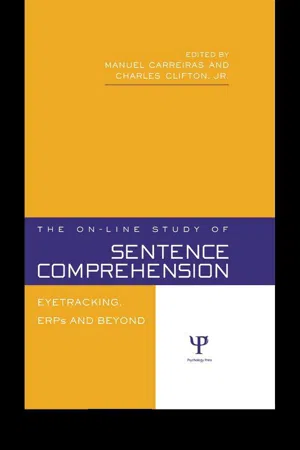
The On-line Study of Sentence Comprehension
Eyetracking, ERPs and Beyond
- 424 pages
- English
- ePUB (mobile friendly)
- Available on iOS & Android
eBook - ePub
The On-line Study of Sentence Comprehension
Eyetracking, ERPs and Beyond
About this book
Information
Publisher
Psychology PressYear
2004Print ISBN
9780415655781
9781841694009
Edition
1eBook ISBN
9781135423933
Chapter 1
On the On-Line Study of
Language Comprehension
MANUEL CARREIRAS AND
CHARLES CLIFTON, JR.
Language has been studied in many ways. It has been examined as an art, as a basis of philosophical investigations, and as a way of gaining insight into the human mind. During the past 50 years, practitioners of various scientific disciplines have developed objective ways of studying language. Linguists try to understand it through the construction of theories of abstract linguistic knowledge. Psycholinguists try to understand how language users engage this knowledge in comprehension and production. Neuroscientists have been digging into the biological substrate of language to study this exclusively human mental activity through identifying the time course of brain processes that are involved in language comprehension. This book provides a glimpse of how research done by linguists, psycholinguists, and neuroscientists can be brought to bear on a fundamentally psychological question—how language is comprehended in real time.
The topic of real-time comprehension of language has held center stage through most of the history of psycholinguistics. This is because psycholinguists have tried to develop theories of how language is comprehended that spell out the cognitive processes taking place when language is being understood. Such information-processing models are essentially claims about how mental representations are created, transformed, and stored, about what types of information are used in performing these operations, and about the architecture of the system that supports the proposed processes. A minimal (but difficult!) criterion for an adequate process model is whether or not it can create appropriate final outcomes; that is, can it create representations that adequately capture what readers and listeners understand sentences and texts to mean? Given that this has been met, even crudely, a second very challenging criterion can be addressed, which is posed by the following question: Is the model supported by “on-line” evidence about the temporal and logical flow of information, about the moment-by-moment processes that are claimed to take place between the presentation of auditory or written material and the achievement of understanding?
As a practical matter of psychological experimentation, these two criteria have traditionally been addressed by taking two types of measures: frequency of success on a task and performance speed. Reaction time has been one of the favorite dependent variables in cognitive psychology in general and psycholinguistics in particular. The use of reaction times to evaluate theories of cognitive processes can be traced to the 19th century when Donders (1868) invented the subtraction method to estimate the speed of internal cognitive processes. In more recent times, Sternberg’s (1966, 1969) use of additive factors analysis and Posner’s (1978) analysis of mental chronometry has stimulated a vast amount of theoretical and experimental work and has led to a notable increase in our understanding of the nature of cognition.
Psycholinguists commonly apply the experimental techniques of mental chronometry. For instance, when studying reading, they try to draw conclusions about what representations are formed, when, and on what basis, as a way of evaluating their claims about the architecture and operation of the reading system. Evidence for their conclusions has traditionally come from the speed and accuracy of responses in laboratory tasks such as lexical decision, word naming, self-paced reading, question answering, and sentence verification. While the evidence that these tasks provide has greatly increased our understanding of the process of language comprehension, they have not always proved adequate to discriminate between competing theoretical proposals. To take just one example, some theorists adopt modular positions following Fodor (1983) (e.g., Frazier & Rayner, 1982; Frazier, 1987); other theorists advocate more interactive positions (Marslen-Wilson & Tyler, 1987; MacDonald, Pearlmutter, & Seidenberg, 1994; Tanenhaus & Trueswell, 1995). Those who push modularity argue that certain types of information must be used and certain types of representations must be built in order for other types of information and representations to come into play. Those who argue for interactive processing envision a far less differentiated representational vocabulary and a far less constrained interplay among different types of information. This modular vs. interactive contrast would appear to have clear implications about the logical and temporal sequence of distinct processes in sentence comprehension. Although traditional measures of comprehension accuracy and speed have provided informative tests of these implications (see Mitchell, chapter 2, this volume), they have not provided evidence that settles the crucial questions to everybody’s satisfaction.
Part of the problem with traditional methods is their relatively coarse granularity. Knowing how long it takes to read a sentence, or even a word, does not tell the researcher how long any particular component process took. More diagnostic evidence comes from patterns of eye movements observed while reading text for comprehension or memory, such as what words are fixated, how long each fixation lasts, and how often the eyes regress to previous part of the sentence. (See van Gompel et al., chapter 7, this volume, for an illustration of how the finer granularity of eyetracking measures can shed light on the underlying processes of comprehending anaphors.)
Another part of the problem with traditional measures (and with many uses of eyetracking) is their lack of specificity. An increase in comprehension time or a disruption in the eye-movement record is just an increase in time. It does not by itself carry any sort of signature about what processes gave rise to the disruption. Sometimes (e.g., Meseguer, Carreiras, & Clifton, 2002) the location or pattern of eye movements can carry hints about what processes are going on at some particular point in time—the eyes may well go to what the reader is thinking about at any moment. Similarly, the visual-world paradigm of measuring eye movements to visual scenes during listening (Tanenhaus, Spivey-Knowlton, Eberhard, & Sedivy, 1995) relies on the apparent fact that listeners tend to look at the referent of what they are hearing. Under this analysis, it can provide quite specific information about what a listener thinks a word or sentence refers to moment-by-moment (see Boland, chapter 4, this volume). Potentially, even more diagnostic information can come from measuring brain activity during reading or listening. Measures of evoked brain-related potentials (ERPs) can arguably provide information about what processes are taking place as well as when they occur (cf., van Berkum, chapter 13, this volume; Osterhout et al., chapter 14, this volume). Such measures, as well as measures of functional brain imaging, can provide information about what is happening in the sentence comprehension process, and (at least for ERP) when it is happening.
Measures of brain activity such as ERP and functional magnetic resonance imaging (fMRI), coming from the new interdisciplinary field of cognitive neuroscience, can in principle do even more. They can ground the cognitive processes of language comprehension, previously treated largely as abstract information processing operations, in the neural underpinnings of the brain (e.g., Posner & Raichle, 1994; Gazzaniga, 2000). Knowing what brain structures are involved in computing different kinds of linguistic information, and when, can place some constraints on what categories of cognitive processes are involved in different aspects of language comprehension. If two language comprehension phenomena involve different regions of the brain, they necessarily engage at least partly distinct cognitive processes; if two phenomena involve the same regions of the brain, they may involve overlapping processes. (See Fiebach et al., chapter 17, this volume, for an example of this reasoning.) Further, knowing what linguistic and nonlinguistic tasks involve which brain regions should place some constraints on the nature of the processes that engage these brain regions.
The methodological advances provided by various uses of eyetracking and measures of brain activity will not, by themselves, solve the problems of identifying the cognitive processes underlying language comprehension. They have to be combined with careful theoretical analyses of how the measures might be related to the presumed underlying processes (see Boland, chapter 4, this volume, and Tanenhaus, chapter 18, this volume, for discussions of linking hypotheses) and used in theoretically sophisticated experimentation. With the goal of highlighting current progress in using these new on-line methodologies and stimulating future progress in their use, the organizers of the Eighth Annual Meeting of Architectures and Mechanisms of Language Processing (AMLaP), which took place September 19 to 21, 2002, in Costa Adeje, Tenerife, Canary Islands, invited several distinguished researchers to present overviews of how eyetracking and cognitive neuroscience measures are advancing our knowledge of language comprehension. Each of these researchers was asked to consider the following questions in preparing their presentations:
- What is an on-line process?
- Why is on-line processing a very important theoretical issue?
- Are eyetracking and ERP good and useful on-line measures?
- Have these technologies helped theoretical knowledge advance?
- What theoretical debates have these technologies promoted?
- What theoretical questions have they helped us answer?
- What new theoretical questions can be asked with these technologies?
The resulting presentations appear as chapters in the present volume. They are complemented by written versions of several papers and posters that were presented at AMLaP. The editors of this book made a (sometimes difficult!) selection of papers and posters that illustrated informative uses of eyetracking and brain activity measures, and invited their authors to submit them to this book. The results, we trust, show that substantial progress is being made in understanding the on-line nature of language processing, and should stimulate even further progress.
We turn to a brief overview of the on-line measures emphasized in this book, and then return to an attempt to highlight the contributions made in the individual chapters. Readers familiar with the basics of eyetracking and measures of brain activity can skip the following sections without loss.
1.1 EYE MOVEMENTS
Eye-movement recoding has become a very popular technique, or better, a family of techniques. There are two sister techniques under the label of eye movements. One has been applied to measure eye movements during reading (see Rayner, 1998). The other has been used to measure eye movements to regions of a scene while participants listen to speech related to what the scene is about (Tanenhaus et al., 1995). Even though in both cases eye movements are recorded, assumptions about what each technique is tapping are different. (See Boland, chapter 4, this volume, for a description of both techniques.)
During reading, eyes do not sweep along a line of print, but advance through little jumps called saccades. A target word is brought to the fovea by a saccade; and the eyes then fixate on the word for something like a quarter of a second to identify it. About 90% of reading time is spent in fixations, including some regressions to an earlier misperceived word. The typical reader makes about three to four saccadic movements per second. Each movement lasts between 20 to 40 ms, and the eyes typically remain fixated for about 200 to 400 ms. Nearly 15% of the eye movements made by typical college students are regressive, meaning they go back to material previously fixated. The continuous recording of eye movements enables researchers to identify locations and durations of fixations during reading, allowing them to draw inferences about cognitive operations while reading.
A reader’s fixation patterns vary greatly over a text, depending on the linguistic characteristics of the words. In developing their early model of text comprehension based on readers’ eye movements, Just and Carpenter (1980) made two assumptions: the immediacy and the eye–mind assumptions. According to these assumptions, a word is the unit of processing, and processing occurs immediately and completely at the time the word is encountered. (See Pickering et al., chapter 3, this volume, for a discussion of these two assumptions.) Gaze duration, which is the summed duration of consecutive fixations on one word before the reader’s eyes leave that word, is assumed to reflect processing time of that particular word.
A substantial amount of research on eye movements in reading was conducted early in the 20th century (see Huey, 1908; Tinker, 1946, 1958). By midcentury, research in this field had nearly stopped. However, prompted by the development of new methodologies and the appearance of information-processing theories of cognition, the study of eye movements in reading reappeared with vigor in the last third of the 20th century (see Rayner, 1998, for a review). Nowadays, eye-movement measures have been used successfully to understand the functioning of several components of language processing, such as phonological and orthographic processing (Lee, Binder, Kim, Pollatsek, & Rayner, 1999; Rayner, Pollatsek, Binder, 1998), the effects of neighborhood (Perea & Pollatsek, 1998), the processing of syllables (Ashby & Rayner, in press; Carreiras & Perea, 2004), lexical ambiguity (Duffy, Morris, & Rayner, 1988), morphological processing (Pollatsek, Hyona, & Bertram, 2000), syntactic processing (Carreiras & Clifton, 1999; Frazier & Rayner, 1982; Ferreira & Clifton, 1986; Trueswell, Tanenhaus, & Garnsey, 1994), plausibility (Pickering & Traxler, 1998), discourse context effects (Altmann, Garnham, & Dennis, 1992), and inference processing (O’Brien, Shank, Myers, & Rayner, 1988).
The recording of eye movements during reading to answer some theoretical questions about language processing and language architecture has helped us to better understand cognitive processes involved during on-line reading. On the one hand, results obtained with other laboratory techniques have generally been obtained with the eye-movement technique (see Mitchell, chapter 2, this volume). Converging evidence enhances our confidence in the phenomenon. On the other hand, due to its impressive temporal resolution and its ability to fractionate reading time into distinct components (long initial fixations, refixations on a word, regressions to earlier words, rereading a word after a regression, etc.), the eye-movement technique provides potentially useful detailed information about what cognitive processes might be occurring at any moment in time. (See Boland, chapter 4, this volume, and van Gompel et al., chapter 7, this volume, for illustrations.) The full value of eye-movement measures, however, will surely be realized only when we have a better understanding of how eye movements are controlled by various sorts of cognitive processes. Powerful and informative models of eye-movement control do exist (e.g., Reichle,...
Table of contents
- COVER PAGE
- TITLE PAGE
- COPYRIGHT PAGE
- CONTRIBUTORS INFORMATION
- CONTRIBUTOR PAGE
- PREFACE
- CHAPTER 1: ON THE ON-LINE STUDY OF LANGUAGE COMPREHENSION
- CHAPTER 2: ON-LINE METHODS IN LANGUAGE PROCESSING: INTRODUCTION AND HISTORICAL REVIEW
- CHAPTER 3: EYE MOVEMENTS AND SEMANTIC COMPOSITION
- CHAPTER 4: LINKING EYE MOVEMENTS TO SENTENCE COMPREHENSION IN READING AND LISTENING
- CHAPTER 5: LEXICAL PREDICTABILITY EFFECTS ON EYE FIXATIONS DURING READING
- CHAPTER 6: THE EMPTY CATEGORY PRO: PROCESSING WHAT CANNOT BE SEEN
- CHAPTER 7: ANTECEDENT TYPICALITY EFFECTS IN THE PROCESSING OF NOUN PHRASE ANAPHORS
- CHAPTER 8: ON-LINE MEASURES OF COREFERENTIAL PROCESSING
- CHAPTER 9: PRODUCTION AND COMPREHENSION MEASURES IN ASSESSING PLURAL OBJECT FORMATION
- CHAPTER 10: CONSTITUENT ORDER PRIMING FROM READING TO LISTENING: A VISUAL-WORLD STUDY
- CHAPTER 11: THE ON-LINE PROCESSING OF AMBIGUOUS AND UNAMBIGUOUS WORDS IN CONTEXT: EVIDENCE FROM HEAD-MOUNTED EYETRACKING
- CHAPTER 12: THAT IS NOT IT AND IT IS NOT THAT: REFERENCE RESOLUTION AND CONCEPTUAL COMPOSITES
- CHAPTER 13: SENTENCE COMPREHENSION IN A WIDER DISCOURSE: CAN WE USE ERPS TO KEEP TRACK OF THINGS?
- CHAPTER 14: SENTENCES IN THE BRAIN: EVENT-RELATED POTENTIALS AS REAL-TIME REFLECTIONS OF SENTENCE COMPREHENSION AND LANGUAGE LEARNING
- CHAPTER 15: GENDER OR GENDERS AGREEMENT?
- CHAPTER 16: EVIDENCE FOR A SHARED MECHANISM IN LINGUISTIC AND NONLINGUISTIC SEQUENCE PROCESSING? ERP RECORDINGS OF ON-LINE FUNCTION- AND CONTENT- INFORMATION INTEGRATION
- CHAPTER 17: DISTINCT NEURAL CORRELATES OF LEGAL AND ILLEGAL WORD-ORDER VARIATIONS IN GERMAN: HOW CAN FMRI INFORM COGNITIVE MODELS OF SENTENCE PROCESSING?
- CHAPTER 18: ON-LINE SENTENCE PROCESSING: PAST, PRESENT, AND FUTURE
Trusted by 375,005 students
Access to over 1.5 million titles for a fair monthly price.
Study more efficiently using our study tools.
Frequently asked questions
Yes, you can cancel anytime from the Subscription tab in your account settings on the Perlego website. Your subscription will stay active until the end of your current billing period. Learn how to cancel your subscription
No, books cannot be downloaded as external files, such as PDFs, for use outside of Perlego. However, you can download books within the Perlego app for offline reading on mobile or tablet. Learn how to download books offline
Perlego offers two plans: Essential and Complete
- Essential is ideal for learners and professionals who enjoy exploring a wide range of subjects. Access the Essential Library with 800,000+ trusted titles and best-sellers across business, personal growth, and the humanities. Includes unlimited reading time and Standard Read Aloud voice.
- Complete: Perfect for advanced learners and researchers needing full, unrestricted access. Unlock 1.5M+ books across hundreds of subjects, including academic and specialized titles. The Complete Plan also includes advanced features like Premium Read Aloud and Research Assistant.
We are an online textbook subscription service, where you can get access to an entire online library for less than the price of a single book per month. With over 1.5 million books across 990+ topics, we’ve got you covered! Learn about our mission
Look out for the read-aloud symbol on your next book to see if you can listen to it. The read-aloud tool reads text aloud for you, highlighting the text as it is being read. You can pause it, speed it up and slow it down. Learn more about Read Aloud
Yes! You can use the Perlego app on both iOS and Android devices to read anytime, anywhere — even offline. Perfect for commutes or when you’re on the go.
Please note we cannot support devices running on iOS 13 and Android 7 or earlier. Learn more about using the app
Please note we cannot support devices running on iOS 13 and Android 7 or earlier. Learn more about using the app
Yes, you can access The On-line Study of Sentence Comprehension by Manuel Carreiras,Charles Clifton, Jr. in PDF and/or ePUB format, as well as other popular books in Psychology & Cognitive Psychology & Cognition. We have over 1.5 million books available in our catalogue for you to explore.