eBook - ePub
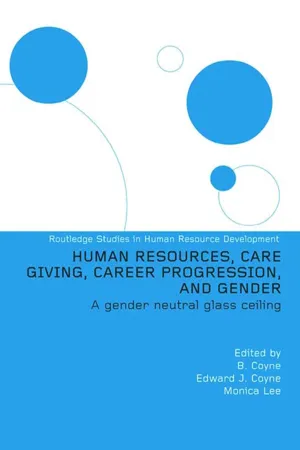
Human Resources, Care Giving, Career Progression and Gender
A Gender Neutral Glass Ceiling
- 192 pages
- English
- ePUB (mobile friendly)
- Available on iOS & Android
eBook - ePub
Human Resources, Care Giving, Career Progression and Gender
A Gender Neutral Glass Ceiling
About this book
This book presents a challenge to feminist perspectives that see the glass ceiling as the exclusive domain of women's careers and work life. The authors address existing debates and extend them to include original empirical evidence from several US and UK comparative studies that look at the effect of caring for dependents (including care for children and elder care) upon the careers and aspirations of both men and women.
1 Introduction
Caring is the shining thread of gold that holds together the tapestry of life.
Ida V. Moffett, Dean of School of Nursing, Samford University, 1981.
Care-giving responsibilities appear easy to understand. Someone must look after the children and other dependants. French (1993) points out that ‘Women have always done it, it is customary.’ Certainly, in the corporation culture, women are seen as more committed to family than to career (Schwartz, 1996). Yet, through choice or necessity, not all women stay at home, and, as Rodgers and Rodgers (1989) observed, ‘working parents have daily dilemmas: “who will take care of a sick child, who will get the car repaired, who will let the plumber in, who will go to the soccer game and/or attend the school conferences?”’ With lone parents, the answer is obvious — that person has the sole responsibility to ensure that care is provided. With married or partnered parents the answer is less obvious, as women increasingly seek to progress in their own careers. For many an employee with serious family responsibilities, the unintended side-effects of the standard work week that is imposed by most employers (UK — 37 hours; USA — 40 hours) has a negative impact upon their career aspirations.
Helen is 46 years old, married, has a high school/secondary education, has children and works part time (20 hours per week) and travels another 4 hours weekly. Her partner works full time. She is part of the clerical staff and earns about 20 per cent of the household income. Helen says that her family commitments have resulted in poor pay and training. She also thinks that her employer neither agrees, understands nor supports her care-giving responsibilities for her children. She is very uncomfortable invoking the care-giving policies and says that ‘time off (even for holidays) is becoming a nightmare’. Helen thinks that her career development has been hindered in the past and at present by her care-giving responsibilities.
This book straddles several disparate areas, particularly Human Resource Development (HRD), politics, policy making, women's studies and organisational strategy and governance, to argue that the role of the care-giver is central to the long-term economic and social viability of nations and organisations. We present empirical evidence to show that care-giving is a gender neutral glass ceiling. This fact, teamed with that of a rapidly ageing workforce, calls for urgent attention to be paid to the problem.
Throughout the book we have inserted short vignettes to emphasise our argument. All of these describe real people and situations that we have encountered during the course of our research — only the names have been changed.
Newspapers, business and agenda magazines, scholarly journal articles, non-governmental-organisation publications, legislative committee reports and other such materials are overflowing with ‘facts’, opinion polls, anecdotal evidence, horror stories, sociological and psychological explanations as to why the ‘employment system’ is being unfair to mothers, to children, to the care-givers and to the care providers. The majority — childless/‘empty-nesters’ — have also entered the fray with charges that preference being given to the care-giver employees is at the expense of the childless/empty-nesters.
Joe has been employed 12 years, is a Senior Accountant, with a BSc degree. He is single, 35 years of age, works full time and his mother lives with him. Joe comments: ‘It appears that if you are single, the firm thinks you have no other responsibilities and should always be available for them. They don't think us singles have a life outside of the firm.’
All seek to ‘change the system’ that is seen by some to be oppressive to the carers of our children and elders and by others to be excessively ‘coddling’ of those who have made the individual choice to be care-givers. At the hub of the employment system are the employers. Many employers are sympathetic to the human drama unfolding around them — at times engulfing them — but all employers must keep a keen eye on their competitive position — locally, nationally and internationally. Governments also have a seat at the table. Not only do democratic governments need to perform their time-honoured task of seeking and leading consensus among the governed but also they must do so within the framework of the unique, never-before-encountered demographic challenges being presented at the dawn of the twenty-first century.
How well society provides for those who cannot provide for themselves is said to be one measure of the term ‘civilised’ society. Yet how to provide for those who cannot provide for themselves can elicit fierce debate. One culture or nation may see beauty in the State assuming a large measure of primary responsibility for providing for the helpless. Another may see beauty in looking first to the family of the helpless with the State intervening only when it is apparent that that family cannot or will not provide. One firm may see beauty in promulgating ‘family-friendly’ policies. Another may see beauty in treating all employees alike. One family may see beauty in family self-sufficiency. Another may see beauty in reaching out for community support. All seek the bottom-line solace of knowing that the helpless have found help. Surely the devil is in the details and the debate waxes on not only amongst nations but also, ever more strongly, within organisations and other elements of the nations themselves.
Webster's College Dictionary (1991) defines a care-giver as ‘a person who cares for someone who is sick or disabled, or an adult who cares for a child’. Diemut Bubeck (1995) pinpointed the essence: ‘care-giving is the kind of work that needs to be done and it is people that are needed to do it [that is, cannot be automated]’. Kossek et al. (2001) defined care-giving decisions as the selection of arrangements for the care of a dependant while an individual performs the work role. They claimed that one of the most universal types of non-work decisions that most employees will make during their careers are care-giving decisions.
Throughout the last few millennium — if not always throughout the ages — society has placed a high priority on the care of its children and elders. Society has also placed a high priority on that activity which supports both self and family — work. The pressures and structures of modern living have increased the need for more of the able-bodied citizens to perform remunerative work (usually outside of the home) but have not relieved the need of children and elders to rely on care-givers for their care.
Popenoe (1996) summarised the family that existed at the beginning of the twentieth century by noting that as income-producing work left the home, so too — during the weekday — did the men. Men increasingly withdrew from the direct-care parenting and specialised in the provider or breadwinner role. The Economist (July 18–24, 1998) reported that the traditional family model developed in the 1940–60s — a male breadwinner and a mother at home with the children — is not around today for a number of reasons. Single women, either up until marriage or up until the birth of their first child, have always worked. In the past few decades growing numbers of married women are working for pay too. The Economist noted that working mothers used to be criticised for neglecting their children; now it is stay-at-home mothers who have to explain themselves. ‘Earnings for mothers are not just pin money anymore. For the growing number of single mothers earnings are essential, and in dual-earner families they often make the difference between just getting by and living comfortably.’ Catherine Hakim, a feminist academic and senior research fellow in the sociology department at the London School of Economics, as reported by Moore (1996), stated: ‘two groups of women have emerged in the past 20 years: career oriented and home-centred’. Hakim, in discussing her ‘theory of divided aspirations’, maintains that only the career-centred get a hearing from the women's movement. Tom Scarritt (2002), editor of The Birmingham (Alabama) News, in an article stressing the need for more women in leadership positions, cautions:
We must be careful, as we encourage more women to be bank presidents and senators, that we do not discourage those women whose success and fulfilment comes in their roles as wives and mothers, or nurses and teachers, or any other of the vital roles that women have traditionally held. The idea should be to expand the opportunities for our capable daughters, not to direct them or make judgements about the paths they choose.
The home-based society in which women worked to supplement their husbands' income for extras began to recede a generation ago. Now the expectation is that both spouses work. The US labour force now includes more than 70 per cent of all women with children between the ages of 6 and 17 and more than one-half of those women with children less than 1 year old. It is not only a question of who is responsible for very young children — but also, is there anyone home to care for adolescents and the elderly? ‘No one intended that the price for business success should be “indifference to family” or that the price of having a family should be to abandon professional ambition’ (Rodgers and Rodgers, 1989).
Men also have care-giving responsibilities. More men are obtaining custody of their children in divorce cases now than in the past (15 per cent in the USA and 5 per cent in the UK — with both percentages growing). Kelly (1991) reported that some men, as well as women, opt for changing the definition of success so as to have a greater balance between home and work. Kelly concluded with statistics that showed more men were becoming the primary child-care provider while their wives were working (18 per cent). Schwartz (1992) speculated that because women had not been assimilated fully into business, child-care was not considered a business issue, nor was flexibility thought to be an important company priority. She noted, however, that since women made up a large portion of the nation's workforce, there was no longer a solid family-support structure at home. Only 16 per cent of full-time workers went home to a non-working spouse, according to the US Bureau of Labor Statistics. In two-career couples, neither parent could expect that the other would automatically tend to the needs of their children. Since high-quality affordable day care was rare, many worried parents were permanently anxious about their children (Schwartz, 1992).
Of the many avenues and institutions involved in our lives, the employment relationship is central to providing the sustenance for our dependants and ourselves. The focus of this book is on employees with care-giving responsibilities for dependant children or adults, and the effect, if any, such responsibilities have upon the career development and career progression of employees. This book provides empirical evidence of the effect of one priority (care-giving) upon another (work). The greater the deterrent effect (if any) of care-giving responsibilities upon an employee's career, the lesser will be the employee's earning capacity. Lesser earning capacity translates into lesser ability to provide care for one's self and one's other dependants.
Career progression — like success in any endeavour — requires dedication of time and effort toward that goal. Though many might wish it otherwise, in the market-based economies of the developed world the need for ‘committed’ employees is seen as the sine qua non for long-term economic survival of any company — regardless of home country. The prevailing
Lynn is a 48-year-old single parent with a Masters degree in Business Administration. She is a Vice President of Human Resources. Early in her career she was divorced and assumed responsibility for the care of her two children while working in a male-dominated industry. Lynn's career has spanned nearly 25 years. She recalls that she relied on her family to help with the care of her older child while she was completing her degree and, later, she was very fortunate to find for her younger child a babysitter (the sister of a friend at work) who was flexible and supportive when she had to work long hours. After the divorce the family relocated and the children became ‘latch-key’ children. They were taught to use the microwave but were not allowed to use the stove to heat their after-school snack. Lynn says she did not have the luxury of getting caught up in the 1980s debate about whether it was better to be at home with your children or to have a fulfilling job.
Lynn now manages the work-life balance programmes and services for the firm and is able to see the evolution in the support that companies provide for working parents. ‘When I was raising my children, I did not dare ask to take extra time off after my child's birth. I also did not ask to take time off for doctor's visits.’ In order to deal with unexpected child-care needs, Lynn developed a practice of saving her vacation for those emergencies that required her to be away from work. Only in the past few years has she discontinued this practice. Currently, this practice is used mostly by men to spend time with their new-born infant and their families and the phrase ‘going undercover’ has been coined to describe it. Having complete parenting responsibilities for her two children hampered Lynn's participation in professional organisations and precluded her from taking a more demanding position. When she compares her career progression to that of her peers, she acknowledges that her care-giving responsibilities were a factor in the amount of time it has taken her to achieve her current status. ‘Trying to be there for my children and put in the “face-time” (long hours) required to impress the boss also led to my neglecting my personal needs during those years, but I am getting better at taking care of myself everyday,’ she says.
concepts and/or perceptions of commitment bring ‘time-freedom’ to the fore. Time-freedom to pursue a career raises the question ‘Is home-base covered?’ Is someone else shouldering the care-giving responsibilities of the home so that the employee has the time-freedom to pursue a career? It is a question that faces any employee with care-giving responsibilities — regardless of gender.
Our modern reality is that females as well as males have career aspirations and that males as well as females have care-giving responsibilities. However, not all (or even the majority) of employees have care-giving responsibilities. An employer's first duty to the community is to be a profitable, going concern capable of providing, at minimum, sustained employment for existing employees. The empirical evidence reported here provides a key to understanding the underlying conflict between career and family. Whilst career/family conflict may well be considered a reality of long standing, the pressures and structure of modern living have combined to rocket the career/family conundrum into prominence — and public debate.
An underlying theme of this book is provided by the national demographics of the developed world. In the words of Peter Drucker:
The most important single new certainty — if only because there is no precedent for it in all history — is the collapsing birthrate in the...
Table of contents
- Cover
- Half Title
- Routledge Studies in Human Resource Development
- Full Title
- Copyright
- Dedication
- Contents
- List of figures
- Preface
- Acknowledgements
- 1 Introduction
- PART I Examining the area
- PART II Some empirical evidence
- PART III Implications
- References
- Index
Trusted by 375,005 students
Access to over 1.5 million titles for a fair monthly price.
Study more efficiently using our study tools.
Frequently asked questions
Yes, you can cancel anytime from the Subscription tab in your account settings on the Perlego website. Your subscription will stay active until the end of your current billing period. Learn how to cancel your subscription
No, books cannot be downloaded as external files, such as PDFs, for use outside of Perlego. However, you can download books within the Perlego app for offline reading on mobile or tablet. Learn how to download books offline
Perlego offers two plans: Essential and Complete
- Essential is ideal for learners and professionals who enjoy exploring a wide range of subjects. Access the Essential Library with 800,000+ trusted titles and best-sellers across business, personal growth, and the humanities. Includes unlimited reading time and Standard Read Aloud voice.
- Complete: Perfect for advanced learners and researchers needing full, unrestricted access. Unlock 1.5M+ books across hundreds of subjects, including academic and specialized titles. The Complete Plan also includes advanced features like Premium Read Aloud and Research Assistant.
We are an online textbook subscription service, where you can get access to an entire online library for less than the price of a single book per month. With over 1.5 million books across 990+ topics, we’ve got you covered! Learn about our mission
Look out for the read-aloud symbol on your next book to see if you can listen to it. The read-aloud tool reads text aloud for you, highlighting the text as it is being read. You can pause it, speed it up and slow it down. Learn more about Read Aloud
Yes! You can use the Perlego app on both iOS and Android devices to read anytime, anywhere — even offline. Perfect for commutes or when you’re on the go.
Please note we cannot support devices running on iOS 13 and Android 7 or earlier. Learn more about using the app
Please note we cannot support devices running on iOS 13 and Android 7 or earlier. Learn more about using the app
Yes, you can access Human Resources, Care Giving, Career Progression and Gender by Monica Lee (Series Editor),Edward J. Coyne,Monica Lee in PDF and/or ePUB format, as well as other popular books in Business & Business General. We have over 1.5 million books available in our catalogue for you to explore.