From the early 80s community policing has been held up as a new commitment to the ideals of service and the rejection of coercive policing styles. The idea was to encourage a partnership between the public and police in which community needs would be met by officers on local beats.
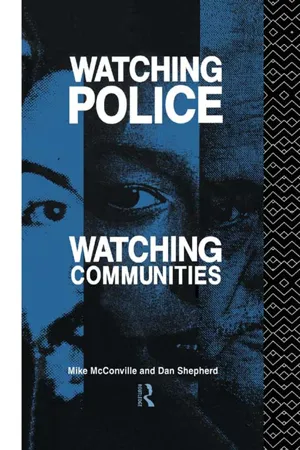
Today, Government ministers and senior police officers depict Neighbourhood Watch, the centrepiece of the scheme, as a great success. However, Watching Police, Watching Communities reveals that most schemes are dormant or dead. The authors trace the causes of scheme failure to the lack of commitment to community policing by police forces. Most importantly, they find a police rank-and-file culture which celebrates aggression, machismo and the assertion of authority especially against areas occupied by ethnic minorities and other disadvantaged groups.
- 284 pages
- English
- ePUB (mobile friendly)
- Available on iOS & Android
eBook - ePub
Watching Police, Watching Communities
About this book
Information
Chapter 1
Crime, communities and the police
So far as the public image of British policing is concerned, the last decade has been the age of neighbourhood watch. Transplanted from the United States of America, watch schemes were introduced into Britain in the early 1980s, expanded rapidly and susbequently became the centrepiece of community crime-prevention initiatives. Neighbourhood watch was promoted as evidence of a break with a past which had been marked by fractured relations with the community, a remote police force, and styles of policing which had contributed to major confrontations with the public, including street disorders. In contrast to impositional policing, neighbourhood watch was to symbolize a new commitment to the ideals of service, in which the police would dedicate themselves to meeting the needs of the community at a local level. The technological age of policing in the 1960s and 1970s, in which cars, computers and radios were said to have created a metal barrier between officers and citizens, was to be replaced by a more consumer-friendly image which emphasized accessibility, approachability and partnership.
In this book we want to look at the sociological meaning behind these images. The book is not simply an examination of neighbourhood watch as a policing initiative; rather, neighbourhood watch is used as a way of looking at police-community relations and the state of contemporary policing in Britain. Thus, whilst we are concerned to look at the extent to which neighbourhood watch has penetrated into the social fabric — where schemes have taken hold and where they have failed to get off the ground; who become members and what influence schemes have upon members' attitudes and behaviour; and what, if any, impact schemes have upon crime and the fear of crime — we are also interested in the extent to which it has penetrated into policing ideologies and policing practices.
Our analysis is based upon an intensive study of neighbourhood watch and non-neighbourhood watch sites in three police forces in England and Wales over the period 1988–90. The research involved in-depth interviews with police officers, together with limited observational work, in the Metropolitan, Avon and Somerset, and Gwent police forces (see the Appendix for further research details). Within each force, research sites were chosen in consultation with the police so as to reflect the diversity of populations served and policing problems encountered, and to produce a spectrum of socio-economic, class and race dimensions.
In each of the research sites, we undertook tape-recorded interviews with samples of community beat officers (CBOs), who had amongst other duties special responsibility for neighbourhood watch schemes, and with their supervising officers and those directly responsible for co-ordinating scheme activities. In addition, we interviewed a cross-section of relief officers (ROs) whose contacts with the public are mostly confined to situations in which a member of the public calls the police for help. Whereas community beat officers are dedicated to a single beat and spend most of their time on their own, relief officers operate in groups and have a roving commission over the whole of a sub-division, including those beats of community officers. Altogether, we carried out over 200 intensive interviews with officers. We also patrolled beats with selected officers, and spent a great deal of time informally in their company.
Over the same period, we undertook a systematic survey of residents in each force, selecting areas which had neighbourhood watch schemes and comparable areas without schemes. In in-depth tape-recorded interviews, we questioned residents about their fear of crime, their knowledge and membership of neighbourhood watch, their security and surveillance practices, their relationships with the police and other related matters. As with the police, over 200 such interviews were conducted throughout the three police force areas.
Neighbourhood watch proved to be a good vantage point from which to view the questions of what the public expect of each other and of the police in a modern liberal capitalist society, as well as that of what the police expect of each other and of the public. Neighbourhood watch confronts important debates not simply about the means of policing but also about its ends; about the extent to which policing is based upon the consent of the policed; about the growth of police powers; about the degree to which policing is universally applied to all sections of society and the extent to which, if at all, there is discriminatory treatment on the basis of class, race and gender. Through neighbourhood watch, we are able to measure the temper of modern policing and to see whether there has been a significant break with the past or a continuation of traditions. Before exploring these issues in the main body of the book, however, we need to say a little about the history of neighbourhood watch in Britain.
THE RISE OF NEIGHBOURHOOD WATCH IN BRITAIN
Neighbourhood watch (NW) was imported into Britain from the United States of America where a variety of schemes (Crime Watch, Block Watch, Community Alert, Home Watch, Neighborhood Watch and others) had been developed in the 1970s, simply as part of a much larger initiative to provide an organizational framework for citizen involvement in local crime prevention activities (Washnis, 1976; Skolnick and Bayley, 1986). The first British scheme appears to have been launched in the Cheshire village of Mollington in July 1982 (Anderton, 1985), a scheme which continues to pride itself over its ‘success’ in combating local crime (‘Village toasts quiet victory over crime’, Guardian, 10 August 1989). Although the South Wales Constabulary was the first British force to implement NW on a force-wide basis (Bowden, 1982), the major impetus for the spread of NW came with its adoption by the Metropolitan Police in 1983.
Inspired by the public commitment to NW of the Metropolitan Police's new Commissioner, Sir Kenneth Newman, two Metropolitan Police officers, Superintendent Turner and Detective Inspector Barker, undertook a short visit to the United States of America to study community crime prevention programmes. The resulting Turner-Barker report, based on visits to Detroit, New York, Seattle and Washington DC, recommended the establishment of pilot programmes along the lines of the Seattle model in London (Turner and Barker, 1983). Within a short time, and without the experience of pilot schemes, the Metropolitan Police launched a force-wide NW programme on 6 September 1983.
At the launch, the police stressed that, although NW would not ‘solve London's crime problems’ the Commissioner believed that it would ‘play its part in effectively reducing the number of offences being committed — through an ever-strengthening contract between the public and the police’. (New Scotland Yard press release, 6 September 1983). Neighbourhood watch, it was stressed, was for ‘ordinary home and car owners’ who wanted to protect themselves and their communities from ‘burglars and thieves’. Although the main emphasis was upon the prevention of burglary and the marking of property, the police felt that ‘if the experience of similar schemes in America is reflected here, neighbourhood watch will make a significant impact on other types of crime, especially street robberies, thefts of and from cars and vandalism’ (ibid.).
The components of NW
The concept of NW is based upon the formation of a network of public-spirited members of the community who will assist the police in the fight against crime. At the launch of the Metropolitan Police scheme, emphasis was placed upon a partnership idea of policing which involved the Commissioner's model of a ‘two-way notional contract between police and public’. This involved a more ‘efficient and effective’ use of limited resources by encouraging the public to accept a greater responsibility for preventing opportunist crime. The overall object was to make the citizen the ‘eyes and ears’ of the police by looking out for the unusual and reporting suspicious occurrences to the police. The principal organizational mechanism for harnessing the efforts of citizens was neighbourhood watch. According to the Guidelines for the Introduction of Neighbourhood Watch written by the then Chief Inspector of Constabulary, Sir Lawrence Byford, in 1985,
Neighbourhood watch is primarily a network of public spirited members of the community who observe what is going on in their own neighbourhood and report suspicious activity to the police. It involves members of the public looking out for the usual and the unusual to protect their own home and that of their neighbour, thereby reducing opportunities for criminal activity. When working effectively, neighbourhood watch can help draw the community together, making it more aware of its environment, its mutual dependence, and responsibility: in short, aiding community cohesiveness.
The official Metropolitan Police guidelines relating to NW issued in June 1983 describe the scheme as having four basic elements: first, ‘neighbours watching out for each other's homes and reporting suspicious activity to the police, thereby reducing the opportunity for burglary and other crimes in the street’; secondly, ‘the marking of valuable property’ using a kit made freely available to the citizen; thirdly, the availability of a free home security survey carried out on request by a local crime prevention officer; and fourthly, ‘the promotion of crime prevention and community campaigns to address particular local environmental issues’. Overall, therefore, the expressed aims were, by involving the public in the war against crime, to reduce crime through preventive measures and the reduction of opportunities, thereby reinforcing or creating community cohesion and lowering the fear of crime.
Individual schemes may be established either through a police initiative or as a result of citizens contacting the police. The police usually organize a launch meeting to which all residents of the target area are invited. The benefits of NW are then detailed and an attempt is made to recruit an area co-ordinator. That person will have special responsibility for liaising with the local community beat officer (CBO). Depending on the numbers of households covered, individual schemes may have a single co-ordinator or may have a substantial organization with numerous ‘street coordinators’ linking up with the area co-ordinator.
Most official pronouncements on NW, however, tend to be vague on detail and there is no clarity on what it means to have a NW scheme or to be a member of a scheme. Indeed, there is a general assumption that definition of a scheme or of membership is unnecessary either because these matters are obvious or because every scheme must be allowed to vary according to local conditions. The result is that there is no official understanding of what constitutes a scheme; what constitutes membership (whether, for example, it is personal or whether it is according to household); what responsibilities or obligations, if any, are imposed on citizens by membership; and what responsibilities or obligations, if any, are imposed on the police by the creation of an official scheme. Thus, it is unclear what is meant when it is claimed that over three and a half million households are covered by NW (Guardian, 10 August 1989). And what does a person have to do in order to qualify as a member: Attend an inaugural meeting? Attend meetings regularly? Be on a co-ordinator's membership list? Place stickers in a window? Undertake surveillance activity? Live in a road where there is a scheme?
Answers to these kinds of question are important in thinking about NW. There is, for example, little purpose in collecting official figures on the number of schemes if there is no agreement about or understanding of what exactly is being counted (cf. Husain and Bright, 1990). Moreover, any analysis which seeks to measure the crime prevention impact of NW must be flawed if it does not take into account the differences between schemes. And any measurement of crime prevention must tease out what, if anything, acts as a deterrent to would-be criminals — stickers, signs, surveillance activity of residents, patrolling, increased security systems. On issues of this sort, official accounts of NW are unhelpful.
‘Success’ and the growth of schemes
Within a very short time of its launch, NW was officially portrayed as a success. Assistant Commissioner Wilford Gibson was reported to have claimed a ‘dramatic’ reduction in burglaries in the Hurlingham area of Fulham, London, as a result of NW (Standard, 31 May 1984), and Metropolitan officers estimated reductions of crime of between 10 and 60 per cent (Standard, 5 November 1984). According to Superintendent Brian Turner, one of the authors of the influential Turner-Barker report of 1983, the benefits of NW included: ‘more information about what's going on in the community and the information is of better quality. So we are able to defeat the criminal by securing convictions much more easily’ (London Weekend Television, The London Programme, 4 January 1985).
The story of success is strongly reflected in individual NW newsletters, most of which are published by or in conjunction with the local police, as the following examples illustrate:
Neighbourhood watch is here to stay and for us it has worked with a tremendous drop in the burglary rate and many success stories.(South Norwood, London, Neighbourhood Watch Newsletter, 1988 issue)
We have already achieved a marked decrease in crime and an excellent detection rate with our neighbourhood watch. ⋯ Burglary is down again for the second year running and we are sure that neighbourhood watch played its part in obtaining this further reduction.(West Midlands Police, Watchwords, March 1989)
‘Neighbourhood Watch Schemes definitely help to reduce crime in their areas, especially burglaries’ says Detective Inspector Tom McNally. ‘To begin with Neighbourhood Watch Schemes became very much more security conscious and fitted good locks and bolts to their doors and windows. This deterred the thief, and there was about a 25 per cent reduction in burglaries on our police area between 1986 and 1987. Now the Neighbourhood Watch Schemes are helping to solve burglaries as well, with the detection rate for the first five months of 1988 twice that for the same period in 1987’.(Avon and Somerset Constabulary, Neighbourhood Watch News: 4)
A similar picture is put forward by government ministers. After a somewhat cautious start, ministers have become increasingly bullish in their support for NW and have advanced strong claims for its success. Thus, one year after the Metropolitan Police launch of NW, Giles Shaw MP, then Minister of State at the Home Office was cautiously optimistic: ‘Whilst it is too early to draw firm general conclusions, initial indications are that neighbourhood watch schemes have reduced crime and increased detection of offenders by the police’ (Home Office, News Release, 19 October 1984). Five years later the then...
Table of contents
- Cover
- Half Title
- Full Title
- Copyright
- Dedication
- Contents
- List of tables
- Acknowledgements
- 1 Crime, communities and the police
- 2 Public satisfaction and dissatisfaction with the police
- 3 Fear of crime
- 4 The reality of neighbourhood watch
- 5 Police commitment to community policing
- 6 Police culture: blue lights and black people
- 7 Institutional dynamics of police culture
- 8 Policing communities
- Appendix
- Bibliography
- Name index
- Subject index
Trusted by 375,005 students
Access to over 1.5 million titles for a fair monthly price.
Study more efficiently using our study tools.
Frequently asked questions
Yes, you can cancel anytime from the Subscription tab in your account settings on the Perlego website. Your subscription will stay active until the end of your current billing period. Learn how to cancel your subscription
No, books cannot be downloaded as external files, such as PDFs, for use outside of Perlego. However, you can download books within the Perlego app for offline reading on mobile or tablet. Learn how to download books offline
Perlego offers two plans: Essential and Complete
- Essential is ideal for learners and professionals who enjoy exploring a wide range of subjects. Access the Essential Library with 800,000+ trusted titles and best-sellers across business, personal growth, and the humanities. Includes unlimited reading time and Standard Read Aloud voice.
- Complete: Perfect for advanced learners and researchers needing full, unrestricted access. Unlock 1.5M+ books across hundreds of subjects, including academic and specialized titles. The Complete Plan also includes advanced features like Premium Read Aloud and Research Assistant.
We are an online textbook subscription service, where you can get access to an entire online library for less than the price of a single book per month. With over 1.5 million books across 990+ topics, we’ve got you covered! Learn about our mission
Look out for the read-aloud symbol on your next book to see if you can listen to it. The read-aloud tool reads text aloud for you, highlighting the text as it is being read. You can pause it, speed it up and slow it down. Learn more about Read Aloud
Yes! You can use the Perlego app on both iOS and Android devices to read anytime, anywhere — even offline. Perfect for commutes or when you’re on the go.
Please note we cannot support devices running on iOS 13 and Android 7 or earlier. Learn more about using the app
Please note we cannot support devices running on iOS 13 and Android 7 or earlier. Learn more about using the app
Yes, you can access Watching Police, Watching Communities by Mike McConville,Dan Shepherd in PDF and/or ePUB format, as well as other popular books in Medicine & Health Care Delivery. We have over 1.5 million books available in our catalogue for you to explore.