- English
- ePUB (mobile friendly)
- Available on iOS & Android
eBook - ePub
About this book
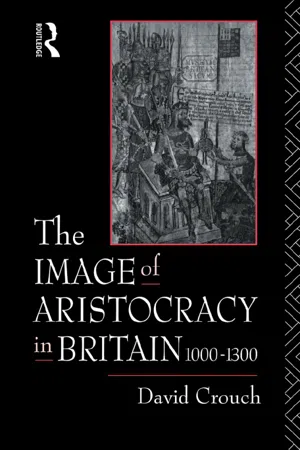
David Crouch provides a broad definition of aristorcracy by examining the ways aristocrats behaved and lived between 1000 and 1300. He analyses life-style, class and luxurious living in those years. A distinctive feature of the book is that it takes a British, rather than Anglocentric, view - looking at the penetration of Welsh and Scottish society by Anglo-French ideas of aristocracy.
Part I
HEREDITARY TITLES AND SOCIAL DIGNITIES
1
THE EARL AND THE COUNT
Aristocracies are particularly fond of titles. Where the possession of political and economic power is hereditary, hereditary titles advertise the ascendancy of one class over the others in a most satisfactory way, and neatly define social divisions. In this and the next chapter I will chart the slow elaboration of the use of titles over several centuries in the societies of England and its neighbours as a means of identifying its aristocracy to itself (and to us).
The essential theme is regulation, as will soon become apparent. I have long considered the use of titles to be at the direction or pleasure of the monarch, or, latterly, the monarch’s government. This is a habit of thought that is difficult to shake off. It was impossible to shake off for earlier generations of historians. Round, Ellis and the peerage lawyers of the nineteenth century cultivated a number of myths, but none was more long-lasting than their unconscious assumption that what was the case with the titles of the English peerage of their day applied equally to the aristocracy of the days before the reign of Edward III. But in the years 1000–1300 there is an abundance of evidence that the aspirations of individuals and the easy conscience of general society tolerated a far looser use of titles, even the greater titles, than has ever been allowed for in this period. At the beginning of the period the king had no ambitions to monitor and control the life of his realm, merely to make money out of it and attain security. That this attitude changed in the fourteenth century is one of the least explored movements of the mind in medieval society. Before 1300 the king’s role in the use and assumption of titles was limited and unambitious. As we will see, the first firm and general pronouncement of a king on a matter of social dignity did not come until 1292 in England.
The hereditary titles we find in 1000 were almost all at one time the names of offices, held at a monarch’s pleasure. But once obtained, a great man would be reluctant to relinquish a title he had been given, and if the sovereign who granted it was willing, the office might stay in his family’s hands and become what has been called, and was called in the eleventh century, a ‘title of honour’: a hereditary dignity which might or might not have real attributes of power about it, but which was infinitely desirable to those who did not have it.1 The idea of hereditary titles in Western society is a very ancient one. To the Romans, and those who came after them, an office was a ‘dignity’, an ‘honour’, one of life’s prizes. With that sort of attitude, it is hardly to be wondered at that the acquisition of office was followed almost naturally by the desire amongst fathers to transmit it as a privilege to their sons. As early as the time of the Roman emperor Theodosius, fathers were petitioning hard for their sons to enjoy their office. After the Empire’s fall, in England and on the Continent, it seems to be a universal phenomenon that lay offices of state tended to fall into the hands of great families. When they did so, these families regarded the offices as their natural entitlement. Titles passing from generation to generation in such families may not have done so out of hereditary right, but it is easy to see how these families would soon have regarded their titles as their right.
The titles of honour that great men used and sought in the year 1000 were already established in some sort of hierarchy. The word is an apt one because men had already by then compared the order of ranks in lay society with the elaborate hierarchy of the Church. The Church was, and long had been, in love with proper order and obedience. It was thought in the early Church that order and hierarchy sprang from men’s souls, where good and evil were unequally mixed; in short, some men were better than others and as a consequence, worthier than others. As a result Christian society must be led by a hierarchy ranked by goodness, with Christ at the summit. Lay society as well as the Church must observe the established ranks. And those ranks were borrowed from the society in which the Church had grown up: the stratified bureaucracy of the Late Roman Empire. Gregory the Great regarded with alarm a society where due order and what was left of the secular hierarchy was not observed. ‘No kings, no dukes, no counts!’ he said of the Lombard kingdom in a letter to his envoy in Constantinople in AD 594, ‘It is fallen into the most profound confusion!’2
There had been a great regard for the use of titles during the Roman Empire, which possessed from the time of Diocletian a rigid bureaucracy inspired by the organisation of its formidable army. In due course, the Roman army and bureaucracy provided many of the titles used by later medieval Europe. Its influence lingered in the Gothic, Lombard and Frankish kingdoms which succeeded the Western Empire, ever anxious to dignify themselves with the rags of power left over from Rome’s heyday. It was in this period, not long after Gregory the Great’s pontificate, that the single work most influential on the later use of lay titles was written. I have already had cause to mention the ‘Etymologies’, written by Isidore of Seville in Gothic Spain in the early seventh century (see pages). Isidore set out an encyclopeadic list of all the ranks he had trawled from his extensive reading. In the ninth book is a list of, and commentary on, the lay dignities he had noted down. Isidore made an effort to put them in an order of importance, for this was essential if the principle of order and hierarchy was to be observed. Isidore’s little list was influential. It inspired later treatises on ranks, and provided a good deal of the material contained within them. A later reader might well find in Isidore much to explain his world. If (like Bracton) one read ‘count’ instead of ‘consul’ (and the two words were often used as equivalents) then one could find in Isidore the basic list of titles in use in Europe in 1000: kings, princes, dukes and counts. The making of a list also provided the foundation of a hierarchy, for it is clear that Isidore intended his list to reflect relative importance. Political writers of thirteenth-century England, Gerald of Wales and Bracton, still quoted Isidore as the ultimate authority on titles. His influence is all-pervasive and startling; the later rank of prince, and its placing in the hierarchy ahead of duke, is partly Isidore’s doing, because in his brief description of the title he was firm in declaring ‘prince’ to be ‘a dignity and an order’.
The theme broached by Isidore was to be part of the intellectual life of the West. It was cherished by Hincmar and Walafrid Strabo, and its vitality persisted after 1000. Ralph Glaber in the early 1030s could talk of ‘the ranks of men’ of which kingship was the highest.3
A passage written about 1100 in a posthumous panegyric of William of Normandy tells us much the same:
He moved through the successive ranks, beginning with consul, Soon he will be beyond the ranks, to emperor from duke.4
These recognised ‘ranks of men’ formed a group of men at the top of society small in number. They were a minority even within the tiny social group represented by the magnates. At most, there were only ever twenty-five men bearing the title of earl at any one time in England between 1000 and 1300. Often the title was confined to far fewer men, seven in the reign of Henry I (1100–35); in 1300 there were eleven. In Normandy the maximum number of counts was five, in the time of Robert II (1087–1106). They undoubtedly formed an élite within an élite. Counts and earls headed all lists of those attending on the king, or owing military service to him. Their ‘high nobility’ was noted by writers of the twelfth century. They were the highest social level of the country, sharing their rank with the king’s sons.
The repertoire of titles in use in 1000 in northern France, under the king, had resolved into a hierarchy headed by the duke (Lat. dux; Fr. duc; Ger. Herzog) with its occasional equivalent of prince (Lat. princeps; Ger. Fürst). These two were in an unresolved bunch at the top, competing for dignity, one might say. Below them was a relative newcomer, the marquis (Lat. marchio; Ger. Margraf), who was acknowledged to be a step above the universal and undifferentiated count (Lat. comes or occasionally consul; Fr. comte; MFr. cuens, contor; Ger. Graf). A hereditary rank of viscount was beginning to be observed below the count in France (Lat. vicecomes; Fr. vicomte). Other lesser ranks, like vidame (Lat. vicedominus) or advocate, had appeared in northern France, but are omitted here as they found no lasting place amongst the others. In England in 1000, of course, things were different, although here too there are traces of hierarchical thinking, but more of England later. The rest of this chapter will be devoted to a consideration of the changing meanings and status of these ranks in the period into the fourteenth century, and their fate after their importation into England. This concerns, in particular, the earl, with whom I will start, because for most of this period the earldom was the only recognised title of honour in England, Scotland and Wales, until the title ‘prince’ made its entry in the later twelfth century.
Earls and counts are distinguished in England today by separate words, as if they were separate ranks. The ‘earl’ is seen to be a specifically English rank; the ‘count’ belongs to the Continent (Scandinavia apart). But this is a relatively new way of looking at it, which only begins to crop up in the sixteenth century in England. In medieval England after the Conquest no difference was seen between French counts and English earls. Latinspeakers called them both comites, English speakers eorlas, and French speakers contes; for that matter Welshmen called them both ieirll. Whether in France or England the title was regarded as the same. The Anglo-Saxon Chronicle in 1120 talked about the ‘eorl of Ceastre’ (Chester) and a few lines later the ‘eorl of Flandran’ (Flanders), and saw no incongruity in relating the two.5 Alan, a count of the Breton ruling family who was also earl of Richmond, could issue charters in the mid-twelfth century describing himself as ‘a count of Brittany and England’ (comes Britannie etAnglie).6 A century later, Richard, brother of King Henry III, styled himself ‘count of Poitou and Cornwall (comes Pictavie et Cornubie)’ because, to him as to Alan, a count was an earl was a count. After the fall of Normandy in 1204, the Norman count of Aumale was able to decamp to his Yorkshire estates and he and his successors lived on there for generations as titular ‘counts of Aumale’ with no feeling of being somehow in the wrong place. The ranks related absolutely in whatever language you used.
The divergence in the use of the titles was a wholly English business, maybe a projection of growing insularity in Tudor England after the Reformation. Certainly by the nineteenth century it was general amongst English writers to separate earls and counts; counts were foreign and different, earls were familiar and English. Modern French writers still do not differentiate. To a Frenchman, the earl of Snowdon is le comte de Snowdon. This causes me some difficulty; how do I proceed? It seems best, however, to stick to modern English usage to avoid confusion. The reader must simply take this as a warning that the modern English use can distort the medieval attitude that preceded it: from the 1070s onwards ‘count’ and ‘earl’ indicated the same rank.
ANGLO-SAXON EALDORMEN AND EARLS
The word ‘eorl’, from which we get the modern ‘earl’, first acquired the cachet of rank in English society in the course of the tenth century. It was eventually to replace an older, and long-established rank, the ‘ealdorman’. The rank of ealdorman was still surviving, indeed flourishing, in England in 1000. The influence and authority of ealdormen varied at the time. Under Aethelred II (978–1016) ealdormen might preside over regions as varied in size as Northumbria and Essex; groupings of shires or single shires. However, not all shires had ealdormen under Aethelred. He was often reluctant to replace ealdormen who died or went into exile: the first known English king consciously to adopt this strategy of limiting access to rank; an oblique acknowledgement of its importance. The ealdormanic office had two known responsibilities: to assist in maintaining justice in their shires, and to lead the armies that defended them. The office was not hereditary, but in practice ealdormen were appointed from families with a history of possessing the office. The title was generally attached to the region of its responsibility (‘ealdorman of East Anglia’, or whatever), but ealdormen might be moved, or their region of authority adjusted.7
‘Eorl’ itself was an old word by 1000, generally used in earlier centuries in poetry. It was a cognate of the Scandinavian jarl, but before the tenth century an ‘eorl’ meant no more (or no less) than a man of high birth. Unlike the word ‘eorl’ in English society, jarl was a word in practical use amongst the Scandinavian peoples to mean a leader of an army or a governor. The appearance of Scandinavian ‘jarls’ in England gave a new meaning to the word ‘eorl’ and in time it was used to mean a rank in society. The idea of an earl seems to have been gaining currency in English circles steadily during the tenth century. Several Scandinavian leaders were recorded as the suffragenei (or under officers) of Ealdorman Athelstan ‘Half King’ during his rule of recently reconquered East Anglia in the middle of the tenth century; one, Thurferth, seems to have had responsibility for the Northamptonshire area, and he and they were doubtless called eorlas in the vernacular, to differentiate from the ealdorman, their chief.8 In 959 King Edgar was said by the Anglo-Saxon Chronicle to have subdued both kings and eorlas to his rule.9 This probably indicates that ‘earl’ was not yet accepted as a title proper to Englishmen as such, for the passage refers to the recognition of the new king’s imperium by marginal folk, British and Scandinavian. But ‘earl’ began to become popular as an indigenous title in the reign of Cnut (1016–35), himself, of course, a Dane.
Cnut’s imposition of provincial governors on the three regions of Northumbria, Mercia and East Anglia in 1017 might well be taken as the point where the story of the English earl began. These governors differed in their wide responsibilities from the ealdorman and his ealdordom of one or more shires.10 These three men were doubtless called earls, although a version of the Anglo-Saxon Chronicle still uses the title ealdorman for Aethelweard, banished in 1020. But the next year we find mentioned in the Chronicle one of the three provincial governors, Cnut’s friend, Thurkil (to whom he had committed East Anglia) c...
Table of contents
- Cover Page
- Title Page
- Copyright Page
- Figures
- Preface
- Introduction
- Part I Hereditary Titles and Social Dignities
- Part II Trappings and Insignia
- Conclusion
- Bibliography
Trusted by 375,005 students
Access to over 1.5 million titles for a fair monthly price.
Study more efficiently using our study tools.
Frequently asked questions
Yes, you can cancel anytime from the Subscription tab in your account settings on the Perlego website. Your subscription will stay active until the end of your current billing period. Learn how to cancel your subscription
No, books cannot be downloaded as external files, such as PDFs, for use outside of Perlego. However, you can download books within the Perlego app for offline reading on mobile or tablet. Learn how to download books offline
Perlego offers two plans: Essential and Complete
- Essential is ideal for learners and professionals who enjoy exploring a wide range of subjects. Access the Essential Library with 800,000+ trusted titles and best-sellers across business, personal growth, and the humanities. Includes unlimited reading time and Standard Read Aloud voice.
- Complete: Perfect for advanced learners and researchers needing full, unrestricted access. Unlock 1.5M+ books across hundreds of subjects, including academic and specialized titles. The Complete Plan also includes advanced features like Premium Read Aloud and Research Assistant.
We are an online textbook subscription service, where you can get access to an entire online library for less than the price of a single book per month. With over 1.5 million books across 990+ topics, we’ve got you covered! Learn about our mission
Look out for the read-aloud symbol on your next book to see if you can listen to it. The read-aloud tool reads text aloud for you, highlighting the text as it is being read. You can pause it, speed it up and slow it down. Learn more about Read Aloud
Yes! You can use the Perlego app on both iOS and Android devices to read anytime, anywhere — even offline. Perfect for commutes or when you’re on the go.
Please note we cannot support devices running on iOS 13 and Android 7 or earlier. Learn more about using the app
Please note we cannot support devices running on iOS 13 and Android 7 or earlier. Learn more about using the app
Yes, you can access The Image of Aristocracy by David Crouch in PDF and/or ePUB format, as well as other popular books in History & World History. We have over 1.5 million books available in our catalogue for you to explore.