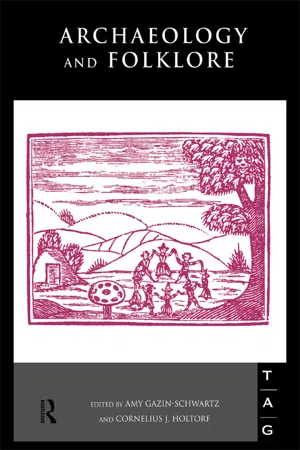
Archaeology and Folklore explores the complex relationship between the two disciplines to demonstrate what they might learn from each other.
This collection includes theoretical discussions and case studies drawn from Western Europe, the Mediterranean and North. They explore the differences between popular traditions relating to historic sites and archaeological interpretations of their history and meaning.
eBook - ePub
Archaeology and Folklore
- 304 pages
- English
- ePUB (mobile friendly)
- Available on iOS & Android
eBook - ePub
Archaeology and Folklore
About this book
Information
PART I
ARCHAEOLOGY AND FOLKLORE STUDIES
CHAPTER ONE
‘ AS LONG AS EVER I’VE KNOWN IT…’
On folklore and archaeology
AMY GAZIN-SCHWARTZ AND CORNELIUS HOLTORF
ABSTRACT
In this introductory chapter, we will consider questions of history, historical accuracy and meaning in formulating new relationships between archaeology and folklore. How do archaeology and folklore, in their broadest senses, differ in constructing ideas about the past? How have these differences arisen historically in different places, and how have archaeologists used or referred to folklore in previous studies? What roles might folklore play in an interpretive archaeology, which focuses on the meanings of the past in the past and in the present?
CONSTRUCTING THE PAST IN FOLKLORE AND ARCHAEOLOGY
Everyone concerned with the past—archaeologist, historian, politician, storyteller, priest, parent—constructs ideas and images of the past from materials available in the present. Through these ideas and images, we invest meaning in past events; but these meanings may differ according to our perspectives. We view the past through the lenses of the present; indeed, people have probably always done so. Archaeology and folklore are two of the many lenses through which the past is given meaning, and it is the aim of this volume to explore and understand differences and similarities in how archaeology and folklore create, and are created through, ideas about the past. In the intersections between these similarities and differences, we hope to find new lenses, through which we can begin to create alternative images of people’s histories. The papers that follow will explore the meanings people attach to the past, or to artefacts associated with the past. They will demonstrate the value of developing a dialogue between different systems of meaning. What aspects of the past, time, material culture are remembered, retold in folklore, and made meaningful in popular culture? How may such memories, stories and practices inform archaeological interpretations?
We do not seek to define a new field, folklore and archaeology (comparable to zooarchaeology or ethnoarchaeology); rather, we have set out to explore the possibilities of developing an interdisciplinary dialogue, and making this dialogue fruitful to the future development of both disciplines. In contrast to a common archaeological practice of borrowing methods, models or data from another field, we want to open a discourse between the fields, believing that a conversation about the many methods, models and sets of data that already exist in the two disciplines will enrich both, by creating new approaches to thinking about common questions, and indeed by raising new questions. The wide range of authors and approaches in our volume gives an indication of the diverse realms this dialogue may address. The multiple ways in which the connections between archaeology and folklore may serve, stimulate or trouble archaeology reveal the potential for a dialogue at the interface of the two fields.
In our introduction, we will briefly review some of the historical background for a study of folklore and archaeology, outlining the origins of both fields of study in a common antiquarian background and tracing the divergence of the two fields over the past century. We will then outline several lines of inquiry through which a study of folklore can enrich and broaden archaeological constructions of the past. First, we will deal with questions about historical accuracy, which lie at the heart of archaeologists’ worries about the reliability of folklore as evidence or data for archaeological interpretation. We will argue that this concern is based on limited views of both folklore evidence and more conventional archaeological evidence. Next we will address the value of folklore for understanding the history of monuments and the multiple meanings those monuments carry throughout their histories. Finally, we will give a brief overview of other areas where attention to folklore can inform archaeological interpretation and practice: issues of time, of identity, of the politics and sociology of archaeology as a discipline, and of the relationships between academic archaeology and the public. These issues do not define the limits of the dialogue between archaeology and folklore; we merely set them out as first steps in demonstrating the value of these connections.
Our thinking is grounded in four key convictions about archaeology, folklore and the creation of history, which we share with most of the authors of subsequent chapters.
First, our arguments are not based in the belief that folklore contains accurate and reliable representations of past behaviour, beliefs or events. The reliability of folklore for historical information has been, as we will discuss further below, the subject of often contentious argument. Our approach seeks to move beyond this problem. Folklore is not the only field where a concern with historical accuracy is problematic; archaeology too gives us the past as perceived and interpreted by present people. Neither field can be relied upon to tell us about the actual past. Folklore does give us a broader understanding of the past as perceived, remembered, and made significant by both past and present people.
Second, we are interested in what monuments and other archaeological objects meant (and mean) to people in their respective lifeworlds and how they were (and are) used in the formation of collective identities. In this context, the antiquity of a particular element of folklore is less important than its significance for interpreting meaning. As interpretive archaeologies have come to understand, the past is a creation of everyone who interprets material remains or fragments of tradition from past people’s lives, whether in the form of folklore or archaeological study. This past can be crucial for people’s understanding of the cultural landscape and their identities therein. Where these identities and different approaches to the past conflict, it is important to develop ways of establishing a dialogue among them.
These problems of accuracy and meaning are fundamental to the history of archaeological uses of folklore. Previously, when archaeologists attempted to apply folklore to archaeological materials, they often found that folk tradition and archaeological remains did not match. Rather than simply rejecting folklore as unreliable and inaccurate, several authors in the book deal with these problems and find that, when folklore is analysed (as archaeological materials have to be analysed), it sometimes does provide plausible interpretation for those materials, whether or not they can prove unbroken continuity of transmission.
Finally, archaeological approaches to sites and monuments most frequently focus on the time of their construction and intensive use. However, visible monuments have life histories as well, extending from their construction up until the present. Folklore reflects some of the later interpretations of prehistoric sites, and contemporary folklore constitutes one important part of present-day understandings of monuments. It thus supplements recent concerns about the role and interpretation of the past in the present, which have mainly focused on various aspects of ‘managed’ heritage.
It will be argued throughout this book that folklore is valuable to archaeologists because it offers us alternative ideas about the past that counter our tendency to portray everyone in all time as versions of ourselves, and because it provides knowledge about the continued importance and therefore the later history of archaeological monuments.
DEFINITIONS
To begin, we should introduce definitions—not because the terms we are using are difficult to understand, but because they are subject to public and academic assumptions. We need to make clear what we will be concerned with in this book.
The term ‘folklore’ usually encompasses both a field of study and the subject matter of that study. In the past, folklore was commonly understood as the traditions and beliefs of a people below the level of ‘high culture’ (after Newall 1980: xv). This limited definition encompassed things like fairy and other folk tales, place names, and regular ceremonies and rituals. However, we wish our definition to be as broad as possible, to include not only traditional oral literature and rituals, but also all material culture, social customs and artistic performances associated with a group of people. This broad definition follows the ideas of contemporary folklorists who recognise that all groups of people maintain many different kinds of traditions, and define themselves through these traditional practices (see also Newall 1980: xv).
This definition is close to the current German understanding of Volkskunde, including whatever is significant in popular culture and people’s everyday lives, with open boundaries to both sociology and (European) ethnology (see Bausinger et al. 1978; Brednich 1988). In Germany, folklore studies (Volkskunde) have a long tradition; since the 1960s, they have focused on the empirical study of culture as a whole, both contemporary and historical. Culture is understood in a very wide sense, including virtually everything that was part of the way people lived (and live) their everyday lives. Volkskundler, like social/ cultural anthropologists, are concerned with how people use material culture, how they act and treat each other, what they believe and think, what they say, how they speak, and what they do, at home, at work or in their spare time, among other things. The past (as tradition, remains or understanding) is then seen not as something which has simply survived and lives on somehow in the present, but as a meaningful and functioning part of a given culture. Ancient elements of a culture may or may not be of great age, but this does not affect their social and cultural significance.
For us, archaeology encompasses the academic study of the past through interpretation of its material remains. Because individuals living in the past had multiple perceptions, understandings and experiences, and because the same can be said for people in the present, we view archaeology as an endeavour open to multiple approaches and perspectives (as outlined by Shanks and Hodder 1995). The goal of archaeology is not to reconstruct the one true past, but to develop rich and sensitive interpretations, in order to make the past intelligible in the present. Many such interpretations and understandings of the past are possible.
HISTORICAL PERSPECTIVES
Both archaeologists and folklorists trace the origins of their disciplines to the works of antiquarians in the sixteenth to nineteenth centuries, but they view antiquarians through different lenses (for detailed accounts of the history of archaeology and of folklore studies respectively, see Bahn 1996; Daniel 1980, 1981; Dorson 1968b; Newall 1980; Trigger 1989). Archaeologists focus on antiquarian recording of archaeological monuments—Stukeley’s detailed drawings of Avebury, or Inigo Jones’ and Stukeley’s plans of Stonehenge before some of the stones had fallen—as examples of antiquarian concern with material culture and monuments of prehistoric Britain. They see this concern prefiguring archaeological interests in these same aspects of the past (Ucko et al. 1991).
Folklorists, on the other hand, are more likely to note the same antiquarians’ descriptions of ‘popular antiquities’, which included traditions, legends, tales, sayings, proverbs, songs and activities. Antiquarians themselves rarely distinguished between observing ancient material relics and recording ‘relics’ of ancient practices or beliefs in the form of folk rituals and tales. They viewed the latter as ‘sharing with material remains the same character of misshapen fragments surviving from a bygone day’ (Fenton 1993:7).
These fragments, both material and oral, are viewed by antiquarians, folklorists and archaeologists alike as fast disappearing relics of the past (see, for example, Bruford and Macdonald 1994; A.Carmichael 1928; Henderson [1879] 1967; Macpherson 1768; Thoms [1846] 1965; preservation legislation). This tradition of the threat to heritage materials follows on antiquarians’ convictions that they were preserving information about the nature of the ‘vulgar’ people, reflecting the original cultures, character and histories of their nations (Wright [1846] 1968:41). Whenever relics of the past have been recorded, they have been thought to be in imminent danger of being lost for all time. With regard to folklore, however, we agree with those who have argued that this concern is largely based on a misunderstanding of its character:
Folklore is not a phenomenon that is dying out or decaying or showing any signs of being in a decline… Certainly it ages, and one part of it and then another may die off. But it is also capable of breeding; it grows, it spreads, it feeds on other matter, and it has the greatest ability to adapt to changing circumstances.
(Opie and Opie 1980:68)
Archaeological sites, too, were threatened by destruction, through development and agricultural intensification. Antiquarians, and later archaeologists, therefore recorded them as comprehensively as they could, in some cases knowing that their records were likely to be all that future generations of archaeologists would have. For example, on the island of Rügen in Germany only 54 megalithic monuments are preserved today; archaeological research makes the most of Friedrich von Hagenow’s map and description from 1829, when 236 megaliths were still known (Schuldt 1972:10, 16–18). Archaeological concern with preservation and recording continues today, through the practices of cultural resource (heritage) management (CRM) and through other surveys like those conducted by the Association of Certificated Field Archaeologists on the island of Raasay, Scotland (see for example Macdonald and Wood 1997).
Defining new fields: folklore and archaeology in the nineteenth century
In the nineteenth century, the fields of archaeology and folklore began to define themselves as separate academic disciplines, in contrast to each other and to the antiquarianism from which they evolved. In 1846 William Thoms proposed the term folklore to replace what had been termed popular antiquities or popular literature (Thoms [1846] 1965: 4–5). Wilhelm H.Riehl, professor for cultural history in Munich, argued as early as 1859 that Volkskunde should be considered an independent discipline. When the British Folk-Lore Society was founded in 1878, it defined its objectives as ‘the preservation and publication of Popular Traditions, Legendary ballads, Loca...
Table of contents
- COVER PAGE
- TITLE PAGE
- COPYRIGHT PAGE
- ILLUSTRATIONS
- CONTRIBUTORS
- PART I: ARCHAEOLOGY AND FOLKLORE STUDIES
- PART II: INTERPRETING MONUMENTS IN ARCHAEOLOGY AND POPULAR CULTURE
Trusted by 375,005 students
Access to over 1.5 million titles for a fair monthly price.
Study more efficiently using our study tools.
Frequently asked questions
Yes, you can cancel anytime from the Subscription tab in your account settings on the Perlego website. Your subscription will stay active until the end of your current billing period. Learn how to cancel your subscription
No, books cannot be downloaded as external files, such as PDFs, for use outside of Perlego. However, you can download books within the Perlego app for offline reading on mobile or tablet. Learn how to download books offline
Perlego offers two plans: Essential and Complete
- Essential is ideal for learners and professionals who enjoy exploring a wide range of subjects. Access the Essential Library with 800,000+ trusted titles and best-sellers across business, personal growth, and the humanities. Includes unlimited reading time and Standard Read Aloud voice.
- Complete: Perfect for advanced learners and researchers needing full, unrestricted access. Unlock 1.5M+ books across hundreds of subjects, including academic and specialized titles. The Complete Plan also includes advanced features like Premium Read Aloud and Research Assistant.
We are an online textbook subscription service, where you can get access to an entire online library for less than the price of a single book per month. With over 1.5 million books across 990+ topics, we’ve got you covered! Learn about our mission
Look out for the read-aloud symbol on your next book to see if you can listen to it. The read-aloud tool reads text aloud for you, highlighting the text as it is being read. You can pause it, speed it up and slow it down. Learn more about Read Aloud
Yes! You can use the Perlego app on both iOS and Android devices to read anytime, anywhere — even offline. Perfect for commutes or when you’re on the go.
Please note we cannot support devices running on iOS 13 and Android 7 or earlier. Learn more about using the app
Please note we cannot support devices running on iOS 13 and Android 7 or earlier. Learn more about using the app
Yes, you can access Archaeology and Folklore by Amy Gazin-Schwartz, Cornelius J. Holtorf, Amy Gazin-Schwartz,Cornelius J. Holtorf in PDF and/or ePUB format, as well as other popular books in Social Sciences & Archaeology. We have over 1.5 million books available in our catalogue for you to explore.