Archaeologists are increasingly aware of issues of gender when studying past societies; women are becoming better represented within the discipline and are attaining top academic posts. However, until now there has been no study undertaken of the history of women in European archaeology and their contribution to the development of the discipline.
Excavating Women discusses the careers of women archaeologists such as Dorothy Garrod, Hanna Rydh and Marija Gimbutas, who against all odds became famous, as well as the many lesser-known personalities who did important archaeological work. The collection spans the earliest days of archaeology as a discipline to the present, telling the stories of women from Scandinavia, Mediterranean Europe, Britain, France, Germany and Poland. The chapters examine women's contributions to archaeology in the context of other, often socio-political, factors that affected their lives. It examines issues such as women's increased involvement in archaeological work during and after the two World Wars, and why so many women found it more acceptable to work outside of their native lands.
This critical assessment of women in archaeology makes a major contribution to the history of archaeology. It reveals how selective the archaeological world has been in recognizing the contributions of those who have shaped its discipline, and how it has been particularly inclined to ignore the achievements of women archaeologists.
Excavating Women is essential reading for all students, teachers and researchers in archaeology who are interested in the history of their discipline and its sociopolitics.
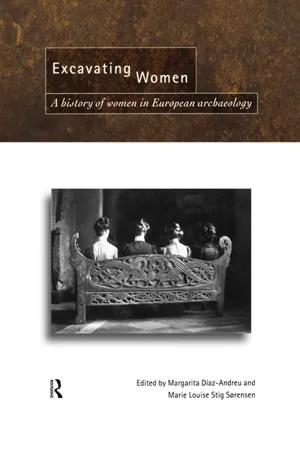
eBook - ePub
Excavating Women
A History of Women in European Archaeology
- 336 pages
- English
- ePUB (mobile friendly)
- Available on iOS & Android
eBook - ePub
Excavating Women
A History of Women in European Archaeology
About this book
Information
1
EXCAVATING WOMEN
Towards an engendered history of archaeology
Towards an engendered history of archaeology
Gender archaeology has by now become a relatively well-established research topic within archaeology. Recent years have seen the publication of a number of edited volumes, a rapidly expanding number of papers and even a few journals and newsletters dedicated to this subject. It is, therefore, very surprising that in this literature historiographic analysis of women archaeologists has played only a minor part. Likewise they are hardly acknowledged in the ‘folk’ histories of the discipline (Lucy and Hill 1994: 2). The need to understand the disciplinary integration of women, to appreciate the varying socio-political contexts of their work, to reveal the unique tension between their roles as women and their academic lives, has become obvious and is strongly felt in many areas of the discipline. The insights yielded by such analysis will have significance at many levels and will be of paramount importance for the intellectual history of archaeology. In particular, they will force a much needed revision of the disciplinary history by revealing its mechanisms of selecting and forgetting, and will play an important role in the analysis of archaeology’s knowledge claims.
The histories of archaeology have broadly accepted and spread a perception of archaeology as being male-centred, both intellectually and in practice. These accounts, written by male archaeologists such as Glyn Daniel (1975), Alain Schnapp (1993) and Bruce Trigger (1989), are inevitably androcentric in their conceptualization and reconstruction of the disciplinary past. Their versions have, however, recently begun to be contested, as concern with critical historiography has grown, and a few explicit historiographical accounts of women archaeologists have appeared. So far, as regards the role of women, the most extensive contributions are the edited volumes by Claassen (1994) and du Cros and Smith (1993). While providing an important beginning, these publications show that there is still a long way to go. In particular they demonstrate a gap in research coverage, as no investigation of the contribution of women outside the USA and Australia exists. This means that, in such a diverse continent as Europe, where, moreover, archaeology has from its beginning had an important social and political role, we know little about the women who participated in the initial stages and subsequent developments. Indeed, the various histories of European archaeology practically ignore women, as if they had contributed not at all, and as if their presence had not played a role in the social context and the institutional milieu in which archaeology was practised. But is this true? What about the seven pictures of women hanging on the wall of the Department of Prehistory in Tübingen, Germany? And the excavations conducted by women such as Kathleen Kenyon? Or the women working in the Archaeological Services, such as Semni Karouzou in the 1920s, or the various generations of women who have worked in museums throughout Europe? The responses to such obvious questions direct us towards the parameters used in the writing of history, suggesting that they are the central problem – that they have made it possible to exclude women from the narrative.
These issues were tackled at the session ‘Women in European Archaeology’ held in Durham at the Theoretical Archaeology Group Annual Meeting (TAG) in December 1993, of which this book is partly the result. The debate created after each paper and the success of the session as a whole made the need for publication obvious, as this would contribute towards a more comprehensive history of archaeology. We also saw the need to look for contributions from countries that were initially not covered. What is presented here is a broader panorama than in the original session, although it is not an exhaustive account of women archaeologists’ history in Europe. Such a task would at present be impossible to accomplish, for the general historiography of the discipline is still poorly researched in many countries. This does not imply that women were not involved from early on in the countries not covered in the volume. A brief browse in Jan Filip’s archaeological encyclopedia (1966/69), for example, quickly provides names of women archaeologists, especially from Eastern Europe, who would be worth further investigation.
The histories of women archaeologists presented in this volume are in various ways influenced by a gender-critical perspective. This means that they are historiographies which see women as embedded in their specific cultural and socio-political contexts. Despite its many internal differences, Europe provides a coherent framework for such a study. Throughout Europe women archaeologists grew up with and were affected by a similar political history, and their perception of the discipline of archaeology at any one time would have been influenced by the same academic discourse. The network of archaeologists in Europe was small and intimate until the expansion of the discipline after the Second World War, and the academic discourse and practices were inter-European as well as nationalistic. The histories of archaeology, furthermore, have mainly been concerned with reconstructing these networks within a homogenized disciplinary past, and it is thus within this historiographic perspective that the neglect of women can most easily be detected. As a consequence, we have to acknowledge that despite our concern about the selection criteria employed by standard histories we have none the less been compelled to use them as our own starting-point. Thus, even in our attempt to conduct critical historiography we are perpetuating a particular traditional view of what constitutes importance. This means that women (or men) who did not publish, did not have important positions, and did not have permanent employment remain invisible. This, at present, puts regrettable but unavoidable limitations upon the project of excavating the disciplinary past self-critically and reflexively. As regards the women who are thus recognized, it is, however, possible to trace shared patterns in their interaction with the discipline despite their individual personalities and circumstances. At the same time comparison between the data allows us to detect cultural variation in the perception of gender relations, and how this influenced the integration of women in the profession in Europe. It also makes it possible to reveal the underlying reasons for counter-intuitive observations about our own contemporary situations, such as the high number of women in archaeology in both Norway and Spain in contrast to Germany.
THEMATIC COMPARISON
The women referred to through the book are each, of course, individual and unique. Out of their histories we can, however, draw points of significance for the social history of archaeology. The main points that will be discussed below provide essential insight into factors that conditioned women’s participation in archaeological practice and their recognition in histories of the discipline. This cannot be an exhaustive account. Our intention is rather to point to some of the most significant and influential factors involved and to outline potential areas for future research. Within the integration process of women in archaeology in Europe there are several clear similarities. The first to be highlighted is that this process was critically related to changes within traditional social structures. Such ruptures were caused in particular by the growing importance given to education, especially in the context of the formation of the nation-state and due to the impact of industrialization. Of special importance also were the social and political changes provoked by both world wars, which saw a dramatic increase in the integration of women in ever wider parts of Europe. Gender ideology, however, involves many aspects of society and the person, and obviously such aspects did not all change at the same time within each area. A good example of this is that as women gained access to professional life this led to a conflict with their status as mothers and wives. Professional women who were married and had children followed significantly different career patterns from their male colleagues and had a significantly different image from non-professional women. Contrary to what may be expected, however, this did not result in these women sharing either political attitudes (particularly with regard to the women’s movement), or a similar perception of themselves as archaeologists.
Access to education not only gave women appropriate qualifications but also, and at least as importantly, different attitudes and ambitions. It is, therefore, significant that the role of education changed during the nineteenth century, and that this was a period during which women gradually gained access to higher levels of education. Initially, the basic educational aim for girls was to prepare them for motherhood and marriage, since cultural knowledge was beginning to be considered essential to a good upbringing. Some of the main components of this knowledge would be familiarity with Latin and Greek languages and literature. In addition, it was increasingly expected that the cultured person would be familiar with topics such as Egyptology. It is also relevant to note that the nineteenth century was the period when the Romantic movement developed, with its empathetic attitude to the landscape and the national past. This affected attitudes, including women’s, towards the past and its physical manifestations in monuments, and thus furthered the general interest in archaeology.
The best education included travel as well. Following the trends developed since the Renaissance and particularly during the Enlightenment, travelling was considered to play an essential role in education. The destination of these journeys was usually Italy, in order to familiarize oneself with the ancient scenarios of the Classical past. The nineteenth century brought two major changes to the journeys: the broadening of the scope of countries to be visited, as the Orient was included, and the greater participation of women. Often these women got involved with archaeology peripherally, such as Mrs Belzoni, who wrote an ethnographic appendix to her husband’s volume on Egyptian archaeology in 1821 (McBryde 1993: xi). Others participated more fully, as appears from Sara Champion’s account (Chapter 9 in this volume) of Amelia Edwards, who made a voyage to Egypt in 1873–4, becoming an expert in Egyptian archaeology and even conducting excavation. Another example, mentioned by Anick Coudart in Chapter 3, is Jane Dielaufoy. Together with her husband, she began a voyage to Perse in 1881 which resulted in several books on the archaeology of the area (Gran-Aymerich and Gran-Aymerich 1991). Marie Louise Stig Sørensen argues (in Chapter 2) that another major influence was the experience women gained as partners to men in the colonial service and missionary activities. This often brought women in contact with the ethnography and archaeology of colonized countries and gave them access to active and meaningful roles in their own right.
Towards the end of the nineteenth century the institutionalization of academia increasingly meant that an appropriate qualification was needed in order to gain access to particular professions. Women were initially denied access to such qualifications and had to fight to obtain the right to formal higher education. Thus, the first studies available to women – not without previous debate on their suitability – were those considered feminine, i.e. mostly nursing and education. These were not included among university qualifications, but they contributed to the acceptability of the idea of women gaining access to further education. Anick Coudart and Margarita Díaz-Andreu both emphazise this point in their chapters as part of the background for understanding when and how women gained access to archaeological education. As archaeology became increasingly professionalized it was even more important for women to obtain formal degrees in order to work as archaeologists and these were given only by universities or similar institutions.1 The dates of women gaining access to university training (at various levels) mark important stages in the history of women in the discipline, not only because it provided them with qualifications, but also because it gave them access to a different ‘mental’ culture. This is, of course, differently dated from country to country, but the following survey gives an idea about when it happened. In Denmark women could attend lectures from 1875, in Norway they were admitted from 1883, while in both Greece and Poland access was gained during the 1890s. The history of women’s access to education is, however, more complex than a list of dates suggests. It involved several alternative systems and progressed through different stages in different countries. In Britain, for example, the first female student attended university lectures in 1871 and women were admitted for some university exams from 1881. They gained full membership of the University of London in 1878, of Oxford in 1918 and of Cambridge only in 1948. However, in addition a women-only system existed parallel to and usually increasingly modelled upon the male system. Thus, Bedford College, as a women’s college, was founded in 1849, and in Cambridge the first female college, Girton, was established in 1873, while the old male colleges in Cambridge did not begin to go ‘mixed’ until the 1970s (Sutherland 1995). This sketchy outline of just some of the components of women’s education in Britain points to some of the fundamental issues involved: access to education became a question of parity, degree and hierarchy, and for a long time access did not necessarily mean that women gained the same degrees as men or that their education was accorded similar value.
Another main cause of the rupture of traditional social relations was industrialization. Social structures and hierarchies were rapidly transformed as soon as women entered the labour market. Working-class women were the first to be affected by industrialization as they were forced into paid labour and thus became visible in the economy. The first women working in archaeology belonged to a very different social stratum, but they were affected by and benefited from the general social changes and transformed expectations. This partly explains why it was precisely in the early industrialized countries, such as England, France and Germany, that women were first involved with archaeology as professionals.2 Women also profited from other consequences of industrialization. The improvement of means of transport gave them greater freedom to move (Hudson 1981), and thus independence. In addition, the greatly increased demands for resources such as coal and timber drastically affected and eroded the natural landscape. In response, the first forms of landscape legislation, scheduling and rescue activities arose, and in this process new jobs and services were created. Archaeology was expanding both as a profession and in the public eye – it became less of a rarity and more of a possible employment for both men and women.
The First World War brought rapid industrialization to the less developed states, and from 1914 all countries in Europe were affected by this process. The impoverishment of the middle classes after the war compelled even more women to work. It is, therefore, in the inter-war period that a significant number of women entered the profession, a trend seen again and significantly increased after the Second World War.
Industrialization was important for the early appearance of women in archaeology in particular countries; but it does not explain the current situation. Surprisingly, it seems that countries in which women became integrated at a later stage, such as Norway, Spain and, in part, Greece, have now achieved the greatest equality in numbers, although Lise Bender Jørgensen (Chapter 11) shows that they are still under-represented in Denmark. A similar pattern is seen in Mexico, where Gero (1988) observed that, unexpectedly, women’s position in archaeology seemed to be better than in the USA. This pattern is not attributable to one single cause, but varies according to the particular disciplinary integration procedures of the country in question. In Norway a system of positive discrimination has undoubtedly helped women to obtain posts, while in Spain, Portugal and Greece (as in Mexico) the traditional system of patronage and a distinct conceptualization of gender seems to give priority to group affiliation rather than gender.
Feminist studies often assume that the first women in academia had a sense of solidarity, and that they self-consciously saw themselves as pioneering women’s acceptance in new fields. It is, however, important to come to terms with the fact that the reality is far from this idealized picture – only then can a critical social historiography emerge. Women in the profession never constituted a unified political group. We can roughly divide these early women into two groups: those who clearly perceived themselves as unique and did not consider their personal experience as relevant for other women, and those who were actively involved with contemporary women’s movements. Comparison between Lis Jacobsen in Denmark and Hanna Rydh in Sweden is enlightening in this regard. Lise Bender Jørgensen shows the former as a very clear example of the first position, whereas Elisabeth Arwill-Nordbladh (Chapter 8) reveals how Hanna Rydh saw her work as relevant to other women and actively promoted the idea of women and women’s contributions in her writing. The two women were contemporaries, they grew up in neighbouring and socio-culturally rather similar countries, they were both married to husbands who appear to have supported them academically, and they both had children. Yet their views on women’s positions in general and their own specifically seem at first sight to be totally opposed. If, however, one looks at the central premises in their views of women’s role in society they are surprisingly similar despite their apparent contrasts, as both emphasized the mother-role and both seemed to accept and strongly believe this to be an unquestionable part of being a women.
This suggests that the concept of the mother constituted a social norm so firmly established that it was unaffected by political and social movements. Views so deeply embedded would have affected all and were not subject to personal choice and preference. In the first few generations of women archaeologists, behaviour that challenged the mother-role would quite simply be considered unnatural, as discussed by Marie Louise Stig Sørensen. It would have taken much determination, courage and ability to withstand social censure and deliberately to flout the norms. The similarities between the women archaeologists resulting from such deeply seated social norms and values, and their influential, almost inescapable nature, is clearly shown by their being shared by different personalities.
The importance given to the mother-role leads us to consider another factor th...
Table of contents
- Cover
- Halftitle
- Title
- Copyright
- Contents
- List of Figures
- List of Tables
- List of Contributors
- 1 Excavating Women: Towards an engendered history of archaeology
- Part I: General perspectives on the history of women in European archaeology
- Part II: History through the individual
- Index
Trusted by 375,005 students
Access to over 1.5 million titles for a fair monthly price.
Study more efficiently using our study tools.
Frequently asked questions
Yes, you can cancel anytime from the Subscription tab in your account settings on the Perlego website. Your subscription will stay active until the end of your current billing period. Learn how to cancel your subscription
No, books cannot be downloaded as external files, such as PDFs, for use outside of Perlego. However, you can download books within the Perlego app for offline reading on mobile or tablet. Learn how to download books offline
Perlego offers two plans: Essential and Complete
- Essential is ideal for learners and professionals who enjoy exploring a wide range of subjects. Access the Essential Library with 800,000+ trusted titles and best-sellers across business, personal growth, and the humanities. Includes unlimited reading time and Standard Read Aloud voice.
- Complete: Perfect for advanced learners and researchers needing full, unrestricted access. Unlock 1.5M+ books across hundreds of subjects, including academic and specialized titles. The Complete Plan also includes advanced features like Premium Read Aloud and Research Assistant.
We are an online textbook subscription service, where you can get access to an entire online library for less than the price of a single book per month. With over 1.5 million books across 990+ topics, we’ve got you covered! Learn about our mission
Look out for the read-aloud symbol on your next book to see if you can listen to it. The read-aloud tool reads text aloud for you, highlighting the text as it is being read. You can pause it, speed it up and slow it down. Learn more about Read Aloud
Yes! You can use the Perlego app on both iOS and Android devices to read anytime, anywhere — even offline. Perfect for commutes or when you’re on the go.
Please note we cannot support devices running on iOS 13 and Android 7 or earlier. Learn more about using the app
Please note we cannot support devices running on iOS 13 and Android 7 or earlier. Learn more about using the app
Yes, you can access Excavating Women by Magarita Díaz-Andreu,Marie Louise Stig Sorensen in PDF and/or ePUB format, as well as other popular books in Social Sciences & Archaeology. We have over 1.5 million books available in our catalogue for you to explore.