- 228 pages
- English
- ePUB (mobile friendly)
- Available on iOS & Android
eBook - ePub
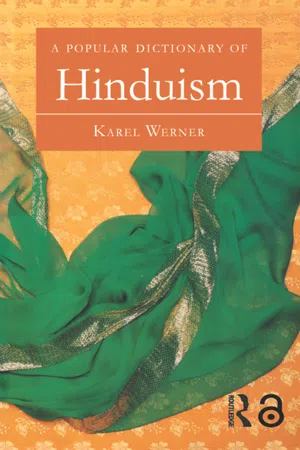
A Popular Dictionary of Hinduism
About this book
A multi-purpose reference work which should become an indispensable companion for anybody who comes into touch with Hinduism. Includes a dictionary of Sanskrit and vernacular terms; a glossary of terms and concepts; and a survey of the historical development of Hinduism.
Information
INTRODUCTION
Hinduism is perhaps the most complicated religious phenomenon in the world. Indeed, views have been expressed that it is not one religion, but many, a kind of coalition of religions. On the other hand, there are some features within Hinduism which bind together the apparently bewildering variety of its deities, cults, customs, spiritual practices, beliefs, sectarian teachings and philosophical schools and which have provided a strong sense of religious belonging as well as of social and cultural togetherness for the peoples of India across linguistic and racial barriers throughout their long history, despite many changes in the political scene.
One reason for the complexity of Hinduism is the fact that it has no known starting-point and no single charismatic figure who could be regarded as its originator. It took shape over a period of many hundreds of years and many diverse influences left their mark on its fabric. It is therefore by following, at least in brief outline, the historical sequences and developments in the religious scene which led to the emergence of Hinduism as a religious system that we can hope to start appreciating its many facets and the way they form a multifarious yet coherent whole. There are several clearly recognizable phases in the historical development of Hinduism:
- The riddle of Harappan religion. A great civilization flourished in the Indus valley and adjacent areas in the third millennium B.C. While its writing still awaits decipherment, the archaeological finds testify to a highly developed and stratified religious system. The nature of the burials indicates a belief in the continuation of life. Numerous female figurines, some of them suggesting pregnancy, point to a cult of the Great Goddess, perhaps the Great Mother of the Universe (known as Aditi to the Vedas and under various forms of the Devi in later Hinduism). Depictions of a male deity as surrounded by animals remind one of the Hindu god Œiva as Paœupati, his meditative position is reminiscent of Œiva’s role as the great Yogi (Yogapati) and his three faces might suggest a trinitarian view of the deity akin to the Trimurti. The ithiphallic feature of this deity and finds of phallic emblems further point to the role of the
 in Œaivite cults. Other connections could be pointed out as a result of a detailed analysis of Harappan pictures on seals by comparison with Hindu mythology.
- The Indo-European prehistory. The Indo-Aryans reached India in the second millennium B.C. in several waves of immigration over a period of several hundred years, after a long and slow migration from Eastern Europe. There they had for a long time been a part of the great IE family of tribes with whom they shared a common language and culture, as is obvious from similarities which survived both the parting of this family into tribes and their migrations and development into separate nations. The Vedic religion of the Indo-Aryans shows a number of parallels with the Greek, Roman, Celtic, Slavonic, Germanic and other ancient IE religions. Besides the gods, of whom the ‘Heavenly Father’ (Vedic Dyaus Pitar, Gr. Zeus Pater, and Lat. Jupiter) is the best known, there are concepts such as ‘destiny’, ‘fate’, ‘retribution’, ‘necessity’ or ‘cosmic order’, and ideas about the afterlife, including the belief in re-incarnation (metempsychosis) and immortality or the final salvation. A careful comparative investigation of these concepts would show how much of what Hinduism stands for has IE roots.
- The Vedic vision of the world. Once in India, the Indo-Aryans further elaborated and consolidated their religious heritage by codifying it, by 1000 B.C., in the collection of hymns known as theVeda. Its authorship is ascribed to generations of inspired seers —poets, visionaries, mystics and philosophers as well as spiritual leaders and moral guides of their communities. They developed a global picture of the cosmos, its beginnings and its duration as governed by the cosmic law on all levels— physical, social, ethical and spiritual. In order to convey their insights in an effective way to the people, they translated them into regular re-enactments of the drama of creation and of the struggle between the forces of life and stagnation or decay through the use of symbolic rituals, both private and communal, and through religious festivals. In this way the lives of individuals, families and communities were regulated. The interplay of cosmic and social forces and their impact on human life was further reflected in the richness of myths and legends with the gods, divine heroes, demons and other supernatural beings as principal actors who could be propitiated and won over to grant prosperity. For those who thought further ahead there were the means of securing heaven after death in the company of blessed forefathers, and those with higher aspirations could even attempt to tread the path to immortality discovered by the greatest among the ancient , thereby becoming exempt from the normal human lot of successive lives. This stage of Indo-Aryan religion is often called Vedism.

- The Brahminic universe of ritual action. As is only natural with human communities, the majority of Vedic people focused their interest on prosperity on earth and at best on securing heavenly rewards in the afterlife without giving much thought to their final destiny. Their expectations were catered for by the successors of the , the guardians of the sacred lore codified in the Veda, who developed into a hereditary caste of priests (brahmins). They succeeded in gaining a high reputation as indispensable experts in ritual communication with the deities and cosmic forces. They compiled two further Vedic collections, the Sama Veda and the Yajur Veda, mainly for their liturgical procedures, and elaborated theories about the correspondences between ritual action and cosmic processes which have come down to us in books known as the. Their confidence in their own skill and in the efficacy of rituals, performed at specially erected altars in the open, was such that there was nothing which, in their view, a correctly performed rite could not bring about. This obviously rather externalized form of religion known as Brahmanism had its heyday at a time (cca 900-600 B.C.) when the Indo-Aryan civilization was expanding and materially prospering.

- The gnosis. The Brahminic ritualism tended to grow out of proportion and was eventually felt by many to be a burden. Thoughtful individuals began to realize that behind its formalism there was not the true spiritual force which once had expressed itself in the inspired hymns that now were endlessly repeated by the brahmins as mere liturgical formulas. A new spiritual search for direct experience of the transcendent divine reality, helped by the existence of hermits and wandering ascetics outside or alongside the Vedic tradition who were given to contemplation rather than to ritual, led to a revival of the mystic vision of the ancient seers. This time its results were expressed not in hymnic poetry, but in the philosophical language of the
 . (The earliest of them became the last section of the Vedic scriptures and came to be recognized as revelation or divinely inspired.)
Besides some spiritually-minded brahmins the bearers of this rediscovered wisdom were members of other classes, among them often aristocratic , including a few kings. The greatsages found the solution to the riddle of life and its goal in the discovery of the essential identity of one’s inner self (atman) with the divine source of the whole universe (brahman). The direct knowledge of this identity, best expressed for us by the Greek word gnosis, results according to them in liberation from rebirth which amounts to the final salvation. It cannot be secured by purely religious piety and observance, because they lead only to a temporary respite in heavenly abodes followed sooner or later by further births in lower realms of . - Movements outside the Vedic tradition. The goal of final liberation was never entirely lost sight of by some of those who lived outside or dropped out of the established Vedic civilization with its cult-orientated priesthood. Among these outsiders were, in the first place, Vratyas, a loose oath-bound alliance of Indo-Aryan tribal fraternities who were the earliest invaders of India and moved eastwards to Magadha when further immigrants arrived in large numbers and settled in Saptasindhu. The Vratyas possessed a wealth of magic, mystic and speculative lore which only partly overlapped with that of the Vedic . It was not compiled into a collection until around 600 B.C. when the Vedic civilization overran also the Vratya territory and brahmins made selective use of Vratya materials to create the Atharva Veda. In it some of the insights are foreshadowed, while its less elevated magic elements and some of its ritual practices also contributed to the future shape of Hinduism.
Further influences, on a higher level, came from solitary sages and wanderers, some known even from early references in the Veda (munis, keœins), who rejected life in society in their pursuit of liberation. There were among them ascetics ; yogis practising a variety of techniques, among them meditational absorption (dhyana); and even speculative philosophers. Some of them acquired a high reputation and circles of disciples gathered around them in their forest schools. Around 500 B.C. there emerged from this background two highly influential movements, namely Jainism and Buddhism. They almost obliterated for several hundred years the Brahminic grip on society, partly also as a result of royal patronage, especially under the Maurya dynasty whose founder, Chandragupta, became a Jain, and its third ruler, Aœoka, an ardent Buddhist. It was Buddhism which then came to dominate many parts of India. - The Brahminic revival and the ‘birth’ of Hinduism. All the unorthodox movements catered, in the first place, for those who aspired to personal liberation through the renunciation of worldly involvement and they were based in ascetic communities which in the case of Buddhism gradually developed into monasteries. Therefore there was a considerable gap, both physically and spiritually, between them and their lay followers who were less committed to the immediate effort of reaching the goal of liberation, but found some inspiration in it as a distant prospect, while supporting the monks materially. Brahmins, on the other hand, lived as family men within the community ready to cater for all its religious needs, including those which monks were not willing to meet, such as officiating at births, marriages and funerals. The previous high authority of the monks in religious matters was, of course, swept aside by the tide of reformist movements and the loss of royal patronage and the confidence of the people, and so the brahmins now made their come-back by incorporating virtually all the innovations into a new...
Table of contents
- COVER PAGE
- TITLE PAGE
- COPYRIGHT PAGE
- ABBREVIATIONS
- PREFACE
- A NOTE ON THE PRONUNCIATION OF THE SANSKRIT ALPHABET
- INTRODUCTION
Trusted by 375,005 students
Access to over 1.5 million titles for a fair monthly price.
Study more efficiently using our study tools.
Frequently asked questions
Yes, you can cancel anytime from the Subscription tab in your account settings on the Perlego website. Your subscription will stay active until the end of your current billing period. Learn how to cancel your subscription
No, books cannot be downloaded as external files, such as PDFs, for use outside of Perlego. However, you can download books within the Perlego app for offline reading on mobile or tablet. Learn how to download books offline
Perlego offers two plans: Essential and Complete
- Essential is ideal for learners and professionals who enjoy exploring a wide range of subjects. Access the Essential Library with 800,000+ trusted titles and best-sellers across business, personal growth, and the humanities. Includes unlimited reading time and Standard Read Aloud voice.
- Complete: Perfect for advanced learners and researchers needing full, unrestricted access. Unlock 1.5M+ books across hundreds of subjects, including academic and specialized titles. The Complete Plan also includes advanced features like Premium Read Aloud and Research Assistant.
We are an online textbook subscription service, where you can get access to an entire online library for less than the price of a single book per month. With over 1.5 million books across 990+ topics, we’ve got you covered! Learn about our mission
Look out for the read-aloud symbol on your next book to see if you can listen to it. The read-aloud tool reads text aloud for you, highlighting the text as it is being read. You can pause it, speed it up and slow it down. Learn more about Read Aloud
Yes! You can use the Perlego app on both iOS and Android devices to read anytime, anywhere — even offline. Perfect for commutes or when you’re on the go.
Please note we cannot support devices running on iOS 13 and Android 7 or earlier. Learn more about using the app
Please note we cannot support devices running on iOS 13 and Android 7 or earlier. Learn more about using the app
Yes, you can access A Popular Dictionary of Hinduism by Karel Werner in PDF and/or ePUB format, as well as other popular books in Social Sciences & Ethnic Studies. We have over 1.5 million books available in our catalogue for you to explore.