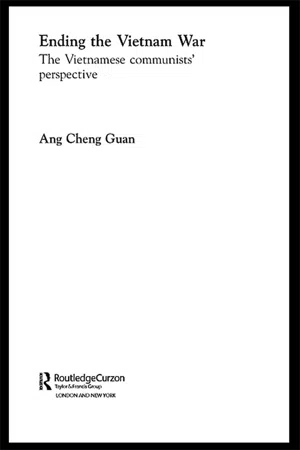
Existing studies of the Vietnam War have been written mostly from an American perspective, using western sources, and viewing the conflict through western eyes. This book, based on extensive original research, including Vietnamese, Chinese and former Soviet sources, tells the story of the war from the Tet offensive in 1968 up to the reunification of Vietnam in April 1975. Overall, it provides an important corrective to the predominantly US-centric narratives of the war by placing the Vietnamese communists centre-stage in the story. It is a sequel to the author's Routledge Curzon book The Vietnam War From the Other Side, which covers the period 1962-68.
eBook - ePub
Ending the Vietnam War
The Vietnamese Communists' Perspective
- 208 pages
- English
- ePUB (mobile friendly)
- Available on iOS & Android
eBook - ePub
1 The start of negotiations
Decision to negotiate
In the wake of the 1968 Tet Offensive, President Johnson announced in a televised address to the nation on 31 March 1968 that (a) he was restricting air strikes of North Vietnam to the area below the 20th degree parallel (b) he had instructed Averell Harriman to begin negotiations as soon as the Vietnamese communists were ready; and (c) he would not be running for the forthcoming US presidential election. In his speech, President Johnson, however, did not say whether he would resume the bombing or raise the level of American forces in Vietnam should the talks fail to materialise.
According to Bui Tin, Johnson’s announcement, coupled with the earlier resignation of Secretary of Defense Robert S. McNamara as well as the recommendation of the ‘Wise Old Men’ that the US should end the war, convinced the Hanoi leadership that the US were preparing to back out of Vietnam. Bui Tin recalled that
[they] discussed these developments among ourselves and concluded that the US must be in great difficulty. Who could be greater than Johnson as President of the United States? Who could yield as much power as McNamara while he was secretary of defense? Who would have his name linked to the Vietnam conflict as closely as Westmoreland? It was clear that the United States had reached a dead end in Vietnam.1
Three days later, on 3 April 1968, Hanoi issued a statement making the point that, even though the US government had not fully met the communists’ demands, they were willing to meet the Americans for preliminary discussions. According to Hoang Van Hoan, the decision to talk with the Americans was not unanimous. Le Duan decided on it and Ho Chi Minh was not consulted. The latter was then recuperating in Beijing on 3 April 1969 when he heard the news that Hanoi had agreed to Johnson’s call for talks.2 Luu Van Loi explained that Johnson’s announcement was especially significant as ‘it marked a great change in the US strategy, from intensification of the war to de-escalation, from refusal of negotiations to acceptance of probing negotiation’. The public (including the international community) would not have supported Hanoi’s outright rejection of Johnson’s offer. But it was also premature to begin negotiations at that time. The Politburo identified the establishment of preliminary contacts and the insistence on complete cessation of US bombing of North Vietnam as the top priority. Meanwhile, secret-probing discussions could be held but there would be no negotiations on substantive matters until the bombing had stopped.3
The Nhan Dan and Quan Doi Nhan Dan editorials of 4 April expressed support for the decision. The editorials noted that the decision to meet the Americans ‘conformed to the aspirations of the world people, who cherished independence, peace and justice, and would surely receive widespread approval and support in the world’. The editorials also underscored the fact that the Vietnamese communists were determined to fight till total victory was theirs.4 Pham Van Dong told the Japanese writer Seicho Matsumoto in an interview on 6 April that Hanoi had already appointed its representative to meet the Americans.5 Hanoi attempted to exploit the split within the US in the aftermath of the Tet Offensive to advance its cause. On 8 April, during a CBS interview, Nguyen Duy Trinh appealed to the American people for support.6 Pham Van Dong also sent a message to the American public through CBS in which he called upon the American people to join the Vietnamese in the common objective of bringing the war to an end by demanding that the US withdraw its troops from Vietnam.7
The Tet Offensive – Phase II
The opening round of the Tet Offensive (which began on 31 January 1968) had not only been a failure but had also resulted in heavy losses on the communist side. Recognising their disadvantage at the negotiation table without first scoring a battlefield victory, Hanoi was desperate for an unqualified military success to help them negotiate from a position of strength. To this end, on 24 April, the Politburo decided to conduct another military offensive.
Bui Tin revealed that this decision to launch the second phase of the Tet Offensive was not unanimous. Vo Nguyen Giap was among those who did not agree with the idea but did not express his opposition outright at the time ‘because he was in the minority and the others would not have listened to him’.8 Phase II of the Tet Offensive took place between 4 May 1968 and 17 August 1968. The communists attacked thirty-one cities, fifty-eight districts, thirty airfields and twenty operation staging bases mainly in Saigon and Gia Dinh, suffering high casualties in the process. On 12 June, they withdrew from Saigon.9
The start of the talks in Paris
On 7 May 1968, en route to Paris, Xuan Thuy, North Vietnam’s representative at the talks, made a stopover at Beijing. The stopover provided Xuan Thuy with an opportunity to gauge Beijing’s feelings towards the decision to negotiate. Apparently, Mao Zedong refused to meet him. Xuan Thuy had a brief meeting with Zhou Enlai, who was reported to have told him that Hanoi’s decision to negotiate with the US was a major tactical and diplomatic mistake and that Hanoi had fallen into an American trap.10
In the midst of Phase II of the Tet Offensive and despite the disapproval of the Chinese, the first session of the peace talks was convened at the International Conference Centre on Avenue Kle´ber in Paris on 13 May 1968. The Vietnamese delegation was led by Xuan Thuy (with Ha Van Lau as his deputy). The US side was led by Averell Harriman (with Cyrus Vance as his deputy). In the words of Luu Van Loi, ‘a new war officially began between Vietnam and the US: a war around a green carpet as bombs were still exploding on the battlefield’.11
Hanoi had four objectives at the preliminary talks: (1) to win international sympathy and support; (2) to divide and isolate the US and its allies; (3) to gain an insight into the US game plan; and, most significantly, (4) to get the US to stop bombing the North unconditionally. The North Vietnamese negotiating team refused to proceed with any substantive discussion until the US ceased all bombing.
After almost a month of posturing at Avenue Kle´ber, on 3 June 1968, North Vietnam’s Foreign Minister Nguyen Duy Trinh directed the Vietnamese negotiators to ‘continue the fruitful public struggle while preparing for starting, at a propitious moment, behind-the-scenes talks concurrently with the public talks’. ‘Behind-the-scenes talks’, Trinh explained, ‘are different from the US secret talks. However, we should prevent the US from using behind-the-scenes talks to deceive public opinion and to create illusion among people.’12
About a fortnight later on 15 June, Hanoi further clarified that the objective of the private contacts was for ‘probing purposes’ and ‘not yet for bargaining’.13 Soon after, on the evening of 26 June, the deputy leaders of both sides, Ha Van Lau and Cyrus Vance, met at the residence of the Vietnamese delegation in Vitry-sur-Seine. Both sides met again in mid- July. At this meeting, Vance reiterated US willingness to cease the bombing. But he insisted that there must be an agreement of what both sides would do after the bombing had stopped. Vance then proposed a ‘two-phase plan’. In Phase I, the US would stop the bombing as well as all military actions in North Vietnam. However, before that could happen, both sides would first need to discuss the measures to adopt after the bombing had halted. In Phase II, the two sides would agree to (1) reestablish the Demilitarised Zone (DMZ) in accordance with the 1954 Geneva Agreements; (2) refrain from increasing their military forces beyond the pre-bombing halt level; and (3) begin substantial discussion on all matters for a peaceful solution to the conflict. The US would accept the National Liberation Front (NLF) as a participant in the substantial talks but Hanoi would have to accept the participation of the Saigon government.
The two deputies met again on 4th and 19th August to clarify and discuss the two-phase plan but the main crux of the issue was the question of whether the cessation of bombing which the US had agreed to was a conditional one. But as Harriman took pains to explain to the North Vietnamese, the US was prepared to stop the bombing unconditionally but there should be ‘circumstances’ which would enable the US to do do.14
The Tet Offensive – Phase III
Meanwhile, the second phase of the Tet Offensive had also failed to provide the clear victory which the Vietamese desired. In August 1968, the Politburo met again. This time the Politburo forewarned of the need to be ‘prepared to defeat the US should they prolong or expand the war’. This contrasted sharply with the view held in December 1967. The assessment then was that it was unlikely that the US would increase its forces and expand the war. Although the leadership was becoming increasingly less optimistic of a military success than they were in December 1967 and in April 1968, they decided to extend the military offensive ‘to win a decisive victory’.
Phase III of the Tet Offensive began on 17 August and continued until 30 September 1968. In this third phase, the communists attacked 27 cities and towns, 100 districts and military posts and 47 airfields. The longest military operation in this phase was the Tay Ninh-Binh Long campaign which involved the 5th, 7th and 9th infantry divisions. It began on 17 August and ended on 28 September.
Le Duc Tho–Harriman private meetings: the first five sessions
The inability of the communist forces to score a convincing military victory in Phase II and the severe losses incurred further compelled the Hanoi leadership in early August 1968 to decide that should the US agree to stop the bombing on terms which the North Vietnamese could minimally accept, they should not ‘miss the opportunity’.15 Le Duc Tho was then recalled from South Vietnam at the end of the second phase of the Tet Offensive to assume a new appointment as adviser to Xuan Thuy. According to Loi, Tho’s appointment and presence in Paris were an indication that Hanoi wanted to push forward the negotiations.16 At the eighteenth round of the Avenue Kle´ber meeting on 21 August 1968, Averell Harriman suggested a private meeting with Le Duc Tho and Xuan Thuy.
The first private meeting between Averell Harriman and Le Duc Tho took place on 8 September 1968 at Vitry-sur-Seine. This was followed by the second on 12 September, the third on 15 September and the fourth on 20 September. The series of private meetings took place in the midst of the Tay-Ninh-Binh Long military campaign. During these meetings, the US tried to coax the North Vietnamese to agree to the participation of the Saigon government in the substantive talks. Harriman was keen on an early fifth meeting but Le Duc Tho was unable to commit a date, pending further guidance from Hanoi (which Tho finally received on 3 October 1968). Meanwhile, the twenty-third Avenue Kle´ber meeting took place on 25 September. At the twenty-fourth Avenue Kle´ber meeting on 2 October 1968, Harriman again broached the possibility of a fifth private meeting. The Vietnamese position remained unchanged. They refused to discuss any other issue until the bombing had ceased.
In the meanwhile, the third phase of the Tet Offensive had also failed to achieve the desired results. Instead, their losses escalated.17 In the analysis of the Politburo, the initial success of the Tet Offensive/‘General Offensive General Uprising’ had undergone ‘complicated changes’.18 By September 1968, it was obvious that the Vietnamese communists had to live with the second of the three possible scenarios that they had sketched out in December 1967. The decisive victory they had hoped for did not materialise. Although the Americans did not expand the war during this period, it did not augur well for the Vietnamese communists because the entire Tet Offensive, which lasted for the better part of 1968 and which had exhausted their human and material resources, served only to bring about another stalemate in the military struggle.
Under these circumstances and mindful of the domestic politics in the US, on 3 October, Nguyen Duy Trinh directed the North Vietnamese negotiators to take advantage of the period leading up to the US presidential election (scheduled on 5 November 1968) to press the US to de-escalate the war. For once, the Vietnamese negotiators in Paris were given the green light ‘to act according to the situation’ but adhering to the following positions: (1) the US must stop the bombing and all other acts of war against North Vietnam unconditionally; (2) North Vietnam would stop shelling the DMZ and respect the DMZ; (3) North Vietnam would agree to a Four-Party Conference on the condition that Saigon recognised the NLF and be willing to work towards the setting up of a coalition government; and (4) North Vietnam was prepared to discuss all issues with the US. The Vietnamese negotiators, however, were given the discretion to decide which issues were best left to discuss in greater depth in the second phase of the talks.
Soon after receiving Hanoi’s instructions, on 11 October 1968, the fifth private meeting was held at the residence of the US delegation in Touraine Street, Sceaux. It turned out to be a successful meeting and the only outstanding issues were the timing of the cessation of bombing and the date and procedure of the talks. Harriman even offered caviar at the end of it. Loi recalled that the Vietnamese delegation had never felt more at ease.
Hiccups and resumption of talks
Just as everyone thought that they had resolved the initial obstacles, two days after, on 13 October, Le Duc Tho unexpectedly received a directive from Hanoi which stated that, besides the cessation of the bombing and fighting, the US must agree to talk directly with the NLF and obtain the Front’s concurrence for the four-party conference. Furthermore, the Saigon government must change its negative policy towards the NLF. Tho was told not to discuss with the Americans the date of the conference. This new directive from Hanoi threw a spanner in the works because, as Loi put it, ‘to demand that the US talk with the NLF and that the Saigon administration change its policies before the start of the Four-Party Conference was an excessive and impractical demand’ and was certain to break up the negotiations.19
This new position indicated that back in Hanoi between 3–13 October 1968, there must have been an extensive debate among the Vietnamese communist leadership over the appropriate policy to adopt. Unfortunately, we do not have any information which could throw some light on what had transpired. Perplexed by the instruction, Le Duc Tho rushed back to Hanoi on the morning of 14 October to seek clarification. Meanwhile, Xuan Thuy was left with the responsibility of stalling the anxious Americans till Tho returned.
Le Duc Tho arrived in Hanoi on 16 October and spent the next three days debriefing the leadership. After much discussion and debate, on 20 October, a new set of instructions was sent to Paris which softened the earlier 13 October rigid position. The two requirements ...
Table of contents
- Cover Page
- Title Page
- Copyright Page
- Acknowledgements
- Introduction
- 1 The start of negotiations
- 2 The widening war
- 3 Fighting and negotiating
- 4 Negotiations at a standstill
- 5 The peace agreement
- 6 An incomplete victory
- 7 Ending the war
- Notes
- Select bibliography
Trusted by 375,005 students
Access to over 1.5 million titles for a fair monthly price.
Study more efficiently using our study tools.
Frequently asked questions
Yes, you can cancel anytime from the Subscription tab in your account settings on the Perlego website. Your subscription will stay active until the end of your current billing period. Learn how to cancel your subscription
No, books cannot be downloaded as external files, such as PDFs, for use outside of Perlego. However, you can download books within the Perlego app for offline reading on mobile or tablet. Learn how to download books offline
We are an online textbook subscription service, where you can get access to an entire online library for less than the price of a single book per month. With over 1.5 million books across 990+ topics, we’ve got you covered! Learn about our mission
Look out for the read-aloud symbol on your next book to see if you can listen to it. The read-aloud tool reads text aloud for you, highlighting the text as it is being read. You can pause it, speed it up and slow it down. Learn more about Read Aloud
Yes! You can use the Perlego app on both iOS and Android devices to read anytime, anywhere — even offline. Perfect for commutes or when you’re on the go.
Please note we cannot support devices running on iOS 13 and Android 7 or earlier. Learn more about using the app
Please note we cannot support devices running on iOS 13 and Android 7 or earlier. Learn more about using the app
Yes, you can access Ending the Vietnam War by Cheng Guan Ang,Ang Cheng Guan in PDF and/or ePUB format, as well as other popular books in History & Asian History. We have over 1.5 million books available in our catalogue for you to explore.