Editorial ScopeThe Environmental Communication Yearbook is a multidisciplinary forum through which a broad audience of academics, professionals, and practitioners can share and build theoretical, critical, and applied scholarship addressing environmental communication in a variety of contexts. This peer-reviewed annual publication invites submissions that showcase and/or advance our understanding of the production, reception, contexts, or processes of human communication regarding environmental issues. Theoretical expositions, literature reviews, case studies, cultural and mass media studies, best practices, and essays on emerging issues are welcome, as are both qualitative and quantitative methodologies. Areas of topical coverage will include:
*participatory processes: public participation, collaborative decision making, dispute resolution, consensus building processes, regulatory negotiations, community dialogue, building civic capacity;
*journalism and mass communications: newspaper, magazine, book and other forms of printed mass media; advertising and public relations; media studies; and radio, television, and Internet broadcasting; and
*communication studies: rhetorical/historical case studies, organizational analyses, public relations/issues management, interpersonal/relational dimensions, risk communication, and psychological/cognitive research, all of which examine the origins, content, structure, and outcomes of discourse about environmental issues.
Submissions are accepted on an ongoing basis for inclusion in volumes published annually.
Audience
Researchers, scholars, students and practitioners in environmental communication, journalism, rhetoric, public relations, mass communication, risk analysis, political science, environmental education, environmental studies, public administrations; policymakers; others interested in environmental issues and the communication channels used for discourse and information dissemination on the topic.
For more information and guidelines for submissions, visit www.erlbaum.com/ecy.htm.
- 288 pages
- English
- ePUB (mobile friendly)
- Available on iOS & Android
eBook - ePub
About this book
Information
CHAPTER ONE
Naming, Interpretation, Policy, and Poetry
Communicating Cedar Breaks National Monument
Christine L.Oravec
University of Utah
University of Utah
Tracylee Clarke
University of Utah
University of Utah
There is a National Monument in southwestern Utah named Cedar Breaks. Far smaller than Bryce Canyon, its larger cousin to the east, Cedar Breaks imitates Bryce’s iron-filled pastel limestone spires without reproducing them. Far less controversial than Grand Staircase-Escalante, its recently monumentalized neighbor to the southeast, it barely calls attention to itself, Perched on the edge of a semicircular bowl of hoodoos and spires eroded by prehistoric oceans, the visitor’s center puts up an unassuming front, a cabin made of logs with picture windows out toward the view and a collection of the usual bird-and-flower identification books inside. Quiet and often overlooked, the monument and its parking lot hold more visitors and their vehicles from other parts of the country than from its native state of Utah. German, Japanese, and Spanish are heard as often as English on the trails and the campgrounds. Cedar Breaks is both usual and unusual; an international clientele flocks to a location most locals pass quickly on their way to Bryce, Zion, and Grand Canyon national parks. In a sense, Cedar Breaks thrives on the fact that it is found in only one certain irreducible location on the face of the earth, a place where all who want to know it must come and see for themselves.
This essay is a catalogue of one week of events in Cedar Breaks and its surrounding attractions. It may also serve as an extended example of the way communication functions inextricably to shape, and be shaped, by the phenomenon it attempts to explain. The emphasis here is upon the concrete; for the study of the environment from a discursive viewpoint is inevitably abstract, and must be balanced by the texture of something palpably experienced, What follows the four descriptive sections of the catalogue (naming, interpreting, policy, and po-etry) is an explanation of how communication studies addresses each of these various functions with respect to the environment Yet the importance of the description of Cedar Breaks for this discussion is signified by its priority within each section. None of the more abstract discourses would have been obtained were it not for the sheer local particularity of this golden jewel, isolated yet resplendent in its own specific place and time.
NAMING: THE WAY WE KNOW AND CONTROL
In Cedar Breaks, names are important. Cedar, for example, is the local euphemism for juniper in parts of the West, although there are no junipers in this area (too high, too cold). Instead, Ponderosa and bristlecone pines (the oldest among them some 1,400 years) dominate the higher reaches of the cliffs. Breaks refers to openings in a wall of mean territory, taken from the explorers’ treks through South Dakota badlands and imputed, oddly, to this collection of broken towers and arches with no true passage to the upland mesas that surround them. Yet say the words slowly. Cedar Breaks. Like a pleasing proper name, it has the right number of syllables, an easy-enough rhythm for a place of middle consequence. Compared to Bryce Canyon, (whose namesake was widely quoted describing the area as a hell of a place to lose a cow), Cedar Breaks harbors the seeds of poetry in its trochaic cadence.
Cedar Breaks contains avian inhabitants that can cause casual weekend naturalists to scurry to their identification books. A black-and-white form on the ground displays a yellow cap and barred wings, unfortunately dead to this world, but more easily identified as a northern three-toed woodpecker in its present state than if flicking from tree to tree. (Audubon killed hundreds, if not thousands of specimens to produce his book of lifelike colored prints. Sibley, the current guide of choice, uses formulaic line drawings-not as collectable or dramatic, but easier on the population.) An article published in a city newspaper 2 weeks after the discovery of this bird will underscore the importance of the species’ increase in population as it pursues its head-rattling search for pine bark beetles in older, diseasedravaged woods like Yellowstone and Cedar Breaks.
A large brown hen stands in the fork of a bristlecone just around the bend. Two unwary hikers stir her up, and she elevates her tall, aristocratic neck and extends her head as if to be guillotined. A sudden “chuck, chuck, CHUCK,” and she bursts away in a small storm of feathers. One member of the hiking party (the first author of this essay) insists that the bird is a wild turkey; only a demurral from the park ranger, a gentle suggestion that blue grouse are more populous here, and a check of two respected guidebooks convinces the amateur ornithologist that the bird is indeed a grouse after all (“Stupid birds,” comments the ranger. “You can almost walk up to them and hit them with a stick.”) Too bad. The sighting of a wild turkey has already become oral legend among other hikers in the immediate vicinity. To spot a wild turkey is much more difficult than to walk up to a blue grouse daydreaming in the shade. The novice naturalist wonders with embarrassment how long and how far the misidentification will travel.
These are the spectacular sightings. Not much for a national preservationground, but important in their place, their time, their significance and their lack of significance. The requisite numbers of juncos (black, red patch on the back) and western tanagers (red head, yellow belly, and black and white wings) fill in the details. And of course the plants; pale blue, almost white columbines, with heads as big as elephant garlic; miniature strawberry linked to all its neighbors within a web of reddish synapses; something called elk weed, a tall stander, looks like a mullein only some of the leaves are chewed back by what must have been tough, yellow elk teeth; the brash early-sun brightness of arrowleaf balsamroot; and blooms of every shade of blue, penstemmon, lupine, long drooping fronds of western bluebell. Finding all the showy flowers in the guidebook might give an amateur the feeling she has a handle on the Breaks.
Environmental communication views the discourse of naming as more than a means of persuasion. It is the study of the way we come to socially construct and know our natural world. A central tenet of this study is that language is epistemic—it is how we come to know, and thus becomes central to the creation of our reality. Within this system of study, symbols and language are conceived of as perceptual lenses. They indicate an orientation toward the environment and thus act to guide our behavior within the environment That is, how we talk about the land or nature creates and influences our interaction with it. For example, if we speak of the environment as a last frontier, something wild or to be feared, our policies, or actions will most likely be those that are defensive or exploitative. Likewise, naming a particular kind of bird a grouse automatically depletes or elevates its position on the birdwatcher’s hierarchy. Viewing the environment as something to be either aided or conquered justifies actions that can hurt or harm it, In the name of preservation or in the name of vindication, we affirm our mastery and control over the land.
One of the intricacies of environmental studies is that there is no one definition of key words like environment, ecology or nature, There are certainly some benefits to such a lack of specificity, because it can break down ideologies of mastery and leave open alternative possibilities. Understanding how words are used differently, or how they play out in the environment, is a key step in creating better collective understanding and common ideology. Certainly, through their multiple uses, words create situations of miscommunication and opportunities for hegemonic euphemism. Indeed, one hopes that not too many others cross the path of a blue grouse and call the animal a turkey. The very act could result in the decimation of one particular high desert turkey population, not to mention a similar population of blue grouse. Yet shared ideology can be created also through communication in participatory contexts. Collaborating on an identification using authoritative and textual resources can increase everyone’s knowledge of a place like Cedar Breaks. Understanding the power of key words used to describe our environment can help us better understand how to build on common ground as we work together to approach environmental problems.
INTERPRETATION: THE WAY WE TRANSLATE WHAT WE KNOW
George Guest is the chief ranger at Cedar Breaks National Monument. In his previous life he ran a few companies, flew a few airplanes, traveled much of the world, and saw most of the United States. He spent the last 12 years as the ultimate representative of the U.S. Government upon the ancient chalky soil of this 60-millionyear-old preserve. By educated guess, he is in his late 60s or early 70s, his uniform fits, his creases are exact, and his Smokey Bear hat seems permanently glued to his silver-fringed head. So is his smile. He welcomes the world to his little domain as if beckoning long-lost relatives back home.
George is a professional. Hard hit by budget cutbacks, the monument can afford only him, another career ranger who is a woman of about 30–35, and a rotating set of seasonals culled mostly from college students in Cedar City, the largest nearby local town some 3,000 feet below the monument. (Distances here are often marked by elevation, not mileage.) Being a professional means that if the weekend-guided trail hike is half an hour late, George will fill in by doing the hourly interp talk along the railings of the overlook behind the visitor’s center a chore no longer in his job description but a necessity just the same.
He does not mind. George was made for this job, and he knows it. He was schooled in the old-time style of Freeman Tilden, whose book on interpretation in the national parks was a standard of yesterday, a collector’s item of today, and with the passing of one more generation, a forgotten art tomorrow. So to listen to George whale on for 45 minutes during what should have been a 20-minute exposition is a kind of natural phenomenon in itself.
If George had done even half the interpretive talks made from these railings (3 times a day, 6 days a week, 4 months a year for 12 years), he would have told the same story some 3,500 times. However you would never know. There is a rhythm to it. First the classic “getting to know you” gambit, corny but useful, as when I discover a couple from Prescott, Arizona in the crowd and later ask them questions on behalf of a student of mine. (They are pleased to share the answers). During my turn, I announce that I am from Salt Lake City. George hangs his head, facetiously moaning “I’m really sorry for you.” Then the geology, full of adjectives and analogies. The Flagstaff sea. The thrusting upward of the Rocky Mountain and Great Basin region. The Cretaceous midcontinent ocean. The laying down of limestone skeletons of tiny ocean dwellers. The filtering down of briny sea water into the hardened mudflats, creating limestone of varying consistency. The long slow etching away of less compacted rock to uncover towers, craters, bridges and balanced boulders in various colors from pink to green to orange. Then us. The end. George bows, and doffs his hat with a flourish. I wait until the crowd disperses, then I approach for some conversation.
I cannot help share with George my experience of what I (still) consider the best job in the world—my one summer of interpretive speech coaching in the park system. He pleads mockingly for a grade on his elocution and enunciation, and I give him an A+. We commiserate over the sorry state of interpretation in the parks since the 1980s—anyone around back then would understand what we mean—and he makes knowing but silent gestures as I bring up the touchy subjects; how do you handle creation science, what happens if the wildfires approach the monument, tell me your opinion about the process of nationalizing the Staircase-Escalante. I realize I will not get answers to these questions. For a moment, I am within the charmed circle again; be a professional, interpret the scenery, but point to the landscape when you are confronted by differing political views. The land will always help you escape. The land will always be there. The land will always make you free.
Suddenly there is no more to be said. Like hungry suitors, George and I look at the Breaks with lover’s eyes.
Interpretation is a tricky task, balancing on the edge between the Scylla of hard cold facts and the Charybdis of swirling language that threatens to drown presumed knowledge in its vortex. Perhaps for this reason, environmental communication is caught up in marking off sharp dualisms; human versus nature, anthropocentric utilitarianism versus biocentric moralism, deep ecology versus ecofeminism. Even though these dualistic binaries are, once again, a construction of language, they have made translation from one side to the other nearly impossible. A case in point; George’s interp talks are gibberish to the university-trained geologist; dangerous in fact, since they perpetuate a Fantasia conception of earthly change. Yet though some visitors to the parks and most of the interpretive rangers read the more technical literature, they soon forget it unless it is accompanied by vivid images of cataclysmic geologic activity. The gap between specialized and popular interpreters becomes wider with time. Except for the rare instance of such a figure as Stephen Jay Gould, respected in both domains, interpretation remains a barrier not a bridge to further public understanding.
Yet there are those who argue that we need to get beyond these divides and begin speaking to each other on a different dialectical level if we are to better understand and approach environmental issues. Due to the fact that rhetoric is viewed as epistemology, it necessarily suggests that there is no one truth. In fact truth or the one right way is not central in the focus, nor is it viewed as desirable. If there is no one way of thinking, then bodies of thoughts (deep ecology, ecofeminism, and biocentrism) can all be validated as epistemological approaches to the environment and understood as vantage points, not as having captured reality.
The interpretive complexity in our current approach to the environment is that it is based upon the dualism of modernity versus post modernity. This duality, in turn, is based upon the dualism of mind versus body. The two spheres are pitted against each other. Either the environment is real and symbolism is discounted, or it is all a social construction. By studying the link between the symbolic and the material, communication illustrates the importance of real experience as well as the symbolic interpretation of that experience. This approach (termed ecological postmodernity), values both the power of the mind’s capacity for symbolism and the experience of the real. Yet to rectify the imbalance toward the abstract, we need to get beyond the argument and back to our sense of the body, nature and place. By studying the symbolic construction of a specific, concrete material reality, environmental communication addresses the most fundamental linguistic relationship of them all—the coupling of verba and res, or words and things.
POLICY: THE WAY WE TAME THE UNMANAGEABLE
During a week in Cedar Breaks, nothing much can happen and then everything can happen. The first week of July 2002 was unprecedented in its heat, lack of moisture, and propensity for wildfires. Hundreds of thousands of acres were burnt in Colorado, Arizona, Oregon, Nevada, and Utah. A fire crawling up a watershed that feeds Zion National Park south of Cedar Breaks had been burning for more than a week, and it was possible to drive to an overlook near the monument and watch the smoke rise from the black patches of charcoal that spotted the green carpeting of the forest. Fortunately, the fire was contained to those patches, and barring further incitements, the watershed, made up primarily of National Forest land, was safe for another year.
The scene at the overlook was rich with the residue of preventative firefighting. One of the pockets of fire had actually made it up the slope to the blacktopped road, which served as a firebreak rimming the curve up to the next wooded ridge. Just beyond that ridge was land nominally belonging to Cedar Breaks Monument. Yet fire is no respecter of human boundaries; should the leading edge have jumped the road, continued up the other side and gone over the ridge, it would have blackened Department of Interior land above as easily as it had blacked Department of Agriculture land below.
The evidence was eloquent. On the lower slope, a large white-dead tree trunk had taken on a wildly reddish color on one side, as if lit by a private setting sun. This trunk was only several feet from the curbside. On the upper slope, where Civilian Conservation Corps workers in the 1930s had sliced the road cut cleanly to allow for the passage of cars around the ridge, the pink limestone supporting the forest took on a painted crimson glow, much the same as the tree opposite. In fact, the entire pullout, the slopes on both sides, and particularly anything close to being lighter in color had been splashed with fire retardant just the day before. The overlook was the target of the retardant, and all of us, tourists, locals, park employees, and firefighters found ourselves standing in the grimly sanguine foreshadow of a potential firestorm.
The firefighter and his truck stood at the overlook and watched. While answering questions and bantering with travelers, he never looked away from the panorama of patchwork black and green just below his feet. That was his job for the day, to inform, yes, but more importantly to enforce the violent suppression of a wild fire that had been finally stopped and tamed. Quietly, he exuded a kind of subdued admiration for the pattern of dark and light sketched by the fire below. “If only we could do controlled burns that way,” he commented, ruefully acknowledging the inability of human organization on a massive scale to accomplish exactly what the wildfire had already done. Yet the fire had been controlled, since the road and the retardant prevented the flames from skipping up the hill and into even less protected landscape. The arbitrariness of boundary lines kept human intervention from mimicking exactly those beneficial processes let loose by the fire.
On another slope up the mountain to Cedar Breaks, another kind of human intervention occurred that week, Ranchers were moving their herds of sheep from lower, warmer winter range (at approximately 5,000 feet) to the higher, cooler plateaus (from 8 to 10,000 feet). When cowboys move stock, whether cattle or sheep, they own the road, and they know it. They can be nice about it or ornery, but “Pardon my dust” is the gist of their undertaking. Over the course of 4 days, by taking the same paved road from the small town of Parowan to the sky-high ski lifts of Brian Head...
Table of contents
- Cover Page
- Title Page
- Copyright Page
- Introduction
- Contributing to the Environmental Communication Yearbook
- Chapter One: Naming, Interpretation, Policy, and Poetry
- Chapter Two: Social Practice and Biophysical Process
- Chapter Three: Eulogy for Tobe West: On the Agitation and Control of a Salvage-Rider Timber Sale
- Chapter Four: Blue Skies, Green Industry: Corporate Environmental Reports as Utopian Narratives
- Chapter Five: The Rhetoric of the Autobiographical Voice in Women’s Environmental Narratives
- Chapter Six: At the 20th Century’s Close
- Chapter Seven: Dialogue and Deliberation in Environmental Conflict: Enacting Civic Science
- Chapter Eight: A Sense of Self-in-Place for Adaptive Management, Capacity Building, and Public Participation
- Chapter Nine: And the Beat Goes On: The Third Decade of Environmental Journalism
- Chapter Ten: Reasoned Action in Environmental Communication Research: Demonstration of an Augmented Model
- Chapter Eleven: Framing of Newspaper News Stories During a Presidential Campaign Cycle: The Case of Bush-Gore in Election 2000
- Chapter Twelve: Nonverbal Ways of Communicating With Nature: A Cross-Case Study
Trusted by 375,005 students
Access to over 1.5 million titles for a fair monthly price.
Study more efficiently using our study tools.
Frequently asked questions
Yes, you can cancel anytime from the Subscription tab in your account settings on the Perlego website. Your subscription will stay active until the end of your current billing period. Learn how to cancel your subscription
No, books cannot be downloaded as external files, such as PDFs, for use outside of Perlego. However, you can download books within the Perlego app for offline reading on mobile or tablet. Learn how to download books offline
Perlego offers two plans: Essential and Complete
- Essential is ideal for learners and professionals who enjoy exploring a wide range of subjects. Access the Essential Library with 800,000+ trusted titles and best-sellers across business, personal growth, and the humanities. Includes unlimited reading time and Standard Read Aloud voice.
- Complete: Perfect for advanced learners and researchers needing full, unrestricted access. Unlock 1.5M+ books across hundreds of subjects, including academic and specialized titles. The Complete Plan also includes advanced features like Premium Read Aloud and Research Assistant.
We are an online textbook subscription service, where you can get access to an entire online library for less than the price of a single book per month. With over 1.5 million books across 990+ topics, we’ve got you covered! Learn about our mission
Look out for the read-aloud symbol on your next book to see if you can listen to it. The read-aloud tool reads text aloud for you, highlighting the text as it is being read. You can pause it, speed it up and slow it down. Learn more about Read Aloud
Yes! You can use the Perlego app on both iOS and Android devices to read anytime, anywhere — even offline. Perfect for commutes or when you’re on the go.
Please note we cannot support devices running on iOS 13 and Android 7 or earlier. Learn more about using the app
Please note we cannot support devices running on iOS 13 and Android 7 or earlier. Learn more about using the app
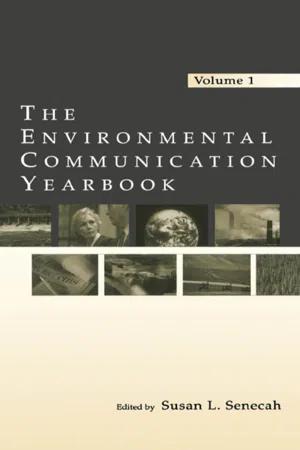
Yes, you can access The Environmental Communication Yearbook by Susan L. Senecah in PDF and/or ePUB format, as well as other popular books in Languages & Linguistics & Communication Studies. We have over 1.5 million books available in our catalogue for you to explore.