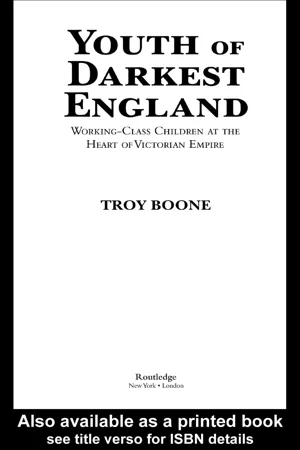
This book examines the representation of English working-class children — the youthful inhabitants of the poor urban neighborhoods that a number of writers dubbed "darkest England" — in Victorian and Edwardian imperialist literature. In particular, Boone focuses on how the writings for and about youth undertook an ideological project to enlist working-class children into the British imperial enterprise, demonstrating convincingly that the British working-class youth resisted a nationalist identification process that tended to eradicate or obfuscate class differences.
eBook - ePub
Youth of Darkest England
Working-Class Children at the Heart of Victorian Empire
- 256 pages
- English
- ePUB (mobile friendly)
- Available on iOS & Android
eBook - ePub
About this book
Information
1
Henry Mayhew's Children of the Streets
The representation of class and youth is at the heart of the urban exploration narrative, a form of sociological journalism that proliferated in the latter half of the nineteenth century and the first decades of the twentieth. The Victorian exemplar of this genre, Henry Mayhew's London Labour and the London Poor (1861–1862), seeks to offer exhaustive information regarding the working classes, as transmitted from the pen of “the traveller in the undiscovered country of the poor”1 to middleclass readers who can construe themselves as armchair ethnographers studying an exotic culture existing within the imperial metropolis itself. Mayhew further advertises the ethnographic novelty of his project thus: “It surely may be considered curious” because it supplies “information concerning a large body of persons, of whom the public had less knowledge than of the most distant tribes of the earth” (LL 1:xv). Mayhew here anticipates a metaphorical parallel that will become common in the latter half of the nineteenth century—a parallel between the urban “savages” of “darkest England” and the non-white “savages” of “darkest Africa.” This parallel is (as we will see in Chapter 4) most explicitly articulated in William Booth's In Darkest England and the Way Out (1890), the title of which sensationalizes Booth's topic (urban poverty) by borrowing from Henry Morton Stanley's bestseller of the same year, In Darkest Africa. In Mayhew, this racialist parallel reveals a problem of both national and imperial importance. According to Mayhew, the chief characteristic of the London poor is their uncontrolled wandering, a mobility not subject to the self-regulation that characterizes middleclass men and women who navi-gate the city space. For Mayhew, this unregulated mobility disqualifies the working classes from full and normative civic participation, as citizens of the English nation, in the life of the imperial metropolis. And because London is the heart of the British Empire, it is but a short discursive leap for Mayhew to compare the London poor to more “distant tribes” similarly subject to British rule without the privilege of citizenship.
Crucially, for the argument of Youth of Darkest England, Mayhew (like William Booth at the end of the century, as we will see in Chapter 4) does not elaborate on this racialist parallel. Instead, Mayhew emphasizes, through-out his work, that the unregulated wandering of the poor is not an essential defect but, rather, the cultural effect of bad parenting, lack of education, and similarly negative influences associated with the development of the young. Mayhew consequently argues that the wanderlust of the poor can be eradicated by means of middleclass instruction and regulation. He thereby introduces the line of argument that others will take up after him and develop at greater length—that the London poor can, by means of middleclass instruction and regulation, be incorporated into the British imperial enterprise. This focus on the need to educate the working classes would seem to imply an anti-essentialist, developmental narrative, the inevitable climax of which should bring the working classes, after suitable training, full status as citizens of the English nation and equality with the middle classes. However, Mayhew steers clear of this implication. Instead, he reinforces the essential difference between the classes by using two subtle representational tactics that dominate later projects to incorporate the working classes into the British imperial enterprise. First, by insistently focusing on workingclass youth, Mayhew implies not only that a nation's children are its future (a platitude that is still with us), but also that, figuratively, the poor constitute a juvenile group in continual need of education and regulation by a middleclass population standing in loco parentis (another platitude that is still with us). Second, by representing the working classes in terms of essential embodiment and the middle classes in terms of well-regulated vision, Mayhew suggests that the transformation of workingclass wandering into a circumscribed mobility useful to nation and empire in fact requires the continual subjection of the poor to middleclass regulators who observe, train, and distribute workingclass bodies in metropolitan and imperial spaces.
1
On the first page of London Labour, Mayhew asserts that wandering is the defining characteristic not of the members of an imperial nation, but of peoples fit for colonization. “Of the thousand millions of human beings that are said to constitute the population of the entire globe,” Mayhew states as an introduction to his text, “there are—socially, morally, and perhaps even physically considered—but two distinct and broadly marked races, viz., the wanderers and the settlers—the vagabond and the citizen—the nomadic and the civilized tribes” (LL 1:1). Mayhew, thus, initially represents the working classes as a racially distinct nation of wanderers (“the undiscovered country of the poor” [1:xv]) and suggests that middleclass intervention to rescue the poor from their degradation is the domestic and classbased version of “the white man's burden”—the imperial nation's responsibility to civilize the colonized native. The implication is that the urban poor can, perhaps, be civilized but are hardly capable of taking part in the expansion and administration of the British Empire. However, Mayhew's text quickly deemphasizes this racialist parallel in order to suggest that the working classes are not essentially excluded from the life of the imperial nation but, rather, constitute an “outcast” group that needs to be incorporated into it. What thus seems in London Labour an equation of class with race is, in fact, a subtle means of implying their similarity in order to then reinforce their difference.
The problem, according to Mayhew, is that the urban poor exist within but are not productive members of both nation and empire: “it would appear, that not only are all races divisible into wanderers and settlers, but that each civilized or settled tribe has generally some wandering horde intermingled with, and in a measure preying upon, it” (LL 1:1). Mayhew here retains the racialist metaphor, yet within a mere three paragraphs, the poor have been transformed from a “distinct” race whose difference from the civilized English is “broadly marked” into a “division” of, or a group “intermingled” within, an English race that includes both uncivilized wanderers and civilized settlers. Although he shies away from the language of essential racial difference, Mayhew's parallelisms (“the wanderers and the settlers—the vagabond and the citizen—the nomadic and the civilized tribes” [ LL 1:1]) nevertheless reaffirm that workingclass people who are wanderers, vagabonds, and nomads cannot be settlers, citizens, civilized. Mobility is, of course, necessary in order to perform the geographical and cultural exchanges that characterize the work of an imperial nation; but without the self-regulation according to laws and cultural standards implied by the term “citizen,” such mobility becomes mere nomadism, which contributes nothing to the work of an empire in which settlers found colonies supposedly in order to spread civilization.2
In addition, according to Mayhew, the disqualification of the wandering poor from English citizenship represents not merely a lost resource but also a danger to the nation. Mayhew warns, “The public have but to read the following plain unvarnished account … and then to say whether they think it safe—even if it be thought fit—to allow men, women, and children to continue in such a state” (LL 1:6). Predictably, the “dangerous classes”—on whose “predatory” activities London Labour reports at great length—primarily threaten the civilized, settled, middleclass citizenry: the London poor are “purely vagabond, doing nothing whatsoever for their living, but moving from place to place preying upon the earnings of the more industrious portion of the community” (LL 1:2). By means of another racialist comparison, Mayhew indicates that the unregulated mobility of the London poor endangers not only domestic peace but also national security:
we, like the Kafirs, Fellahs, and Finns, are surrounded by wandering hordes—the “Sonquas” and the “Fingoes” of this country—paupers, beg-gars, and outcasts, possessing nothing but what they acquire by depredation from the industrious, provident, and civilized portion of the community. (LL 1:2)
This passage might seem merely to repeat the privileging of settled cultures over nomadic groups parasitically attached to them: the agrarian Kafirs of South Africa “have their Bushmen … these are called Fingoes—a word signifying wanderers, beggars, or outcasts” (LL 1:1); the Fellahs, farming peasants of Egypt, are distinct from “the Arabian Bedouins,” a “wild and predatory tribe who sought the desert” (LL 1:1); the “Lappes seem to have borne a somewhat similar relation to the Finns,” who “cultivated the soil like the industrious Fellahs” (LL 1:1); and even as stereotypically degraded a group as the Hottentots have their “Bushmen and Sonquas … the term ‘sonqua’ meaning literally pauper” (LL 1:1). However, by comparing the middleclass English to Kafirs, Fellahs, and Hottentots—all groups subject to colonial rule by the mid-Victorian period—Mayhew offers the sinister suggestion that the outcast status of the urban poor, and the resulting lack of national unity, could render England itself vulnerable to colonization by a more powerful imperial force. Similarly, although the Finnish are European, the word “Finn” bears the trace of colonial conquest, being the name used by Teutonic nations to refer to people calling themselves “Suomi.”
In contrast to the introductory statement of the problem—which relies on an attention-grabbing parallel between the English working classes and colonized natives—the bulk of the succeeding three volumes of London Labour seeks to demonstrate that the mobile, but unregulated, working classes exist outside national life not due to any essential difference from the English middle classes, but due to ignorance on the part of the poor. According to imperialist logic, racial difference is a greater disqualification from citizenship than miseducation (skin color cannot be changed, but ignorance can be rectified). Accordingly, Mayhew replaces racial difference with educational lack to suggest the solution to the problem he exposes: middleclass education and regulation of the poor will enable the incorporation of the latter group into the life of the nation and empire. The supposed fact that workingclass disengagement from national and imperial affairs is the result of ignorance is revealed by the often-amusing answers Mayhew receives to the (unrecorded) questions, regarding politics and geography, that he asks his interviewees. For instance, Mayhew reports on his interview with a mudlark (a Thames-side scavenger), “London was England, and England, he said, was in London, but he couldn't tell in what part.… Such was the amount of intelligence manifested by this unfortunate child” (LL 2:156). In other answers that Mayhew cites, such ignorance of national affairs is shown to be anything but harmless. An older interviewee, a crippled street-seller of birds, displays the same ignorance as the mudlark, with the addition of a defiant, unpatriotic apathy: “it's nothing to me who's king or who's queen. It can never have anything to do with me. It don't take my attention” (LL 2:67). In an 1850 contribution to the Morning Chronicle (which was not included in London Labour), Mayhew quotes another answer, from a sailor describing his colleagues, that goes beyond mere apathy to assert an articulate resistance that threatens the military security of the empire: “All the men were dissatisfied. They didn't care one jot for their country. Fight against America if a war broke out! Not they. Would I? No. They don't impose on sailors in America.”3
Mayhew's emphasis on educational lack, and thus on the implicit improvability (rather than essential degradation) of the working classes, goes far to explain his prominent interest in workingclass children, the usual subjects of education. His analysis of costermonger boys (hawkers of fruit and vegetables) typifies Mayhew's claims:
It is idle to imagine that these lads … will not educate themselves in vice, if we neglect to train them to virtue.… If they are not taught by others, they will form their own characters—developing habits of dissipation, and educing all the grossest passions of their natures. (LL 1:35–36; emphasis mine).
Which “others” should undertake this education of poor children is an important issue in London Labour. That this role cannot be filled by workingclass parents is emphatic in the text. According to Mayhew, the “class bred to the streets” are
the natives of the streets—the tribe indigenous to the paving-stones—imbibing the habits and morals of the gutters almost with their mothers’ milk. To expect that children thus nursed in the lap of the kennel, should when men not bear the impress of the circumstances amid which they have been reared, is to expect to find costermongers heroes instead of ordinary human beings. We might as well blame the various races on the face of the earth for those several geographical peculiarities of taste, which constitute their national characteristics. (LL 1:320)
Such moments confirm Christopher Herbert's claim that Mayhew—unlike later degeneration theorists such as William Booth, whose work I discuss in Chapter 4—does not represent the poor in terms of “a low-grade racial stock biologically predestined for a ‘wandering’ existence.”4 Such a representation, as Youth of Darkest England is meant to demonstrate, does not serve the interests of Victorian and Edwardian reformers who seek to institute hegemonic imperialism and lead different classes to identify with one another in terms of a shared national and racial heritage. Mayhew's racialist comparisons in the passage quoted above have quite different implications from those in the ethnographic flight of fancy with which London Labour begins. The very phrase “We might as well” calls attention to the fact that workingclass English children are not equivalent to “various [other] races,” except insofar as neither group can be blamed for not having been educated otherwise than it was. That the parents of London street children are utterly blameworthy is, however, made perfectly clear by the unsubtle parallelism whereby the workingclass mother's breast, lap, and milk equal (respectively) a “gutter,” a “kennel,” and degraded “habits and morals.”
Employing still another natural metaphor, Mayhew argues for the importance of middleclass intervention to reverse the effects of such a deleterious upbringing:
even as the seed of the apple returns, unless grafted, to its original crab, so does the child, without training, go back to its parent stock—the vagabond savage. For the bred and born street-seller, who inherits a barrow as some do coronets, to be other than he is—it has here been repeatedly enunciated—is no fault of his but of ours, who could and yet will not move to make him otherwise. (LL 1:320)
The gardening metaphor clearly implies that the tendency of the London poor to vagabondage, however “natural” and thus (at least in the case of children) blameless, should be averted by “grafting” middleclass values onto the workingclass child...
Table of contents
- Front Cover
- Half Title
- Title Page
- Copyright
- Dedication
- Contents
- Series Editor’s Foreword
- Acknowledgments
- List of Illustrations
- Introduction
- Chapter 1 Henry Mayhew’s Children of the Streets
- Chapter 2 Class, Violence, and Mid-Victorian Penny Fiction: “Murder Made Familiar”?
- Chapter 3 Improving Penny Fiction:The “Ticklish Work” of Treasure Island
- Chapter 4 Remaking Lawless Lads and Licentious Girls:The Salvation Army and the Regeneration of Empire
- Chapter 5 The Boy Scouts and the Working Classes
- Chapter 6 Patriot Games:Football and the First World War
- Notes
- Bibliography
- Index
Trusted by 375,005 students
Access to over 1.5 million titles for a fair monthly price.
Study more efficiently using our study tools.
Frequently asked questions
Yes, you can cancel anytime from the Subscription tab in your account settings on the Perlego website. Your subscription will stay active until the end of your current billing period. Learn how to cancel your subscription
No, books cannot be downloaded as external files, such as PDFs, for use outside of Perlego. However, you can download books within the Perlego app for offline reading on mobile or tablet. Learn how to download books offline
Perlego offers two plans: Essential and Complete
- Essential is ideal for learners and professionals who enjoy exploring a wide range of subjects. Access the Essential Library with 800,000+ trusted titles and best-sellers across business, personal growth, and the humanities. Includes unlimited reading time and Standard Read Aloud voice.
- Complete: Perfect for advanced learners and researchers needing full, unrestricted access. Unlock 1.5M+ books across hundreds of subjects, including academic and specialized titles. The Complete Plan also includes advanced features like Premium Read Aloud and Research Assistant.
We are an online textbook subscription service, where you can get access to an entire online library for less than the price of a single book per month. With over 1.5 million books across 990+ topics, we’ve got you covered! Learn about our mission
Look out for the read-aloud symbol on your next book to see if you can listen to it. The read-aloud tool reads text aloud for you, highlighting the text as it is being read. You can pause it, speed it up and slow it down. Learn more about Read Aloud
Yes! You can use the Perlego app on both iOS and Android devices to read anytime, anywhere — even offline. Perfect for commutes or when you’re on the go.
Please note we cannot support devices running on iOS 13 and Android 7 or earlier. Learn more about using the app
Please note we cannot support devices running on iOS 13 and Android 7 or earlier. Learn more about using the app
Yes, you can access Youth of Darkest England by Troy Boone in PDF and/or ePUB format, as well as other popular books in Literature & Literary Criticism. We have over 1.5 million books available in our catalogue for you to explore.