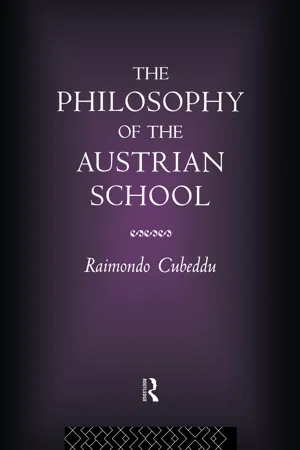
The Austrian School has made some of the most significant contributions to the social sciences in recent times but attempts to understand it have remained locked in a polemical frame. In contrast, The Philosphy of the Austrian School presents a philosophically grounded account of the School's methodological, political and economic ideas. Whilst acknowledging important differences between the key figures in the School - Menger, Mises, and Hayek - Raimondo Cubeddu finds that they also have significant things in common. Paramount amongst these are theories of subjective value and notions of spontaneous order, both of which rest on theories of seminal avenues of research in the social sciences and a major reformulation of liberal ideology.
- 288 pages
- English
- ePUB (mobile friendly)
- Available on iOS & Android
eBook - ePub
The Philosophy of the Austrian School
1
METHODOLOGICAL PROBLEMS
Wieso vermögen dem Gemeinwohl dienende und für dessen Entwickel-ung höchst bedeutsame Institutionen ohne einen auf ihre Begründung gerichteten Gemeinwillen zu entstehen?(Menger, Untersuchungen)
1. Methodological foundations; 2. The Methodenstreit and its legacy; 3. The critique of historicism; 4. The critique of scientism and of constructivist rationalism
§ 1. METHODOLOGICAL FOUNDATIONS
Menger’s Untersuchungen über die Methode der Socialwissenschaften, und der politischen Oekonomie insbesondere1 occupies a pre-eminent position in the history of the social sciences. For it is in this work that the first steps were taken towards an investigation of epistemological problems that are still wide open today, while at the same time the methodological and political implications of Historismus2 were brought to the fore. Indeed, not only did the Untersuchungen play a fundamental role in clarifying the basic issues at the heart of the theoretical social sciences; they also enabled a new framework to be established for relations between the social sciences and the two phenomena that have been the overriding feature of the study of these sciences for the last several centuries, namely the tendency to study them from an empirical-naturalistic point of view, and the trend towards studying them from a historical viewpoint.
But much of the importance of this work also resides in its position as the focal point of the Austrian School’s philosophy of the social sciences and epistemology. Apart from the misunderstandings of Mises’s and Hayek’s occasionally diverging views, it has exerted constant influence both over methodological, philosophical and political questions and also over the objectives around which the polemics revolved. The arguments put forward by Hayek and Mises against the theories of knowledge of historicism and socialism are inevitably drawn into this complex of issues.
The Untersucbungen, however, not only represent a treatise on the theoretical social sciences and a polemical tract, but can also be seen as the first attempt to forge a link between the study of the social sciences and the marked shift in the science of economics that goes under the name of the ‘marginalist revolution’. Menger thus has the merit of having made clear that the theory of subjective values would lead to a profound change in the theoretical approach to the social sciences, for his conception of economics was that of a discipline capable of opening up new perspectives in the interpretation of motivations and prediction of the outcome of human action. This stood in contrast to the predominant approach in the Germanic region, which regarded economics as occupying a lower-ranking position within the framework of the allgemeine Staatslebre.3 Menger, on the other hand, reshaped the web of relations between politics, ethics and economics, reclaiming the latter from the purely instrumental and subordinate status previously assigned to it, and drew up a new theory of the origin and development of social institutions.
Once attention has been focused on these innovative aspects, the question arises whether the criticisms levelled against the Historical School of German Economists can be restricted simply to the epistemological problems involved in the reduction of the science of economics to the history of economics.4 For this line of interpretation does not give a satisfactory explanation of why Menger should have devoted so much time and energy to criticizing a research programme when he was aware of the triviality of the epistemological foundations on which it rested. In fact, his criticisms were directed not only against the methodological approach, but against the ideological programme of the Historical School of German Economists as well. He identified this programme as consisting not just in the reduction of the science of economics to economic history, but more particularly in a refusal to acknowledge the relevance of the ‘marginalist revolution’, and furthermore in an attempt to consider economics as a tool of politics and ethics.
The conceptual scheme of the Untersucbungen unfolds through a series of criticisms directed towards (1) the positivist doctrine of science (F. Bacon, Comte, J.S. Mill), (2) the role of rationalist knowledge in human affairs (Smith) and (3) the claim that theoretical knowledge of human concerns can be derived from history (Roscher, Knies, Hildebrand, Schmoller). In other words, Menger refused to accept the positivist conception of science together with the fragmenting of knowledge; he rejected the pragmatism of ‘abstract rationalism’, and he contested the validity of the founding theories of knowledge and the conclusions of the Historical School of German Economists.
A salient feature of the Untersucbungen is thus their criticism of the theoretical and cultural presuppositions of the Historical School of German Economists, in particular the latter’s attempt to ground all knowledge in history. Yet Menger did not cast doubt on the value of historical knowledge in the field of political action; rather, he drew on examples taken from Plato, Aristotle, Machiavelli, Bodin or the Physiocratics, Voltaire, Montesquieu, Smith and Savigny to deny any originality in what were purported by the exponents of the Historical School to be important discoveries.5
Another important feature of this critism concerned the classification of the economic sciences and their method. Menger distinguished three groups:
first, the historical sciences (history) and statistics of economy, which have the task of investigating and describing the individual nature and the individual connection of economic phenomena; second, theoretical economics, with the task of investigating and describing their general nature and general connection (their laws); finally, third, the practical sciences of national economy, with the task of investigating and describing the basic principles for suitable action (adapted to the variety of conditions) in the field of national economy (economic policy and the science of finance).6
This subdivision was to be found again, structured in greater detail, in the concluding part of the work.7 Menger reproached the Historical School of German Economists for what he saw as a confusion between the three types of science and for deducing norms of practical action from a mistaken conception of economic science. Any social policy founded on a false conception of human life will be doomed to failure.8 This classification, which appears as the systematic nucleus of the Untersucbungen, may be helpful for a better understanding of Menger’s critical assessment of the Historical School. It may also provide insight into the relation between empirical-realistic orientation, and exact orientation and between empirical laws and exact laws. Finally, it can shed light on the function of economic science.
The fundamental mistake made by the Historical School of German Economists was that of conceiving society as an empirical and organic-naturalistic whole. This led members of the school to study society by means of a method of investigation – the inductive-comparative method – which proved to be unsuited to its nature as a whole. Consequently, the goal pursued by this school of discovering the laws governing society and history could not lead to theoretically acceptable results.
Unlike the Historical School of German Economists, which tended to regard social bodies as data and underestimated the role of individuals in their formation, Menger considered such bodies to be the product, at times involuntary, of individual choices. Thus a theoretical knowledge of society cannot, in his view, be founded on empirical generalizations, but rather will have to start out by splitting up more complex facts into their simpler component parts. Just like other ‘exact laws’, then, theoretical economics will be called upon to investigate «the concrete phenomena of the real word as exemplifications of a certain regularity in the succession of phenomena, i.e. genetically». Therefore his discovery model was to consist in an attempt to explain «the complicated phenomena of the research field peculiar to it as the result of the coworking of the factors responsible for its origin. This genetic element is inseparable from the idea of theoretical sciences.»9
Thus the problem facing Menger was that of understanding and providing an answer to the following question: «how can it be that institutions which serve the common welfare and are extremely significant for its development come into being without a common will directed towards establishing them?» But he had no intention of theorizing the pre-eminence of economics within the framework of the social sciences. For among the institutions which «are to no small extent the unintended result of social development» he numbered law, religion, language, state, money, market, prices of goods, interest rates, ground rents, wages and many other phenomena of social life and in particular of economy.10
This marked a shift from the organicist naturalism of the Historical School of German Economists, from positivism and the individualistic tradition of rationalist liberalism, for Menger’s interpretation saw the history of mankind as an evolution that was in some sense underpinned by a ‘naturality’ or ‘essence’ [Wesen] inherent in man. This conception of history may also be viewed as an extension of the concept of society Menger derived from Aristotle,11 now seen as embracing the entire historical process.
This approach led Menger to deny that the phenomena of the human world can be considered on a par with phenomena belonging to the natural world. But he was also critical of the interpretation of the origin of human institutions – which he defined as ‘pragmatistic’ – put forward by those who consider these institutions to be the products arising from individual or collective human will. He objected on the grounds that not all institutions can be explained in this manner. This «pragmatic» interpretation – an approach Menger also ascribed to Smith – was to his mind typical of a «onesided rationalistic liberalism [einseitiger rationalistischer Liberalismus]», of a «partially superficial pragmatism [zum Theil oberflachlicher Pragmat-ismus]». By the very attempt to wipe the slate clean of any irrational aspects and create new, more rational institutions, this approach, in Menger’s view, was doomed and «contrary to the intention of its representatives inexorably leads to socialism»12
Menger did not extend to the philosophy of the social sciences the method and aims of the science of economics. But he did extend to the theoretical social sciences (including economics) a theory of human action and of the rise and development of social institutions. The revolutionary nucleus of his thought thus consists of the new avenues his theory of subjective values opened up in the study of social phenomena.
Confirmation of the view that Menger did not aim to formulate an economic interpretation of the birth and development of society comes from his conviction that the earliest reaction to pragmatism arose in the field of law. For it was Burke, «trained for it by the spirit of English jurisprudence», who was able to understand «with full awareness the significance of the organic structures of social life and the partly unintended origins of these». This interpretation, previously put forward by Montesquieu, achieved full actualization in Germany, where Burke’s ideas acted as the spur «for an atta...
Table of contents
- Cover
- Half Title
- Full Title
- Copyright
- Dedication
- Contents
- Preface
- 1 METHODOLOGICAL PROBLEMS
- 2 THE THEORY OF HUMAN ACTION
- 3 FROM SOCIALISM TO TOTALITARIANISM
- 4 THE FATE OF DEMOCRACY
- 5 THE LIBERALISM OF THE AUSTRIAN SCHOOL
- Bibliography
- Name index
- Subject index
Trusted by 375,005 students
Access to over 1.5 million titles for a fair monthly price.
Study more efficiently using our study tools.
Frequently asked questions
Yes, you can cancel anytime from the Subscription tab in your account settings on the Perlego website. Your subscription will stay active until the end of your current billing period. Learn how to cancel your subscription
No, books cannot be downloaded as external files, such as PDFs, for use outside of Perlego. However, you can download books within the Perlego app for offline reading on mobile or tablet. Learn how to download books offline
Perlego offers two plans: Essential and Complete
- Essential is ideal for learners and professionals who enjoy exploring a wide range of subjects. Access the Essential Library with 800,000+ trusted titles and best-sellers across business, personal growth, and the humanities. Includes unlimited reading time and Standard Read Aloud voice.
- Complete: Perfect for advanced learners and researchers needing full, unrestricted access. Unlock 1.5M+ books across hundreds of subjects, including academic and specialized titles. The Complete Plan also includes advanced features like Premium Read Aloud and Research Assistant.
We are an online textbook subscription service, where you can get access to an entire online library for less than the price of a single book per month. With over 1.5 million books across 990+ topics, we’ve got you covered! Learn about our mission
Look out for the read-aloud symbol on your next book to see if you can listen to it. The read-aloud tool reads text aloud for you, highlighting the text as it is being read. You can pause it, speed it up and slow it down. Learn more about Read Aloud
Yes! You can use the Perlego app on both iOS and Android devices to read anytime, anywhere — even offline. Perfect for commutes or when you’re on the go.
Please note we cannot support devices running on iOS 13 and Android 7 or earlier. Learn more about using the app
Please note we cannot support devices running on iOS 13 and Android 7 or earlier. Learn more about using the app
Yes, you can access The Philosophy of the Austrian School by Raimondo Cubeddu in PDF and/or ePUB format, as well as other popular books in Business & Business generale. We have over 1.5 million books available in our catalogue for you to explore.