Distance education is practised in all parts of the world and in recent years, its scope has developed enormously and rapidly. It has become an intrinsic part of many national educational systems and an academic discipline in its own right. Research into the area has produced a body of theory which is now being used to improve its practice.
This new edition of Theory and Practice of Distance Education has been thoroughly updated both by describing how practice has changed, and by examining recent research in the field. Like the first edition, this book provides a comprehensive survey of distance education, looking at it globally and discussing the different lines of thought and models used. It describes the place of distance education in educational thinking, its various theories, principles, and techniques of presentation, its organization and its administration.
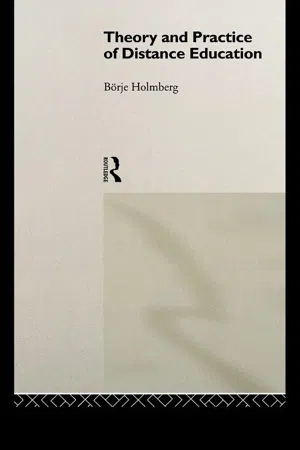
- 264 pages
- English
- ePUB (mobile friendly)
- Available on iOS & Android
eBook - ePub
Theory and Practice of Distance Education
About this book
Information
Table of contents
- COVER PAGE
- TITLE PAGE
- COPYRIGHT PAGE
- FIGURES
- PREFACE
- 1: TODAY’S OVERALL PICTURE OF DISTANCE EDUCATION
- 2: THE BACKGROUND OF DISTANCE EDUCATION
- 3: PLANNING DISTANCE EDUCATION
- 4: COURSE DEVELOPMENT— FUNDAMENTAL CONSIDERATIONS
- 5: STRUCTURES AND MEDIA OF DISTANCE-EDUCATION COURSES
- 6: INTERACTION BETWEEN STUDENTS AND THE SUPPORTING ORGANIZATION
- 7: THE ORGANIZATION AND ADMINISTRATION OF DISTANCE EDUCATION
- 8: SPECIAL APPLICATIONS OF DISTANCE EDUCATION
- 9: THEORETICAL APPROACHES TO DISTANCE EDUCATION AND THEIR PRACTICAL CONSEQUENCES
- CHAPTER 10: THE ROLE AND CONCEPT OF EVALUATION
- 11: THE ACADEMIC DISCIPLINE OF DISTANCE EDUCATION
- REFERENCES
Trusted by 375,005 students
Access to over 1.5 million titles for a fair monthly price.
Study more efficiently using our study tools.
Frequently asked questions
Yes, you can cancel anytime from the Subscription tab in your account settings on the Perlego website. Your subscription will stay active until the end of your current billing period. Learn how to cancel your subscription
No, books cannot be downloaded as external files, such as PDFs, for use outside of Perlego. However, you can download books within the Perlego app for offline reading on mobile or tablet. Learn how to download books offline
Perlego offers two plans: Essential and Complete
- Essential is ideal for learners and professionals who enjoy exploring a wide range of subjects. Access the Essential Library with 800,000+ trusted titles and best-sellers across business, personal growth, and the humanities. Includes unlimited reading time and Standard Read Aloud voice.
- Complete: Perfect for advanced learners and researchers needing full, unrestricted access. Unlock 1.5M+ books across hundreds of subjects, including academic and specialized titles. The Complete Plan also includes advanced features like Premium Read Aloud and Research Assistant.
We are an online textbook subscription service, where you can get access to an entire online library for less than the price of a single book per month. With over 1.5 million books across 990+ topics, we’ve got you covered! Learn about our mission
Look out for the read-aloud symbol on your next book to see if you can listen to it. The read-aloud tool reads text aloud for you, highlighting the text as it is being read. You can pause it, speed it up and slow it down. Learn more about Read Aloud
Yes! You can use the Perlego app on both iOS and Android devices to read anytime, anywhere — even offline. Perfect for commutes or when you’re on the go.
Please note we cannot support devices running on iOS 13 and Android 7 or earlier. Learn more about using the app
Please note we cannot support devices running on iOS 13 and Android 7 or earlier. Learn more about using the app
Yes, you can access Theory and Practice of Distance Education by Borje Holmberg in PDF and/or ePUB format, as well as other popular books in Education & Education General. We have over 1.5 million books available in our catalogue for you to explore.