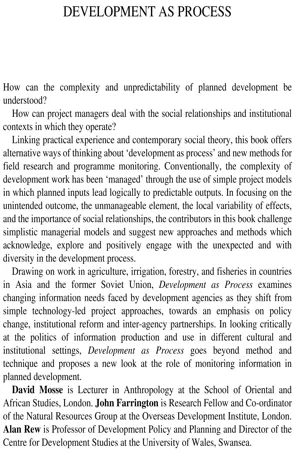
Process" approaches to economic and social development appear to be more flexible and offer greater prospects of success than traditional "project" methods.
Development as Process addresses the questions raised by the different natures of the two approaches. The authors examine development projects through experience in water resources development in India and in organizational learning by a Bangladeshi NGO. Inter-agency contexts are examined in the setting of an aquaculture project in Bangladesh and in the setting of agriculture and natural resources development in Rajisthan, India. Finally, the role of process monitoring is explained in the context of policy reform, with illustrations from forestry in India and land reform in Russia.
eBook - ePub
Development as Process
Concepts and Methods for Working with Complexity
- 216 pages
- English
- ePUB (mobile friendly)
- Available on iOS & Android
eBook - ePub
Development as Process
Concepts and Methods for Working with Complexity
About this book
Part 1
Process Monitoring and Impact Assessment in Development Projects
3
Participatory Water Resources Development in Western India
Influencing Policy and Practice Through Process Documentation Research
Introduction
Throughout the world state-managed irrigation systems are in serious disrepair and irrigation administrations are facing deepening financial crisis. An important response to this is the policy of participatory irrigation management (PIM). PIM aims to improve the performance and financial viability of irrigation structures through systems of consultative planning, cost recovery and the turning over of operations and maintenance to local water users themselves. To achieve this, considerable institutional innovation is needed at the local level in order to promote farmer participation in irrigation management. Furthermore, it is repeatedly found that the effectiveness of PIM depends upon an understanding of local social contexts and on having good information feedback on initiatives in farmer management. This chapter examines the way in which process documentation research (PDR) has provided a purposeful instrument to achieve this.
In India, PIM currently shapes large-scale investment in land and water management programmes. This policy shift is rooted in state concerns about the financial viability of irrigation systems. For the past few decades the focus has been on increasing farmers’ contributions through enhanced water charges. Thus in 1972, the Indian Irrigation Commission recommended that the water rates should be so fixed that irrigation works do not become a burden on the state exchequer. In 1987, the National Water Policy stated that the water rates charged should be adequate to cover the annual operation and maintenance cost and a part of capital cost of a project. However, by the early 1980s, in Gujarat state the average annual revenue from the water rates covered only about 8 per cent of the annual operation and maintenance costs. In 1985, an expert group of the state’s Irrigation Department recommended that water rates should be gradually increased so that by 1991–2 the revised rates would be able to cover 33 per cent of the annual operation and maintenance costs. The recommendation was endorsed by the Gujarat Agriculture Commission in 1988. Lastly, and most importantly, the state government is currently contemplating the introduction of participatory farmer-management in the high-profile Sardar Sarovar Project on the river Narmada which has an irrigated area of 1.8 million hectares.
Despite its consistent policy intention, the fact is that the state government of Gujarat has not been able to revise water rates. This failure of the state has given focus to a number of voluntary organisations and cooperatives which, by contrast, have been able to charge significantly higher rates for irrigation water and recover them from the farmers. In most such experiments, the farmers have actively participated in the management of the system after being convinced of the certainty of adequate, assured and timely availability of water. Indeed, there is now a prevailing consensus that the key to making irrigation water management systems viable lies in promoting farmer management. Thus in June 1995, the Gujarat government passed a resolution ‘to introduce [the] Participatory Irrigation Management principle, based on partnership between farmers’ associations and Government as [a] “Turnover Programme” for [the] administration and economical management of Government water resources’ (DSC 1996). Thirteen pilot projects were identified in different regions of the state in which the management of the projects was to be ‘turned over’ to farmers after necessary physical improvements had been made. In the case of five pilot projects, voluntary organisations have been involved in the planning and implementation. This initiative presents a major policy innovation.
A parallel initiative came from the department of Rural Development which in 1994 under a national anti-poverty programme financed two rain water harvesting projects in Bhavnagar district in Gujarat. Like PIM this initiative also involves both the development of physical infrastructure and community management through village-level institutions.
The most important shift in policy in both these projects is the shift from a top-down ‘blueprint’ approach to a participatory ‘process approach’. As Korten puts it, ‘under a community-based system of resource management, the task of a responsible government agency is not to control all development resources. Rather it is to enable communities to mobilise, control and manage resources more effectively for their own benefit’ (Korten 1989). The relative failure of government programmes and the apparent success of NGO projects suggested a need to understand the critical elements in participatory resources management. Furthermore, implementing agencies themselves face a need to explore new ways of gaining knowledge about the context, strategies and impact of their own interventions.
Facing a similar policy need for local innovation in the late 1970s, the Philippine National Irrigation Administration (NIA) developed a tool for the recording and analysis of the implementation of experimental approaches to irrigation management which it called process documentation research (PDR). There too the context was an initiative for community management and the strengthening of a communal irrigation system through new water users’ associations.
PDR, an adaptation of participant observation research, provided a means to gain access to the experiences of selected pilot irrigation projects. It generated detailed information on the process of village-level implementation for NIA staff (de los Reyes 1989), providing a ‘window’ through which to view the ‘how’ and ‘why’ of uncensored field experience as the programme proceeds (Shah 1993).
Following the Philippines experiment, the scope of PDR has further widened in that it now aims to provide an increasingly interactive means for agencies to learn about the process aspects of programme implementation. However, the core method of information collection during the course of project implementation (as against ex post documentation) remains the same. As argued in Chapter 1, the observation and analysis of the implementation process helps organisations measure the progress of a development activity and assess its impact on the village society and economy. PDR is equally useful in determining the sustainability, viability and replicability of given programmes and approaches.
It is with these objectives that PDR support was provided to the agencies implementing participatory irrigation management projects and water harvesting projects in Gujarat. This support was provided by the Gujarat Institute of Development Research (GIDR), Ahmedabad and financed by the Ford Foundation. GIDR already had, at the time, some experience of ex post documentation of processes in a few participatory development projects. In 1993, for example, the Institute worked on two participatory irrigation projects for the Aga Khan Rural Support Programme (AKRSP) in Gujarat. On the strength of this, the government of Gujarat agreed to appoint GIDR as the PDR agency for five of the thirteen pilot participatory irrigation projects in the state. The remainder of this chapter analyses our preliminary experience in conducting PDR in the AKRSP programme, and subsequent adaptations in three of the participatory pilot irrigation projects, and in two rainwater harvesting projects.
Process Documentation Research in the Aga Khan Rural Support Programme (AKRSP) Projects
In Gujarat, AKRSP first experimented with participatory irrigation management in three districts, namely, Bharuch, Surendranagar and Junagadh. Here we focus on work undertaken in the latter two districts. GIDR undertook PDR in selected villages both on schemes to rehabilitate existing irrigation systems and on new schemes. The AKRSP programme of PIM began in 1986 with the rehabilitation of an existing percolation tank benefiting two contiguous villages – Rupavati and Devalia – in Surendranagar district. GIDR was invited to document the processes in the Rupavati tank project and the irrigation scheme called the Bandiabelli project. The second project for which GIDR was invited to document the processes was a new lift irrigation scheme (LIS) constructed in Zadka village in Junagadh district.
AKRSP’s general approach involved the selection of villages and programmes and then the formation of a ‘village development society’ (Gram Vikas Mandal, or GVM) involving participating households as members. With the help of AKRSP officials, the members elect/select society office-bearers – a president, a secretary – and a managing committee to take care of day-to-day administration, the maintenance of accounts, and liaison with AKRSP and other organisations such as the banks. AKRSP emphasises the role of the GVM and its members in programme implementation and coordination with government and other agencies. Moreover, the construction work in these schemes is undertaken with locally available labour and supervised by AKRSP staff.
Given this programme orientation, the PDR concentrated on, first, the NGO-villagers interface including the evolution of water users’ organisations and farmers’ participation in them; second, various aspects and issues of farmers’ contributions towards the share capital and the operation and maintenance fund; and, third, farmers’ involvement in the planning and execution of repairs and rehabilitation of the structures.
PDR in Participatory Pilot Irrigation Projects
In Gujarat, PDR also has an important role in influencing policy change on irrigation at the state level. AKRSP was instrumental in introducing participatory irrigation management through lobbying the Gujarat government. This involved the communication of successful NGO approaches to a wider range of stakeholders in irrigation, culminating in a state-level consultation workshop organised in February 1993 by the government of Gujarat to agree recommendations for the involvement of farmers in irrigation projects. The workshop brought together an unprecedented range of players, including representatives from the government of India, the government of Maharashtra (a neighbouring state), NGOs, farmers’ cooperatives, educational institutions, an expert from the Philippines, the Ford Foundation, the European Economic Community and state government officials. The participation of this wide range of ‘stakeholders’ was institutionalised through a government resolution to constitute a High-Level Working Group chaired by the Chief Secretary. In November 1994, at the instance of the World Bank, the Working Group also included social scientists from the two institutions involved in PDR (GIDR and the Institute of Rural Management, Anand). Finally, in January 1996, the Director of Canals for the Sardar Sarovar Narmada Corporation – a body set up to implement this major irrigation programme – was also included as a member in view of the plans to introduce participatory irrigation management in the Narmada project. This Working Group sought broad consensus on what was viewed as a major policy innovation, initially implemented in thirteen pilot irrigation projects chosen to be ‘learning laboratories’. At these sites the programme included the formation of water users’ associations, and the organisation of farmers into cooperatives. These tasks were to be undertaken by NGOs.
Following the experience of the NIA in the Philippines, five pilot projects were selected for close monitoring through PDR beginning in October 1995. The specific tasks of the process documenters were: first, to evolve a broadly defined framework for identifying the leading questions and issues and a methodology for data collection; second, to prepare concurrent PDR reports on the implementation of the projects and to discuss them periodically with the implementing agencies and the working groups set up for this purpose; and third, to bring out occasional papers analysing the linkages between different components of the participatory approach of the project.
PDR in Rainwater Harvesting Structures
A similar approach was adopted in relation to the water harvesting project implemented by two voluntary organisations in Bhavnagar district of Gujarat: Kundla Taluka Gram Seva Mandal (KTGSM) and Lok Bharati. The project involves planning and building rainwater harvesting structures such as check dams, gully plugs, earthen dams and percolation tanks to conserve rainwater and to augment dwindling ground water levels. As with AKRSP and PIM pilot projects, there is an emphasis on promoting local management systems, village institutions, and capital contributions (up to 20 per cent) from the benefiting farmers. Equally PDR focuses on the NGO-villager interface, farmer group development and farmers’ contributions and involvement in structure maintenance.
In each of these programme contexts it was necessary, before undertaking PDR, to explain the methodology and address apprehension among the implementing agencies (for details, see below).
Methodology
Our process documentation methods have both evolved and varied between projects. Initially, in the AKRSP projects in Rupavati and Zadka villages, the approach involved ex post documentation of implementation processes. Both quantitative and qualitative data were collected. The former involved a structured questionnaire which proved helpful in building rapport through house-to-house contact. Qualitative methods hinged on the role of the ‘field observers’ who were placed close to the project villages. Their task was to build a picture of local communities and the context of programme implementation. It was important to explain clearly the purpose of the PDR to villagers and project field staff alike, and to establish a distinction in the eyes of villagers between the process documentors and implementing agency personnel. Once this was achieved, focus group discussions (FGDs) were conducted to trace the history of development interventions in rural development in the villages. The groups mostly comprised the members from the same community or those who had a similar stake in the AKRSP programmes.
A number of meetings were held in the two villages with the officebearers and ordinary members of the Gram Vikas Mandals, as well as with non-participating landed and landless households. In-depth interviews were also conducted with the staff of AKRSP and some of the members who owned land in the project villages but did not ordinarily live there.
In the case of the pilot participatory irrigation and rainwater conservation projects, the approach adopted for PDR was more directly focused on events as they occurred. Reporting to the Working Group was therefore concurrent. Methods here involved a combination of participant observation, ethnographic research and survey methods. Since PDR involves collection of information on the project and related activities as they unfold in the field, in each project village a field observer (FO) was placed to facilitate the collection of information. The FO is the last link in the chain of researchers providing eyes and ears of the team at the grass-roots level.
As with the AKRSP process documentation, attention was paid to collecting baseline data from rapid surveys and developing rapport with villagers. Despite good rapport, some difficult issues remained; for example, the question of village selection. Given the impossibility of covering all the project villages, selection is inevitable (four of the thirty villages in the case of the rainwater harvesting project). The question was how to select villages; what happens to important processes that take place in villages that are left out; or who should select the villages – the PDR agency or the implementing agency? We shall take up this and other issues in the last section of the chapter.
Major Process Documentation Research Results
In this section we will review some cases to show the results which PDR work has produced in each of the programmes where it has been taken up.
The AKRSP Project
Process research in the AKRSP villages generated some important insights. In Rupavati village, for example, process research highlighted differences in perception between AKRSP staff and participating villagers. In particular, while the NGO’s irrigation tank development objectives emphasised participation as a means to achieve long-term improvements in the performance of an irrigation system, villagers gave priority to short-term wage-employment benefits.
The PDR also threw light on the dynamics of intra-village conflict which, in Rupavati, eventually led to the formation of separate institutions for the two principal caste groups. The implications of this for the functioning of the local resource management institutions, for village committees, and for handling the risks of free riding on infrastructural and institutional benefits were also traced through process research.
The process research identified the way in which patron-client systems continued to operate within new ‘people’s institutions’. On the one hand this led to an unequal allocation of resources as powerful players gained privileged access to benefits; on the other hand, the new institutions were able to effect new challenges to existing structures. For example, PDR work showed how AKRSP was able to challenge the caste dominance of Bharwads over lower status Kolis, and through the structure and procedures of the new ‘village development society’ (the GVM or Grama Vikas Mandal) institutionalise a new symmetry in village-level caste relations. However, this social balance went along with weak management and allowed other asymmetries, such as between the head-enders and the tail-enders in the use of the irrigation system, to persist.
PDR also helped dispel certain illusions about villager cooperation and voluntarism. First, it wa...
Table of contents
- Cover
- Half Title
- Title Page
- Copyright
- Contents
- Notes on contributors
- Preface
- Acknowledgements
- Introduction
- Part 1: Process monitoring and impact assessment in development projects
- Part 2: Process monitoring in inter-agency contexts
- Part 3: Process monitoring and policy reform
- Bibliography
- Index
Trusted by 375,005 students
Access to over 1.5 million titles for a fair monthly price.
Study more efficiently using our study tools.
Frequently asked questions
Yes, you can cancel anytime from the Subscription tab in your account settings on the Perlego website. Your subscription will stay active until the end of your current billing period. Learn how to cancel your subscription
No, books cannot be downloaded as external files, such as PDFs, for use outside of Perlego. However, you can download books within the Perlego app for offline reading on mobile or tablet. Learn how to download books offline
Perlego offers two plans: Essential and Complete
- Essential is ideal for learners and professionals who enjoy exploring a wide range of subjects. Access the Essential Library with 800,000+ trusted titles and best-sellers across business, personal growth, and the humanities. Includes unlimited reading time and Standard Read Aloud voice.
- Complete: Perfect for advanced learners and researchers needing full, unrestricted access. Unlock 1.5M+ books across hundreds of subjects, including academic and specialized titles. The Complete Plan also includes advanced features like Premium Read Aloud and Research Assistant.
We are an online textbook subscription service, where you can get access to an entire online library for less than the price of a single book per month. With over 1.5 million books across 990+ topics, we’ve got you covered! Learn about our mission
Look out for the read-aloud symbol on your next book to see if you can listen to it. The read-aloud tool reads text aloud for you, highlighting the text as it is being read. You can pause it, speed it up and slow it down. Learn more about Read Aloud
Yes! You can use the Perlego app on both iOS and Android devices to read anytime, anywhere — even offline. Perfect for commutes or when you’re on the go.
Please note we cannot support devices running on iOS 13 and Android 7 or earlier. Learn more about using the app
Please note we cannot support devices running on iOS 13 and Android 7 or earlier. Learn more about using the app
Yes, you can access Development as Process by John Farrington,David Mosse,Alan Rew in PDF and/or ePUB format, as well as other popular books in Physical Sciences & Geography. We have over 1.5 million books available in our catalogue for you to explore.