eBook - ePub
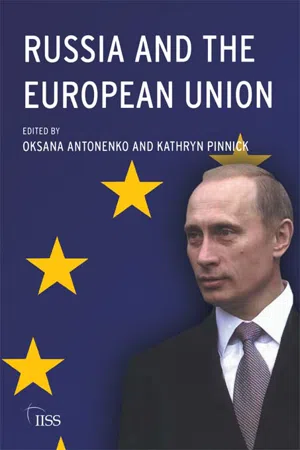
Russia and the European Union
Prospects for a New Relationship
- 304 pages
- English
- ePUB (mobile friendly)
- Available on iOS & Android
eBook - ePub
About this book
The focus of this book is the implications of EU enlargement in May 2004 for EU-Russian relations. How should the EU and Russia develop their priorities as neighbours? What role could Russia's border regions play in shaping this policy? The book looks at the array of political, security, economic, and social concerns raised by the enlargement process. It incorporates different perspectives from existing and new EU member states, Russian scholars and politicians from Moscow and the northwestern regions of Russia.
Trusted by 375,005 students
Access to over 1.5 million titles for a fair monthly price.
Study more efficiently using our study tools.
Information
PART ONE
1. From ‘Frontier’ Politics to ‘Border’ Policies Between the EU and Russia
Borders perform many functions. They are ‘power containers’ in so much as they mark the outer limit of an entity and of its identity. They are also ‘power definers’ in relation to entities that lie beyond that line. Borders are a means of protecting an entity from outside threats, and offer a way of defining an internal space. They revolve around notions of inclusion and exclusion: whatever lies within a border is defined as ‘us’, and whatever falls beyond is defined as ‘them’. Compared to the concept of the ‘frontier’, which is, by definition, more vague, with unclear lines of demarcation, power and control, borders are tightly delineated and clearly drawn. One can cross a border; one passes through a frontier. Borders are lines; frontiers are zones.
After the collapse of the Soviet Union, and for much of the 1990s, a ‘frontier’ separated the European Union (EU) and the Russian Federation. The zone between the external border of the EU and the new borders of Russia was characterised by an enlarging but reluctant ‘empire’ (in the shape of the EU), which was slowly and with difficulty developing an accession strategy towards an arc of post-communist countries in the new Eastern Europe, and a retreating former empire, which was enduring a painful transformation process while seeking to fashion new relations with states that had previously been under its tutelage.1 The outcome was a blurred area with overlapping interests and policies. The lines between the two parties were not clearly drawn. Furthermore, neither the EU nor Russia was particularly concerned about the other, as both were deeply engaged in their own internal reform processes.
This is changing. The EU and Russia have started a process to define the nature of their external borders with each other, and to fashion a ‘border’ policy towards the other. In the early years of the twenty-first century, the EU and Russia remain focused on their own internal development and transformation, which are all-encompassing processes that leave little time and energy for thinking about interests and requirements on their borders. Moreover, the process of defining appropriate relations between the EU and Russia is in an embryonic and fragmented state. Nonetheless, the nature of border relations between Brussels and Moscow is becoming clearer. The frontier days may be coming to an end.
A number of factors are likely to influence emerging border politics between the EU and Russia. First, the two parties are distinct entities. That is, neither one wants to integrate or join the other. In particular, President Vladimir Putin's Russia has declared that it is not seeking to accede to the European Union. Second, the two parties have separate interests, which they look to satisfy through their own means. At the same time, though, the EU and Russia recognise that they have numerous common interests. In regard to this third factor, Brussels and Moscow both realise that they cannot be entirely independent from one another. Consequently, EU–Russia relations revolve around a range of border questions. The EU has an interest in ensuring that enlargement is successful and in securing the transformation of Russia along ‘European’ lines. Russia, meanwhile, wants to prevent enlargement from undermining its political and economic interests, and to have an equal say on the continent.
The development of a smooth partnership between the EU and Russia has been delayed by numerous variables. First, there is the difficulty of establishing a relationship between a diverse group of states, within which sovereignty is pooled, and a traditional state that is deeply defensive of its sovereignty. Second, the EU and Russia have devoted most of their energies since 2000 to pressing internal questions; indeed, both have instigated a process of internal transformation. The focus of Brussels and Moscow on enlargement and state consolidation respectively has left little time and energy to concentrate on the other party.
This chapter is in three parts. The first examines the main elements that are forcing the EU to come to terms with Russia as a neighbour. The second analyses the evolution of EU thinking on, and policy towards, Russia, mainly through an examination of two important developments in 2003–04: the release in March 2003 of the European Commission's communication entitled Wider Europe – Neighbourhood: A New Framework for Relations with our Eastern and Southern Neighbours, representing a systematic attempt by the EU to define a neighbourhood policy;2 and the review taking place within the European Council of the Union's Russia policy, launched in December 2003 as a result of the perception that significant failings have occurred. The third part of the chapter looks at the state of the EU–Russia political dialogue, before examining the problems that are holding back the process. EU–Russia interaction in regard to the conflict in Moldova is discussed in the conclusion, providing insight on the friction that characterises the current security relationship.
Forces pushing for definition of the borders
Various forces are driving the EU's new border relationship with Russia. It is not an overstatement to say that the EU is currently in the midst of a revolution, following the accession of ten new member states on 1 May 2004. The impact of enlargement on the internal and external dynamics of the Union is likely to be fundamental. Internal political dynamics that the EU has become used to, even reliant on, will change, and new constellations of actors with new interests and needs will emerge.
The impact of enlargement will be fourfold. First, the EU's new member states have different interests and priorities compared to the old members. In the run-up to accession, Poland, for example, was instrumental in pushing for a greater EU role in Moldova and Ukraine.3 The new members bring a new urgency to border questions with the East, which have hitherto only been touched upon. Second, the enlarged EU has new borders, with Belarus, Russia and Ukraine (and, from 2007, following the accession of Romania, with Moldova and the Black Sea). These borders place new emphasis on EU thinking about the states on its periphery, and the policies that should be adopted in response to potential and actual threats emerging from these regions.
Third, partly as a result of these changes, the EU has started to think about new policies towards the states on its new borders. For much of the 1990s, EU ‘foreign policy’ revolved around the question of membership/non-membership: if the prospect of membership existed, then the EU had a policy towards that particular state; if accession was not an option, then the EU had little in the way of policy. This is changing. In a sense, we are witnessing the birth of the EU as a full foreign-policy actor, able to develop a variety of policies to promote its interests abroad.
Finally, despite all of the reports of the death of the EU's Common Foreign and Security Policy (CFSP), the crisis over Iraq saw the EU emerge as a security actor in 2003, now with military operations in Africa and the Balkans. The Iraq crisis also stimulated thinking on the development of an EU Security Strategy, drafted in June 2003 by the EU High Representative for Common Foreign and Security Policy, Javier Solana, and formally approved by member states in December 2003.4 The Security Strategy stresses the need to have a belt of well-governed countries on the EU's periphery and to develop the strategic partnership between Brussels and Moscow. Although there are myriad problems, the European Security and Defence Policy (ESDP) is not dead. Far from it.
The forces driving the EU and Russia to consider their needs and the nature of their relations more intensely thus stem from internal developments within each of the parties. Russia, under Putin, has recognised the importance of the EU as its main trading partner, as well as the increasing role to be played by the EU not only in Europe, but also in relation to wider security developments. Russia can no longer afford to ignore or misunderstand the EU. As for the EU, although it underlined the importance of its relations with Russia throughout the 1990s, the imperative of enlargement, and the shifts associated with the process, have obliged it to start to consider seriously its interests and priorities with regard to Russia. For most of the 1990s, the EU remained distant from Russia, both in policy and geographical terms; enlargement has placed the Union on the doorstep of Russia.5
EU policy towards Russia has gone through two main stages. The first began with the Partnership and Cooperation Agreement (PCA), which was finalised at the European Council meeting in Corfu, Greece, in June 1994. (The Common Strategy on the Russian Federation was another feature of EU policy in this first period.) While the PCA remains the cornerstone of EU–Russia relations, the Union launched a new approach towards Russia in 2003 with the Wider Europe initiative and in 2004 with the comprehensive review of its Russia policy. This demonstrates that, throughout the 1990s and in the early twenty-first century, the EU has attempted to develop an appropriate mechanism for interacting with Russia. The internal review of EU policy undertaken in early 2004 is a sign that a satisfactory solution has still to be found.
The PCA and the Common Strategy
The PCA, comprising 112 articles, ten annexes, two protocols and a joint declaration, and running to no less than 178 pages, is mostly concerned with trade and economics.6 The ‘partnership’ has numerous goals, ranging from increasing economic ties, to supporting Russia's democratic and market transition, to the eventual creation of a free-trade area.7 Classifying Russia as a state with a transition economy, the PCA goes some way towards liberalising trade, based on the mutual exchange of most-favoured nation status. Despite having a strong technical focus, the PCA also sets the objective of developing a ‘political dialogue’ between the EU and Russia to ‘bring about an increasing convergence of positions on international issues of mutual concern, thus increasing security and stability’. The PCA also determined a number of institutional mechanisms for EU–Russia interaction: biannual presidential summits; annual meetings of a Cooperation Council (at the ministerial level); biannual meetings of a Cooperation Committee (at the level of senior officials); and regular meetings of nine Sub-Committees, and a Parliamentary Cooperation Committee.
More than anything else, the PCA highlights the deeply technical nature of the EU–Russia relationship, which, notwithstanding a quick reference to political dialogue, remains overwhelmingly focused on trade matters. Moreover, the institutional layers of the dialogue underline the heavily bureaucratic nature of the relationship. The structure and pace of the dialogue are more a function of the internal requirements of the EU than of the relationship itself. For example, the biannual summits are determined by the rotating EU presidency and not by the need for continual high-level discussion.
The implementation of the PCA was soon undermined by developments within Russia. The governments that served under Russian President Boris Yeltsin throughout the 1990s never pushed for the full application of many of its terms. As a result, in the words of the former British Ambassador to Moscow, Sir Rodric Braithwaite, ‘the practical results of the PCA have been disappointing’.8 Moscow's reluctance stemmed from a desire to control the pace of reform and to protect certain sectors of the economy. Russian governmental inefficiency and lack of competence were additional factors. Furthermore, entry into force of the PCA was delayed until December 1997 because of EU concerns over the first war in Chechnya (1994–96). The Chechen ‘irritant’ forced the EU and Russia to approve an Interim Agreement, signed in July 1995, to regulate their relations.9
The Common Strategy on Russia, approved in Cologne, Germany, in June 1999, was the Union's first attempt to formulate a shared vision.10 In some respects, the Common Strategy was a limited exercise: it remains underpinned by the PCA, and no additional resources have been dedicated to developing relations with Russia. At the same time, the stated goal of the Common Strategy is to assist ‘Russia's return to its rightful place in the European family in a spirit of friendship, cooperation, fair accommodation of interests and on the foundations of shared values, enshrined in the common heritage of European civilisation’. To achieve this grandiose objective...
Table of contents
- Cover Page
- Half Title Page
- Title Page
- Copyright Page
- Contents
- Maps and Tables
- Contributors
- Acknowledgements
- Glossary of EU Terms
- Abbreviations
- Frontmatter Page
- INTRODUCTION The Enlarged EU and 1 Russia: From Converging Interests to a Common Agenda
- PART ONE EU Enlargement and EU–Russia Relations
- PART TWO The New Neighbourhood and EU–Russia Borders
- PART THREE Kaliningrad – a Pilot Region for EU–Russia cooperation?
- APPENDIX: Socio-economic indicators of Russia's North-west regions
- Index
Frequently asked questions
Yes, you can cancel anytime from the Subscription tab in your account settings on the Perlego website. Your subscription will stay active until the end of your current billing period. Learn how to cancel your subscription
No, books cannot be downloaded as external files, such as PDFs, for use outside of Perlego. However, you can download books within the Perlego app for offline reading on mobile or tablet. Learn how to download books offline
Perlego offers two plans: Essential and Complete
- Essential is ideal for learners and professionals who enjoy exploring a wide range of subjects. Access the Essential Library with 800,000+ trusted titles and best-sellers across business, personal growth, and the humanities. Includes unlimited reading time and Standard Read Aloud voice.
- Complete: Perfect for advanced learners and researchers needing full, unrestricted access. Unlock 1.5M+ books across hundreds of subjects, including academic and specialized titles. The Complete Plan also includes advanced features like Premium Read Aloud and Research Assistant.
We are an online textbook subscription service, where you can get access to an entire online library for less than the price of a single book per month. With over 1.5 million books across 990+ topics, we’ve got you covered! Learn about our mission
Look out for the read-aloud symbol on your next book to see if you can listen to it. The read-aloud tool reads text aloud for you, highlighting the text as it is being read. You can pause it, speed it up and slow it down. Learn more about Read Aloud
Yes! You can use the Perlego app on both iOS and Android devices to read anytime, anywhere — even offline. Perfect for commutes or when you’re on the go.
Please note we cannot support devices running on iOS 13 and Android 7 or earlier. Learn more about using the app
Please note we cannot support devices running on iOS 13 and Android 7 or earlier. Learn more about using the app
Yes, you can access Russia and the European Union by Oksana Antonenko,Kathryn Pinnick in PDF and/or ePUB format, as well as other popular books in Politics & International Relations & International Relations. We have over 1.5 million books available in our catalogue for you to explore.