- 384 pages
- English
- ePUB (mobile friendly)
- Available on iOS & Android
eBook - ePub
About this book
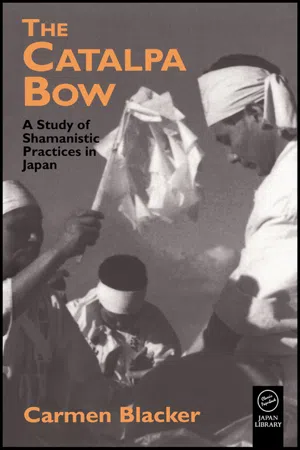
This classic work describes shamanic figures surviving in Japan today, their initiatory dreams, ascetic practices, the supernatural beings with whom they communicate, and the geography of the other world in myth and legend.
Information
1
The Bridge
In the Nō play Aoi no Ue we are shown, limp and enigmatic in the middle of the stage, a single folded robe. It represents the prostrate form of the Princess Aoi, lying mortally sick of a malignant possession. To cure her condition two figures are summoned. The first is a woman called Teruhi, a sibyl gifted with the power of causing the spirits of both the living and the dead to manifest themselves and speak. She beats on a small drum, twangs her bow of catalpa wood, and recites the summoning spell:
- Ten shōjō chi shōjō
Naige shōjō rokkon shōjō
Yoribito wa
Ima zo yorikuru
Nagahama no
Ashige no koma m
Tazuna yurikake.
‘Pure in heaven and pure in earth. Pure within and pure without. Pure in all six roots … You who draw near, loosen now the reins of your grey horse as you gallop to me over the long beach.’
Compelled by the magic words and by the sound of the bow string, the spirit molesting the sick woman appears at the far end of the bridge which gives access to the stage. She wears the serene white mask of the Nō woman. Further compelled by the twanging of the catalpa bow, she begins to speak and to name herself. She is the angry apparition of the Lady Rokujō, superseded and disgraced by the woman on whom she is now revenging herself. Overcome with hatred, she crosses the bridge, creeps towards the prostrate figure and strikes it with her fan.
Though the sufferer immediately grows much worse, the sibyl is now at the end of her resources. She can summon a spirit and cause it to speak, but she cannot banish it, nor can she remove its malice. For this task a second source of power is needed. This, they remember, can be be found not far away in the Saint of Yokawa, a holy man celebrated for the austerities he has performed in mountains. Reluctantly he leaves his hermitage and confronts the spirit. Her aspect is now fearfully changed. Gone is the tranquil white mask with its archaic smile. A mallet in her hand, she now reveals the face of a demon with horns, golden teeth and long black hair. Rubbing his rosary of red wooden beads, the Saint recites the Lesser Spell of Fudō Myōō:
- Namaku samanda basarada.
He then invokes the Kings of the Five Directions, and intones the Middle Spell of Fudō:
- Namaku samanda basarada.
Senda makaroshana
Sowataya untarata kamman.
At the sound of the holy words the phantasm shrinks, drops her mallet and retreats across the bridge to a realm where, we are given to understand, her hatred will be transformed to compassion and she will achieve the salvationary state of Buddhahood.1
The bridge over which the apparition has come and gone represents the tenuous joining of two divided worlds. Our familiar human world is no more than a narrow segment of the cosmos which now confronts us. Beyond it lies a further realm, altogether ‘other’, peopled by beings non-human, endowed with powers non-human, whose whole order of existence is ambivalent, mysterious and strange. Between these two worlds there is no ordinary continuity. Each is contained, like a walled garden, by its own order of being, and separated by a barrier which represents a rupture of level, a break in ontological plane. This barrier the ordinary man or woman is powerless to cross. They cannot at will make the passage to this other perilous plane, nor can they see, hear or in any way influence the beings who dwell there.
The spiritual beings on the other side are not so confined. To them access from one world to another is virtually free and unrestricted. Not only can they visit our world without let or hindrance, but they hold within their control a large sphere of our lives. This sphere was believed to be roughly that over which we ourselves have no control. The fertility of the rice crop, the due onset of the rains, the occurrence of storms, sickness, fire and accident, all these lay in the gift of the inhabitants of the other world beyond the barrier. Even today, although in intellectual circles in Japan an aggressive secularism tends to be the rule, the belief still persists among many sections of the community that the causes of all calamity in human life lie in the spiritual realm. Sickness, accident, drought or fire are the work either of angry ghosts or of offended numina. To discover the causes of these misfortunes we must therefore look into the other dimension where these beings live and enquire what spirit is responsible and the reason for his anger.2
On the goodwill of these non-human beings, therefore, depends the prosperity of the community. Treat them correctly with the right rituals and offerings, summon them correctly with the right spells, and they will leave their own world to visit ours and will exercise their superior power for the benefit of man. But once offend or neglect them and they will irrupt uninvited and furious into our world, to blast the offending community with curses.
Ordinary men and women are powerless to deal with these perilous and ambivalent forces. Certain special human beings, however, may acquire a power which enables them to transcend the barrier between the two worlds. This power bears no relation to the physical strength or mental agility with which we are ordinarily endowed. It is of a different order altogether, acquired by means which often weaken a man’s bodily health and strength, and which appears from time to time in boys who are virtual halfwits. It is a special power to effect a rupture of plane, to reach over the bridge and influence the beings on the other side.
I use the word ‘shaman’ in the following chapters to indicate those people who have acquired this power; who in a state of dissociated trance are capable of communicating directly with spiritual beings. These people in Japan appear in two complementary forms. The first, whom I shall call the medium or the miko, is exemplified by the sibyl Teruhi. She can enter a state of trance in which the spiritual apparition may possess her, penetrate inside her body and use her voice to name itself and to make its utterance. She is therefore primarily a transmitter, a vessel through whom the spiritual beings, having left their world to enter ours, can make their communications to us in a comprehensible way.
The second and complementary source of power, whom I call the ascetic, is exemplified by the Saint of Yokawa. He is primarily a healer, one who is capable of banishing the malevolent spirits responsible for sickness and madness and transforming them into powers for good. To acquire the powers necessary for this feat he must accomplish a severe regime of ascetic practice, which should properly include, besides fasting, standing under a waterfall and reciting sacred texts, a journey to the other world. Whereas with the medium, therefore, it is the spiritual beings who leave their world and come to ours, with the ascetic the passage is in the opposite direction. It is he who must leave our world and make his way through the barrier to visit theirs. This journey he may accomplish in ecstatic, visionary form; his soul alone travels, his body left behind meanwhile in a state of suspended animation. Or he may accomplish the journey by means of symbolic mimesis; the other world projected by means of powerful symbolism on to the geography of our own, he can make the journey through the barrier in body as well as soul.
Corresponding with each of these figures is a particular kind of trance.3 With the medium, infused or possessed by a spiritual being, a number of physical symptoms are commonly found. These include a violent shaking of the clasped hands, stertorous breathing or roaring, and a peculiar levitation of the body from a seated, cross-legged posture I have seen both men and women propel themselves some six inches into the air from this position, again and again for several minutes on end. A violent medium is always considered more convincing than a docile one, the nonhuman character of the voice and behaviour indicating more vividly the displacement of the medium’s own personality by the entry of the divinity. This kind of trance, we shall later see, can either be self-induced, or can be stimulated by a second person, usually the ascetic.
The second type of trance is entirely different. It is a deep, comatose state of suspended animation. This is the condition into which the ascetic’s body must fall if his soul is to leave it in order to travel to other realms of the cosmos. His body remains behind, an empty husk, while his soul traverses barriers through which it cannot follow. We shall find that today this trance occurs only rarely. The capacity for this kind of dissociation, and for the visionary journey which goes with it, seems to have diminished in recent centuries, and today the magic journey is most commonly accomplished by symbolic action in full waking consciousness.
I have said that both the medium and the ascetic are shamans because each in their particular manner of trance acts as a bridge between one world and another. Let us at this point pause for a moment to consider what exactly are the characteristics of the shaman which differentiate him from other ‘specialists in the sacred’. How does he differ from the healer or medicine man, for example, from the prophet or from the magician?
Certainly, as Eliade warns us, the word is often used with regrettable vagueness to designate almost any person possessing magic power in a ‘primitive’ society. More meaningful and authoritative definitions have been drawn up, however, which present the shaman in a clearer light. All base themselves on the shaman as he appears, or used to appear, in Siberia. ‘Shamanism in the strict sense is preeminently a religious phenomenon of Siberia and Central Asia.’ Siberia is the locus classicus, the long home of the shaman, and it is from observation of his activities among such peoples as the Tungus, the Mongols, the Samoyedes, the Eskimo and the Altaians who inhabit this vast area that the prototypal image of the shaman has been built up. The very word derives from the Tungus saman, which in its turn derives ultimately from the Sanscrit ramaná (Prakrit samana) through the Chinese sha-men. This Tungusic name was applied by the Russians to similarly gifted people among the Turks and Mongols, and later came to be adopted by historians of religion and anthropologists to persons possessing similar powers all over the world.4 Thus shamanic persons among the North American Indians, for example, or the Australian aborigines, in Indonesia, China, Tibet or Japan, have all been so designated because to a greater or lesser extent they share the peculiar characteristics of the Siberian prototype. These can be briefly enumerated.5
The shaman is, first, a person who receives a supernatural gift from the spirit world. The gift is bestowed usually by a single spiritual being, who afterwards becomes his guardian and guide, sometimes even his spiritual wife. Before this critical moment in his life, the future shaman suffers for months or even years from a peculiar sickness, sometimes loosely called arctic hysteria. The symptoms range from physical pains—racking headaches, vomiting, aches in the joints and back—to more hysterical or neurasthenic behaviour of wandering off into the forest, falling asleep or fainting for long periods, or hiding from the light.
These symptoms usually disappear, however, at the critical moment of initiation. This violent interior experience often takes the form of a vision, in which a single supernatural being appears to him and commands him to abandon his former life and become a shaman. Thereafter his soul is snatched out of his body and carried off to another realm of the cosmos, either above or below the human world. There he undergoes the fearful experience of being killed and revived. He sees his own body dismembered, the flesh scraped or boiled off the bones to the point when he can contemplate his own skeleton. He then sees new flesh and new organs clothed over his bones, so that in effect he is remade, resuscitated as a new person.
From this terrifying but characteristically initiatory experience he emerges a changed character. His former oddity and sickliness give way to a new dignity and assurance of personality, strengthened by special powers conferred by the guardian spirit who calls him to his new life and which thereafter enable him to render special services to his community.
Foremost among these powers is the ability to put himself at will into altered states of consciousness in which he can communicate directly with spiritual beings. He can fall into the state of trance, for example, in which his soul separates itself from his body and travels to realms of the cosmos inaccessible to the physical body. By travelling upwards to the multiple layers of heavens, for example, he can acquire from the spiritual inhabitants there useful knowledge of hidden things. By travelling downwards to the underworld he can rescue the souls of sick people, kidnapped and taken there by spirits. From his knowledge of the topography of these other worlds, moreover, he can act as guide to the souls of the newly dead, who without his help might well lose their way along the unfamiliar road.
The shaman does not carry out this special work unaided. He is given indispensable help in his task, first by a retinue of assistant spirits and secondly by a panoply of magic clothes. The helping spirits, which often take the form of bears, wolves, eagles or crows, are given to him by his guardian at the time of his initiation. They appear at once at his behest, ready to act as messengers or guides. The magic clothes and instruments, of which the drum is the most important, embody in their shape, in the materials of which they are made, in the patterns and figures engraved upon them, symbolic links with the other world. Thus his drum, made from the wood of the World Tree, his cap of eagle and owl feathers, his cloak adorned with stuffed snakes and an immense weight of metal plaques and tubes, all resolve into means whereby his passage from one world to another is facilitated.
The shaman’s work also requires a cosmos of a specific shape. For most Siberian peoples, the cosmos appears in three superimposed layers or tiers. In the middle lies the human world. Above it lie seven layers of heavens, a number to which a Babylonian origin is usually assigned. Below it lies a dark underworld, sometimes also disposed in seven levels, in the nethermost of which stands the palace of Erlik Khan, the Lord of the Underworld, and where sometimes nine underground rivers have their mouths. Joining these various cosmic levels at the very centre of the universe is a marvellous giant Tree. With its roots in the lowest underworld and its crown of branches in the highest heaven, this Tree in all its splendour is at once the axis of the cosmos and the source of ever-renewing life. Thus the shaman, as he travels either upwards to heaven or downwards to the underworld, to planes sealed off from ordinary ungifted persons, follows the ‘hole’ made through the universe by this Tree. His journey is therefore made at the very centre and core of the cosmos.
The trance in which the soul leaves the body is not the only condition of altered consciousness which the shaman can assume at will. He must also be capable of offering his body as a vessel for possession by spirits. Eliade, it is true, considers the faculty of possession to be secondary and derivative from the ‘out of the body’ consciousness. Other authorities, however, such as Dominic Schröder, accord it importance equal and complementary to the ‘out of the body’ trance.
Lastly, we may mention the power which Eliade considers particularly characteristic of the shaman, and closely connected with his ecstatic condition; mastery of fire. The shaman is impervious to heat and cold, to burning coals and arctic ice alike. This power he achieves by rousing within himself the interior heat known to mystics in various parts of the world, and which signifies that the heated person has passed beyond the ordinary human condition. He now participates in the sacred world.
Such is the special complex of powers by which the shaman is usually defined. He is thus a gifted person of a distinctive kind. He is at once a cosmic traveller, a healer, a master of spirits, a psychopomp, an oracular mouthpiece. These various powers, however, are combined and organised round the central faculty of trance; of so altering his consciousness at will that he can communicate directly with the inhabitants of the supernatural world.
We shall see in the following chapters that the medium and the ascetic in Japan can on this definition justifiably be called shamans. We shall find examples of initiation sickness, of the supernatural call, of the ‘out of the body’ trance in which the soul travels to heaven and hell. We shall find assistant spirits, magic clothes and instruments, and abundant evidence of the interior heat which produces mastery of fire. The cosmos in Japan, it is true, is somewhat differently shaped, with no evidence of the wondrous giant Tree at the centre of the world. It is true too that among the initiatory visions of the medium and the ascetic few have so far come to light which describe the dismemberment of the body, reduction to a skeleton and resuscitation with new flesh on the bones. In place of the Tree, however, we shall find an almost equally splendid Mountain; and in place of the dismemberment and remaking of the body we shall find other symbolism which equally unequivocally points to the initiatory schema of death and rebirth.
We shall find too that it is not meaningful to treat either of these figures in isolation from the other. Complementary though they may at first appear, the medium and the ascetic are closely bound together. Both, we shall find, must undergo the same ascetic practice before their particular kind of power can be acquired. Both must be present at certain rituals in order to achieve the necessary communication with spirits. Sometimes both kinds of power seem to be present, or at any rate overlapping, in the same person. During the feudal period it was common to find marriages between the two kinds of people, an ascetic husband married to a female medium. Clearly we have two mutually dependent functions, which it is convenient to treat under the same nomenclature.
The phenomena of shamanism in Japan are further complicated by the fact that they do not derive from a single homogeneous source: like ...
Table of contents
- Cover Page
- Title Page
- Copyright Page
- Preface to the Third Edition
- Preface to the Second Edition
- Preface to the First Edition and Acknowledgements
- Illustrations
- 1: The Bridge
- 2: The Sacred Beings
- 3: Witch Animals
- 4: The Other World
- 5: Ascesis
- 6: The Ancient Sibyl
- 7: The Living Goddess
- 8: The Blind Medium
- 9: The Ascetic’s Initiation
- 10: The Visionary Journey
- 11: The Symbolic Journey
- 12: The Ascetic’s Power
- 13: Village Oracles
- 14: Mountain Oracles
- 15: Exorcism
- 16: Conclusion
- Appendix: Climbing the Ladder of Swords
- Abbreviations
- Notes
- Select Bibliography
- Additional Bibliography (Third Edition)
- Glossary
Trusted by 375,005 students
Access to over 1.5 million titles for a fair monthly price.
Study more efficiently using our study tools.
Frequently asked questions
Yes, you can cancel anytime from the Subscription tab in your account settings on the Perlego website. Your subscription will stay active until the end of your current billing period. Learn how to cancel your subscription
No, books cannot be downloaded as external files, such as PDFs, for use outside of Perlego. However, you can download books within the Perlego app for offline reading on mobile or tablet. Learn how to download books offline
Perlego offers two plans: Essential and Complete
- Essential is ideal for learners and professionals who enjoy exploring a wide range of subjects. Access the Essential Library with 800,000+ trusted titles and best-sellers across business, personal growth, and the humanities. Includes unlimited reading time and Standard Read Aloud voice.
- Complete: Perfect for advanced learners and researchers needing full, unrestricted access. Unlock 1.5M+ books across hundreds of subjects, including academic and specialized titles. The Complete Plan also includes advanced features like Premium Read Aloud and Research Assistant.
We are an online textbook subscription service, where you can get access to an entire online library for less than the price of a single book per month. With over 1.5 million books across 990+ topics, we’ve got you covered! Learn about our mission
Look out for the read-aloud symbol on your next book to see if you can listen to it. The read-aloud tool reads text aloud for you, highlighting the text as it is being read. You can pause it, speed it up and slow it down. Learn more about Read Aloud
Yes! You can use the Perlego app on both iOS and Android devices to read anytime, anywhere — even offline. Perfect for commutes or when you’re on the go.
Please note we cannot support devices running on iOS 13 and Android 7 or earlier. Learn more about using the app
Please note we cannot support devices running on iOS 13 and Android 7 or earlier. Learn more about using the app
Yes, you can access The Catalpa Bow by Carmen Blacker in PDF and/or ePUB format, as well as other popular books in Social Sciences & Ethnic Studies. We have over 1.5 million books available in our catalogue for you to explore.