Challenging Aphasia Therapies presents an entirely new approach to thinking on the subject of aphasia therapy by liberating it from traditional models. This is achieved through a process of reflection in which many assumptions previously taken for granted are challenged and reassessed. Internationally renowned experts successfully demonstrate the benefits of learning about aphasia therapy through the process of engaging in it.
Topics covered include:
* the role of context, culture and conversation in shaping and directing aphasia therapy
* the ethical issues that arise from the current tensions between market driven health care industries and the moral commitment to their client welfare
* the value of therapy. Contributors challenge the common notion of successful therapy as solely performance related.
* the potential and competent use of humour in aphasia therapy.
The identification of the strengths and limitations of clinical models and the focus on relevant directions for therapy will be of interest to practising clinicians as well as anyone involved in study or research in speech and language therapy.
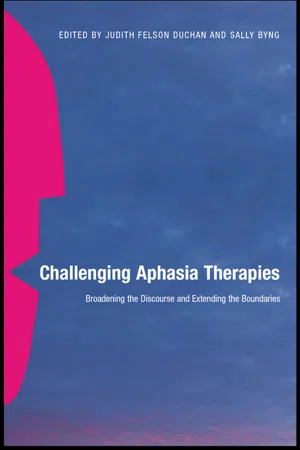
eBook - ePub
Challenging Aphasia Therapies
Broadening the Discourse and Extending the Boundaries
- 192 pages
- English
- ePUB (mobile friendly)
- Available on iOS & Android
eBook - ePub
Challenging Aphasia Therapies
Broadening the Discourse and Extending the Boundaries
About this book
Information
Publisher
Psychology PressYear
2004Print ISBN
9780415646468
9781841695051
Edition
1eBook ISBN
9781135422813
1 Challenging aphasia therapies
Sally Byng and Judith Felson Duchan
This is a book of challenging musings by speech-language therapists pathologists who work with individuals who are living with aphasia. The authors, international authorities in the field of aphasia therapies, explore their thoughts about how people with aphasia live with their communication disabilities and how they learn new ways of communicating. The authors also explore how they, themselves, have learned about doing therapy through the process of engaging in it.
While those writing these chapters have published widely, here they are departing from what they are accustomed to. The usual mode in journals and books in the field of speech-language therapy/pathology is to write objectively about impairments, tasks, and client progress. In this book, the authors become introspective, and focus on their own experiences as clinicians and on their relationships with their clients. They ruminate about learning processes—both their own and their clients. And in doing so they reveal some of the conundrums arising from working in the field of aphasia therapy.
The book is intended for speech-language therapists/pathologists and students in English-speaking countries who work with people living with aphasia. It may also be of interest to researchers and practitioners in therapy-based professions, e.g., psychology, psychotherapy, and occupational therapy. The writing is reflective and personal, and includes particular examples and issues that have given the authors pause.
Our authors have challenged their ways of doing “business as usual” in different ways. Some have taken a long hard look at their own identity as therapists and examined some of the principles and ethics underpinning their perspectives on therapy (Martha Taylor Sarno, Carole Pound, Jon Lyon, and Claire Penn). Others have reflected on the nature and process of therapy, sometimes using different media (music and humour) to provide a fresh perspective on interaction in therapy (Nina Simmons-Mackie, Roberta Elman, Julie Morris, David Howard, and Sinead Kennedy). And still others have offered some examples of practices in providing therapy or getting feedback on outcomes, which reflect their views of the relationship between the therapist and the person with aphasia (Carole Pound, Audrey Holland, Amy Ramage, Aura Kagan, and Judy Duchan).
A number of themes emerge from the writings in this book. Here we will give you a peek at a few, others we leave for you to discover on your own as you read these challenging chapters.
COMBINING THE PERSONAL WITH THE PROFESSIONAL
Perhaps one of the most obvious features of this book is the sense of the personal journeys that the contributors have undertaken in their development as therapy practitioners. What is clear is that being an aphasia therapist requires a willingness to be open to personal change, to face personally difficult issues, and to be prepared to think about and learn from one’s personal experiences. Therapists must also be prepared meet the challenges that come from interacting with others, their clients, who are facing major life changes. Taking on such concerns requires not only the skill to support others but also the ability to reflect on one’s own life issues, and a willingness to be open to challenges and questions.
Several of the authors provide examples of how to integrate the personal with the professional. They do this in different ways. Martha Taylor Sarno, when reflecting on what it means to be a person and a therapist, asks that we be aware of our own feelings of vulnerability and that we examine our personal assumptions about the relevance of our therapy approaches. Carole Pound follows suit by plumbing her own experiences as a patient. Carole also draws lessons for the disability movement as she outlines some parallels between her personal and professional experiences.
Claire Penn and Nina Simmons-Mackie offer other takes on how to relate the personal and professional. Claire considers how her former teachers facilitated her search for a personal way of doing therapy, and Nina sees humour as a way for professionals to become more accessible personally to their clients.
Reading these authors’ personal accounts reveals their rich potential for developing insights for aphasia therapies. Until now there has been little attention given to the personal side of therapy in the literature on aphasia. We do not seem to think about the impact that working with people with aphasia can have on how and who we are. Nor do we look directly at who we are for our impact on our clients. The contributions in this book demonstrate how creative and liberating it can be for therapists to examine their personal histories to discover how best to conduct themselves in their therapies.
CHALLENGING THE TACIT ASSUMPTION OF CURE
There is another area of reflection running through the chapters in this book. It has to do with the fact that therapists cannot offer a cure for aphasia. Now this may not feel like a very novel observation, but a number of the contributors hint, directly and indirectly, that therapists might not recognize this fact. How much does the way we practise actually suggest, covertly, to people with aphasia that we think they can get back to where they were before their stroke? By taking them through steps to help them “get better” are we giving them the false assumption that the steps will eventuate in cure?
Even if we were to be explicit about the long-term and chronic nature of aphasia, we must still contend with the stories conveyed in the media and other venues of popular culture that promise what Carole Pound has described as “restitution stories”, in which the person with the disability conquers the problem and returns to his or her former life.
What are people living with aphasia to make of the fact that we think we can help them to get so far, but no farther? This worry is poignantly expressed by Valerie Rosenberg, who is quoted by Claire Penn as asking questions such as “Is this permanent or what?” in reference to her aphasia, and wondering “What happened with my bargain with God?”.
What support are we giving our clients to deal with the impact of not being able to be who they were again? Martha Taylor Sarno addresses this need for support explicitly as an ethical issue. If therapists provide therapy for only a part of the impact of aphasia, and knowingly do not provide support for other aspects of the impact, particularly if those impacts affect functioning in life, is that practice ethical? Claire Penn’s description of her client who committed suicide, despite having made what Claire judged to be an excellent recovery, demonstrates the importance of this issue. And Carole Pound offers some suggestions for how to become involved in supporting people to “live with aphasia”. She recommends “doing therapy differently” with a focus on the social and everyday life aspects of the disability.
Julie Morris, David Howard, and Sinead Kennedy raise issues about the differences in therapy in the acute stages and therapy delivered several years post-onset. What must it be like for someone who has lived for 7 years with an impairment, and the disability that stems from it, to return to therapy? What is someone looking for and anticipating will happen at this stage? How do ideas of therapy cures change with time?
ADDRESSING TIME, RESOURCE, AND SYSTEM BARRIERS TO QUALITY THERAPY
Jon Lyon and Martha Taylor Sarno raise a further, related issue: the use of resources. How much does providing therapy for aphasia cost? Jon Lyon tells us the cost of his course of intervention with Patty, and broadly what was achieved for the expenditure. He effectively raises the question—what do other therapies achieve for people with aphasia, in life terms, at what cost? This is a bald question, but one that, we suspect, is not met directly enough by people providing services.
We bemoan the lack of available resources. Martha Taylor Sarno and Jon Lyon bring this problem home as they describe the virtually negligible support for aphasia therapy in the current US healthcare system. But we do not see evidence that service providers have thought through what that means for the priorities in providing therapy, nor researchers asking what that means for the priorities in research.
How, for example, do therapists negotiate with people with aphasia what service they could deliver in, say, 20 sessions? If a therapy would need much more than 20 sessions, yet that is all that is realistically available, is it ethical to embark on it, when it is unclear whether the remaining time needed to have an impact on someone’s life will be funded? And do we make that evident to people at the outset? These are crucial questions facing all therapies.
Much of the literature suggests that for therapy to address the impairment effectively, many sessions are required. When therapists realize they do not have this option, do they give up and not even start therapy because they know they do not have the resource required at the outset? Jon Lyon offers an interesting solution to this vexing problem. He suggests that we could do a lot more to empower our clients to manage their own therapy, after which point they won’t need a therapist! Martha Taylor Sarno provides another direction for solving the resource problem. She invites clinicians to examine how to use existing resources such as adult education and access to other community-based resources to support those with aphasia.
In their chapter, Julie Morris, David Howard, and Sinead Kennedy add yet another issue to the concern about resources. A common assumption made by therapists and those with aphasia has been that with more resources, the desired improvement would be obtainable. This was not the case for their client, Lawrence. Even after their intensive 162 hours of language therapy, Lawrence did not improve dramatically on the quantitativemeasures used, but he and his wife felt that significant gains had been made—both in the use of a specific strategy to support communication and in his confidence. This leads to questions about how much and what type of therapy is required to increase confidence, which seems to have been an important by-product of the therapy for Lawrence.
PROVIDING ENOUGH TIME TO ATTAIN PERSONAL CHANGE
It does not take much imagination to see that becoming aphasic represents a major life event, for anyone. Nor does it take much imagination to realize that recovering from losing your ability to talk and learning to live a new way of life cannot be achieved overnight, or even in a few months, as is brought home in Claire Penn’s story of Valerie Rosenberg’s phases of therapy, and in Carole Pound’s description of the phases of living with a disability. It is clear from Valerie’s own words and Claire Penn’s description of the therapy process that people learning to live with aphasia must go through a significant period of personal development and skills acquisition. Essentially that is what rehabilitation involves—learning new skills and adapting your identity—regardless of the disabling condition you are experiencing.
Why is it that we have had such difficulty getting across this obvious message about the importance of long-term rehabilitation, especially to third-party payers? Could it be because of the undue focus on sophisticated neurolinguistics, on the complexity of the impairment, on the creation of a scientific mystique around aphasia, that Martha Taylor Sarno draws attention to? Have we obfuscated many of the other real issues where people need support in our efforts to gain scientific credibility? And in so doing, have we prevented the people who make decisions about healthcare spending from understanding the significance of aphasia in people’s lives, and what it takes to provide people with the support they need to make their journeys back to life again?
Aura Kagan and Judy Duchan talk about these issues in relation to how aphasia therapies have been evaluated. These authors review the various approaches to measuring therapy outcomes and conclude that even those outcomes that are consumer-based do not probe deeply enough into the dimensions of success that are in the minds of those with aphasia. The authors identify various things that have blocked professionals from obtainingauthentic client-based evaluation of their therapies, and then offer some solutions to these professional barriers.
UNDERSTANDING THAT APHASIA IS MORE THAN A LANGUAGE IMPAIRMENT
Aphasia is a life-changing event. All of the chapters in this book attest to that. The authors treat recovery as a complex process and provide examples of their attempts to address multiple issues that arise for people. What they reinforce is that planning a programme of therapy for someone with aphasia needs to comprise an imaginative, broad-based range of opportunities. Those opportunities should have to do with language and communication, identity and lifestyle, involving not just the person with aphasia, but those with whom they live. None of the chapters takes into account only one of these facets of therapy. How the balance of those components is negotiated is complex. It is what Jon Lyon calls a “systems” approach.
The invisible nature of aphasia is, according to Martha Taylor Sarno, a large part of the difficulty in coping with it. For example, a commonly occurring aspect of aphasia is psychological depression and isolation, which has to do with the general experiences related to suffering and depression— something that is not obvious to those who see the problem strictly in terms of language impairment. Carole Pound asks that we see aphasia therapy as including the everyday aspect of the disability, and how to cope. She offers a number of examples of how support at this level is needed to meet therapy relevant for clients with aphasia—suggestions that go beyond working with language impairment.
Claire’s Penn’s “pragmatic, wholistic” therapy involves a set of strategies to meet her clients’ life challenges. Early in her client’s therapy, Claire developed with Valerie Rosenberg a set of verbal mediators, strategies, hints, what Claire calls “one-liners” to guide Valerie in organizing, remembering, conversing, and coping as she engaged in everyday life activities. (Helpful strategy guides like this are also a feature of Audrey Holland’s work with Roger Ross.) Later, in their course of therapy that Claire calls “taking stock”, she and Valerie worked on setting directions for the future.
When Jon Lyon describes his client with aphasia as experiencing a “loss of intimacy”, as someone whose life has been thinned out because of her confinement, he is seeing aphasia as much more than a language impairment. And when Nina Simmons-Mackie makes an appeal for including humour in the scope of communication and communication disability, she is seeing language and communication as ranging beyond words and sentences into a wonderful new realm of the comical.
DEALING WITH POWER RELATIONS DURING THERAPY
What the chapters in this book also reveal is that it is not sufficient only to think about the topics that therapy addresses—one must also consider the role that the therapist plays and how therapy is conducted. Nina Simmons- Mackie, Aura Kagan, Judy Duchan, and Carole Pound all draw attention to the power that the therapist wields. The impact of the relationship on the outcome of therapy is also described by Roberta Elman, Audrey Holland, and Carole Pound. All argue strongly for client-directed approaches rather than clinician-dominated ones. Carole Pound, for example, describes the authoritarian clinician who assumes all of the responsibility for therapy direction and content. She makes a strong appeal for clinicians to give up their power and allow their clients to identify their own problems and the course of therapy.
When analyzing the dynamics of humour in a therapy session Nina Simmons-Mackie makes the startling discovery that therapists are the ones who usually crack the jokes and the ones who have the option of whether or not to laugh. She found it to be the notable exception when a client initiated humour or failed to respond to something funny said or done by the clinician. She takes these as signs of the power of the therapist over the client.
Roger Ross, the person Audrey Holland and Amy Ramage introduce us to, was interested in directing his own therapy groups and in controlling his own therapies. This raises another issue of client power—does client power ever need to be challenged? We would suggest, as do Carole Pound, Audrey Holland and Amy Ramage that clinicians who empower their clients need also to know when not to go with the clients’ preferences. Roger Ross’s disdain for coffee and cake groups should not be presumed to be the opinion of other people with aphasia.
Aura Kagan and Judy Duchan offer a method for giving those receiving therapy the means to evaluate their own progress. The structured interviews, using methods of supported conversation, offered the people they talked with a way not only of evaluating the success and failures of their own therapies, but also of discussing aspects of therapy that they would recommend to others with aphasia.
RECOGNIZING MISPLACED THERAPIES AND IDENTIFYING MISGUIDED THERAPISTS
Our authors are not only adventuresome in exploring new areas of therapy, they are also willing to take the risk of criticizing their own past therapies and those of others. Mistakes in the choice and execution of therapies are described by:
- Martha Taylor Sarno when she talks about the minimal attention in the past to psychosocial aspects of aphasia;
- Nina Simmons-Mackie in her examples of humour that is either misplaced or offensive;
- Jon Lyon when he talks about “restoration therapies” that have a single focus on changing a small part of an impairment;
- Audrey Holland and Amy Ramage who give an example of a therapist who lacks self-doubt, assuming she knew better than her aphasia client about whether there is such a word as “pert”;
- Roger Ross, Audrey’s client, who was able to describe/diagnose his difficulties (e.g., “I have no sound patterns in my head”) more succinctly and transparently than his clinicians might have done (e.g., “difficulty in accessing the phonological lexicon”);
- Roberta Elman who remembers with embarrassment and regret her early therapies composed of drills, which she used to consider the important work, to the neglect of conversation, which she then considered to be fluff;
- Carole Pound, who remembers a time when she was searching for a the...
Table of contents
- COVER PAGE
- TITLE PAGE
- COPYRIGHT PAGE
- NOTES ON CONTRIBUTORS
- INTRODUCTION
- 1 CHALLENGING APHASIA THERAPIESSALLY BYNG AND JUDITH FELSON DUCHAN
- 2 APHASIA THERAPIES: HISTORICAL PERSPECTIVES AND MORAL IMPERATIVES
- 3 DARE TO BE DIFFERENT: THE PERSON AND THE PRACTICE
- 4 EVOLVING TREATMENT METHODS FOR COPING WITH APHASIA APPROACHES THAT MAKE A DIFFERENCE IN EVERYDAY LIFE
- 5 CONTEXT, CULTURE, AND CONVERSATION
- 6 JUST KIDDING! HUMOUR AND THERAPY FOR APHASIA
- 7 LEARNING FROM ROGER ROSS: A CLINICAL JOURNEY
- 8 GROUP TREATMENT AND JAZZ: SOME LESSONS LEARNED
- 9 THE VALUE OF THERAPY: WHAT COUNTS?
- 10 CONSUMERS’ VIEWS OF WHAT MAKES THERAPY WORTHWHILE
Trusted by 375,005 students
Access to over 1.5 million titles for a fair monthly price.
Study more efficiently using our study tools.
Frequently asked questions
Yes, you can cancel anytime from the Subscription tab in your account settings on the Perlego website. Your subscription will stay active until the end of your current billing period. Learn how to cancel your subscription
No, books cannot be downloaded as external files, such as PDFs, for use outside of Perlego. However, you can download books within the Perlego app for offline reading on mobile or tablet. Learn how to download books offline
Perlego offers two plans: Essential and Complete
- Essential is ideal for learners and professionals who enjoy exploring a wide range of subjects. Access the Essential Library with 800,000+ trusted titles and best-sellers across business, personal growth, and the humanities. Includes unlimited reading time and Standard Read Aloud voice.
- Complete: Perfect for advanced learners and researchers needing full, unrestricted access. Unlock 1.5M+ books across hundreds of subjects, including academic and specialized titles. The Complete Plan also includes advanced features like Premium Read Aloud and Research Assistant.
We are an online textbook subscription service, where you can get access to an entire online library for less than the price of a single book per month. With over 1.5 million books across 990+ topics, we’ve got you covered! Learn about our mission
Look out for the read-aloud symbol on your next book to see if you can listen to it. The read-aloud tool reads text aloud for you, highlighting the text as it is being read. You can pause it, speed it up and slow it down. Learn more about Read Aloud
Yes! You can use the Perlego app on both iOS and Android devices to read anytime, anywhere — even offline. Perfect for commutes or when you’re on the go.
Please note we cannot support devices running on iOS 13 and Android 7 or earlier. Learn more about using the app
Please note we cannot support devices running on iOS 13 and Android 7 or earlier. Learn more about using the app
Yes, you can access Challenging Aphasia Therapies by Judith Felson Duchan,Sally Byng in PDF and/or ePUB format, as well as other popular books in Psychology & Cognitive Psychology & Cognition. We have over 1.5 million books available in our catalogue for you to explore.