eBook - ePub
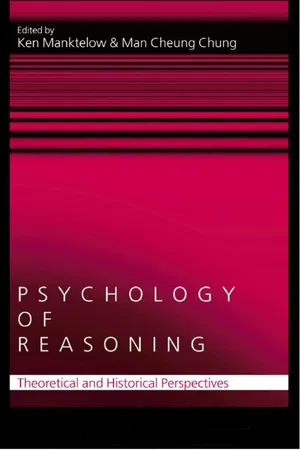
Psychology of Reasoning
Theoretical and Historical Perspectives
- 388 pages
- English
- ePUB (mobile friendly)
- Available on iOS & Android
eBook - ePub
About this book
This collection brings together a set of specially commissioned chapters from leading international researchers in the psychology of reasoning. Its purpose is to explore the historical, philosophical and theoretical implications of the development of this field. Taking the unusual approach of engaging not only with empirical data but also with the ideas and concepts underpinning the psychology of reasoning, this volume has important implications both for psychologists and other students of cognition, including philosophers. Sub-fields covered include mental logic, mental models, rational analysis, social judgement theory, game theory and evolutionary theory. There are also specific chapters dedicated to the history of syllogistic reasoning, the psychology of reasoning as it operates in scientific theory and practice, Brunswickian approaches to reasoning and task environments, and the implications of Popper's philosophy for models of behaviour testing. This cross-disciplinary dialogue and the range of material covered makes this an invaluable reference for students and researchers into the psychology and philosophy of reasoning.
Information
Publisher
Psychology PressYear
2004Print ISBN
9780415654012
9781841693101
Edition
1eBook ISBN
9781135425685
1 The contextual character of thought
Integrating themes from the histories and theories of the study of reasoning
K. I. Manktelow and M. C. Chung
The study of reasoning, unlike what was once said about psychology as a discipline, has both a long past and a long history. Indeed, it would not be too far-fetched to claim that people have been studying and reporting on their reasoning abilities for as long as they have been studying anything. So the shadow cast by this history is probably longer than in any other field of the cognitive sciences: modern authors still regularly appeal to the writings of their ancient philosophical forebears, most notably Aristotle, who lived over 2300 years ago. Even within the confines of contemporary empirical psychology, a long line can be traced back: the earliest such reference in this book is a near century old, from 1908.
All the more curious, then, that present-day students of the psychology of reasoning can find their attempts to situate the field rather an arduous business. While you will often find such material in the introduction sections of empirical papers, and in the background sections of theoretical reviews, you can feel rather like an archaeologist piecing together an object from various fragments you happen upon. One aim of this book is to enable those interested in the psychology of reasoning to apprehend more of its general historical base, and hence get a better appreciation of the direction in which the ideas are flowing, by finding more of these pieces in one place. We will have a better idea of where we are going if we are clearer about where we have come from.
In addition to the rich strata of history on which the psychology of reasoning stands, there has been an increasing acknowledgement, as it has turned from a task-based data-gathering enterprise to a deeper and wider theoretical one, that there are connections to be made both to other aspects of the study of human thought, and to cognitive science in general. Psychologists studying reasoning have often made appeals for engagement with these other fields and have increasingly gone out looking for it in recent years. Every recent major theoretical statement has been made in these terms, as several of the present chapters portray, although sometimes, as Stenning and van Lambalgen argue here, there has been a step in the other direction and a detrimental split has opened up. A second aim of this book is to present some of these theoretical extensions and contacts.
The third aim of the book was something of an act of faith on the part of its editors. We have 14 contributions here, taken from a wide range of areas of study; some of these areas will be familiar to and expected from people already interested in the psychology of reasoning, some perhaps less so. We believed (hoped) that it would be possible to identify emergent themes, from both the historical and theoretical strands, that would enable both ourselves and you, the reader, to form the more grounded view of the field that is one of the benefits of its progress towards being a more integrated science. That faith has been amply repaid, and in the rest of this introduction we shall set out some of these themes (you may well find others); they have informed the way the chapters have been organized.
One of the first true empirical psychologists, Hermann Ebbinghaus, devoted his life’s work to the attempt to explain memories from their cradles to their graves, as it were: from their acquisition to their loss. He realized that in order to accomplish the first of these tasks, the material to be remembered had to be free of all prior associations, otherwise he could not be sure he was looking at the very start of an act of memory. Hence the development of his famous nonsense syllables. Something like this idea has also been applied in the psychology of reasoning: if one wants to study an inference, it had better not be contaminated by memory, otherwise any interesting effects could be attributed to knowledge rather than thought. This was the nub of Mary Henle’s (1978) famous objection, that she had never found errors that could unambiguously be attributed to faulty reasoning. The answer seems obvious: strip out, as Ebbinghaus thought he had done, all possibility of other influences, and study only reasoning. Thus a research programme grew up based around the study of responses to various abstract tasks. This programme is reviewed in greatest detail in older texts such as Wason and Johnson-Laird (1972) and Evans (1982), although it is also at the core of later ones such as Evans, Newstead, and Byrne (1993), Garnham and Oakhill (1994), and Manktelow (1999).
However, the assumption that one can study reasoning directly by using abstract tasks has been replaced by a realization that, if one strips out content, one is losing something essential about reasoning (as one is about memory). This is far from a new idea in itself, as Mike Doherty and Ryan Tweney relate; it was at the heart of Brunswik’s approach to psychology. (It was also acknowledged by Wason and Johnson-Laird, in both the title and the substance of their 1972 book.) Brunswik was guided by the principle of representative design: that the essential elements of the environment in question must figure in research design. If this principle is taken on board, certain consequences follow as to the way you go about designing experiments and interpreting their findings, as Doherty and Tweney show. Brunswik’s ideas are probably most familiar to students of reasoning through the work of Gigerenzer and colleagues on fast and frugal heuristics and probabilistic mental models (see Gigerenzer, Todd, & the ABC Research Group, 1999), but they are becoming more influential more widely: a whole issue of the journal Thinking and Reasoning was devoted to this approach in 1996.
The need to acknowledge the relation between the task and the natural cognitive ecology of research participants has also been the fundamental concern of the “rational analysis” approach to cognition, as Nick Chater and Mike Oaksford demonstrate. They turn Brunswik’s principle around, and ask of a given reasoning task, what environment is that task reflecting? In common with Brunswik, rational analysis thus requires a specification of the cognitive environment. A scientist might design a task assuming that the participant’s response to it reflects one kind of cognition, but as Porgy said, it ain’t necessarily so. The participants might be coming at it from quite another direction, in which case our evaluation of their performance is under serious question. Chater and Oaksford take the example of tasks ostensibly designed to assess logical deduction, but on which there is evidence that participants may be attempting optimal information gain. This approach is one of the most important recent theoretical and methodological innovations in the psychology of reasoning, and can only gain in influence in the future. It chimes with the standpoint of the philosopher Gilbert Harman (e.g., 1999), who argues that reasoning is all about belief revision, and hence that “deductive reasoning” is not reasoning, since deduction is concerned only with finding proofs, and so does not increase information. Chater and Oaksford remind us of this position when they declare that, since much of the experimental study of deductive reasoning does not seem to engage it, the term “psychology of deductive reasoning” may be a misnomer.
These are fundamental ideas about the way research into reasoning is and ought to be done, and the sorts of theories that ought to be compiled, but the acknowledgement of the importance of the contexts of thought can be cashed out in other ways. Much of our thinking – and almost all of the thinking that has been studied by psychologists – is verbal, and so the linguistic context comes to the fore. And at the heart of reasoning, as David Over emphasizes, is the conditional, usually expressed using sentences containing “if”. This is reflected in the experimental study of human reasoning, where studies of conditional reasoning far outweigh any other kind. Over points out problems with “logicism”, the idea that the study of conditionals must be restricted to those that embody statements expressing certainties. Most of the statements we make about the world are uncertain to some degree, and so most real-world conditional arguments cannot strictly be deductively valid. Adherence to a strong logicist approach to conditionals leads to some long-recognized, jarring paradoxes. Furthermore, many of our conditional expressions concern counterfactual or deontic situations, and so are not amenable to a strict deductive analysis in the first place. Over traces the history of the study of conditionals both in psychology (through the theories of natural deduction and mental models) and philosophy (focusing on the work of Ramsey and Stalnaker). He concludes that considerations of utility and probability are necessary in explaining reasoning with all types of conditional, with the hitherto “standard” indicative conditional being usefully seen as a special case of the deontic conditional. This decision-theoretic approach to conditional reasoning is shared by Chater and Oaksford, although they take a radically different theoretical stance.
The semantics and pragmatics of conditionals are also the focus of David O’Brien, Antonio Roazzi, Maria Dias, Joshua Cantor, and Patricia Brooks; they reflect on what a close analysis of these factors implies for research using the most well-known experimental paradigm on conditional reasoning, the Wason selection task. They concentrate on the indicative–deontic distinction, which has been the locus of much contemporary theorizing. It has often been held that when we evaluate an indicative conditional, in the selection task and elsewhere, we are dealing with its possible falsification, whereas when we evaluate a deontic conditional, we are dealing with possible violations of it. So in the former case, the status of the sentence is in question but in the latter it is not. Using a large range of task scenarios, O’Brien and colleagues show that it is easy to be simplistic about this, for instance in falsely assuming that deontic rules cannot be falsified, or in distinguishing lies and mistakes. The solution is a precise specification of both the semantics and the pragmatics of the task in question (a Brunswikian moral). Such an analysis leads in their view to a unified conception of conditional reasoning, where differences in performance can be explained using pragmatic principles and general-purpose reasoning mechanisms, rather than domain-specific processes.
The importance of the reasoner’s interpretation of task materials is also the starting point for Keith Stenning and Michiel van Lambalgen’s analysis. They also address the selection task, and like Over and O’Brien and colleagues, strongly contest the “standard” reading of the conditional as corresponding to the logic of material implication (which states that a conditional is true when its antecedent is false or its consequent is true). Unlike the more intuitive analysis of O’Brien and colleagues, they point to developments in logical semantics as a descriptive rather than normative discipline, and urge a reunification between psychology and logic, whose divorce, they argue, has hindered the progress of research. Similarly, selection task research has contained an outdated philosophy of science based on Popper’s falsificationist doctrine, another area that has moved on in recent times. As with O’Brien and colleagues and Chater and Oaksford, Stenning and van Lambalgen argue that researchers should not blithely assume that participants in a selection task experiment are using an implication conditional and seeking possible falsifications, and they too go into detail about the indicative–deontic distinction. Rather, the participants’ task is to discover how the researcher intends the task and rule to be understood. Without this basic semantic account, we are in no position to argue about mental processes. Thus, echoing a sentiment first expressed by Anderson (1978) and urged on the psychology of reasoning by Evans (1982), theories require an account of both representation and process.
As we have seen above, there has been a lot of attention devoted to the indicative–deontic distinction in recent times, and this is the concern of the chapter by Ken Manktelow. He also locates his analysis in research on the Wason selection task, completing a trilogy of chapters that do so; the reason for this is that the empirical base of the upsurge in interest in deontic reasoning lies in work using that problem. It was given its most powerful stimulus in the mid 1980s, in the widely known studies of Cheng and Holyoak and Cosmides. One of the offshoots of the direction of attention to deontic reasoning was the reawakening of a bipolar argument concerning the integrity of reasoning. Broadly speaking, an indicative statement concerns matters of fact, while a deontic statement prescribes an action. This difference has been acknowledged since Aristotle, as the difference between pure, or theoretical, reasoning and practical reasoning. Are they two sides of the same coin, or different currencies? Manktelow considers a variety of approaches to this fundamental question, and raises another: that there may be a further distinction to be made, as causal reasoning does not fit comfortably under either heading.
There have been many centuries of argument over whether the intuitive pure–practical distinction reflects a categorical distinction in human cognition, and recent empirical studies have led to a number of modern authors espousing that position. Two foregoing chapters here, by Over and by O’Brien and colleagues, however, come down on the side of a unified approach to reasoning. That being so, how is reasoning carried out in the human mind? One answer is alluded to by O’Brien et al. – that people use a kind of mental logic, allied to the pragmatic principles about which they go into detail. The major alternative to this proposal is reviewed by Phil Johnson-Laird, who traces the historical antecedents of the theory of mental models. This is unquestionably the most influential theoretical proposal in the field, as reflected in the volume of published research that appeals to the notion of mental models, and the range of its applications. These began outside the field of reasoning, and extend ever more widely within and beyond its conventional boundaries; some flavour of this breadth of application can be gained here. Johnson-Laird finds precedents in 19th-century science, but locates the theory’s true ancestry in the work of the philosopher C. S. Peirce, the Mozartish psychologist Kenneth Craik, and his contemporary, the “Gestalt behaviourist” E. C. Tolman. Another measure of a theory’s influence is, of course, the amount of criticism as well as support that it attracts, and you will find many such statements here, most notably in the chapters by Over and by Stenning and van Lambalgen.
Before the field’s preoccupation with conditionals, the selection task, and other such delights, its territory was largely occupied by the classical syllogism. This once again reflects its ancient antecedents, as the syllogism was first systematized and extensively written about by Aristotle. Once again, then, we can look for a line of inquiry through a long stretch of time, and this is what Guy Politzer does. As with Johnson-Laird’s history of mental models, Politzer finds a rich fossil record and concludes, rather challengingly for present- day researchers, that the important psychological observations were made about a century ago. And, as with mental models, one can go back even further: students of the syllogism will already be familiar with the 18th century creations of Venn and Euler, though perhaps less so, surprisingly, with Leibniz’s pre-emption of such devices. One can of course go all the way back to Aristotle, who made psychological as well as logical proposals whose echoes can still be heard in modern theorizing.
Modern theorizing brings us to the third of these avowedly historical chapters, this time focusing on a theory that has a more recent origin, but which, like the theory of mental models, has had a wide influence on research into reasoning. Jonathan Evans gives a personal historical account of the origins and development of this theory, going back to his work with Peter Wason in the 1970s. This is particularly apt given that Wason was responsible more than any other individual for the way that the psychology of reasoning looks today, and it is fitting that his direct as well as his indirect influence is represented here (other references to Wason’s own research can be found in the chapters by Stenning and van Lambalgen and by Poletiek, and a number of his former associates figure among this book’s contributors). The dual process theory began life as an explanation for some curious selection task findings, but has taken on much greater import in the years since then, most extensively in its revisions resulting from Evans’ collaboration with Over. Along the way, it has been influenced by ideas from other areas of cognitive psychology, and interestingly has been paralleled by independent developments of a similar kind, again in other areas.
Within the psychology of reasoning, dual process ideas inform the stance of David Green, who reviews an approach to the study of reasoning that, while sharing some features and interests with the kinds of research we have been dealing with so far, goes into a different kind of territory: the use of reasoning. Green’s concern is with argumentation, and as with so many areas of reasoning research, it has some direct philosophical ancestry, this time in the work of Stephen Toulmin. Green focuses on the dual representation of arguments: their structure and the mental models that comprise them (again showing the scope of influence of the theory of mental models). He also ventures into terrain that is relatively less explored not only in most research on reasoning, but in most of cognitive psychology: the interaction between affect and cognition. He argues that both need to be considered if argumentation is to be understood. Anyone who has ever been involved in argument, no matter how “reasoned” – that’s anyone – will testify that it can become decidedly hot, and it is likely that the emotional context of reasoning will come increasingly into focus in future.
Green’s chapter is an example of one that takes the psychology of reasoning into areas where it does not often go. This was an aim we stated at the outset: to show that the study of reasoning is an enterprise that connects with a wide range of fields of research into human mentality. Several of the previous chapters (e.g., Chater and Oaksford, Over, Manktelow) have made one connection in particular: that between reasoning and decision making. Some (e.g.,...
Table of contents
- COVER PAGE
- TITLE PAGE
- COPYRIGHT PAGE
- CONTRIBUTORS
- 1. THE CONTEXTUAL CHARACTER OF THOUGHT: INTEGRATING THEMES FROM THE HISTORIES AND THEORIES OF THE STUDY OF REASONING
- 2. REASONING AND TASK ENVIRONMENTS: THE BRUNSWIKIAN APPROACH
- 3. RATIONALITY, RATIONAL ANALYSIS, AND HUMAN REASONING
- 4. THE PSYCHOLOGY OF CONDITIONALS
- 5. VIOLATIONS, LIES, BROKEN PROMISES, AND JUST PLAIN MISTAKES: THE PRAGMATICS OF COUNTEREXAMPLES, LOGICAL SEMANTICS, AND THE EVALUATION OF CONDITIONAL ASSERTIONS, REGULATIONS, AND PROMISES IN VARIANTS OF WASON’S SELECTION TASK
- 6. THE NATURAL HISTORY OF HYPOTHESES ABOUT THE SELECTION TASK: TOWARDS A PHILOSOPHY OF SCIENCE FOR INVESTIGATING HUMAN REASONING
- 7. REASONING AND RATIONALITY: THE PURE AND THE PRACTICAL
- 8. THE HISTORY OF MENTAL MODELS
- 9. SOME PRECURSORS OF CURRENT THEORIES OF SYLLOGISTIC REASONING
- 10. HISTORY OF THE DUAL PROCESS THEORY OF REASONING
- 11. COHERENCE AND ARGUMENTATION
- 12. REASONING ABOUT STRATEGIC INTERACTION: SOLUTION CONCEPTS IN GAME THEORY
- 13. WHAT WE REASON ABOUT AND WHY: HOW EVOLUTION EXPLAINS REASONING
- 14. THE PROOF OF THE PUDDING IS IN THE EATING: TRANSLATING POPPER’S PHILOSOPHY INTO A MODEL FOR TESTING BEHAVIOUR
- 15. CONSTRUCTING SCIENCE
Trusted by 375,005 students
Access to over 1.5 million titles for a fair monthly price.
Study more efficiently using our study tools.
Frequently asked questions
Yes, you can cancel anytime from the Subscription tab in your account settings on the Perlego website. Your subscription will stay active until the end of your current billing period. Learn how to cancel your subscription
No, books cannot be downloaded as external files, such as PDFs, for use outside of Perlego. However, you can download books within the Perlego app for offline reading on mobile or tablet. Learn how to download books offline
Perlego offers two plans: Essential and Complete
- Essential is ideal for learners and professionals who enjoy exploring a wide range of subjects. Access the Essential Library with 800,000+ trusted titles and best-sellers across business, personal growth, and the humanities. Includes unlimited reading time and Standard Read Aloud voice.
- Complete: Perfect for advanced learners and researchers needing full, unrestricted access. Unlock 1.5M+ books across hundreds of subjects, including academic and specialized titles. The Complete Plan also includes advanced features like Premium Read Aloud and Research Assistant.
We are an online textbook subscription service, where you can get access to an entire online library for less than the price of a single book per month. With over 1.5 million books across 990+ topics, we’ve got you covered! Learn about our mission
Look out for the read-aloud symbol on your next book to see if you can listen to it. The read-aloud tool reads text aloud for you, highlighting the text as it is being read. You can pause it, speed it up and slow it down. Learn more about Read Aloud
Yes! You can use the Perlego app on both iOS and Android devices to read anytime, anywhere — even offline. Perfect for commutes or when you’re on the go.
Please note we cannot support devices running on iOS 13 and Android 7 or earlier. Learn more about using the app
Please note we cannot support devices running on iOS 13 and Android 7 or earlier. Learn more about using the app
Yes, you can access Psychology of Reasoning by Ken Manktelow,Man Cheung Chung in PDF and/or ePUB format, as well as other popular books in Psychology & Applied Psychology. We have over 1.5 million books available in our catalogue for you to explore.