- 210 pages
- English
- ePUB (mobile friendly)
- Available on iOS & Android
eBook - ePub
About this book
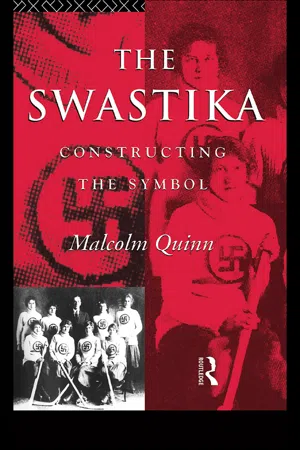
Despite the enormous amount of material on the subject of Nazism, there has been no substantial work on its emblem, the swastika. This original and controversial contribution examines the role that the swastika played in the construction of the Aryan myth in the nineteenth century, and its use in Nazi ideology as a symbol of party, nation and race, treating it as symbolic phenomenon in a cultural context. By identifying the swastika as a boundary or liminal image, Malcolm Quinn allies visual anaysis to issues of material culture and history.
1
SYMBOL
This is what we were once ourselves in those immemorial times when Tacitus described us: unique, free of all taint, like only unto itself.
(Friedrich Gottlieb Klopstock)
Since we took myths seriously, literally, we found Troy, quite real, under the rubble of history. We have the debris of the history of Hitler, and now we have to seek the myths underneath.
(Hans Jürgen Syberberg, Hitler, a Film from Germany, 1982)
Visitors in search of diversion and instruction at the Paris Exposition of 1889 might have been intrigued by an unusual display at the Palais des Artes Libéraux, where a Polish librarian named Michael Zmigrodski had arranged drawings of over 300 objects, each bearing a swastika or, as he put it ‘an ornament which I believe to have a swastikal origin’.1 This tableau, in which the swastikas were arranged in groups labelled ‘Prehistoric’, ‘Pagan’ and, unusually, ‘Christian’ was afterwards deposited in the St Germain Museum of Prehistory. Over and above Zmigrodski’s sub-classifications stands the embracing taxonomy of ‘objects bearing swastikas’, and it was not simply vulgar showmanship which led him to direct his audience to a sudden recognition of the swastika as it magically appeared amongst a group of inscriptions or in an ornamental band. A contemporary commented that ‘[Zmigrodski] has made it his special study to show that this cross had everywhere a symbolical, and not merely ornamental value’.2 The expedient of using drawings, rather than providing the objects themselves for inspection, turned the swastika into an exhibit whose twodimensionality in fact negated the principle of an exhibition ‘in the round’, since the spectator was not asked to consider and interpret the object from all angles, but simply to recognise a distinctive and repeated sign. However, the donation of these drawings to the Musée des Antiquités Nationales reified this pseudoexhibition as material evidence in its own right. That this was possible indicates the overwhelming popularity of ‘Aryan’ theories of ancestry and race in Europe at that time; Zmigrodski the librarian and swastika-hunter was also an anti- Semite, whose self-appointed task was to promote the swastika as the heraldic device of the Aryo-Germanic family. He compared the swastika to a fly trapped in amber, its unchanging form representing the preservation of a racial essence over time, and his declared aim was to prove that ‘in a very ancient epoch, our Indo-European ancestors professed social and religious ideas more noble and elevated than those of other races’.3
In August 1889 Zmigrodski addressed both the first International Congress of Popular Traditions and the tenth International Congress of Anthropology and Prehistoric Archaeology on the subject of the swastika.4 The committee and correspondents of the latter contained a number of Aryanists and swastikaphiles from around the globe. Alex Bertrand, the director of the St Germain Museum of Prehistory who acquired Zmigrodski’s drawings, was vice-president of the Congress. Delegates to the conference included Thomas Wilson, Heinrich Schliemann, and the anti-Semite Emile Burnouf, who in a letter to Schliemann in 1872 had noted that ‘the swastika should be regarded as a sign of the Aryan race. It should also be noted that the Jews have completely rejected it.’5 Also present was Professor Ludwig Müller of Copenhagen, an advocate of the theory that the swastika was the emblem of the supreme god of the Aryan race. Britain was represented by A.H.Sayce, who had contributed to Schliemann’s dissertation on the swastika in the archaeologist’s Troja of 1884.
In Zmigrodski’s conference papers, exhibition and published texts, recognising and naming the image of the swastika became a way of claiming kinship and assuming race identity, and the visual discrimination of a ‘signobject’ was made equivalent to discrimination on the grounds of race. The Aryan is thus provided with a way of seeing and a ‘programme for perception’.6 Zmigrodski’s technique is similar to the racial morphology, the ‘fingering of skulls’ described by Ernest Renan in 1882,7 since it attempted to define an Aryan aesthetic of forms, which are set apart from those other forms previously designated as undesirable. In Zmigrodski’s exhibition, the swastika was recognised and cognitively ‘recovered’ from all that it was not (many-armed, contextually-coded, ornamental, Semitic, etc.), and the chosen emblem, like the chosen race, existed in a condition of ‘negative visibility’. The symbol is made visible as a symbol by a process of selection and exclusion: it stands alone and represents itself. The opportunity which the swastika presented to a racist discourse in the nineteenth century, and which was to be seized and fully politicised by Nazism in the twentieth, was provided by an image which was strongly defined as a self-identical image but which had repeatedly eluded a positive textual identification. A rationalist discourse found itself frustrated by the swastika, the ‘troublesome puzzle’ described by Max Müller and one example of the uncanny ‘world of problems’ which Hegel had seen in Indian art.8 Since the swastika could not be satisfactorily and finally decoded within the available categories of the meaningful symbol or the meaningless ornament, it could begin to function only as the image of a negative value and of a purity established in opposition to definitions of the unclean. In 1894, Count Goblet D’Alviella wrote of the swastika that ‘there is hardly a symbol which has given rise to more varied interpretations’.9 The swastika thus exposed the fallacy of an attempted closure and final decoding which, as theorists such as Jacques Derrida have suggested, can only indefinitely replicate itself. D’Alviella, however, had already solved this problem by naming the image as the sign of its own unsignability.10 The swastika defied definition, but it was precisely this quality which allowed Zmigrodski to confer on the swastika the status of a pure form, racially apotropaic and repelling all contact: ‘it stands in isolation and is set within a frame, in modern terms a votive image.’11 Such an image could be recognised and acknowledged, but it could never satisfactorily be ‘read’ and then translated by all races.
Zmigrodski’s interest in the ‘Aryan’ swastika had been prompted by the discovery of swastika-bearing objects by the archaeologist Heinrich Schliemann at the hill of Hissarlik in Turkey, which Schliemann firmly believed was the site of Homeric Troy, the realisation of the boyhood dream of discovery described to sentimental effect in the introduction to his book Ilios. Schliemann’s treatment of the swastika exemplifies the process by which a symbol can become deracinated from tradition and replaced within a tradition of the symbol. In another sense, it continued the discourse on ruins and the narrative elaboration of prehistoric fragments which characterises the Homeric myths themselves.12 However, in employing the swastika as the device which could include his heroic Trojan thesis within an even grander Aryan scheme, Schliemann disturbed the integrity of the traditions represented by his chosen Homeric and Vedic texts. In defining the swastika itself as an Aryan ancestral sign, he constructed a lineage preceding history and tradition, a continuity of visual forms which were seen as the trace element of a race.
It should be pointed out that Schliemann’s theories generally presented Aryanism in its broadest, least anti-Semitic and most Asiatically-oriented form: methodologically, however, the archaeologist’s politics of interpretation set precedents for others and for the future. His expedient of using images of the swastika instead of words, instead of preventing a misrepresentation and safeguarding a tradition, confirmed the swastika as a self-representation, a symbol referring not to a set of meanings or practices but only to a set or distributed group of similar signs. This set of swastikas was then constituted as a material trace of the Aryan race, as Schliemann attempted to turn Indo-European phonetic comparisons into archaeological evidence. Where phonetic comparison looked for constant factors across diverse languages, the swastika came to represent the undiversified and self-contained system of an Aryan Ursprache (original speech), a unity established by recognising similarity and eliminating difference.
Zmigrodski’s exhibition, together with his two books in which the swastika is the leitmotif, illustrate how two discourses on language were being brought together in order to establish the swastika as an image of race purity. These two discourses were that of Indo-European language theory and a debate on and around the German language itself. What united them was the theme of the original, untainted, self-generating and self-identical unit, represented in Zmigrodski’s texts by a swastika ‘of pure form’. This obscure object of desire was arrived at by a process akin to that used in panning for gold; Zmigrodski’s analysis of the swastikas excavated by Heinrich Schliemann at Troy sifted through the ‘many hundreds’ recognised by the archaeologist to arrive at sixtyfive representatives of quintessential Aryanism:
Dr Schliemann’s atlas contains around six hundred objects adorned with a swastika. We find there:
sixty-five swastikas of pure form.
one hundred and fourteen crosses with the four points or [nail holes].
one hundred and ninety two swastikas with three branches, known as triquetrums.
eighty-six swastikas with four branches.
sixty-three with six branches.
[total 520]13
This list highlights the similarity and the differences between the methods of Schliemann and Zmigrodski. While both were keen to identify as many Aryan swastikas as possible, Zmigrodski conducted a purge on Schliemann’s less commited and less racially motivated Aryanism, narrowing down the field of vision and discrimination from the ‘many hundreds’14 of images mentioned by the archaeologist. Thirty years later, this list was shortened even further by Albert Krohn and Adolf Hitler, who removed all but one rightward-turning black swastika ‘set apart’ in its white circle on a red background, an image intended to remain unchanged and self-identical despite its reproduction in all forms of mass propaganda.
In 1886, however, Zmigrodski had to deal with the various forms of ‘swastikalike’ or rotationally symmetrical signs encountered at Hissarlik, and was obliged to construct a theory of sign reproduction for the swastika which explained variant or badly-executed forms on the grounds that the ‘pure’ swastika was so well known to the inhabitants of Troy that even a bad example would be immediately recognised. Yet even here we can see the beginnings of the ‘sign field’ created by Hitler, for in Zmigrodski’s Neoplatonic scheme, each visible image is encountered as a more or less effective representation of the ideal swastika form rather than as the representation of some signified meaning. In other words, there is no positive value for which the image of the swastika is the ersatz or standin: its ‘meaning function’ is to be anti-Semitic, and this is achieved when the swastika is most alike to itself, and purged of a reference or a likeness to anything else.
FROM REPRESENTATION TO RECOGNITION
This ritual purification of the ‘Aryan’ swastika was conducted within a discourse of Indo-European language theory which was itself methodologically informed by dialogues of recognition, and by the isolation and annexation of elements which were then used to construct pure, self-regulating synchronic systems. The basic method of cross-linguistic comparison had been available since 1598, when Lipsius listed nearly thirty-six identical words in Persian and German;15 however, Lipsius explained these similarities using the idea of mutually loaned words, revealing an emphasis on vocabulary which was to be sustained throughout the seventeenth and eighteenth centuries. Thus, as Foucault has pointed out in The Order of Things, the distinct character of nineteenth-century linguistics cannot be accounted for on the grounds of new discoveries such as the system of Sanskrit grammar,16 but rather is more accurately explained by employing the idea of a paradigm shift from diachrony to synchrony through which ‘language began to fold in upon itself, to acquire its own particular density, to deploy a history, an objectivity, and laws of its own’.17 Language as a self-consistent abstraction began to replace the word as concrete particular.
The way in which the swastika began to function as an Aryan sign was dictated by the qualities of the Aryan myth itself, and its strange existence as a duo-temporal ‘mythology of structure’. This meant that the methodological approach of Indo-European linguistics, which looked for synchronic constants across different languages such as Latin, Sanskrit, German and Greek,18 was linked to a diachronic vision of the ancestors. This combination allowed for the concept of a pure origin, pure because the addition of synchronicity meant that the racial/linguistic essence remained constantover time. Other races and other languages suffered entropy and decay; only the Aryan, it was argued, remained distinct and unaffected.
It is this theory to which Zmigrodski subscribed when he identified the swastika as a form victorious over the vicissitudes of time, a self-generating ‘mother’ image which had survived the maleficent influence of other forms. It was also this ideology which contributed to an emphasis upon the recognition of identity by the systematic elimination of elements of variation, and the sleight of hand through which an immeasurably ancient sign can also be seen to herald a present awakening or renewal.
This Aryanist discourse on the swastika clashed with a cryptological approach to the image, which saw it as the obdurate and frustrating barrier to a rational and textual explanation. Into this latter camp falls the tragic swastikology of Dr E. Brentano, who in a letter to Heinrich Schliemann attempted to refute the archaeologist’s ‘Aryan symbol’ explanation of the swastika and supplant it with a theory that the image was a form of writing, and that this swastikal alphabet was evidence that the artefacts found at Hissarlik were ‘historic’ and not ancient.19 Brentano’s letter was only one of the disputes which troubled Schliemann at this time, the most persistent of his detractors being a retired German army officer named Ernst Bötticher, who claimed that Hissarlik was not Troy but a necropolis, and a site of ritual immolation.20 Brentano’s more pedantic criticism focused on an illustration in Schliemann’s boo...
Table of contents
- COVER PAGE
- TITLE PAGE
- COPYRIGHT PAGE
- ILLUSTRATIONS
- FOREWORD
- PREFACE
- ACKNOWLEDGEMENTS
- INTRODUCTION: READING THE SWASTIKA
- 1. SYMBOL
- 2. ORNAMENT
- 3. SWASTIKA
- NOTES
- SELECT BIBLIOGRAPHY
Trusted by 375,005 students
Access to over 1.5 million titles for a fair monthly price.
Study more efficiently using our study tools.
Frequently asked questions
Yes, you can cancel anytime from the Subscription tab in your account settings on the Perlego website. Your subscription will stay active until the end of your current billing period. Learn how to cancel your subscription
No, books cannot be downloaded as external files, such as PDFs, for use outside of Perlego. However, you can download books within the Perlego app for offline reading on mobile or tablet. Learn how to download books offline
Perlego offers two plans: Essential and Complete
- Essential is ideal for learners and professionals who enjoy exploring a wide range of subjects. Access the Essential Library with 800,000+ trusted titles and best-sellers across business, personal growth, and the humanities. Includes unlimited reading time and Standard Read Aloud voice.
- Complete: Perfect for advanced learners and researchers needing full, unrestricted access. Unlock 1.5M+ books across hundreds of subjects, including academic and specialized titles. The Complete Plan also includes advanced features like Premium Read Aloud and Research Assistant.
We are an online textbook subscription service, where you can get access to an entire online library for less than the price of a single book per month. With over 1.5 million books across 990+ topics, we’ve got you covered! Learn about our mission
Look out for the read-aloud symbol on your next book to see if you can listen to it. The read-aloud tool reads text aloud for you, highlighting the text as it is being read. You can pause it, speed it up and slow it down. Learn more about Read Aloud
Yes! You can use the Perlego app on both iOS and Android devices to read anytime, anywhere — even offline. Perfect for commutes or when you’re on the go.
Please note we cannot support devices running on iOS 13 and Android 7 or earlier. Learn more about using the app
Please note we cannot support devices running on iOS 13 and Android 7 or earlier. Learn more about using the app
Yes, you can access The Swastika by Malcolm Quinn in PDF and/or ePUB format, as well as other popular books in History & World History. We have over 1.5 million books available in our catalogue for you to explore.