This book honors Jack W. Brehm's contributions to psychology, all of which revolve around a central theme of motivation and social behavior. It begins with two personal chapters and then presents a collection of cutting-edge, substantive chapters authored by researchers whose work Brehm has strongly influenced. It concludes with a chapter by Jack Brehm that reflects on the field of psychology, discusses a new theory of social influence, and offers ideas about the direction in which our understanding of human behavior could move.
Motivational Analyses of Social Behavior will be of value to research scientists, educators, and practitioners interested in social motivational processes and those who developed major theories in this area. Interested readers include individuals specializing in social, clinical, organizational, personality, health, and motivational psychology, and psychophysiology. The book would also be ideal for advanced courses on social motivation and the history of psychology.
eBook - ePub
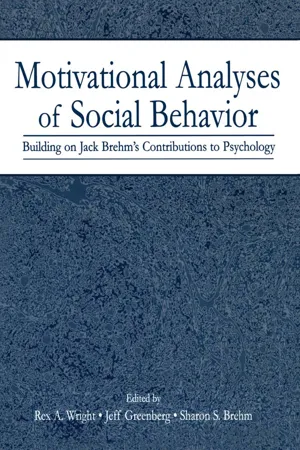
Motivational Analyses of Social Behavior
Building on Jack Brehm's Contributions to Psychology
- 296 pages
- English
- ePUB (mobile friendly)
- Available on iOS & Android
eBook - ePub
Motivational Analyses of Social Behavior
Building on Jack Brehm's Contributions to Psychology
About this book
Information
Publisher
Psychology PressYear
2004Print ISBN
9780415650304
9780805842661
Edition
1eBook ISBN
9781135633097
I
ABOUT JACK

1
Biographical Sketch and Personal Perspectives
Rex A. Wright
Jeff Greenberg
Sharon S. Brehm
The faculties of universities around the world include people who have made significant contributions to psychology. However, they contain few who have affected their field and those around them as profoundly as has Jack Brehm. Known internationally for his research and theorizing, Jack is also widely admired as a mentor, colleague, and human being of uncommon character. If Jung had known Jack, he likely would have declared him to be someone extraordinarily true to the archetype of the seeker of knowledge. As all who do know him soon realize, Jack marches to the sound of his own internal drummer. And what he marches toward is the goal of pure knowledge and understanding. Regardless of the social, cultural, or professional Zeitgeist, Jack has painstakingly studied what he has found to be interesting. The result has been a powerful body of work that will be utilized and built on for years to come.
In this chapter, we provide a brief biography of Jack and some personal glimpses of Jack as we have known him.
A BIOGRAPHICAL SKETCH
Jack W. Brehm was born January 16, 1928, to Carl and Charlotte Williams Brehm. He grew up in Des Moines, Iowa, not far from another Des Moines notable, Cloris Leachman. After high school, Jack served in the Navy for 2 years (1946–1948) and then attended Harvard College on the GI Bill (1948–1952). At Harvard, Jack took Social Psychology from Garner Lindzey and Group Dynamics from Howard Riecken. He also prepared an honors thesis under the supervision of Riecken and Robert Blake. Jack’s mother was a welfare caseworker most of her life, and Jack intended to continue the helping tradition by becoming a clinical psychologist. However, he was advised by Blake to develop his research skills instead. In 1952, Jack traveled to the University of Minnesota to study with Leon Festinger, who at the time was developing his soon-to-be-famous theory of cognitive dissonance. Jack’s PhD dissertation introduced the free-choice dissonance paradigm and was the first published experiment designed to test dissonance processes (Brehm, 1956).
During his career, Jack has been a member of the faculty at Yale University (1955–1958), Duke University (1958–1975), and the University of Kansas (1975–present). He has also held temporary appointments at the University of Washington (1963–1964, 1973–1974), the State University of New York at Stony Brook (1968–1969), Universität Mannheim (1978), Colorado College (1982), Princeton University (1986), and Universität Bielefeld (1994). While at Yale, Jack and Robert Cohen conducted seminal dissonance studies focusing on the role of choice and commitment in dissonance processes. After moving to Duke, Jack continued his research on dissonance and wrote extensively on the theory. His dissonance publications during the Duke years included a highly influential Nebraska Symposium on Motivation chapter (Brehm, 1962) and two classic books, one with Cohen (Brehm & Cohen, 1962) and another with Robert Wicklund (Wicklund & Brehm, 1976). Taken as a whole, Jack’s work on dissonance has played a major role in the understanding and continuing investigation of dissonance processes for almost half a century.
At Duke, Jack conceived of and began testing another theory of motivation—psychological reactance. Jack’s early reactance work at Duke led to numerous scientific publications, ranging from a classic article (Brehm & Cole, 1966) on the potential of a favor to diminish the tendency to help (which stands as the only article in the history of the Journal of Personality and Social Psychology to cite no references) to his monograph proposing and documenting the theory (Brehm, 1966). Later reactance work at the university led to additional publications, including a reactance theory update (Brehm, 1972) and a widely cited chapter with Camille Wortman that integrated reactance and learned helplessness processes (Wortman & Brehm, 1975). Like Festinger’s dissonance theory, Jack’s reactance theory has had an extraordinary impact, both in the United States and beyond. It has been studied extensively not only in social psychology, but also in other disciplines such as political science and marketing, and has been applied in countless contexts ranging from clinical psychology to business.
Since moving to the University of Kansas, Jack has continued to contribute to the dissonance and reactance literatures. For example, he and Sharon Brehm published their book evaluating reactance theory and comprehensively reviewing the research related to it (S. Brehm & J. Brehm, 1981). He also has written articles with Linda Simon, Jeff Greenberg, and others on topics such as trivialization as a mode of dissonance reduction (Simon, Greenberg, & Brehm, 1995) and the question of whether aversive behavioral consequences are necessary for dissonance to be aroused (Harmon-Jones, Brehm, Greenberg, Simon, & Nelson, 1996).
However, the bulk of Jack’s time at Kansas has been devoted to understanding processes even more basic than dissonance and reactance. One central interest has been in the determinants of motivational intensity, or effort expended at a point in time. Work on this topic began with an unpublished paper (Brehm, 1979) that outlined elements of a motivation intensity theory (referred to at different points in its evolution as a “theory of motivational suppression” and later as “energization theory”). Work on this topic continued through the 1980s and led to various publications, most notably a chapter in the Annual Review of Psychology with Elizabeth Self (Brehm & Self, 1989). Since their proposal, Jack’s ideas about motivational intensity have received attention from a variety of academic quarters, particularly from psychophysiologists attempting to understand effort-related cardiovascular responses (Wright, 1996; Wright & Kirby, 2001).
A second main interest at Kansas has been only a step removed from motivational intensity; the determinants of emotional intensity, or affect experienced at a point in time. Jack’s ideas on this topic are still relatively new. Nonetheless, they have generated a good deal of research, much of which was reported in an article that appeared in the Personality and Social Psychology Review (Brehm, 1999).
PERSONAL PERSPECTIVES
As is the case with all academics, Jack’s influence has not been restricted to the impact of his published work. He has also influenced many people through his personal interactions with them—as a mentor, as a colleague, as an individual of great kindness and generosity. To convey some of what it’s like to know and work with Jack, each of us offers below a summary of how he has contributed to our own development.
Sharon Brehm
Somehow in writing this commentary, I have the sense that I&m in a 19th-century novel, and the author’s voice is booming over me: “And, dear reader, she married him.” Yes, I did marry Jack, in the fall of 1968, having first met him in the spring of 1967 when I applied for a job as research assistant and worked for him that summer. We lived in New York from 1968 to 1969 and then moved back to North Carolina. After I completed my PhD at Duke in 1973, we went to Seattle for Jack’s sabbatical and for my clinical psychology internship. During our one year of a commuter marriage, when I had a temporary appointment at Virginia Tech and Jack was back at Duke, we also suffered through the challenges of a dual-career job hunt. Fortunately, we found a welcoming group of colleagues at the University of Kansas and moved to Lawrence in 1975. Unfortunately, however, our marriage had started to fray around the edges; by 1978, it had unraveled entirely.
But that’s not the end of the story. After having been an extraordinarily supportive husband and mentor when I was in graduate school, and having insisted that I should have a “real” tenure-track job even if that meant that he would have to leave Duke, Jack became an extraordinarily supportive ex-husband and continuing mentor. We wrote a book together after we were divorced. And we tried to set an example of an amicable divorce, joking that we were the first in our neighborhood to have one! It was OK, we reassured people, to invite us to the same parties.
And here I am now, in 2002, working with Rex and Jeff on a book in honor of Jack’s contributions to social psychology. But that’s typical—not of me, but of Jack. In his quiet, unobtrusive way, he maintains one of the largest networks of friends and colleagues that I’ve ever seen. So, although you don’t hear from him all that often nor see him so frequently, he is there, just enough, to stay in touch. Whenever there’s a project afoot, like this one, the network is easy to mobilize.
Across all his relationships, two of Jack’s most distinct characteristics can be easily observed. First, there is his absolute fidelity to the value of intellectual (and, for that matter, artistic) accomplishments of the first rank. Jack is playful, amusing, and in no way pompous. But he is fundamentally an aristocrat of the mind. He believes that there is first-class work in this world and that we should all strive for that level of understanding (or performance). Coming in as a close second, the more you get to know him, the more you realize that he is also an absolute egalitarian in his reaction to people. He simply doesn’t care what gender you are, what your family background is, how rich you might be, or the titles you have on your business card. All he wants to know is whether you’ve got anything interesting to talk about. These two characteristics have helped to make him a fine scientist, and they have ensured that he would become one of social psychology’s greatest teachers.
Rex Wright
I studied with Jack at the University of Kansas shortly after he moved there from Duke. I had worked as an undergraduate at the University of Texas with two of Jack’s students, Richard Archer and Robert Wicklund. So the step from Austin to Lawrence seemed natural.
My memories of graduate school are a tangle of the personal and the professional, largely because of Jack’s style in dealing with students. People who work with Jack do not meet with him only in his office and only at daily, weekly, or monthly intervals. Rather, they generally step into the stream of Jack’s life. Research discussions are as likely to take place at a cafe or on the road to some gathering as they are in Jack’s office. And when discussions do occur in Jack’s office, they frequently are spontaneous, beginning when a student drops by unannounced and ending when someone simply has to attend to something more pressing. To be sure, there are formal aspects to studying with Jack. But those aspects are embedded in a context of informality. Among other things, this leads students to view academics not as a career separable from one’s personal life, but as a way of life.
I am among Jack’s greatest admirers. Therefore, it may come as a surprise that the fit between Jack and me as mentor and student initially was not perfect. For one thing, I found it maddening that Jack would respond so frequently to my research ideas with a reflective, “Hmm. So why do you find that interesting?” As a green graduate student not too far removed in time from the Gulf of Mexico shrimp boats around which I was raised, I felt that the ideas were interesting, darn it, just because they were. It was only later that I came to understand that Jack was nudging me to think about psychological processes, and in theoretical terms.
In addition, I arrived at Kansas when Jack was developing his ideas about the intensity of motivation. Although I tried to approach Jack’s emerging intensity theory with an open mind, I found it at first to be dry and uninspiring. Little did I know then that within a few years, I would become captivated by motivation intensity questions and would begin devoting ridiculous amounts of time and energy to answering them.
Jack and I got on famously once we (read “I”) moved past these problems. He guided me through the minefields of graduate school, and has remained available as a friend and consultant. Over the years, we have shared dozens of dinners together, traveled on occasion, and spent cou...
Table of contents
- Cover
- Half Title
- Title Page
- Copyright Page
- Table of Contents
- Preface
- Part I: About Jack
- Part II: Influences
- Part III: Reflections
- Jack Brehm’s PhD Students
- Author Index
- Subject Index
Trusted by 375,005 students
Access to over 1.5 million titles for a fair monthly price.
Study more efficiently using our study tools.
Frequently asked questions
Yes, you can cancel anytime from the Subscription tab in your account settings on the Perlego website. Your subscription will stay active until the end of your current billing period. Learn how to cancel your subscription
No, books cannot be downloaded as external files, such as PDFs, for use outside of Perlego. However, you can download books within the Perlego app for offline reading on mobile or tablet. Learn how to download books offline
Perlego offers two plans: Essential and Complete
- Essential is ideal for learners and professionals who enjoy exploring a wide range of subjects. Access the Essential Library with 800,000+ trusted titles and best-sellers across business, personal growth, and the humanities. Includes unlimited reading time and Standard Read Aloud voice.
- Complete: Perfect for advanced learners and researchers needing full, unrestricted access. Unlock 1.5M+ books across hundreds of subjects, including academic and specialized titles. The Complete Plan also includes advanced features like Premium Read Aloud and Research Assistant.
We are an online textbook subscription service, where you can get access to an entire online library for less than the price of a single book per month. With over 1.5 million books across 990+ topics, we’ve got you covered! Learn about our mission
Look out for the read-aloud symbol on your next book to see if you can listen to it. The read-aloud tool reads text aloud for you, highlighting the text as it is being read. You can pause it, speed it up and slow it down. Learn more about Read Aloud
Yes! You can use the Perlego app on both iOS and Android devices to read anytime, anywhere — even offline. Perfect for commutes or when you’re on the go.
Please note we cannot support devices running on iOS 13 and Android 7 or earlier. Learn more about using the app
Please note we cannot support devices running on iOS 13 and Android 7 or earlier. Learn more about using the app
Yes, you can access Motivational Analyses of Social Behavior by Rex A. Wright,Jeff Greenberg,Sharon S. Brehm in PDF and/or ePUB format, as well as other popular books in Psychology & Clinical Psychology. We have over 1.5 million books available in our catalogue for you to explore.