eBook - ePub
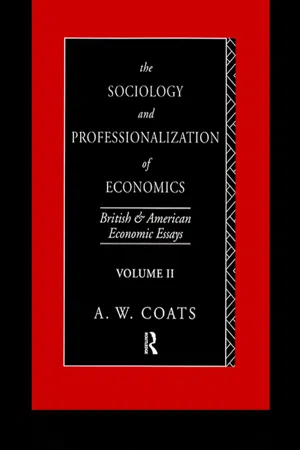
The Sociology and Professionalization of Economics
British and American Economic Essays, Volume II
- English
- ePUB (mobile friendly)
- Available on iOS & Android
eBook - ePub
The Sociology and Professionalization of Economics
British and American Economic Essays, Volume II
About this book
A.W. Coats has made unique contributions to the history of economic thought, economic methodology and the sociology of economics. This volume collects together, for the first time, a substantial part of his work on the sociology and professionalization of economics.
Information
1 INTRODUCTION
The chapters in this volume represent an economic and social historian’s approach to the history of economics.1 This involves a shift away from the customary preoccupation with the history of economic theory towards broader, less precise and more elusive matters, such as the interrelationships between economic ideas and their historical context, the influence of economic ideas on policy, and the public reputation, organization and professionalization of economics as an academic discipline and/or science.
It is easy to explain why most historians of economics have unduly neglected, or at least inadequately explored, such matters. Even in these days of intense academic specialization there are few full-time scholars in the field, largely because most practising professional economists attach little value to work of this kind, and consequently graduate students regard it as an unsound basis for a career. Most of the leading contributors to the history of economics have been trained as economists, rather than historians; and generally speaking this is desirable, for broad expanses of late-twentieth-century economics are inaccessible to those without any, or with outdated qualifications in the discipline, as I can personally attest! As economists, historians of the subject are naturally fascinated by the development of economic theory, since this is usually regarded as the foundation of economies’ claim to be the most ‘scientific’ of the social sciences; and the fact that some of the discipline’s greatest masters have displayed a serious interest in the history of theory (e.g. Marx, Marshall, Schumpeter, Mitchell, Viner, Keynes, Samuelson, Hicks) has given it a certain cachet.2 But, unfortunately, the history of economics has too often been treated as a subordinate or spare-time activity, so that it has infrequently been pursued with sufficient dedication and persistence.
For economists who treat the history of their discipline as a part-time activity or avocation, more comprehensive studies of the sources, development and impact of economic ideas are simply too demanding of time and energy. Joseph Schumpeter’s massive History of Economic Analysis (1954), to cite an outstanding example, gives some indication of the magnitude of the task, for he never succeeded in integrating the ‘analysis’ —ostensibly his main focus—with the historical background and what he called the ‘intellectual scenery’, to which he devoted so much space. Moreover, he expressly denied any interest in the history of economic policy. Another notable example of the sheer amount of work involved in writing what might loosely be termed an historian’s history of economics (though the author was a distinguished economist) is Wesley Mitchell’s classic lectures on Types of Economic Theory (1967, 1969). In his case the attempt to combine the history of economics with more general history effectively broke down when he reached the later nineteenth- and twentieth-century literature. Like Keynes, Schumpeter and Mitchell were, of course, much more than mere economists; whereas in recent times those with up-to-date training in economics tend to be much narrower in their scholarship, a state of affairs discouraging them from undertaking ambitious historical studies.
An economic and social historian’s approach to the history of economics entails no denial of either the intellectual attractions or the importance of economic theory. Nor does it imply that those who study what Schumpeter termed ‘the filiation of scientific ideas’ (i.e. economic analysis) are necessarily less adequate as historians—except in so far as they examine economic ideas in isolation from their historical setting. There is room for a division of labour here, as elsewhere. It is simply that there is much more to the history of economics than the evolution of theory, even when the subject is treated solely as an academic discipline or professional activity. And this assertion is even more true if we broaden the definition to include the history of economic thought or opinion, for then it is difficult to draw the line between the development of economic ideas and general intellectual history, not to mention other branches of historical study.
While continuing to plead the case for a broader, more comprehensively historical and explicitly sociological approach to the history of economics, I have never claimed that this is the only route to be followed, or that my own approach and choice of subjects should be regarded as exemplary. My intellectual interests have in fact evolved in an almost haphazard fashion.3 There has been no consistent or coherent plan. Most of the essays in this volume resulted simply from a desire to learn something about aspects of the history of economics neglected by others. My publications on the American Economic Association, for example, originated in my aim of converting my Ph.D. dissertation into a book, which was modified under the benign influence of Harold Williamson, the organization’s Secretary and a leading economic historian, who was reluctant to embark on the official history he was so admirably equipped to undertake. Likewise, my initial vague interest in the role of economists in British government was stimulated and encouraged by Sir Alec Cairncross, who did not however entirely approve of my decision to include agricultural economists and statisticians, as well as economic generalists. This work was a logical development of my research on economic methodology and the philosophy of economics, for the epistemological questions, ‘In what sense, if any, is economics a science?’ and ‘What do economists know?’, led naturally to the occupational question, ‘Why should anyone employ an economist, rather than some other expert or professional?’ Even when the question is couched in the simplest terms, there remains the problem of specifying what economists actually ‘do’ in non-academic settings—i.e. how they utilize their training and special skills. And the investigation of these activities takes the history of economics right out of academia (except in so far as ‘inning’ and ‘outing’ are regular practices) into the ‘real’ world, as it is so quaintly termed.
If this volume required an additional subtitle, the triad ‘ideas, individuals, institutions’ would be apt. Generally speaking, historians have paid ample attention to the first two—with some reservations when ‘individuals’ is extended to include groups, schools of thought, and research traditions. But the character and significance of the institutional contexts in which economists have acquired their qualifications and performed their functions, whether academic or non-academic, have on the whole been sorely neglected. With respect to qualifications, universities have been the overwhelmingly preponderant qualifying institutions during the past century or so; and it is clear from the multi-country project on the institutionalization of political economy undertaken a few years ago, that they have been in the business of teaching economics, in one form or another, at least since the mid-eighteenth century.4 Nevertheless, few historians of economics have taken a serious interest in the history of higher education, either in general or in particular, although there have been revolutionary changes in this sector since the later nineteenth century.5 The scope for comparative studies of academic systems and styles of teaching and research in economics is considerable.
With respect to functions, academic economists of course perform as teachers, researchers and administrators; but outside academia economists are to be found in a bewildering variety of workplaces. Their activities in government have indeed attracted some scholarly attention, and there is a rich literature produced by ex-government economists (mainly in the UK and the USA), some of whom have written about their experiences extensively and perceptively. The last five chapters in this volume address various general and particular aspects of this type of activity; but as yet we have only scratched the surface, and for most countries the available archival evidence has been deplorably underutilized.6 In my view, the literature on the role of economists in government should be used as an integral component in the vocational preparation of graduate economists. It is not only often entertaining, and intrinsically interesting from an historical standpoint; it also provides valuable insights into an important part of the economics profession’s collective learning experience, especially since World War II.
When we turn to the private sector the research possibilities are even more open. As the chapters on the American Economic Association in this volume reveal, businessmen made a significant impact on that organization at least up to the late 1920s, while as late as 1960 businessmen constituted the largest single category among the Royal Economic Society’s members.7 Yet we still know remarkably little about businessmen’s interest in economics or economists’ activities in private enterprises—in manufacturing, commerce and finance. Here again there is tremendous scope for revealing research if we seek to understand the economists’ contribution to society.
As noted elsewhere,8 my focus on the sociology and professionalization of economics, which is unusual among historians of economics, was a long-term by-product of my fascination with Anglo-American differences in the development of economic ideas, and in the structure and functioning of the discipline. At an early stage in my career I was privileged to review Schumpeter’s History of Economic Analysis,9 part I of which proved a lasting stimulus, while a decade or so later Michael Polanyi’s Personal Knowledge (1958) and T.S.Kuhn’s Structure of Scientific Revolutions (1962) sensitized me to the interdependence of the history, philosophy and sociology of science. I realized that the philosophical debate in the 1960s about the relative importance of ‘internal’ and ‘external’ influences on the growth of knowledge obviously applied to the development of economics, both in general and in specific terms, and this influenced my papers on Kuhn’s magnum opus; on the economic and social context of the marginal revolution —where I devoted some attention to the problem of historical explanation; and on the role of ‘authority’ in British economics10—an article which subsequently led to research on the tariff reform movement, Pigou’s appointment as Marshall’s successor, and broad reflections on the cultural context of British and American economics.11
There is an obvious link between these writings and the second and third chapters in this volume which were designed to introduce historians of economics to the growing sociology of science (knowledge) literature. I have never felt the urge to develop a comprehensive framework or systematic theory of the sociology of economics, desirable though this might be. The existing theories seemed for the most part to be either too one-sided or unduly influenced by ideological prejudices. However it is worth noting that a philosopher-economist, Uskali Maki, has recently been attempting to rectify this situation in two stimulating essays, having complained with some justification that ‘the literature on the sociology of economics is very scarce, and often conceptually hazy’.12 I wish him every success in this endeavour; and wholeheartedly endorse his cautious ‘minimum suggestion…that the methodologists of economics would do wisely to recognize and analyze and tentatively apply the varieties of social theories of science suggesting a number of ways in which science may be socially conditioned’. While seeking a via media between ‘asocial or weakly social theories of science’ and ‘antirealist relativisms’, Maki believes economists may pursue both social and epistemic goals.13 This topic, together with the interrelationships between methodology and professionalism, will be considered at some length in Volume III of this series.
In principle, the sociology of economics is virtually unlimited in scope since it embraces every facet of the two-way interactions between the discipline and society at large. In practice, however, the recent scholarly preoccupation with the internal sociology of economics has diverted attention away from broader, more amorphous, and consequently less manageable questions about the impact of economics on society. This is one reason for welcoming the economists’ increasing awareness of the nature and significance of the professionalization process, especially since the so-called crisis of the late 1960s and early 1970s, for this subset of the sociology of economics has both internal and external dimensions.14 The former predominate in the now very large literature on the scholarly economics journal output which yields many insights into the intra-disciplinary communications network and the structure of the discipline, as well as being a sensitive indicator of the current state of knowledge at any time as well as past and future research trends.15 The characteristic academic predilection for navel-gazing is clearly apparent when one compares this voluminous literature with the dearth of scholarly studies of economics in the newspapers, popular magazines, radio, television, and other media of communication between economists and the general public.16 The past history of these media is another vast territory hitherto almost entirely ignored by historians of economics.
As a final point, one major link between the internal and external dimensions of the profession is the education of economics graduates, which has recently been the subject of close scrutiny and active debate.17 This issue raises crucial questions about the profession’s responsibilities...
Table of contents
- COVER PAGE
- TITLE PAGE
- COPYRIGHT PAGE
- NOTES ON CHAPTERS
- ACKNOWLEDGEMENTS
- 1. INTRODUCTION
- PART I: THE SOCIOLOGY OF ECONOMICS
- PART II: INSTITUTIONS, THEIR HISTORY AND ACTIVITIES
- PART III: THE ECONOMICS PROFESSION AND THE ROLE OF ECONOMISTS IN GOVERNMENT
Trusted by 375,005 students
Access to over 1.5 million titles for a fair monthly price.
Study more efficiently using our study tools.
Frequently asked questions
Yes, you can cancel anytime from the Subscription tab in your account settings on the Perlego website. Your subscription will stay active until the end of your current billing period. Learn how to cancel your subscription
No, books cannot be downloaded as external files, such as PDFs, for use outside of Perlego. However, you can download books within the Perlego app for offline reading on mobile or tablet. Learn how to download books offline
Perlego offers two plans: Essential and Complete
- Essential is ideal for learners and professionals who enjoy exploring a wide range of subjects. Access the Essential Library with 800,000+ trusted titles and best-sellers across business, personal growth, and the humanities. Includes unlimited reading time and Standard Read Aloud voice.
- Complete: Perfect for advanced learners and researchers needing full, unrestricted access. Unlock 1.5M+ books across hundreds of subjects, including academic and specialized titles. The Complete Plan also includes advanced features like Premium Read Aloud and Research Assistant.
We are an online textbook subscription service, where you can get access to an entire online library for less than the price of a single book per month. With over 1.5 million books across 990+ topics, we’ve got you covered! Learn about our mission
Look out for the read-aloud symbol on your next book to see if you can listen to it. The read-aloud tool reads text aloud for you, highlighting the text as it is being read. You can pause it, speed it up and slow it down. Learn more about Read Aloud
Yes! You can use the Perlego app on both iOS and Android devices to read anytime, anywhere — even offline. Perfect for commutes or when you’re on the go.
Please note we cannot support devices running on iOS 13 and Android 7 or earlier. Learn more about using the app
Please note we cannot support devices running on iOS 13 and Android 7 or earlier. Learn more about using the app
Yes, you can access The Sociology and Professionalization of Economics by A. W. Bob Coats in PDF and/or ePUB format, as well as other popular books in Negocios y empresa & Negocios en general. We have over 1.5 million books available in our catalogue for you to explore.