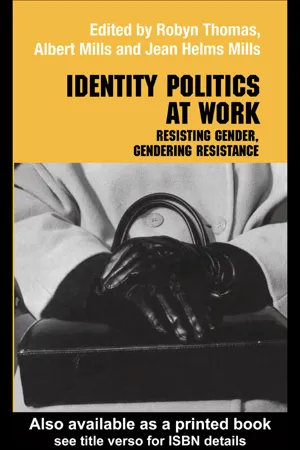
eBook - ePub
Identity Politics at Work
Resisting Gender, Gendering Resistance
- 240 pages
- English
- ePUB (mobile friendly)
- Available on iOS & Android
eBook - ePub
Identity Politics at Work
Resisting Gender, Gendering Resistance
About this book
This book represents the coming together of two key debates within organization studies: theorizing on gender and ways of understanding resistance. These debates have been given renewed vigour with the 'postmodern turn' in organization studies and feminist theory. Fusing these two literatures together offers a far deeper understanding of the issues of power, subjectivity and agency.
Representing a growing interest in the contributions that feminist theorizing can offer to the study of organizations, this book focuses on issues of gender and resistance in organizations and, in particular, presents theorising which attends to the dualistic debate of compliance versus resistance to offer more generative understandings of reistance.
1
Introduction
Resisting gender, gendering resistance
Introduction: the fall and rise of workplace resistance
This book is about workplace resistance, a topic that has a long pedigree within studies on organizations. However, its popularity has been somewhat cyclical with a number of studies during the late 1980s and early 1990s suggesting that workplace resistance has declined or even been effectively eradicated. This demise has been attributed to declining trade union membership and the concomitant shift to a service sector economy (traditionally less unionized than manufacturing), and a more transient, vulnerable, temporary and therefore passive workforce (Prasad and Prasad, 1998). However, it has been the ‘outflanking’ (Collinson, 1994) of workplace oppositional practices that has been the main focus of the ‘resistance as a thing of the past’ genre of writing, a development attributed to ‘new’ forms of management control (Knights and Willmott, 1989; Sewell and Wilkinson, 1992; du Gay, 1993; Townley, 1993; Willmott, 1993; Grey, 1994). Appropriating aspects of Foucault's (1977) work on panoptic surveillance and discipline, studies have drawn attention to new forms of surveillance and the self-disciplining subject in modern organizations. Here it is suggested that ‘new’ forms of management control, aimed at the ‘hearts and minds’ of workers, effectively colonize worker subjectivities such that they participate in their own subjugation, removing the presence of opposition. Dominant organizational discourses thus ‘create’ these ‘designer workers’ where there is no longer a difference between workers’ conceptions of self and that offered within the organizational discourse (Jacques, 1996). Furthermore, it is suggested that the postmodern era has heightened feelings of insecurity and vulnerability, stimulating the need for greater security of the self, upon which new management control practices feed (Alvesson and Willmott, 2002).
Of course, things are not so straightforward. Over the past decade, a number of studies have challenged suggestions that ‘all is quiet on the workplace front’ (Thompson and Ackroyd, 1995). This ‘second coming of resistance’ has led to some fairly heated debates on structure and agency. While the epistemological roots of these debates have been diverse, ranging from a reiteration and reaffirmation of labour process inspired studies through to the appropriation of post-colonial theory, queer theory, feminist theory and poststructuralism, common to all is the refutation of the demise of oppositional practices.
The contributions to this edited volume illustrate that resistance is ‘alive and kicking’, albeit not necessarily revolutionary in effect. Taking up a theme emerging in the literature, the thesis of this book is that definitions of resistance need to be broadened to appreciate those micro-political practices often overlooked in earlier critical inspired studies of workplace opposition. Notably, the book brings together two key debates within the field of organization studies: theorizing on gender, and ways of understanding resistance. These debates have been given renewed vigour with the ‘postmodern turn’ (Best and Kellner, 1997) in organization studies and feminist theory but within largely separate literatures. In recent years, a number of (pro)feminist writers within organization studies have recognized the contribution that a fusion of these literatures might offer in understanding issues of power, subjectivity and agency. This book represents a growing interest in the contributions that feminist theorizing can offer to the study of organizations. The book focuses on issues of gender and resistance in organizations and, in particular, presents theorizing which attends to the dualistic debate of compliance versus resistance to offer more generative understandings of resistance. It is therefore argued that the theoretical insights from alternative epistemologies and disciplines, notably feminist theory, can reinvigorate resistance studies and present forms of resistance (or ‘oppositional practices’) otherwise overlooked in functionalist and critical labour process inspired studies. Arguing this, we not only focus on resistance acts and behaviours but also examine discursive forms of resistance, i.e. resistance at the level of identities and meanings. Therefore, the chapters in this book contribute to the development of a more sophisticated conceptualizing of gender and the micro-politics of resistance in two ways. First, focusing on the lived experiences of women and men in a range of organizations, the book presents a range of empirically grounded understandings of the character and nature of resistance that has greater nuance and complexity than that currently offered. Second, in broadening the definitions of resistance, the book offers more detailed and varied understandings of resistance that can account for a range of means and motives for individual struggles to appropriate and transform dominant norms.
Conceptualizing resistance
The rich heritage of studies on workplace opposition is mainly concentrated at the level of the collective, focusing on overt and often violent protest against management-imposed controls. In addition, individual forms of low-level ‘misbehaviour’ have also been studied (Ackroyd and Thompson, 1999). Accounting for the causes of such resistance, ‘mainstream’ functionalist studies have concentrated on the management of change. Analysis of forms of resistance within functionalist accounts of organizations tends to pathologize both resistance and resistors, with acts of resistance being viewed as both temporary and irrational, the outcome of cognitive failures by individuals and/or groups to appreciate the inherent good and ultimate benefit from the change initiative (Coch and French, 1948; Judson, 1991). However, it is within critical accounts that the core of resistance studies can be found. Here is seen a long tradition of research on forms of workplace conflict, either organized and collective forms such as strikes, coming out of an industrial relations tradition (Hyman, 1989), or unofficial acts of counter-productive behaviour, or ‘misbehaviour’, that arise in the effort bargain, including sabotage, deviance, mischief and antagonism (Ackroyd and Thompson, 1999). Theoretically informed by Marxist and neo-Marxist perspectives, resistance is framed in terms of class struggle, seen as the natural outcome of structural relations of antagonism between capital and labour. These studies have contributed a rich and influential challenge to the functionalist domination within organization studies.
However, a number of tensions can be highlighted with existing conceptualizations of workplace resistance. These relate to definitions of resistance and what does and does not ‘count’ as resistance; the identification of forms of resistance; and the subject/object of resistance. First, in defining resistance, considerable energies have been spent on putting boundaries around, and demarking differences between, categories of resistance, compliance, accommodation and consent (Kondo, 1990). Definitions of resistance are generally conceived of as something in opposition to managerially enforced controls and are presented in a mutually reinforcing control-resistance dyadic relationship. However, as Kondo (1990) argues, to present resistance, accommodation, consent or compliance in neat categories suppresses differences within and between these categories suggesting a mutual and temporal ‘fixidity’. A less limiting approach is to view resistance as something socially constructed in context, rather than resorting to a neo-positivistic and rational framework (Sewell, 2000) and pre-conceptualizing what constitutes ‘real’ resistance.
Second, there is the tendency to determine a priori which acts and behaviours constitute resistance, in effect essentializing resistance (Prasad and Prasad, 1998). A discursive construction of resistance examines how resistance is produced and performed in different contexts, specific to events, actors and practices.
Finally, studies on resistance have, in line with organization studies in general, been largely silent about gender, both in the embodied sense and symbolically. The appreciation of resistance as the collective, overt actions of groups of male blue-collar workers still forms the framework of recognition when most people think of resistance. Early labour process inspired studies have largely concentrated on blue-collar male, or ‘genderless’ workers in factory settings, where the gender of the researchers and researched was not recognized as having an impact on the knowledge generated. There have been some studies that have considered the genders of the researcher and of the researched. For example, studies on female workers have focused on resistance of female factory workers (Pollert, 1981, Ezzamel et al., 2003), administrative and service workers (Gottfried, 1994), female professional workers (Katila and Meriläinen, 2002; Thomas and Davies, 2002; Kerfoot, 2003; Meyerson and Scully, 1995) and women in Asian and developing countries (Kondo, 1990; Scott, 1985). Generally, however, gender has been ignored or under-explored in the majority of resistance studies (Tancred-Sheriff, 1989). Managerial and professional employees have also received scant attention. Thus, analysis of resistance has presented reactions by a homogenous and genderless body to that which is imposed on it, thereby reducing individuals to structurally and environmentally determined phenomena.
Therefore, analysis of resistance has often privileged structure over agency and there has been a general ignorance of resistance at the level of the individual. The result is analysis that oscillates between ‘worker-as-docile-automaton’ (Fleming, 2002:194) and overly romanticized images of worker resistance. Unless the act or behaviour studied falls into a narrowly defined and often politically inspired notion of resistance, it goes unnoticed, resulting in the impression that workplace resistance is a thing of the past.
The chapters presented in this collection suggest that traditional conceptualizations of resistance present only a partial script. In particular, they highlight how many resistance practices—both at the level of behaviours and at the level of identities and meanings— are complex, contradictory, ambiguous and nuanced. Several of the chapters in the collection pick up on more recent interest in workplace resistance that has drawn attention to the omnipresent forms of routine, mundane, low-level and subtle forms of oppositional practices, which are overlooked by the somewhat grandiose conceptualizations found in earlier studies. Furthermore, several chapters also focus on forms of discursive resistance at the level of the individual subject, an aspect of resistance given greater scrutiny with the increased focus on socio-ideological controls aimed at the capturing of the ‘hearts and minds’ of workers (Alvesson and Willmott, 2002). Therefore, conceptualizations of resistance are not solely confined to acts and behaviours, but also to interpretive challenges to managerial discourses. This focus on discursive resistance is still underdeveloped within the organizational literature, despite its detailed development in feminist and post-colonial literatures. However, in recent years, the contribution of alternative knowledges for re-imagining resistance has been recognized. A significant focus of recent studies has been on what has been termed ‘routine’ resistance (Scott, 1985, cited in Prasad and Prasad, 1998:226); those forms of low-level, subversive, informal micro practices. Thus we have seen a widening in scope of resistance studies to examine the motivations of different groups and individuals to resist, in a wide range of workplace and cultural settings. In addition we see a broadening of what ‘counts’ as resistance, to emphasize the more routine, low-level and individual forms of resistance, socially constructed in context.
Gendering resistance
Gender and agency
Those feminists at pains to ‘gender organization studies’ were not endeavouring to ‘add women and mix’ but to transform the field, to be able to think in new ways and reenvisage knowledge about organizations. Likewise, the gendering of resistance has also brought to light new ways of seeing and thinking about resistance, radically challenging traditional notions of resistance and oppositional practices. The contribution of feminism and post-colonial theory, together with insights from poststructuralism, can be seen as key contributors to the rekindling of resistance studies and presenting new ways of understanding resistance.
Issues of agency have long been a concern within feminist theory. Feminism is a political project, with its raison d’être being the transformation of gender relations to eradicate women's subordination. Resistance can be understood as part of wider concerns with issues of agency that form a core to feminist analysis of gendered relations as durable but not inevitable and unchanging. This challenge to the inevitability of gender relations provides the source of resistance to feminism, although there are many internecine battles and autocritiques on how this resistance might be played out, and to what effects. A detailed debate has thus built up within feminist theory on forms of resistance and issues of political adequacy partly in reaction to the early overly deterministic analysis of patriarchal oppression in first-wave feminism (McNay, 2003).
In recent years, there has been increased interest in Foucauldian-influenced studies, both in feminist theory and in organization studies, drawing on Foucault's conceptualization of power and the subject. Much of this research has tended to emphasize the more deterministic interpretation of Foucault, focusing on subjectification as subjection (McNay, 2000). However, drawing on Foucault's conceptualization of power has led to a move away from an essentialized subject who can ‘authentically’ resist power (defined as repressive) to a more complex, fluid and generative understanding of power and agency. For poststructuralist feminists this has meant a revisioning of resistance from a relatively passive and oppositional activity by victims of oppression, to more proactive and generative understandings (ibid.). This has resulted in a focus on the subjective interpretations of disadvantage, challenging forms of gender inequality and a refusal to accept subjectivities and identities defined in dominant discourses (Sawicki, 1994; Weedon, 1993). In other words, rather than viewing resistance merely as the reaction to a specific form of management control, a more sophisticated understanding of resistance is offered, one that can accommodate the ambiguities and complexities of the dialectics of freedom and constraint involved in the process of subjectification. This presents a more invigorated concept of agency than that offered in many traditional accounts of workplace resistance.
Within feminist theory there has been a move away from ahistorical theories of patriarchy and female subordination to present a more constructive notion of agency that recognizes gender identity as robust yet not immutable. By questioning the notion of fixed and stable gender identities, and recognizing that identities are socially constructed rather than biologically determined, new spaces are opened up for alternative voices, new forms of subjectivities, new meanings and new values (Weedon, 1993). Thus there has been a shift of focus from presenting women and men as clear-cut homogenous groups and from the reduction of masculinity and femininity to a simple dualism, biologically determined. The deconstruction of categories of gender enables a multiplicity of individual experiences to be reflected on, therefore, and enables the move away from presenting women as subordinated by male dominance, failing to capture the complexities of agency. From an empirical agenda, this advances theorizing from previous organizational research that has either negated or privileged the feminine.
Micro-political resistance
Weedon (1993:111) defines micro-political resistance as ‘resistance to the dominant at the level of the individual subject’. This involves contests over meanings, the articulation of counter discourses and ‘the production of alternative forms of knowledge or where such alternatives already exist, of winning individuals over to these discourses and gradually increasing their social power’ (ibid.).
Thus a micro-political resistance takes place at the point of critical reflection—those ‘moments of difficulty’ (Rajchman, 1991, quoted in Sawicki, 1994) that occur between an individual's notion of self (itself derived from discourse) and the subjectivity offered in a dominant discourse. This offers an agential self, a thinking subject with the will and capacity to resist through the reflection upon, and challenging of, the hegemonic ways of being, offered in dominant discourses. A micro-political resistance enables a breaking out of the strait-jacket of ‘all or nothing’ revolution to focus on the ‘thou...
Table of contents
- Cover Page
- Half Title Page
- Series
- Title Page
- Copyright Page
- Dedication
- Contents
- Notes on contributors
- Acknowledgements
- 1 Introduction Resisting gender, gendering resistance—Robyn Thomas, Albert J. Mills and Jean Helms Mills
- Part I Constructing selves Autoethnographies
- Part II Resisting subjects in context
- Part III Questioning the politics in micro-political resistance
- Index
Trusted by 375,005 students
Access to over 1.5 million titles for a fair monthly price.
Study more efficiently using our study tools.
Frequently asked questions
Yes, you can cancel anytime from the Subscription tab in your account settings on the Perlego website. Your subscription will stay active until the end of your current billing period. Learn how to cancel your subscription
No, books cannot be downloaded as external files, such as PDFs, for use outside of Perlego. However, you can download books within the Perlego app for offline reading on mobile or tablet. Learn how to download books offline
Perlego offers two plans: Essential and Complete
- Essential is ideal for learners and professionals who enjoy exploring a wide range of subjects. Access the Essential Library with 800,000+ trusted titles and best-sellers across business, personal growth, and the humanities. Includes unlimited reading time and Standard Read Aloud voice.
- Complete: Perfect for advanced learners and researchers needing full, unrestricted access. Unlock 1.5M+ books across hundreds of subjects, including academic and specialized titles. The Complete Plan also includes advanced features like Premium Read Aloud and Research Assistant.
We are an online textbook subscription service, where you can get access to an entire online library for less than the price of a single book per month. With over 1.5 million books across 990+ topics, we’ve got you covered! Learn about our mission
Look out for the read-aloud symbol on your next book to see if you can listen to it. The read-aloud tool reads text aloud for you, highlighting the text as it is being read. You can pause it, speed it up and slow it down. Learn more about Read Aloud
Yes! You can use the Perlego app on both iOS and Android devices to read anytime, anywhere — even offline. Perfect for commutes or when you’re on the go.
Please note we cannot support devices running on iOS 13 and Android 7 or earlier. Learn more about using the app
Please note we cannot support devices running on iOS 13 and Android 7 or earlier. Learn more about using the app
Yes, you can access Identity Politics at Work by Jean Helms Mills,Albert J. Mills,Robyn Thomas in PDF and/or ePUB format, as well as other popular books in Business & Business General. We have over 1.5 million books available in our catalogue for you to explore.